Practical solutions in a critical environment
“Bad sampling” in controlled environments is rarely a single dramatic error. It is a chain of small, normal-looking slips: a tube opened too early, a cap set down on a bench for a moment, a swab head that grazes a glove, or a sample that dries or cross-contacts during transport. The downstream impact shows up later as biased trends, retesting, or an investigation that cannot separate true contamination from sampling artifacts.
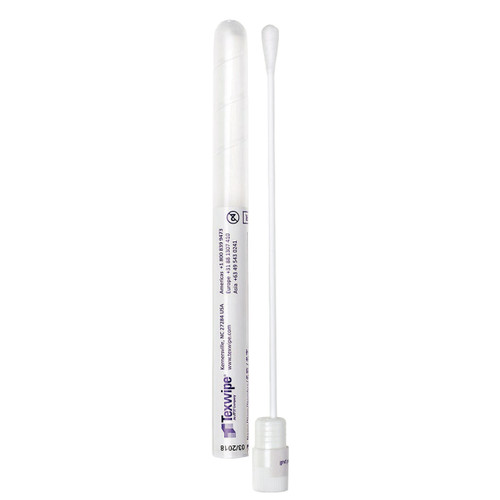
STX764T is built to reduce those operational risks by combining the swab and the transport container into a sterile, ready-to-use unit. You are not improvising with a separate tube, bag, or label. The swab is placed into a 1 mm-thick medical-grade polypropylene transport tube with a molded round-bottom design, and the system uses a cap-and-seal approach intended to protect sample integrity from point of collection to lab receipt.
Low-linting outcomes depend on technique and surface condition. No swab is truly lint-free; edge sharpness, surface roughness, wetness level, contact pressure, and stroke discipline govern what you see on the surface and what ends up in the sample.
What is this swab used for
Texwipe STX764T is a sterile dry collection and transport system designed for collection and transport of bacteriological specimens and other surface samples. It is commonly used for diagnostic sampling, environmental monitoring, DNA sampling, and general surface sampling where the goal is to collect a representative sample and deliver it to the lab with minimal handling ambiguity.
It is also used for surface sampling and “pickup” tasks such as collecting fine powders. Manufacturer guidance for this family also notes cleaning with solvents such as IPA or acetone, but for transport-system work the practical priority is method discipline: if your protocol requires wetting (neutralizer, sterile buffer, IPA, etc.), qualify the full system (swab + chemistry + dwell + tube materials + lab extraction) rather than treating it as a generic solvent swab.
Why should customers consider this swab
- Integrated tube-and-swab format reduces handling steps versus “swab + separate container,” which helps protect sample integrity during collection and transport.
- Tube label includes a tamper-evident seal, helping maintain “first-open” confidence at point of use.
- Lot code and expiration date are clearly marked on each tube to support chain-of-custody discipline and investigation speed.
- Medical-grade cap design is described with cap rings for a tight seal and protection against contamination during transport.
- Fifty tubes are triple-bagged for introduction into sterile areas; a case liner is described as a fourth protective layer at the case level.
- Gamma irradiation is described to a Sterility Assurance Level (SAL) of 10-6, with sterile validation language tied to AAMI guidance and ISO 11137 framing.
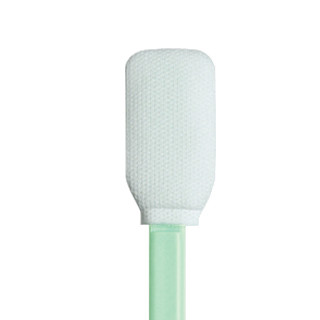
- Spun polyester head on a flexible polystyrene handle provides a controlled, repeatable sampling geometry for defined-area sampling and trending.
Materials and construction
Head: 100% USP-grade spun polyester
Head bond: water-based (aqueous) adhesive (spun swab construction)
Handle: flexible polystyrene; handle color: white
Transport tube: 1 mm-thick medical-grade polypropylene tube; seamless molded round-bottom design
Cap system: medical-grade LDPE molded cap (manufacturer description) with cap rings intended to maintain a tight seal
Practical implication: this SKU should be treated as a sampling system, not just a swab. The tube materials, cap interface, and tamper-evidence contribute directly to whether the sample remains defensible. If your method includes wetting chemistry, confirm compatibility with polystyrene (handle) and the adhesive bond line under your dwell time and temperature window.
Specifications in context
STX764T’s geometry supports repeatable technique when you define the method. The small head (4.6 mm wide by 17.0 mm long) is useful for ports, seams, and constrained contact zones where large swabs over-sample or touch unintended surfaces. The 155 mm overall length supports reach and helps operators avoid “choking up” close to the sampling plane, which can increase accidental head contact and pressure variability.
If you trend results (bioburden, DNA, residues, or other analytes), treat sampling as a controlled process: define area, stroke count, overlap, pressure guidance, and transport time and conditions. The transport tube helps preserve integrity, but it cannot rescue an undefined sampling pattern.
| Attribute |
STX764T |
| Head material |
spun polyester (USP-grade stated by manufacturer) |
| Head width |
4.6 mm (0.181") |
| Head thickness |
4.6 mm (0.181") |
| Head length |
17.0 mm (0.669") |
| Handle material |
polystyrene (flexible) |
| Handle width |
2.5 mm (0.098") |
| Handle thickness |
2.5 mm (0.098") |
| Handle length |
134.0 mm (5.276") |
| Total swab length |
155.0 mm (6.102") |
| Head bond |
water-based (aqueous) adhesive |
| Handle color |
white |
| Transport system notes |
1 mm medical-grade polypropylene tube; LDPE molded cap; tamper-evident tube label |
Cleanliness metrics
For sterile transport systems, the most consequential “cleanliness” controls are often sterility assurance, packaging integrity, and background control that protects your test result. Texwipe describes this system as gamma irradiated to SAL 10-6 and notes testing for endotoxins, ions, and nonvolatile residue (NVR). In high-sensitivity applications (DNA, trace residues, or analytical methods near detection limits), the right move is to qualify with blanks and, when needed, obtain lot documentation rather than assuming universal background performance.
Ion extractables (typical data availability)
| Metric |
STX764T (public reference posture) |
| Typical per-ion values |
Testing category is stated; use method blanks and request lot documentation when background is critical. |
Nonvolatile residue (NVR) (typical data availability)
| Metric |
STX764T (public reference posture) |
| Typical NVR values |
Testing category is stated; qualify with your solvent/extraction and run blanks to protect interpretability. |
Operator takeaway: trustable sampling is repeatable sampling. Define area, strokes, overlap, wetness state (dry vs specified wetting), and transport time so results are comparable across operators and days.
Packaging, sterility and traceability
- Packaging (STX764T): 1 swab/tube; 50 tubes/bag, triple bagged; 10 bags/case; 500 swabs/case.
- Packaging integrity features: cap rings described to ensure a tight seal; tube label described with a tamper-evident seal to support integrity at point of use.
- Sterility: gamma irradiated; described as SAL 10-6 with validation language tied to AAMI guidelines and ISO 11137 framing.
- Traceability cues: lot code and expiration date clearly marked on each tube; certificates of irradiation and compliance are described as attached to each case (program-level control).
- Shelf life (series statement): sterile – 3 years from date of manufacture (use the expiration printed on each tube as the controlling field requirement).
Best-practice use
Treat STX764T as a single-sample, closed-loop tool. The tube is part of the control strategy: it limits exposure time, reduces mix-ups, and makes chain-of-custody easier to defend. The goal is to collect what is present without adding what is not — and without weakening the evidentiary value of the sample during transport.
Operator-level swabbing technique module
- One tube at a time: stage the closed tube, open only when the surface is ready, and minimize cap-off time. Do not stage open caps or open tubes on the bench.
- Head protection: avoid contact with gloves, sleeves, bench tops, tube rim, or the exterior label area. If contact occurs, discard and restart with a fresh unit.
- Defined-area sampling: define a target area (template if needed), use unidirectional strokes with overlap, and keep pressure light and repeatable. Rotate the head as it loads; stop when drag increases.
- Dry vs wetted methods: this is a dry transport system (no transport media in the tube). If your protocol requires wetting (neutralizer, sterile buffer, lab-specified agent), wet once with controlled volume and do not re-dip into a shared reservoir.
- Transport discipline: label immediately per your chain-of-custody SOP, document location/time/operator, and control hold time and temperature as required by your lab method.
- Controls for trustable results: run a field blank (opened and handled the same way without contacting the surface) when trending or when investigating a borderline result.
Common failure modes
- Opening tubes early and leaving caps/tubes exposed on the bench, increasing background and weakening “first-open” confidence.
- Touching the swab head or tube rim during presentation, introducing operator-driven contamination.
- Undefined sampling patterns (inconsistent area, strokes, pressure), creating trends that cannot be defended during review.
- Cross-contamination by using one swab across multiple sites or handling multiple open tubes at once.
- Transport drift (uncontrolled hold time/conditions) that changes recovery before the lab receives the sample.
Closest competitors
The closest alternatives are sterile, dry transport swab systems where the differentiators are packaging integrity features (tamper evidence, seal design), unit-level traceability, material compatibility with your method, and documentation depth. For transport-system SKUs, “the tube” is part of the product—compare the complete system, not only the swab tip.
- Puritan sterile transport swab system formats: compare tube design, unit labeling (lot/expiration visibility), and chain-of-custody usability at the bench.
- Copan dry specimen collection/transport formats: widely used in diagnostic workflows; compare method fit, labeling conventions, and transport integrity features required by your lab.
- Berkshire sterile sampling and transport-adjacent formats: evaluate packaging discipline and documentation support for your regulated or ISO-aligned program.
Critical environment fit for this swab
STX764T fits pharmaceutical, biologics, microbiological lab, and diagnostic testing workflows where sampling must be sterile, traceable, and transport-ready without improvised containers. It is especially useful when you need a defined, small contact tip and a closed tube that helps preserve integrity from point-of-collection to lab receipt.
SOSCleanroom’s relationship with ITW Texwipe supports continuity of supply and documentation discipline, which reduces the risk of unplanned substitutions that can change recovery behavior, background, and audit readiness. That matters in ISO-aligned cleanroom programs and in regulated environments where documentation expectations often track FDA quality systems and standards-driven approaches associated with ASTM and IEST.
Operational support matters, too. Fast shipping and responsive customer service help keep validated work instructions intact by preventing “make-do” substitutions when schedules tighten.
Source basis
- SOSCleanroom product page (STX764T): https://www.soscleanroom.com/product/swabs/texwipe-stx764t-sterile-dry-collection-and-transport-system-polyester-swab/
- Texwipe manufacturer product page (STX764T): https://www.texwipe.com/sterile-dry-collection-and-transport-tube-stx764pt
- Texwipe technical data sheet: “SPUN SWAB SERIES” (US-TDS-053 Rev.09/21): https://www.texwipe.com/images/uploaded/documents/Swabs/Texwipe-Spun-Swabs-TDS.pdf
- Texwipe technical data sheet (Sterile Dry Collection and Transport System, Rev 02-02/16): https://www.texwipe.eu/Content/Images/uploaded/documents/swabs/TDS_SterileTransportSystem_en.pdf
- International Organization for Standardization (ISO) reference (ISO 14644-1:2015): https://www.iso.org/standard/53394.html
- FDA (Food and Drug Administration): https://www.fda.gov/
- ASTM (American Society for Testing and Materials): https://www.astm.org/
- IEST (Institute of Environmental Sciences and Technology): https://www.iest.org/
SOSCleanroom is the source for this Technical Vault entry.
Briefed and approved by the SOSCleanroom (SOS) staff.
Last reviewed: January 6, 2026
© 2026 SOSCleanroom