The Technical Vault
By SOSCleanroom
Last reviewed: January 5, 2026
Texwipe TX705 Wrapped Cotton Cleanroom Swab: High-Sorbency Utility Cleaning When Cotton Is the Right Gate
Practical solutions in a critical environment
Cotton swabs are not the default choice for the most residue-sensitive or particle-critical cleanroom steps. They persist in real facilities for one reason: there are jobs where fast, high-sorbency pickup is the control plan. A small lubricant film, a localized spill, a powder deposit, or a recessed feature can demand quick absorption and reach without spreading contamination across a larger area.
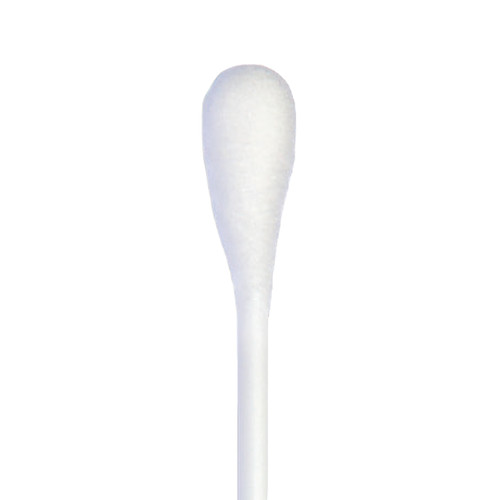
TX705 is designed for that utility niche. It is a wrapped cotton head on a long wood handle, manufactured to consistent tolerances and supported by published contamination characterization so you can place it deliberately in the process rather than guess. When a consumable becomes part of the method, SOSCleanroom’s long-standing relationship with ITW Texwipe supports continuity of supply and documentation discipline, reducing the risk of unqualified substitutions when schedules tighten.
What is this swab used for
- Environmental and surface sampling where a cotton swab format is acceptable in your SOP.
- Spot cleaning with solvents such as IPA or acetone, including controlled pickup of localized residues.
- Applying and removing lubricants and ointments on small features and interfaces.
- Picking up fine powders from confined areas where wipes cannot maintain contact.
- Recess access work where the long handle reduces incidental glove contact with the work zone.
A practical placement rule
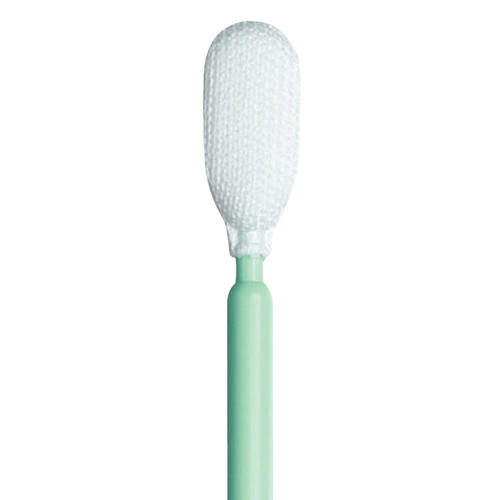
Use TX705 when sorbency and reach are the primary controls and your residue/particle risk assessment allows cotton. For residue-sensitive finishing, optical surfaces, and highly particle-critical steps, a thermally bonded synthetic swab (knit polyester or cleanroom foam) is often the safer gate.
Why should customers consider this swab
- High sorbency for fast pickup: Cotton loads quickly, which is exactly what you want for small spills, thin lubricant films, and powder pickup.
- Long-handle reach reduces touch contamination: Keeping gloves farther from the contact zone is a simple, meaningful control in tight features.
- Consistent tolerances and lot coding: Texwipe notes spun swabs are made using high-precision automated processes and are lot coded for traceability.
- Defined construction variables: The cotton head is bonded to the wood handle with a water-based adhesive. That is normal for this category, and it is a known boundary condition you can manage in the SOP.
- Characterized background contamination: Published ion extractables and NVR values support risk-based placement (where cotton is acceptable vs. where it dominates the background).
- Autoclave-safe material posture: Wood-handled spun swabs are described as autoclave safe, with excellent chemical and heat resistance (validate within your site’s process and packaging presentation).
Materials and construction
TX705 uses a 100% cotton head and a long wood handle. Cotton’s advantages are sorbency and compliance: it wets readily, conforms to small features, and picks up fluids and powders efficiently at low pressure. The long hardwood handle improves reach and helps keep hands out of the work zone during detailed cleanup.
The cotton head is secured to the wood handle by a water-based adhesive. In controlled work, that adhesive bond is not automatically a concern, but it is a real process variable. Extended solvent soaking, aggressive twisting in bores, scraping sharp edges, or using the swab as a probe can stress the bond and increase the risk of transfer or shedding. If your step involves high mechanical stress or prolonged solvent contact, a thermally bonded synthetic swab is typically the more stable control.
A contamination-control reality check: no swab is truly lint-free. A wrapped cotton head can be used in a low-linting manner for appropriate tasks, but technique and surface condition govern outcomes. Abrasion on burrs, rough coatings, or sharp edges can generate fibers or fragments regardless of branding.
Specifications in context
TX705 is sized as a classic long-handle utility swab for reach and control in recesses. The head geometry provides meaningful sorbent volume for pickup and application, while the narrow shaft supports access into tighter features. The trade-off is residue control: cotton loads quickly and can redeposit if you over-wet, overwork one face, or drag the swab back over cleaned areas.
- Head material: Cotton
- Head width: 7.0 mm (0.276")
- Head thickness: 7.0 mm (0.276")
- Head length: 17.0 mm (0.669")
- Handle material: Wood
- Handle width: 2.5 mm (0.098")
- Handle thickness: 2.5 mm (0.098")
- Handle length: 135.0 mm (5.315")
- Total swab length: 152.0 mm (5.984")
- Head bond: Adhesive (water-based adhesive noted by the manufacturer)
- Handle color: Brown
- Design notes: 100% cotton head; long wooden handle
Cleanliness metrics
The values below are manufacturer-reported contamination characterization results and are not specification limits. Use them as a baseline for product background contribution, then control the variables that dominate real outcomes: solvent grade, wetness level, stroke discipline, and when you discard the swab. Texwipe notes these data represent typical analyses (test methods available upon request) and should be interpreted as characterization, not acceptance criteria.
Ion extractables for TX705 (µg/swab)
| Ion |
Value |
| Calcium | 2.85 |
| Chloride | 0.31 |
| Fluoride | 0.22 |
| Magnesium | 0.06 |
| Nitrate | 0.89 |
| Phosphate | 0.67 |
| Potassium | 20.11 |
| Sodium | 18.26 |
| Sulfate | 1.04 |
Nonvolatile residue (NVR) for TX705 (mg/swab)
| Extractant |
Value |
| DI water (DIW) | 0.251 |
| Isopropyl alcohol (IPA) | 0.781 |
Practical interpretation: cotton’s sorbency is also why background matters. If you are seeing haze, streaks after evaporation, or unexplained residues, the cause is often a combination of solvent grade, wetness control, and consumable background. Use these data to decide where cotton is acceptable, and gate residue-sensitive steps to a synthetic swab architecture when needed.
Packaging, sterility and traceability
- Packaging (TX705): 1,000 swabs per bag (10 inner bags of 100); 5 bags per case (5,000 swabs per case).
- Traceability: Lot coded for ease of traceability and quality control (manufacturer statement).
- Sterility: TX705 is non-sterile. Texwipe lists sterile cotton swab options (for example, STX705W with wood handle and STX705P with polystyrene handle) that are individually packaged in a peel-apart sleeve and triple-bagged for introduction into sterile areas.
- Shelf life: Non-sterile: 5 years from date of manufacture; sterile: 3 years from date of manufacture (manufacturer statement for the series).
- Country of origin (manufacturer statement): Non-sterile: Made in the Philippines. Sterile: Made in Philippines, gamma-irradiated in the USA.
Use the inner-bag structure like a control: open only what you need, reseal promptly, and keep the bag out of high-traffic airflow. For sterile introductions, treat sterility as a validated packaging-and-process system. “Autoclave safe” as a material attribute does not create a sterile product claim for a non-sterile swab.
Best-practice use
TX705 works when you treat it as a pickup/applicator tool and control the conditions that turn cotton into a smear tool: over-wetting, overworking one face, and dragging a loaded head back over cleaned areas.
Operator technique module (utility cotton swab control)
- “Damp” solvent technique: Apply solvent to the swab until it is uniformly damp, not dripping. If liquid beads or runs, you are too wet. Over-wetting increases pooling, wicking into seams, and tide marks after evaporation.
- Stroke count logic: Use single-direction strokes with overlap. On small areas, 3–6 straight strokes per face is a practical starting point. Rotate the swab frequently and discard early once the head loads or darkens.
- Geometry control: Use the long handle to maintain a stable angle into slots, tracks, and channels. Keep gloves and sleeves out of the contact plane. Avoid twisting that stresses the adhesive bond in tight bores.
- Pressure guidance: Use the lowest effective pressure. Excess pressure increases abrasion on burrs and rough coatings, raising fiber risk and leaving drag lines.
- Solvent compatibility framing: IPA is common; acetone and other solvents may be used per your SOP. Validate compatibility with the surface/coating and adjacent polymers before standardizing a method. Texwipe notes the swab can withstand strong solvents such as 1,1,1-trichloroethane.
- Handling discipline: Stage only what you will use immediately. Do not re-dip a used swab into a shared solvent reservoir. Do not allow the head to touch the bench, glove fingertips, or packaging exterior after opening.
- Disposal and documentation cues: Discard after localized use. If you are supporting an investigation or controlled sampling, capture lot number, solvent, location, and the number of passes used.
Standards context: controlled environments commonly align housekeeping and contamination-control practices to ISO cleanroom classification frameworks and IEST guidance. If the work supports regulated manufacturing, ensure your method and documentation posture align with your site’s quality system and FDA expectations. ASTM methods are widely used across industry to evaluate materials and residues; use them as a reference point when building internal qualification logic.
Common failure modes
- Over-wetting and flooding seams: Turns pickup into redistribution and can leave post-evaporation streaks. Control by standardizing wetness (damp, not wet) and using fewer strokes per face.
- Reusing a loaded face: Cotton loads quickly; a loaded head smears and redeposits. Control with rotation rules and early discard triggers.
- Abrasion on burrs and rough coatings: Raises fiber/fragments risk. Control by reducing pressure, adjusting angle, and switching to a synthetic architecture when geometry is abrasive.
- Bond stress from twisting in bores: Can challenge adhesive-bond integrity. Control by avoiding aggressive twisting and using a geometry-matched swab when torque is required.
- Using cotton as a final-touch tool on sensitive surfaces: Elevates residue and scratch risk. Control by reserving TX705 for sorbency-driven pickup and recess access, then gating finishing steps to knit polyester or cleanroom foam.
- Assuming autoclave safe equals sterile: Creates compliance exposure. Control by treating sterility as a validated packaging-and-cycle system with verified presentation.
Closest competitors
In the same functional class (cotton utility swabs used in controlled work), the meaningful differentiators are construction controls (adhesive bond consistency, handle material), published contamination characterization, packaging discipline, and traceability/lot coding. Those factors determine whether the swab is a managed input or a hidden variable.
- Puritan cotton-tipped applicators (industrial and controlled-environment offerings): Often available in similar form factors. Evaluate documentation depth, packaging controls, and whether ion/NVR characterization is published for your risk profile.
- HUBY-340 cleanroom cotton swabs (comparable utility cotton formats): Common in electronics/precision environments. Compare head construction, shaft material, and any published contamination characterization relevant to your residue sensitivity.
- Avantor/VWR or Fisherbrand cotton swab offerings: Widely used, but selection should be driven by lot discipline, packaging, and available characterization rather than appearance.
Critical environment fit for this swab
TX705 fits best as a controlled utility swab: sorbency-driven pickup, localized application/removal work, surface sampling where cotton is permitted, and recess access where a long handle reduces touch events. It is not a default for final cleaning on scratch-sensitive or residue-critical surfaces. Use the published contamination characterization as a placement tool, and gate residue-sensitive steps to synthetic swab architectures when needed.
SOSCleanroom reinforces critical-environment fit by supporting continuity of supply through our established ITW Texwipe relationship, fast shipping to prevent “workarounds,” and customer service that understands controlled-environment constraints. When an investigation requires lot correlation, stable sourcing and consistent documentation reduce the chance that the consumable becomes the uncontrolled variable.
Source basis
- SOSCleanroom product page (TX705): https://www.soscleanroom.com/product/swabs/texwipe-tx705-wrapped-cotton-cleanroom-swab/
- ITW Texwipe manufacturer product page (TX705): https://www.texwipe.com/wrapped-cotton-tx705
- SOS-hosted PDF copy (primary stable reference): Cleanroom Swabs, Cotton Series, Rev01-09/15: https://www.soscleanroom.com/content/texwipe_pdf/TX705TDS_en.pdf
- ITW Texwipe Technical Data Sheet: Spun Swab Series, US-TDS-053 Rev.09/21 (physical characteristics, contamination characterization, packaging, shelf life, country of origin statements): https://www.texwipe.com/images/uploaded/documents/Swabs/Texwipe-Spun-Swabs-TDS.pdf
- International Organization for Standardization (ISO): https://www.iso.org/standard/53394.html
- FDA (Food and Drug Administration): https://www.fda.gov/
- ASTM (American Society for Testing and Materials): https://www.astm.org/
- IEST (Institute of Environmental Sciences and Technology): https://www.iest.org/
Source: SOSCleanroom
© 2026 SOSCleanroom