The Technical Vault
By SOSCleanroom
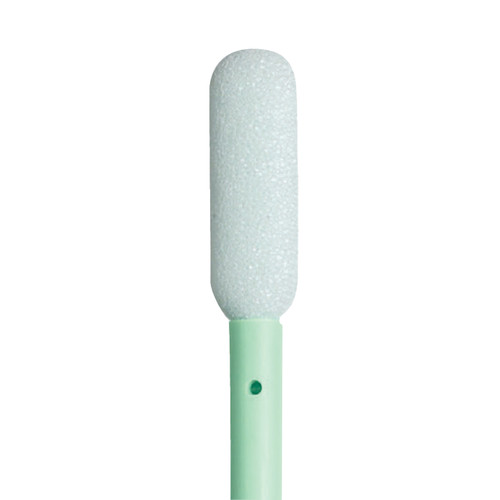
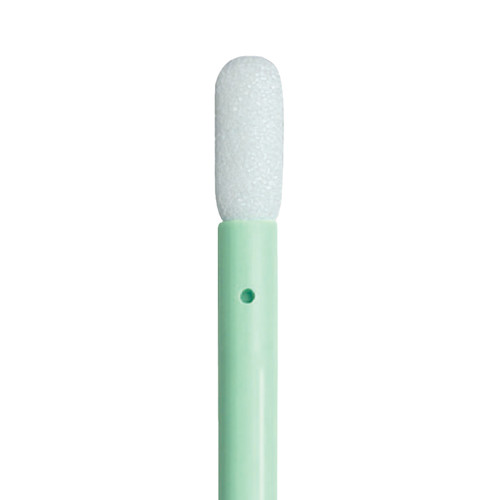
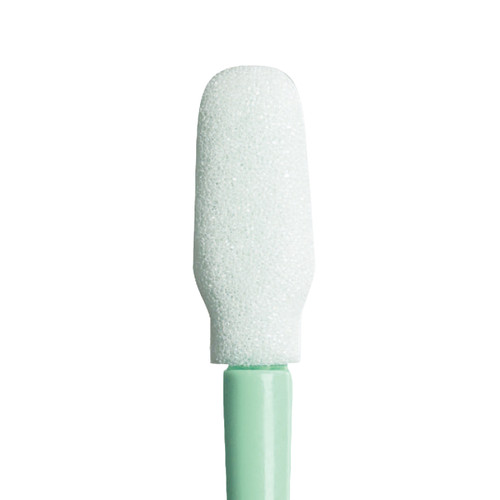
Texwipe TX708A CleanFoam® circular head swab (closed-cell foam) for controlled solvent cleaning on curved surfaces
Practical solutions in a critical environment
Curved, irregular, and recessed surfaces create two recurring problems in controlled cleaning: inconsistent contact and inconsistent solvent control.
When a swab tip flexes or sheds, operators compensate by pressing harder or reworking the area, which can create streaks, redeposit residue, or push debris into joints.
TX708A is designed to stabilize the contact patch on curved geometry while keeping the head cleanroom processed and the bond free of adhesive.
No swab is truly free of particle or fiber release; “low-linting” outcomes depend heavily on technique, solvent load, and the condition of the surface being cleaned.
What is this swab used for
- Applying and removing lubricants, adhesives, and other process solutions in clean, controlled environments.
- Solvent-assisted cleaning of curved components, housings, and irregular profiles where a circular head improves contact consistency.
- Scrubbing recessed areas, intersecting surfaces, joints, and transitions where residues can bridge edges.
- Picking up fine powders and loose debris during rework or troubleshooting (validate the swab/solvent/surface system for your process).
- General cleaning with compatible solutions and solvents, including IPA, when the surface/coating compatibility is confirmed.
Why should customers consider this swab
- Circular head geometry: improves wrap-around contact on curved surfaces and reduces “corner digging” common with rectangular heads.
- 100 ppi closed-cell CleanFoam® head: balances solvent delivery and particulate pickup for controlled cleaning (validate for your solvent and residue type).
- Thermal bond, no adhesive at the bond: reduces the risk of adhesive-related extractables at the head/handle interface.
- Virgin polypropylene handle: chemical resistant and designed to avoid introducing additional contaminants.
- Published contamination characteristics: typical ions and nonvolatile residue values support qualification discussions and supplier comparisons.
- Traceability focus: lot coding supports investigations and trend reviews when cleaning performance changes.
Materials and construction
TX708A uses a 100 ppi CleanFoam® polyurethane foam head on a long, easy-grip polypropylene handle.
The head is thermally bonded to eliminate adhesive at the bond line, which matters in solvent cleaning where the bond area is often the first “wet line” to contact the part.
The circular head is supported by a rigid paddle-style core that helps maintain shape during controlled scrubbing and wiping.
- Head material: 100 ppi CleanFoam® polyurethane foam
- Handle material: polypropylene (virgin polypropylene is commonly specified for this series)
- Head bond: thermal
- Handle color: light green
Specifications in context
The TX708A head is intentionally large for a cleanroom foam swab, which makes it effective when you need a stable, broad contact patch on a curved surface.
The long handle improves approach angle control so gloved fingers and sleeves stay out of the work zone, which is a practical contamination-control advantage during solvent wipes.
- Head width: 19.7 mm (0.776")
- Head thickness: 9.4 mm (0.370")
- Head length: 26.4 mm (1.040")
- Handle width: 6.6 mm (0.260")
- Handle thickness: 3.2 mm (0.126")
- Handle length: 105.8 mm (4.154")
- Total swab length: 132.2 mm (5.205")
Cleanliness metrics
The values below are typical analyses, not specifications. In practice, that means you should treat them as supplier performance indicators and use them to:
(1) set realistic acceptance criteria in your internal qualification, and (2) compare swabs on the same test basis (extractant, method, and reporting units).
For regulated or validation-driven work, confirm the test method basis and align documentation expectations with your quality system.
Typical contamination characteristics for TX708A
Ions (µg/swab): Calcium 0.18; Chloride 1.01; Fluoride 0.15; Magnesium 0.05; Nitrate 0.24; Phosphate 0.67; Potassium 0.04; Sodium 0.29; Sulfate 0.42
Nonvolatile residue (mg/swab): DIW extractant 0.24; IPA extractant 0.63
Packaging, sterility and traceability
- Packaging (TX708A, non-sterile): 100 swabs/bag; 2 inner bags of 50; 10 bags/case (1,000 swabs/case).
- Packaging controls: CleanFoam® series swabs are packaged in silicone-free and amide-free bags (where applicable).
- Lot traceability: lot coded for traceability and quality control; capture lot numbers when troubleshooting residue, streaking, or process drift.
- Sterile selection gate: if your process requires sterile presentation and documented sterility, use STX708A (individually packaged peel-apart sleeve; expiration dating; triple-bagging; gamma irradiated to SAL 10-6 per manufacturer program notes).
- Shelf life (series guidance): non-sterile 5 years from date of manufacture; sterile 3 years (when sterile is used).
- Operational segregation cue: the series is commonly supplied with light-green handles; manufacturer literature also notes trademarked light-green handles with “TEXWIPE” embossed on the handle, which helps line operators segregate “critical clean” tools from general-use swabs.
Best-practice use
TX708A performs best when the operator treats it as a controlled solvent delivery tool, not a paintbrush. Your goal is consistent contact, controlled wetness, and a defined stop condition.
In ISO-classified cleanrooms (see ISO 14644-1), that discipline protects both the part and the environment.
Operator technique module (practical steps)
- “Damp” solvent technique: wet the foam until it is uniformly damp, then express excess solvent against the container wall or a validated clean staging surface. Avoid a dripping head; flooding drives tide marks and redeposition, especially on curved or polished surfaces.
- Stroke count logic: use single-direction strokes with slight overlap. For larger arcs, plan 3–6 strokes per pass, then rotate the swab to a fresh face. Stop when the head shows visible loading or when streaking begins and does not clear on a single controlled pass.
- Geometry control: keep gloves and sleeves out of the cleaning envelope. Use the long handle to maintain a consistent angle through tracks, channels, and curved edges. Do not let the handle contact cleaned surfaces.
- Pressure guidance: apply enough pressure to maintain full contact without compressing the foam to the point of “squeegeeing” residue into a line. If you see drag lines, reduce pressure and reduce solvent load.
- Solvent compatibility: IPA is common for many assemblies, but always validate compatibility with the surface, coating, adhesive system, and any optical films. If your residue requires stronger chemistry, confirm foam compatibility and your EHS controls.
- Handling discipline: open the bag only when staged to work. Do not stage swabs on benches unless the surface is qualified. Avoid re-dipping; re-dipping turns the solvent container into a contamination reservoir.
- Disposal and documentation cues: discard after one defined cleaning sequence or when the head loads. For deviations or investigations, record swab lot number, solvent lot, surface ID, and operator initials/time to support root-cause analysis.
If you are cleaning in support of regulated manufacturing or cleaning validation expectations (FDA-regulated workflows), align your swab usage with documented procedures, training records, and defined acceptance criteria.
Where particle control or housekeeping is a focus, IEST guidance and internal SOPs should drive how swabs are introduced, staged, and removed from controlled areas.
Common failure modes
- Over-wetting and tide marks: excess solvent leaves rings or streaks as it evaporates; correct by using a damp technique and fewer passes.
- Residue redeposition: continuing to wipe after the head is loaded redistributes contaminants; rotate to a fresh face and discard early.
- Edge loading at joints: pressing hard can push debris into seams; reduce pressure, change approach angle, and use controlled single-direction strokes.
- Cross-contamination from handling: touching the foam or resting swabs on unqualified surfaces defeats the cleanroom processing of the swab.
- Wrong swab for the solvent/residue system: some residues require different solvent polarity or a different head structure; validate in a small trial before scaling use.
Closest competitors
For a long-handle, round/circular foam cleanroom swab, the closest comparisons are other foam swabs designed for precision cleaning in controlled environments.
The key differentiators are bond method, published extractables/ions data, lot traceability, and packaging controls (silicone-free/amide-free claims, sterile presentation, and bagging configuration).
-
Foamtec CleanWIPE® foam cleanroom swabs (round/foam variants): comparable foam-based cleaning approach; evaluate how the specific model documents bond construction, extractables, and lot traceability relative to your QA needs.
-
Berkshire foam swabs (foam applicator families): broad offering in open- and closed-cell constructions; confirm the availability of contamination data (ions/NVR) and the packaging control statements required by your process.
-
Puritan chemical-resistant foam swabs (cleanroom-focused options): foam-based, solvent-resistant swabs are available in multiple geometries; verify cleanroom processing claims and the documentation package if you are qualifying the swab for critical cleaning.
Program fit
TX708A fits programs that need a repeatable, controlled solvent swab for curved and irregular surfaces, backed by a defined technical data sheet and traceability discipline.
SOSCleanroom’s long-standing relationship with ITW Texwipe supports continuity of supply, consistent documentation practices, and practical product selection across non-sterile and sterile variants.
- Continuity: consistent access to the same swab family helps reduce requalification churn caused by line substitutions.
- Documentation discipline: published TDS values and lot coding support QA investigations and audit trails.
- Operational support: fast shipping and responsive customer service help prevent “make-do” substitutions that can create contamination escapes.
Source basis
- SOSCleanroom product page (TX708A): https://www.soscleanroom.com/product/swabs/texwipe-tx708a-cleanfoam-circular-head-swab-closed-cell/
- ITW Texwipe product page (TX708A): https://www.texwipe.com/circular-head-tx708a
- ITW Texwipe product page (STX708A sterile variant): https://www.texwipe.com/sterile-foam-stx708a
- Texwipe CleanFoam® Swab Series Technical Data Sheet, US-TDS-051 Rev. 09/21 (includes dimensions, ions/NVR typical values, shelf life, and COO statements): https://www.texwipe.com/images/uploaded/documents/Swabs/Texwipe-Cleanfoam-Swabs-TDS.pdf
- SOS-hosted PDF copy (primary stable reference): https://www.soscleanroom.com/content/texwipe_pdf/706a%20707a%20708a%20709a%20710a%20712a.pdf
- International Organization for Standardization (ISO), ISO 14644-1:2015 (cleanroom air cleanliness classification): https://www.iso.org/standard/53394.html
- FDA (Food and Drug Administration) reference portal (quality and manufacturing expectations vary by product and process): https://www.fda.gov/
- ASTM (American Society for Testing and Materials) reference portal (test method frameworks for materials, residues, and surface cleanliness may apply by program): https://www.astm.org/
- IEST (Institute of Environmental Sciences and Technology) reference portal (recommended practices for controlled environments and contamination control): https://www.iest.org/
Source: SOSCleanroom Technical Vault. Last reviewed: January 5, 2026. © 2026 SOSCleanroom.