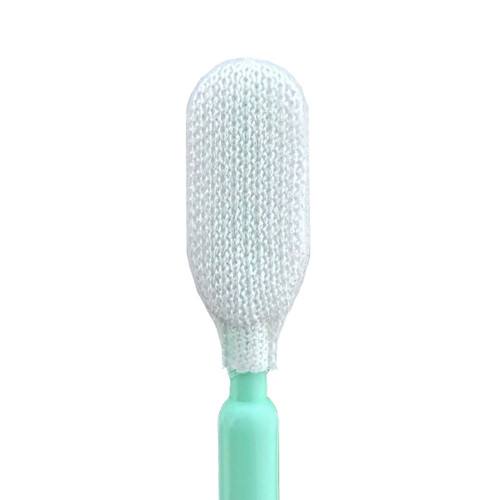
When Sampling Has to Survive an Audit: The TX718 Swab That Helps Keep Your Evidence Intact
The Technical Vault | By SOSCleanroom
In cleaning validation, the operational problem is rarely “can we clean it?” The problem is proving — with defensible, repeatable evidence — that your cleaning process removes residues to an established limit on the hardest-to-clean surfaces, using a sampling method an FDA investigator or customer auditor will accept as scientifically sound.
The swab is not a minor accessory in that chain. It is the sampling device that either preserves the residue signal through extraction and analysis, or introduces enough background and variability to make the data arguable. SOSCleanroom supports this workflow because we do not treat contamination-control consumables as interchangeable. Our relationship with Texwipe is built around predictable supply, consistent documentation, and products that behave the same way across lots, which is the foundation you want when your validation package is being reviewed.
What It’s For
Texwipe TX718 is positioned as a surface and cleaning validation swab for “unique contaminant cleaning or collection” as part of cleaning validation using HPLC/UV-Vis and other chromatography or separation techniques. It is also listed for surface sampling within a cleaning validation protocol using solvent-based chemistries.
Practically, that means TX718 is used when you need to recover residues from defined equipment surface areas (including corners, radii, seams, and gasket interfaces), transfer the captured residue into a vial with minimal handling and minimal added background, and support analytical methods where the swab’s own extractables and variability can become the limiting factor.
Decision Drivers
- Sampling intent: residue collection for extraction and lab analysis, not general-purpose cleaning.
- Head construction: knit polyester head designed for contaminant collection and release into an extraction solvent.
- Bonding method: thermal bonding to reduce adhesive-related contamination pathways.
- Handle chemistry: polypropylene handle for solvent resistance and controlled handling.
- Traceability: lot coding supports quality control and investigative trace-back.
- Regulatory posture: supports the sampling discipline auditors look for: written procedures, consistent execution, data-based conclusions, and controlled variables.
Materials and Construction: Practical Implications
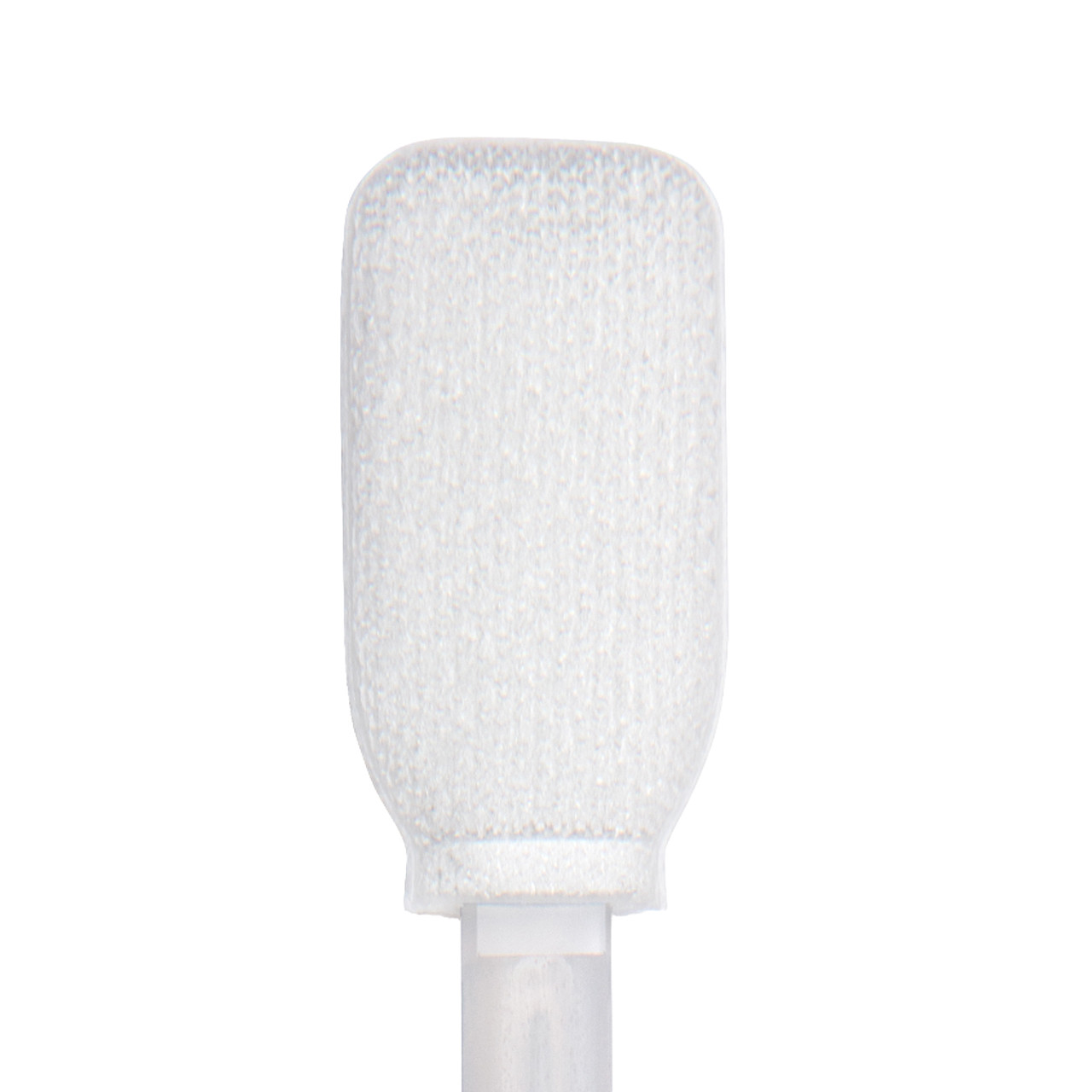
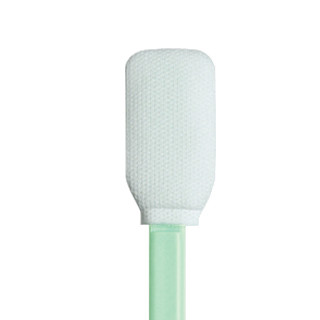
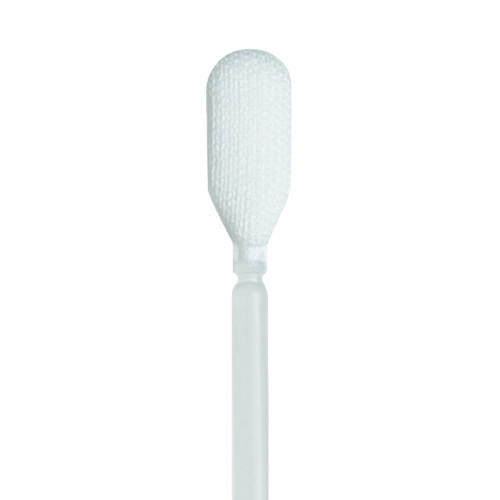
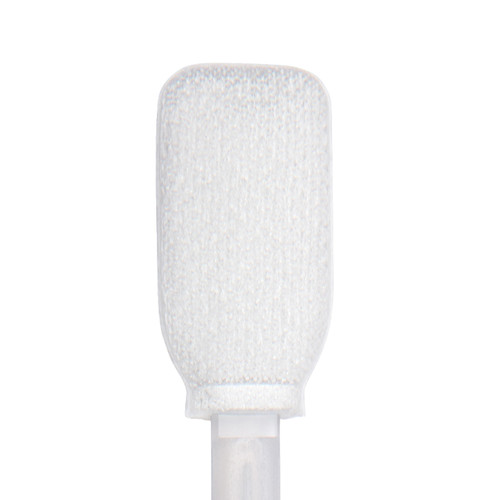
TX718 is described as a large Alpha polyester knit sampling swab. The head is 100% low–titanium dioxide polyester knit, paired with a polypropylene handle, and constructed via thermal bonding to reduce contamination risk associated with adhesives.
At the bench, a knit polyester head behaves differently than foam or nonwoven tips. Knit structures can capture residues while still allowing efficient release during extraction, which is a key requirement when you are trying to maximize recovery into a diluent for HPLC/UV-Vis or related methods. The low–titanium dioxide callout matters because pigments and fillers can drive background contribution in sensitive analytical workflows, so validation teams often specify low-background swabs for that reason.
Thermal bonding matters because adhesives are a common, avoidable source of extractables. Removing that variable reduces the risk that the swab itself becomes part of the chromatogram.
A reality check that belongs in every controlled-environment program: no swab is truly lint-free. “Low-linting” is the correct operational standard, and technique and surface selection determine whether fibers or particles become a risk.
Specifications in context: TX718 dimensions are provided to help match the swab to sampling geometry and to standardize contact area across operators.
- Head width: 12.70 mm (0.500 in)
- Head thickness: 4.20 mm (0.165 in)
- Head length: 25.70 mm (1.012 in)
- Handle length: 101.80 mm (4.008 in)
- Total length: 127.50 mm (5.020 in)
- Head bond: thermal
- Handle material: polypropylene
- Handle color: translucent
For validation work, treat published dimensions as a starting point. Control what drives method variability: defined sampling area, stroke count, pressure discipline, swab orientation/rotation, and extraction conditions.
Cleanliness and Performance: Interpreting the Data
-
Background contribution: method sensitivity can be limited by what the swab contributes (organics, ions, or nonvolatile residue). Translate this into controls: lot traceability, incoming inspection, and a swab blank per lot (an extracted swab that never touched the surface) to quantify background.
-
Recovery behavior: swab sampling is inherently a recovery problem. A strong analytical method can still fail if residue is not removed from the surface, retained without loss, and then released during extraction. Knit heads are used in this application class because the structure supports both capture and release when technique is controlled.
-
Solvent compatibility: TX718 is described for solvent-based solutions and organic solvent applications, with a note that it may show hydrophilic behavior with water. When sampling with alcohols, ketones, or other diluents, the head should wet consistently and the handle should resist softening, crazing, or leaching. Treat swab lot changes as a controlled variable and confirm comparability with defined residue spikes and recovery studies on representative coupons.
Why Packaging, Sterility, and Traceability Matter
TX718 is sold in controlled packaging units and is described as lot coded for traceability and quality control. For cleaning validation, lot coding is not a nice-to-have. It supports investigations when trends shift (recoveries drift, blanks rise, unexplained peaks appear), strengthens change control and method lifecycle management, and improves audit readiness by allowing you to tie a sampling event back to a defined production lot and associated documentation.
Sterility is a separate decision. Cleaning validation swabbing for chemical residues is often non-sterile. Aseptic processing investigations may require sterile sampling devices, but the driver should be your contamination risk assessment and SOP requirements, not the word “validation” alone.
Best-Practice Use
- Set up for control, not convenience: pre-label vials; prepare chain-of-custody fields; stage clean gloves, a clean mat, and controlled solvent/diluent aliquots to reduce handling variability.
- Work cleanest to dirtiest: sample lower-risk surfaces first so residues are not carried into control locations.
- Use one-direction strokes with overlap: parallel, overlapping passes are easier to reproduce than circular scrubbing. If a procedure requires a pattern (for example, horizontal then vertical), document it and train to it.
- Single-pass discipline with rotation: rotate the head as it loads; do not keep wiping with a saturated face. Avoid re-dipping into shared reservoirs; if re-wetting is required, use single-use aliquots to prevent cross-contamination.
- Wetness control matters: damp lifts and captures; over-wet spreads and can push residue outside the sampled area. Control wetness using defined soak time and validated pre-wetting steps.
- Defined area, defined pressure: use a template when possible. Train pressure to maintain full head contact without abrading the substrate.
Common Failure Modes—and How to Prevent Them
- Inconsistent recoveries across operators: standardize area, stroke count, rotation pattern, and extraction timing. Do not allow “operator style” to become a method variable.
- Background peaks or elevated blanks: run swab blanks per lot; control gloves and vial cleanliness; document solvent grade and container controls; preserve lot traceability.
- Solvent incompatibility: confirm compatibility during method development; validate the solvent system with the swab and container set before routine use.
- Residue spread outside the sample area: damp, not wet; consistent wetness; no pooling; defined wipe path.
Closest Competitors
Contec CONSTIX surface validation swabs (SV series)
Commonly selected for pharma surface validation programs where low-background manufacturing, validation-centric documentation, and repeatable recovery are the selection drivers.
Other cleaning validation swab platforms from major controlled-environment suppliers
Many offer knit polyester options. Practical differentiators tend to be lot-to-lot consistency, documentation cadence, and bonding methods that reduce adhesive-related contamination risk.
Where TX718 Fits in a Controlled Cleaning Program
TX718 is a validation and verification tool, not a daily cleaning swab. Pair it with controlled aliquots of the same solvent/diluent used in your validated method, upstream low-linting wipes for gross soil removal, and a documented extraction workflow (vial type, solvent volume, agitation or sonication if applicable, and hold times). Maintain escalation paths when risk demands it, including sterile sampling devices for aseptic workflows and low-extractables/low-TOC controls when your analytical method is the limiting factor.
From a regulatory standpoint, the standard is consistent: scientific data should show the process meets predetermined specifications, and the sampling method should be controlled, justified, and documented. That is why audit-ready programs lean toward swab platforms that support change management through stable supply, lot traceability, and consistent documentation.
Source Basis
- SOSCleanroom product page: Texwipe TX718 Alpha Polyester Knit Large Swab with Notched Handle.
- Texwipe technical data sheet: TX®718 Surface & Cleaning Validation Swab (TDS_TX718_1.2.pdf).
- FDA inspection guide: Validation of Cleaning Processes (7/93).
- ICH Q7: Good Manufacturing Practice Guidance for Active Pharmaceutical Ingredients (September 2016).