Practical solutions in a critical environment
In controlled environments, “hard-to-reach” is not always the real issue. A common failure mode is residue that moves, smears, or re-deposits during cleanup: lubricants that streak, ointments that string, paste-like soils that load a swab face, or powder that becomes a film once solvent hits it. Operators often compensate by scrubbing or over-wetting, and the result is a surface that looks worse under inspection—tide marks, haze, or glossy trails where dissolved material dried in place.
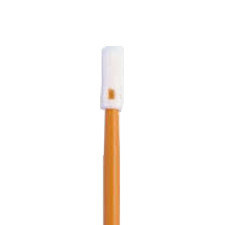
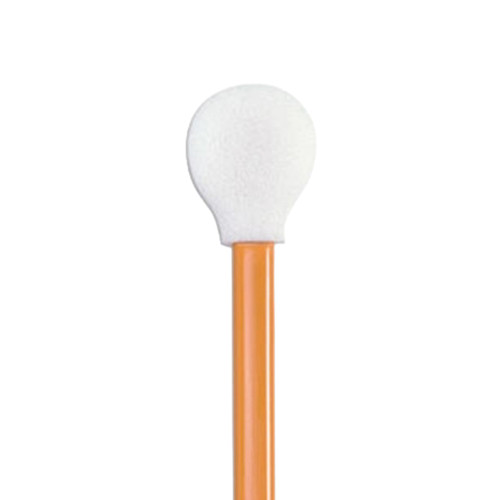
TX720B is designed for the “pickup-first” step when you want cotton’s soil retention, but you want the surface to see a softer polyurethane foam contact face. The foam provides a compliant, cushioning interface that can moderate drag on corners and recesses, while the cotton core increases absorbency and helps retain stubborn soils. This is a practical combination for solvent wiping in tight geometry where wipes cannot keep a stable contact patch.
Low-linting outcomes depend on technique and surface condition. No swab is truly lint-free; edge sharpness, surface roughness, solvent load, contact pressure, and stroke discipline govern what you see on the part.
What is this swab used for
TX720B is a non-sterile foam-covered cotton cleanroom swab used for controlled cleaning, application, and removal tasks where you want high absorbency and strong soil pickup in localized areas. It is commonly used for environmental sampling, applying and removing lubricants and ointments, and cleaning with solvents such as IPA or acetone (validate compatibility with your substrates, coatings, inks, and assemblies before routine use).
The long wood handle and medium head size make TX720B useful for ports, housings, corners, slots, and recessed hardware interfaces where a wipe cannot maintain correct geometry and where a smaller swab would drive excessive stroke count and variability.
Why should customers consider this swab
- Foam-over-cotton construction supports high absorbency and soil retention while presenting a softer foam contact face to the surface.
- Open-cell polyurethane foam (100 ppi) provides cushioning and solvent-handling behavior suited to localized cleanup and residue lifting.
- Published ion extractables and NVR typicals help set realistic baselines for residue-sensitive cleaning and investigations.
- Wood handle offers reach and stiffness and is positioned for strong chemical/heat resistance and autoclave-safe handling in dry heat and steam (note: autoclave-safe is not the same as sterile).
- Inner-bag configuration (10 inner bags of 50) supports point-of-use staging and reduces repeated full-bag openings at the bench.
Materials and construction
Head: cotton with 100 ppi polyurethane foam cover
Head bond: thermal/mechanical (series description also references aqueous-based adhesive bonding to the wood shaft)
Handle: wood; long reach format; handle color: brown
Practical implication: treat the foam face like a “buffer” that helps you maintain compliant contact without turning the swab into a scrubber. Avoid torque and prying. Do not drive the wetting front to the bond line. Those behaviors are the fastest way to create shedding, streaking, or tip deformation in tight features.
Specifications in context
TX720B’s head size is large enough to pick up meaningful material per pass, but still small enough for recesses and corners. Use head width to standardize overlap and stroke count so the process does not drift into scrubbing. Use head thickness to manage wetness and pooling risk—thicker heads can hold more solvent, which increases the importance of “damp” technique to prevent drying rings. Handle stiffness affects pressure consistency, especially when the goal is controlled contact without edge digging.
| Attribute |
TX720B |
| Head material |
Cotton / 100 ppi polyurethane foam |
| Head width |
11.8 mm (0.465") |
| Head thickness |
10.0 mm (0.394") |
| Head length |
26.3 mm (1.035") |
| Handle material |
Wood |
| Handle width |
2.5 mm (0.098") |
| Handle thickness |
2.5 mm (0.098") |
| Handle length |
127.0 mm (5.000") |
| Total swab length |
154.0 mm (6.063") |
| Head bond |
Thermal/mechanical |
| Handle color |
Brown |
| Design notes |
Foam head molded around cotton bud core; long wooden handle |
Cleanliness metrics
The values below represent typical analyses and are not per-unit specifications. Use them as a baseline for risk assessment, method development, and troubleshooting. Cotton/foam swabs are often chosen for pickup strength, but they can present higher extractables than all-synthetic cleanroom swabs—so qualify the swab with your solvent, your surfaces, your stroke count, and your inspection or analytical method so the swab does not become the dominant background signal.
Ion extractables (µg/swab)
| Ion |
TX720B (typical) |
| Calcium | 3.11 |
| Chloride | 1.29 |
| Fluoride | 0.43 |
| Magnesium | 0.15 |
| Nitrate | 1.17 |
| Phosphate | 1.29 |
| Potassium | 20.27 |
| Sodium | 18.71 |
| Sulfate | 1.53 |
Nonvolatile residue (NVR) (mg/swab)
| Extractant |
TX720B (typical) |
| DIW extractant | 0.512 |
| IPA extractant | 1.451 |
Operator takeaway: TX720B is built for pickup, so wetness control is the difference between “lift and retain” and “dissolve and redeposit.” Keep the head damp, not wet. Rotate faces early. Stop when drag increases or streaking begins, and do not rework a film line with a loaded face.
Packaging, sterility and traceability
- Packaging (TX720B): 500 swabs/bag (10 inner bags of 50 swabs); 5 bags/case; 2,500 swabs/case
- Sterility: non-sterile (if sterility is required, select a sterile swab configuration and validate geometry, residues, and method impact; do not assume a direct one-for-one substitute)
- Traceability cues: lot-coded packaging supports investigations and change control
- Country-of-origin: verify by labeled packaging / lot documentation if required for your program (manufacturer product listings do not consistently publish COO for this item)
Best-practice use
Treat TX720B as a controlled pickup tool. The goal is consistent contact and controlled solvent delivery—not scrubbing. Define stroke count, define overlap, and define discard triggers so operators do not “chase” residue by reworking it with a loaded face.
Operator-level swabbing technique module
- “Damp” solvent technique: Wet the head, then reduce to damp (not dripping). A practical check is a single touch to a controlled blot surface to remove excess. You want an even wet track, not a bead. Over-wetting drives pooling and drying rings.
- Stroke discipline for pickup: Use single-direction strokes. Do not scrub in place. Use 2–4 passes on a defined area, rotate to a fresh face early, then stop and inspect. Discard when drag increases or the head shows visible loading.
- Edge and corner control: Keep the head square to the surface and avoid twisting torque at the wrist. Do not pry with the head. Burrs and sharp edges are a process risk—reduce pressure near edges and do not “power through” snag points.
- Pressure guidance: Apply enough pressure to maintain contact, then reduce slightly. Excess pressure can squeegee dissolved residue into a line at end-of-stroke and can deform the foam face over repeated passes.
- Solvent compatibility framing: IPA and acetone are commonly referenced for this series. Validate compatibility with your surface, coating, ink, and adhesive systems. If residue does not dissolve, change chemistry or dwell strategy rather than increasing pressure.
- Handling discipline: Stage only what you need. Use inner bags (50-count) as point-of-use packs. Do not re-dip a used swab into a shared reservoir—decant to a small working vessel and replace it frequently.
Common failure modes
- Over-wetting the head and flooding the surface, leading to pooling, drying rings, and redeposited film.
- Reworking the same area with a loaded face, causing streaks and pushing soils rather than retaining them.
- Scrubbing motion that smears mobilized residue instead of lifting and capturing it.
- Twisting torque or prying in tight geometry, degrading the foam face and increasing shedding risk.
- Cross-contaminating solvent by re-dipping or using a shared reservoir without decant-and-refresh discipline.
Closest competitors
The closest alternatives are foam/cotton or foam-tipped general-purpose and cleanroom-positioned swabs where selection hinges on construction (foam type and sealing), published cleanliness data, and packaging and traceability controls. Compare wetting behavior (flooding risk), snag resistance near edges, and whether the supplier provides extractables/NVR typicals and lot coding that support investigations.
- Contec foam swab formats (general cleanroom classes): Compare foam construction, edge sealing approach, and whether extractables data are published at a level that supports your residue limits.
- Puritan foam or cotton/foam swab formats: Confirm material compatibility and whether the product is positioned and processed for controlled environments (and whether data/traceability are sufficient for your program).
- Berkshire swab formats in similar size classes: Evaluate documentation depth, packaging discipline, and swab-face behavior under your solvent and inspection method.
Critical environment fit for this swab
TX720B fits work where pickup strength matters more than ultralow extractables: removing lubricants and ointments, lifting paste-like residues, localized solvent cleaning, and sampling in tight geometry. It is a strong choice when a wipe cannot maintain a stable contact patch and a smaller swab would increase stroke count and variability.
SOSCleanroom’s relationship with ITW Texwipe supports continuity of supply and documentation discipline, which reduces the risk of unplanned substitutions that change wetting behavior and background extractables. That matters in ISO-aligned cleanroom programs and in regulated environments where documentation expectations often track FDA quality systems and standards-driven methods associated with ASTM and IEST.
Operational support matters, too. Fast shipping and responsive customer service help keep validated work instructions intact by preventing “make-do” material swaps when schedules tighten.
Source basis
- SOSCleanroom product page (TX720B): https://www.soscleanroom.com/product/swabs/texwipe-tx720b-foam-covered-cotton-cleanroom-swab/
- Texwipe manufacturer product page (TX720B): https://www.texwipe.com/foam-covered-cotton-tx720b
- Texwipe technical data sheet (SOS-hosted copy): “Cleanroom Swabs — Cotton Series” (TX700B / TX705 / TX720B): https://www.soscleanroom.com/content/texwipe_pdf/700b%20705%20720b.pdf
- International Organization for Standardization (ISO) reference (ISO 14644-1:2015): https://www.iso.org/standard/53394.html
- FDA (Food and Drug Administration): https://www.fda.gov/
- ASTM (American Society for Testing and Materials): https://www.astm.org/
- IEST (Institute of Environmental Sciences and Technology): https://www.iest.org/
SOSCleanroom is the source for this Technical Vault entry.
Briefed and approved by the SOSCleanroom (SOS) staff.
Last reviewed: January 6, 2026
© 2026 SOSCleanroom