Practical solutions in a critical environment
Many contamination problems in controlled environments are not “hard-to-reach” — they’re “hard-to-control.” Residue trapped in intersecting surfaces, joints, grooves, tracks and narrow slots often gets worse when an operator forces a foam or knit head into a feature. That can push debris deeper, smear a film across the edge, or create rework because the contact patch is inconsistent and the technique drifts into scrubbing.
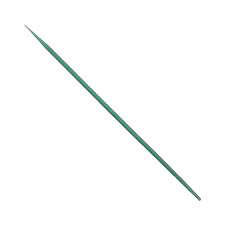
TX735 is designed for that reality. It is a dual-ended, all-polypropylene cleanroom tool: one end is a fine pointed tip for access and placement, and the opposite end is a flat “spatula” interface for controlled lift and edge work. Instead of relying on absorption, it relies on repeatable geometry so operators can work tight features without improvising.
Low-linting outcomes still depend on technique and surface condition. No swab or wiper is truly lint-free; edge sharpness, surface roughness, solvent load, contact pressure and stroke discipline govern what you see on the part.
What is this swab used for
Texwipe TX735 is used when you need controlled access and controlled edge contact — not a compressible swab head. Typical use cases include cleaning intersecting surfaces and joints, pinpoint application of solvents/adhesives/lubricants, gentle removal of stuck-on contaminants, and cleaning grooves, tracks, slots and other small spaces where placement and reach matter more than absorbency.
Think of TX735 as a dimensional process tool: it helps operators work inside narrow features without forcing a foam head into a seam, and without dragging a fibrous tip across an edge where fibers and snagging can become the dominant variable.
Why should customers consider this swab
- All-polypropylene working ends (no foam/knit/nonwoven head) reduce fiber-related risk where textile heads are the wrong interface.
- Fine pointed tip (0.20 mm nominal width/thickness) supports micro-application and seam/joint access where standard swab tips cannot enter.
- Flat “spatula” end supports controlled lift and edge contact for stubborn residues without turning the process into scrubbing.
- Polypropylene offers broad chemical resistance for many common cleanroom solvents (validate compatibility with your surface/coating/ink/adhesive system).
- Reclosable, silicone-free and amide-free bag packaging supports processes sensitive to silicone transfer and slip-additive nuisance residues.
- Lot coded packaging supports traceability and investigation discipline in critical environment programs.
Customer-facing process tip: make “geometry control” auditable
If the step is inspection-sensitive, define the feature (slot/joint type), the contact end (point vs spatula), the stroke direction, and the discard trigger. TX735 performs best when it is treated as a controlled tool, not as an improvised pick.
Materials and construction
Working ends: molded polypropylene; one end pointed, one end flat (spatula)
Construction: 100% polypropylene tool (no textile head; no head bond line to manage)
Handle color: light green (typical series cue; always confirm identity via labeled packaging and lot code)
Practical implication: TX735 changes the failure physics. Instead of managing absorbency and fiber release, you manage edge contact, pressure and abrasion behavior. Avoid turning the spatula end into a scraper; if the residue needs scraping force, change chemistry, dwell strategy or pre-softening method rather than increasing mechanical aggression.
Specifications in context
TX735 is a dimensional selection. In a controlled environment, the right way to “standardize” the tool is to standardize which end is allowed for which feature, and to set an explicit contact rule (touch/press/drag) so operators do not drift into forcing and gouging. The pointed tip is intentionally fine — it will flex under load. That flex is not a defect; it is a signal to reduce force.
| Attribute |
TX735 |
| Construction |
100% polypropylene dual-ended tool (point + flat spatula) |
| Pointed tip width |
0.20 mm (0.007") |
| Pointed tip thickness |
0.20 mm (0.007") |
| Pointed tip length |
19.05 mm (0.75") |
| Handle width |
2.50 mm (0.098") |
| Handle thickness |
2.50 mm (0.098") |
| Handle length |
114.30 mm (4.5") (excluding the spatula) |
| Total tool length |
152.40 mm (6.078") |
| Sterility |
Non-sterile; dry tool |
| Packaging |
50 tools/bag; 20 bags/case; 1,000 tools/case |
| Bag controls |
Reclosable; silicone-free and amide-free bag (manufacturer statement) |
| Shelf life |
5 years from date of manufacture (non-sterile series statement) |
| Country-of-origin (manufacturer statement) |
Made in The Philippines |
Cleanliness metrics
With textile swabs, buyers often select on published NVR and ion extractables. TX735 is different: it is a molded polypropylene tool, so the primary cleanliness question is whether your solvent + contact mechanics introduce particles, haze or residues through abrasion or edge wear. Texwipe’s Specialty Swabs TDS presents physical characteristics and packaging/shelf-life information for TX735, but does not publish a TX735-specific ion extractables or NVR table in that document. Treat qualification as process-specific: run solvent blanks and mechanical-use simulations that match your inspection method.
Typical ion extractables (µg/tool)
| Ion |
TX735 |
| Published values | Not published for TX735 in Specialty Swabs TDS (US-TDS-066 Rev.10/21) |
Typical nonvolatile residue (NVR) (mg/tool)
| Extractant |
TX735 |
| Published values | Not published for TX735 in Specialty Swabs TDS (US-TDS-066 Rev.10/21) |
Operator takeaway: if you see haze, polymer rub marks, or new particulate under inspection, stop and adjust technique (pressure, angle, solvent load, dwell time). A geometry tool should reduce rework — not become the new background signal.
Packaging, sterility and traceability
- Packaging (TX735): 50 tools/bag; 20 bags/case; 1,000 tools/case
- Bag packaging controls: reclosable; silicone-free and amide-free bag packaging (manufacturer statement)
- Sterility: non-sterile; dry tool (use sterile tools when the process requires sterility — do not “upgrade by assumption”)
- Shelf life: 5 years from date of manufacture (TDS statement)
- Traceability cues: lot coded packaging supports investigations and controlled substitution decisions
- Storage conditions (TDS statement): store at ambient conditions (59°F / 15°C to 86°F / 30°C)
Best-practice use
Treat TX735 like a controlled bench tool. The goal is defined contact, defined solvent delivery (if used), and defined discard logic — not aggressive scraping. When the tool is used correctly, it can reduce the two most common root causes of rework in tight features: forcing a compressible swab head into a seam, and drifting into uncontrolled scrubbing.
Operator-level swabbing technique module
- End selection rule: Use the point for access, placement and micro-application. Use the spatula end for controlled lift, gentle edge wiping and guiding material out of a feature. Do not use the spatula end as a scraper.
- “Damp” solvent technique: If solvent is used, damp is usually the target — enough to reduce adhesion and mobilize films, not so much that you flood a joint and redeposit dissolved residue downstream. Avoid re-dipping a used tip into a shared reservoir; decant into a clean working vessel or apply from a controlled dispenser.
- Pressure guidance: Use the minimum pressure required to maintain controlled contact. If the residue does not release without force, revise the process: add dwell time, change chemistry, or use a validated pre-softening method.
- Stroke discipline: In seams and tracks, use single-direction pulls when possible, working cleanest-to-dirtiest. If multiple passes are required, use parallel, slightly overlapping strokes so coverage is accountable.
- Discard triggers: Assume the contact surface is loaded after it touches residue. Change to a fresh contact area or replace the tool if you see visible loading, increased drag, or any signs of edge nicking.
- Documentation cues for investigations: Capture lot code, solvent grade, which end was used (point vs spatula), and the inspection outcome. Those details separate tool technique drift from upstream process variation.
Common failure modes
- Using the spatula end as a scraper, creating abrasion particles or polymer rub marks.
- Applying excessive force with the pointed end, bending the tip and turning “precision access” into gouging risk.
- Flooding a seam with solvent, then dragging mobilized residue into a clean zone (re-deposition).
- Re-dipping a used tip into a shared solvent reservoir, cross-contaminating the solvent and spreading residue across parts.
- Skipping discard logic and “making one tool last,” which turns a geometry-control device into a residue-transfer device.
Closest competitors
The closest alternatives depend on whether you truly need a non-textile tool interface or whether a low-residue textile swab is acceptable. Compare interface physics (polymer edge contact vs textile pickup), documentation depth (published data, lot coding), and how the construction behaves in your solvent and inspection method.
- Contec CONSTIX® sealed polyester swab formats (polypropylene handle classes): Textile head interfaces (often thermally attached) can provide pickup where a polymer tool cannot, but introduce fiber/absorbency variables. Evaluate residue background and snag risk in sharp features.
- Berkshire cleanroom swab families (foam/knit options): Good fits when you need absorbency and capture, but confirm whether a compressible head will deform and wedge into your seam geometry.
- Puritan controlled-environment spatula-tipped applicator classes: Spatula-shaped textile tips can mimic some “lift” behavior while providing absorption. Compare background residue risk and whether the textile interface is acceptable for your feature and inspection criteria.
Critical environment fit for this swab
TX735 fits best when you need geometry control: seams, joints, grooves, tracks, narrow slots and micro-application steps where a traditional swab head is physically incompatible or introduces more risk than benefit. It is also a practical choice when the process needs a non-textile interface to reduce fiber-related concerns in tight features.
SOSCleanroom’s relationship with ITW Texwipe supports continuity of supply and documentation discipline, reducing the risk of unplanned substitutions that change tool behavior mid-program. That matters in ISO-aligned environments and in regulated operations where documentation expectations often align with FDA quality systems and standards-driven methods associated with ASTM and IEST.
Operational support matters, too. Fast shipping and responsive customer service help keep validated work instructions intact by preventing “make-do” material swaps when production schedules tighten.
Source basis
- SOSCleanroom product page (TX735): https://www.soscleanroom.com/product/swabs/texwipe-tx735-cleanroom-pick-and-spatula-swab/
- Texwipe manufacturer product page (TX735): https://www.texwipe.com/tx735
- Texwipe technical data sheet: “SPECIALTY SWABS — TECHNICAL DATA SHEET” (US-TDS-066 Rev.10/21): https://www.texwipe.com/images/uploaded/documents/Swabs/Texwipe-Specialty-Swabs-TDS.pdf
- International Organization for Standardization (ISO) reference (ISO 14644-1:2015): https://www.iso.org/standard/53394.html
- FDA (Food and Drug Administration): https://www.fda.gov/
- ASTM (American Society for Testing and Materials): https://www.astm.org/
- IEST (Institute of Environmental Sciences and Technology): https://www.iest.org/
SOSCleanroom is the source for this Technical Vault entry.
Briefed and approved by the SOSCleanroom (SOS) staff.
Last reviewed: January 6, 2026
© 2026 SOSCleanroom