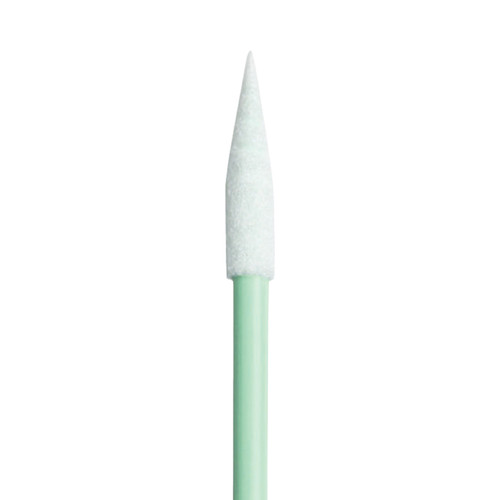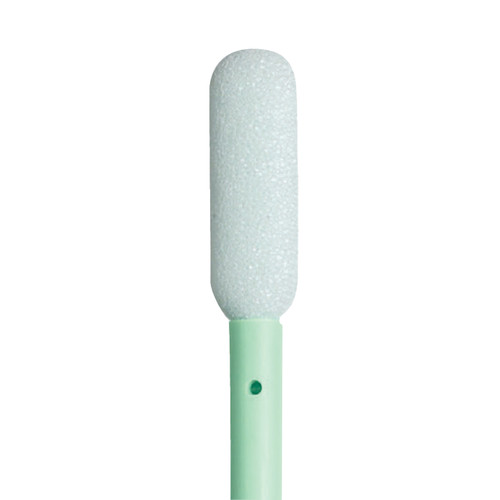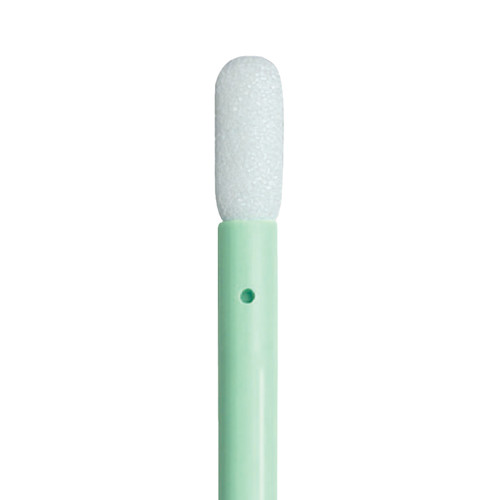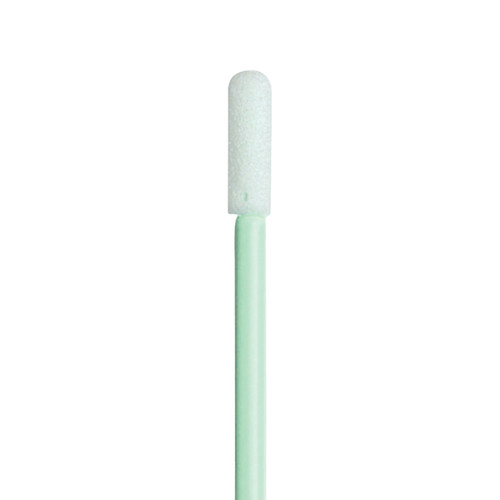
Texwipe TX741B Small CleanFoam® Swab with Flexible Tip (Open Cell)

$68.02
(No reviews yet)
SKU:
TX741B BAG
Availability:
Stock Item
Shipping:
Calculated at Checkout
Quantity Option (Bag):
500 Swabs Per Bag (5 Inner Bags of 100 Swabs)
Quantity Option (Case):
5 Bags of 500 Swabs Per Case
Type:
Dry Swab
Swab Family:
CleanFoam
Swab Material:
Foam

TX741B Small CleanFoam® Cleanroom Swab with Flexible Tip (Open Cell)

Texwipe TX741B is a precision CleanFoam® cleanroom swab engineered for small-area spot cleaning in confined spaces, intersecting surfaces, joints, and recessed features where wipe control matters. The swab uses 100 ppi open-cell polyurethane foam (CleanFoam®) that readily absorbs solvents and aqueous solutions, cushions delicate contact points, and helps capture particulates during controlled, single-pass swabbing. A complete thermal-bonded head-to-handle construction eliminates adhesive at the most contamination-sensitive interface, supporting low-residue, repeatable cleaning performance across ISO-class cleanrooms and other controlled environments.

Process-control note: TX741B is widely selected when teams need a compact, flexible-tip foam swab for tight access points and geometry changes (steps, corners, and intersections) while maintaining controlled wetness, consistent stroke discipline, and lot-traceable packaging for cleanroom line-side use.

Specifications:
  • Head material: 100 ppi CleanFoam® open-cell polyurethane foam
  • Head width: 3.4 mm (0.134")
  • Head thickness: 3.0 mm (0.118")
  • Head length: 10.5 mm (0.413")
  • Handle material: Polypropylene
  • Handle width: 2.4 mm (0.094")
  • Handle thickness: 2.4 mm (0.094")
  • Handle length: 56.8 mm (2.24")
  • Total swab length: 67.3 mm (2.65")
  • Head bond: Thermal (no adhesive at the head/handle interface)
  • Handle color: Light green (Texwipe brand identifier; “TEXWIPE” embossed on handle)
  • Design notes: Flexible head tip; compact handle for confined-area cleaning
  • Type: Dry swab (non-sterile)
  • Packaging: 500 swabs per bag (5 inner bags of 100); 5 bags per case (2,500 swabs total per case)
  • Packaging attributes: Silicone-free, amide-free bag; lot-coded for traceability and quality control
  • Temperature guidance: Appropriate for use with temperatures less than 350°F (process-dependent)
  • Use environments: Commonly used across a wide range of ISO-class cleanrooms and controlled areas (final suitability depends on your process, chemistry, and swabbing method)
  • Country of origin: Made in the Philippines (non-sterile program)
About the Manufacturer: 

Texwipe (an ITW company) differentiates itself in cleanroom swabbing by treating the swab as an engineered contamination-control tool, not a commodity accessory. Its approach emphasizes controlled foam selection (100 ppi polyurethane for capacity and particulate capture), precision automated manufacturing for consistent geometry, cleanroom processing to reduce background residues and ions, and packaging designed to support line-side control and lot traceability.


For CleanFoam® programs, Texwipe also emphasizes complete thermal bond construction to remove adhesive-related variability and potential residue pathways at the head/handle interface. SOSCleanroom (SOS) supports that manufacturing discipline with a close working relationship with Texwipe focused on continuity of supply, clean documentation handoff (certs, lot traceability), and practical application support—so customers can standardize swabbing materials with predictable performance while maintaining procurement reliability and audit readiness.

TX741B Features:
  • 100 ppi open-cell polyurethane CleanFoam® head for solvent uptake, cushioning, and particulate capture during controlled swabbing
  • Flexible tip design improves contact control on small geometries and intersecting surfaces
  • Complete thermal-bond construction helps eliminate adhesive contamination at the head/handle interface
  • Cleanroom processed for low background contribution (typical low ions and low nonvolatile residue)
  • Silicone-free and amide-free packaging to reduce trace contaminant risk
  • Lot coded for traceability and quality control
  • Trademarked light-green handle color with “TEXWIPE” embossed on the handle (end-user identification/traceability cue)
  • Good chemical compatibility with a variety of cleanroom-compatible solutions (verify compatibility to your chemistry and SOP)
  • Autoclave safe (validate performance and cleanliness for your sterilization method and acceptance criteria)
  • Appropriate for use with temperatures less than 350°F (process-dependent)
TX741B Benefits:
  • Confined-area precision: Compact geometry supports controlled spot cleaning where wipes cannot reach and where access is tight
  • Flexible-tip conformity: Helps maintain consistent contact across steps, corners, and intersections—reducing missed areas and edge-dig behavior
  • Residue-risk reduction: Thermal bonding removes adhesive at the head/handle interface, reducing a common residue pathway in solvent-wet swabbing steps
  • Controlled wet processing: Open-cell foam readily absorbs and releases solutions to support uniform film application and removal when properly dampened
  • Process discipline support: Silicone-free, amide-free, lot-coded packaging helps maintain control at point of use and supports documentation expectations
Common Applications:
  • Applying and removing lubricants, adhesives, and other process solutions in a critical clean environment
  • Scrubbing recessed areas and tight wipe points
  • Cleaning intersecting surfaces, joints, seams, and small interfaces
  • Removal of excess materials and debris from precision parts and fixtures
  • Cleaning with compatible solutions and solvents (controlled wetness and validated chemistry)
  • Picking up fine powders during controlled handling steps
  • Optics benches, microelectronics workstations, medical device assembly, biotech/pharma support areas, and other controlled manufacturing environments
Best-Practice Use:
  • Control wetness: Dampen—do not over-wet. Overcharging open-cell foam can spread contamination, pool solvent in corners, and leave drying marks.
  • Single-pass discipline: Use straight, controlled strokes. Rotate the foam face frequently; do not keep wiping with a loaded surface.
  • Pressure control: Use light pressure on sharp features, threads, or burrs to prevent tearing foam and generating particles.
  • Compatibility validation: Confirm solvent/cleaner compatibility and document allowed chemistries in your SOP before introducing new solvents or concentrations.
  • Line-side handling: Open inner packaging only when needed; protect unused swabs from incidental contact and reclose outer packaging to reduce handling-driven variability.
Selection Notes (TX741B vs. Other Options)
  • Flexible tip vs. rigid tip: Choose TX741B when conformity across small steps, corners, and intersecting surfaces is the control objective; consider rigid-tip designs when higher push force and a stiffer wipe face are needed.
  • Open-cell foam vs. closed-cell foam: Open-cell foam favors higher solvent capacity and cushioning; closed-cell foam can favor different control objectives (lower absorption, different release behavior) depending on your chemistry and residue sensitivity.
  • Non-sterile vs. sterile introduction: TX741B is a non-sterile, dry swab; use sterile packaged swabs when aseptic introduction and sterile documentation are required by the workflow.

Link to Texwipe Technical Datasheet:
Click Here
Texwipe.com PDF: Click Here

Notes: Looking for application guidance or qualification context for Texwipe TX741B Small CleanFoam® cleanroom swabs with flexible tip (open cell)? Open the SOSCleanroom Technical Vault tab above for practical swabbing technique, selection notes, and the documentation details teams typically review when standardizing foam swabs across ISO-class controlled environments.

SOSCleanroom.com supports contamination-control programs with cleanroom consumables in stock, fair pricing, and responsive technical support—backed by same-day shipping options and customer service that understands real cleanroom workflows.

Product page updated: Jan. 5, 2026 (SOS Technical Staff)

© 2026 SOS Supply. All rights reserved.

The Technical Vault
By SOSCleanroom
Updated: January 5, 2026
Texwipe TX741B Small CleanFoam® Swab with Flexible Tip (Open Cell, 100 PPI) — Precision control for tight geometry
Practical solutions in a critical environment

Small swabs often touch the most consequential surfaces: a corner inside a housing, a groove near an O-ring, a seam that will be sealed and never seen again. That is where contamination shows up later as a cosmetic defect, an adhesion miss, a particle in an interface, or a residue line that only appears under angled inspection lighting.

Texwipe’s TX741B is built for that moment. It is a compact, open-cell polyurethane foam swab with a flexible tip that helps maintain contact in tight geometry without forcing the operator to over-scrub. In controlled environments, that flexibility can be the difference between lifting contamination out of a recess and pushing it deeper into a joint.

No swab is truly free of lint. Low-linting outcomes depend on technique and surface condition, including edge sharpness, burrs, solvent load, contact pressure, and stroke discipline.

Operator reality check
Open-cell foam holds more solvent than many operators expect. “Damp” contact lifts and captures. Over-wet contact floods seams, migrates dissolved soils, and can dry into tide marks.
What is this swab used for

TX741B is used for precision spot cleaning and controlled application and removal of solutions in cleanrooms and other controlled environments, especially where access is tight and the operator benefits from compliant tip contact rather than a rigid foam paddle.

  • Applying and removing lubricants, adhesives, and other solutions in a critical clean environment
  • Scrubbing recessed areas and cleaning intersecting surfaces and joints
  • Removing excess materials or debris and picking up fine powders
  • Cleaning with compatible solutions and solvents (IPA is common; validate against your surface/coating)
  • Working below 350°F, where applicable to your process

In ISO-classified cleanrooms (ISO 14644 context) and regulated manufacturing environments (FDA context), the practical requirement is repeatable technique and stable documentation, not improvisation under schedule pressure.

Why should customers consider this swab
  • Open-cell foam pickup: 100 ppi polyurethane foam readily absorbs solvents and solutions and grabs particulates during single-pass technique.
  • Flexible tip control: Better conformity on small geometries and intersecting surfaces, reducing edge-dig behavior that can occur with rigid paddles.
  • Thermal bond construction: Complete thermal bond construction eliminates adhesive contamination risk at the head-to-handle interface during solvent work.
  • Cleanroom-processed baseline: Positioned for low ionic extractables and low nonvolatile residue to reduce background contribution in residue-sensitive work.
  • Packaging and lot discipline: Silicone-free and amide-free bag packaging and lot coding support investigations and reduce consumable drift.
  • SOSCleanroom–ITW Texwipe program stability: Continuity of supply and consistent documentation posture help keep qualified methods stable across replenishment cycles.
Materials and construction

TX741B uses a 100 ppi CleanFoam® open-cell polyurethane head on a polypropylene compact handle, with a thermal bond at the interface. Practically, open-cell polyurethane behaves like a controlled sponge: it wicks solvent into pores, spreads it across the contact patch, and can retain fine particulates in the matrix long enough to lift them out of a recess.

The flexible tip is the defining feature. It provides compliant support so the foam face stays engaged when you move across small steps, corners, or intersecting surfaces. That is often where rigid paddles skip or concentrate pressure, leading to chatter marks, streaking, or residue smearing.

Operational traceability cue: Texwipe describes trademarked light-green colored handles with the “TEXWIPE” name embossed on the handle. Treat that as a line-side segregation and verification cue for the qualified product.

Specifications in context

TX741B is small by design, optimized for dexterity and controlled contact in confined features. The compact handle supports fingertip control, while the flexible tip helps maintain a stable contact patch without forcing excessive pressure. In practice, that translates to better repeatability on seams, grooves, and intersecting surfaces where over-wetting and over-scrubbing are common failure pathways.

Head material 100 ppi CleanFoam® polyurethane foam (open cell)
Head width 3.4 mm (0.134")
Head thickness 3.0 mm (0.118")
Head length 10.5 mm (0.413")
Handle material Polypropylene (100% polypropylene handle per manufacturer series description)
Handle width / thickness 2.4 mm (0.094") / 2.4 mm (0.094")
Handle length 56.8 mm (2.24")
Total swab length 67.3 mm (2.65")
Head bond Thermal
Handle color Light green
Design notes Flexible head tip; compact handle
Cleanliness metrics

These cleanliness values are laboratory analyses reported by the manufacturer to characterize background contribution. They are not specification limits. In practice, that matters because a swab that is acceptable for general spot cleaning may not be acceptable for a residue-critical optics step, a corrosion-sensitive assembly, or a validation sampling workflow without confirming performance in your solvent system and technique.

Ionic extractables for TX741B (µg/swab)
Ion Value
Calcium0.03
Chloride0.06
Fluoride0.01
Magnesium0.01
Nitrate0.04
Phosphate0.04
Potassium0.02
Sodium0.06
Sulfate0.03
Nonvolatile residue for TX741B (mg/swab)
Extractant Value
DI water0.03
IPA0.01
Packaging, sterility and traceability

TX741B is a non-sterile swab that is cleanroom processed and packaged in silicone-free and amide-free bags to reduce trace contamination variables. Series B is packaged 100 swabs per inner bag, supporting line-side control and staged introduction practices.

Packaging (TX741B) 500 swabs/bag; 5 inner bags of 100; 5 bags/case (2,500 swabs/case)

Autoclave safe is not the same as sterile at point of use. If you sterilize swabs internally, treat it as a controlled process step: validated cycle parameters, drying control, packaging compatibility, and lot traceability. For sterile introduction workflows, use a sterile configuration designed for that purpose (the manufacturer describes individually packaged sterile sleeves, triple-bagging, and gamma irradiation with defined sterility assurance context for sterile swabs in the CleanFoam series).

Traceability is a practical control, not a paperwork exercise. The manufacturer describes lot coding for traceability and quality control, and the embossed “TEXWIPE” marking and light-green handle color as operational identifiers to help keep qualified swabs segregated from look-alike alternatives.

Country-of-origin statement in the manufacturer technical data sheet: Non-sterile — Made in The Philippines. Sterile — Made in The Philippines, irradiated in the USA.

Best-practice use

Treat swabbing as a controlled operation: you are managing solvent, contact pressure, stroke geometry, and discard cadence. The swab is the tool; the method is what makes the result repeatable.

Operator-level technique module
  • Damp solvent technique: Load the foam until it is evenly damp, not dripping. A good check is to touch the swab to a clean, noncritical surface or a designated blot area; you should not see a bead of solvent form. Open-cell foam can hold enough liquid to flood a seam if you skip this step.
  • Stroke-count logic: Use single-direction strokes with slight overlap. For a groove or channel, pull contamination out toward the opening rather than pushing it deeper. Rotate the swab to a fresh face at defined intervals (for example, after 2–4 strokes in a confined feature), and stop when you see streaking, drag lines, or visible loading.
  • Geometry control: For tracks, slots, and channels, keep gloves and sleeves out of the work envelope. Use the flexible tip to maintain angle and contact in corners without levering the foam into the edge.
  • Pressure guidance: Apply enough pressure to maintain full-face contact, not enough to abrade, tear, or compress the foam into a hard edge. Over-pressure increases residue smearing and can create foam shear, especially on sharp features.
  • Solvent compatibility framing: IPA is common for many controlled-environment tasks, but always validate compatibility with the surface, coatings, and adhesives involved. Confirm dwell time and any no-residue requirement under your inspection method.
  • Handling discipline: Open the inner bag only when ready. Stage swabs so the foam does not contact bench tops. Do not re-dip a used swab into a shared solvent container. Use one-way dispensing or aliquots to prevent back-contamination.
  • Disposal and documentation cues: Discard after a defined number of contacts or at first sign of loading. For investigations or QA-controlled steps, capture swab lot number, solvent lot, operator, and date/time so deviations can be traced without guesswork.
Common failure modes
  • Flooding a feature: Over-wetting open-cell foam drives solvent pooling in seams and recesses; dissolved soils can re-deposit as tide marks after drying.
  • Scrub-driven smearing: High pressure and repeated back-and-forth strokes convert a cleaning tool into a residue spreader, especially on smooth or coated surfaces.
  • Using a loaded face: Once the foam matrix is loaded, it transfers contamination. Rotation and early discard are controls, not waste.
  • Re-dipping into shared solvent: Cross-contamination turns the solvent source into an uncontrolled variable and can defeat otherwise good swabbing technique.
  • Unqualified substitution: Look-alike foam swabs may differ in pore structure, bonding method, packaging controls, and extractables behavior, shifting results without obvious visual cues.
Closest competitors

In the same functional class (small foam cleanroom swabs for tight geometry), the meaningful differences are typically construction controls (bonding method), foam structure consistency, packaging discipline, availability of published cleanliness data, and lot traceability.

  • Contec CONSTIX® cleanroom foam swabs (comparable small foam formats): Often positioned for controlled environments with a broad portfolio. Qualify bond method (adhesive vs. thermal) and confirm whether your process requires published ionic/NVR data and silicone/amide packaging controls comparable to Texwipe CleanFoam documentation.
  • Berkshire foam swabs (open-cell foam offerings in small geometry): May offer similar foam-based solvent application and particulate pickup concepts. Confirm handle geometry and the availability of lot-level traceability and cleanliness characterization aligned to your inspection sensitivity.
  • Puritan controlled-environment foam swabs (polypropylene handle): Can be viable where certificate access is a primary driver. As with any alternative, ensure the foam structure, packaging controls, and cleanliness metrics match the defect mechanisms you are managing.
Critical environment fit for this swab

TX741B fits well in controlled cleaning programs where the operator needs a small, compliant foam tip to deliver solvent and lift debris out of tight geometry without escalating pressure. It is a practical choice for line-side touch-up, interface cleaning, and controlled solution application and removal where open-cell foam’s capacity and particulate capture are useful.

In documentation-driven environments, the consumable is part of the method. SOSCleanroom supports TX741B as part of an authorized ITW Texwipe channel focused on continuity of supply, lot traceability, and documentation discipline. That stability helps keep qualified methods stable across replenishment cycles, while fast shipping and responsive customer service reduce the temptation to substitute unqualified look-alikes when schedules tighten.

If your risk profile changes, change the consumable on purpose: select sterile configurations when aseptic introduction is required, and consider ESD-specific options when static discharge is a primary defect mechanism. When acceptance criteria are residue- or validation-driven, confirm that your swab choice and technique are aligned to the test method and surface sensitivity.

Source basis
SOSCleanroom product page (TX741B): https://www.soscleanroom.com/product/swabs/texwipe-tx741b-small-cleanfoam-swab-with-flexible-tip-open-cell/
SOS-hosted PDF copy (primary stable reference; CleanFoam® Series B incl. TX741B): https://www.soscleanroom.com/content/texwipe_pdf/740b%20741b%20742b%20751b%20752b%20757b.pdf
Texwipe manufacturer product page (TX741B): https://www.texwipe.com/small-cleanfoam-tx741b
Texwipe manufacturer Technical Data Sheet: CLEANFOAM® SWAB SERIES (US-TDS-051 Rev. 09/21) https://www.texwipe.com/images/uploaded/documents/Swabs/Texwipe-Cleanfoam-Swabs-TDS.pdf
International Organization for Standardization (ISO) cleanroom classification context (ISO 14644-1:2015): https://www.iso.org/standard/53394.html
FDA (Food and Drug Administration) quality and contamination-control context: https://www.fda.gov/
ASTM (American Society for Testing and Materials) methods and materials standards context: https://www.astm.org/
IEST (Institute of Environmental Sciences and Technology) recommended practices context: https://www.iest.org/
SOSCleanroom is the source for this Technical Vault entry.
Last reviewed: January 5, 2026
© 2026 SOSCleanroom