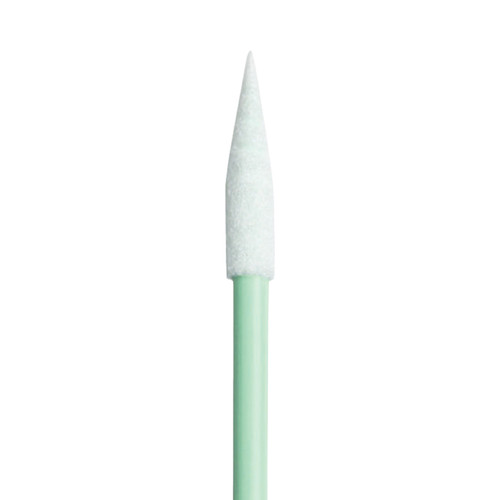
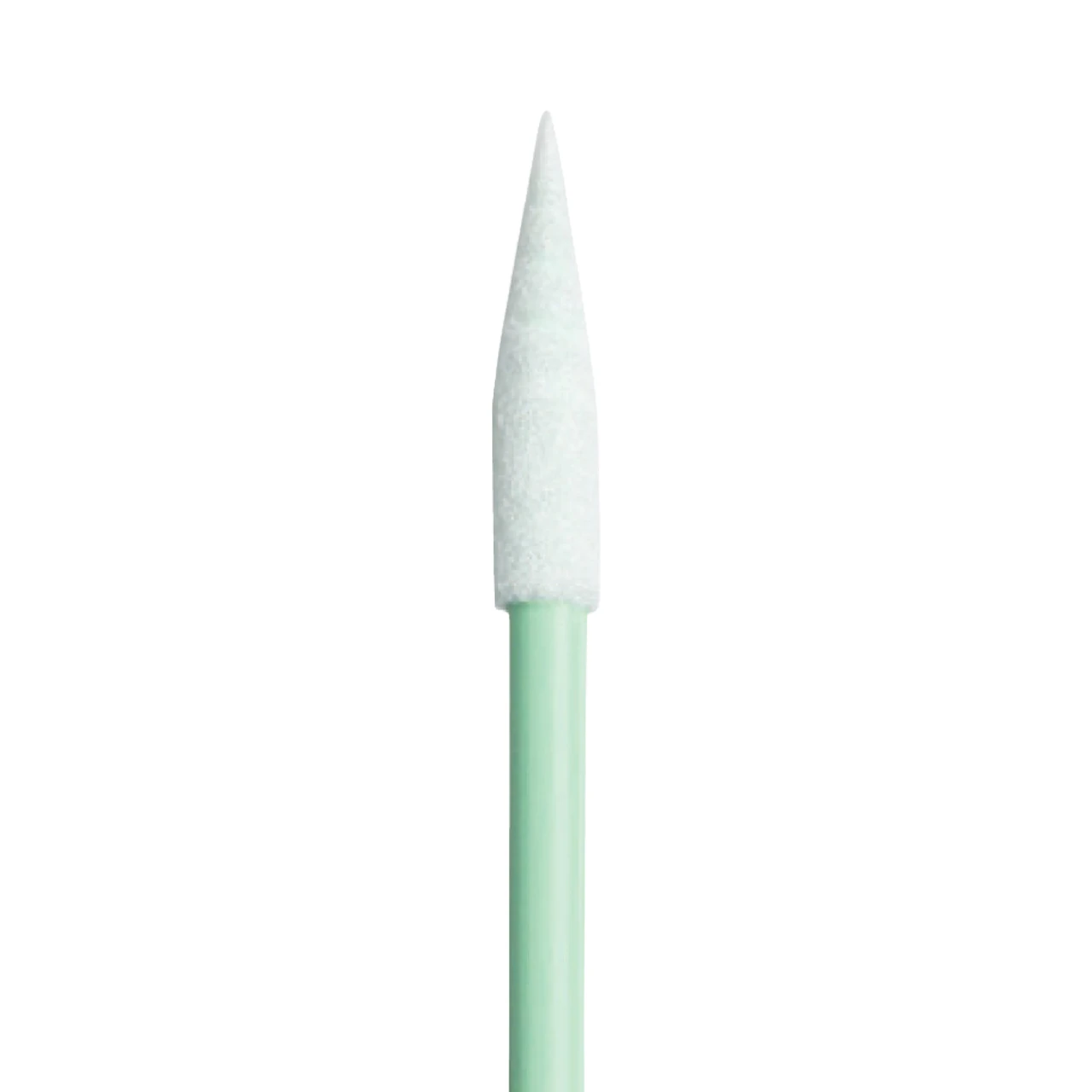
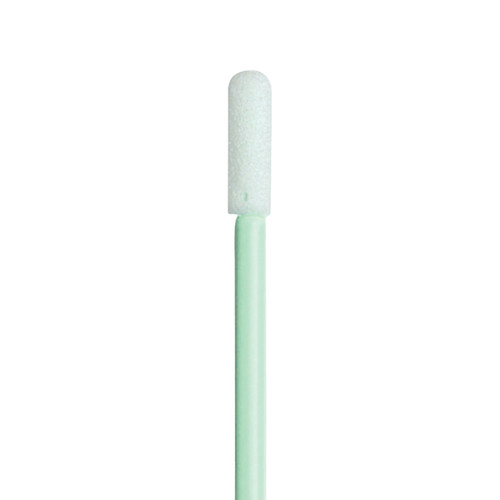
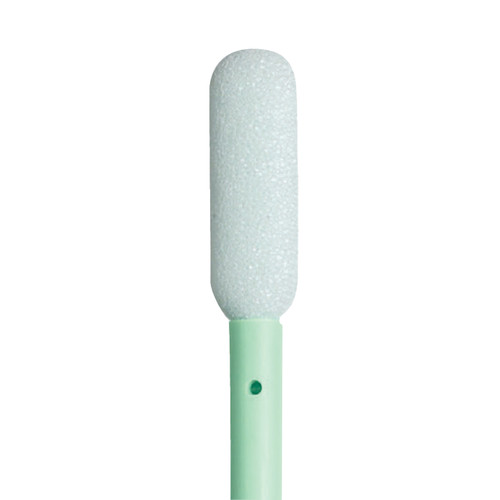
Texwipe TX751B Small Compressed CleanFoam Swab (Open Cell)

$70.43
(No reviews yet)
SKU:
TX751B BAG
Availability:
Stock Item
Shipping:
Calculated at Checkout
Quantity Option (Bag):
500 Swabs Per Bag (5 Inner Bags of 100 Swabs)
Quantity Option (Case):
5 Bags of 500 Swabs Per Case
Type:
Dry Swab
Swab Family:
CleanFoam
Swab Material:
Foam

Texwipe TX751B Small Compressed CleanFoam Swab (Open Cell)

Texwipe TX751B is a small, compressed, open-cell CleanFoam® polyurethane foam cleanroom swab engineered for precision cleaning, particulate pickup, and controlled solvent application in tight geometries. It uses 100 ppi open-cell polyurethane foam to readily absorb solvents and solutions while grabbing particulates, and it is thermally bonded (no adhesive) to help reduce adhesive-driven residue pathways. The compact, precision pointed tip is designed for recessed features, intersecting surfaces, joints, and small-area wipe points where a standard wipe cannot physically reach. As with all swabs, performance is process-dependent and no swab is truly “lint-free” in every condition—the goal is low-linting, controlled residues, and repeatable technique.

Process-control note: TX751B is typically chosen when teams need a compact open-cell foam swab that can carry solvent into tight features, lift residues/particulates, and support repeatability with lot coding, silicone-free/amide-free packaging, and thermal-bond construction (no adhesives).

Specifications:
  • SKU: TX751B
  • Type: Dry swab
  • Swab family: CleanFoam Series B (open cell)
  • Head material: 100 ppi open-cell polyurethane foam (CleanFoam®)
  • Head bond: Thermal bond (no adhesive)
  • Handle material: 100% virgin polypropylene
  • Handle color: Light green (Texwipe identity cue; often paired with “TEXWIPE” embossing on applicable lines for line-side standardization)
  • Design notes: Precision pointed tip; compact handle
  • Packaging (bag): 500 swabs per bag (5 inner bags of 100 swabs)
  • Packaging (case): 5 bags of 500 swabs per case
  • Bagging: Silicone-free and amide-free bag
  • Temperature guidance: Appropriate for use with temperatures less than 350°F (process dependent)
  • Shelf life (manufacturer guidance): Non-sterile — 5 years from date of manufacture
  • Country of origin (manufacturer statement): Made in the Philippines (non-sterile)
About the Manufacturer: 

Texwipe (an ITW company) differentiates itself in contamination-control swabbing by treating the swab as an engineered tool, not a commodity stick. That approach shows up in material selection (e.g., controlled-structure polyurethane foam), thermal-bond construction to eliminate adhesives, controlled processing intended to reduce non-volatile residues (NVRs) and ionic extractables, and packaging designed to protect cleanliness at point of use.


SOSCleanroom (SOS) supports that manufacturing discipline with an authorized-channel relationship focused on continuity of supply, lot traceability, and clean documentation handoff—so customers can standardize a precision foam swab like TX751B with predictable performance and procurement reliability for controlled environments, critical cleaning, and quality-driven workflows.

TX751B Features:
  • 100 ppi open-cell CleanFoam® polyurethane head designed to readily absorb solvents/solutions and grab particulates
  • Thermal bond construction (no adhesive) to help reduce adhesive contamination pathways
  • Cleanroom processed to support low levels of NVRs and ions (typical values are manufacturer-reported and method dependent)
  • Lot coded for traceability and quality control
  • Silicone-free and amide-free bagging to help reduce transfer-film risks in sensitive processes
  • 100% virgin polypropylene handle for chemical resistance and controlled handling
  • Autoclave safe in dry heat and steam (application dependent; validate against your process)
  • Compact geometry: precision pointed tip with a short overall length to improve control at small wipe points
TX751B Benefits:
  • Precision cleaning in tight features: Pointed, compressed head helps reach grooves, joints, and recessed geometries where wipes and larger swabs cannot make controlled contact
  • Residue control by design: Thermal-bond construction avoids adhesive introduction, supporting cleaner process baselines in solvent wiping and critical cleaning steps
  • Solvent handling + pickup: Open-cell foam readily carries compatible solvents and helps lift residues/particulates (validate solvent compatibility and contact time to your SOP)
  • Program consistency: Lot coding plus controlled packaging supports change control, investigations, and repeatability across operators and shifts
  • Operator control: Compact handle and small head reduce over-travel and incidental contact during spot cleaning
Common Applications:
  • Applying and removing lubricants, adhesives, and other solutions in a critical clean environment
  • Scrubbing recessed areas
  • Removal of excess materials and debris
  • Cleaning intersecting surfaces and joints
  • Cleaning with compatible solutions and solvents (including IPA where compatible)
  • Picking up fine powders
  • Small-area precision cleaning in microelectronics, optics, medical device, pharmaceutical, biologics, and semiconductor workflows
Best-Practice Use:
  • Control the wetting step: Wet the foam (do not soak the handle) using a validated solvent/cleaner; consistency in wetness is a primary driver of repeatability.
  • Use a single-direction technique: For residue removal, use controlled, one-direction strokes; avoid scrubbing in circles that can redeposit contamination.
  • Rotate contact faces: Use the pointed geometry intentionally; rotate or replace the swab instead of reusing a loaded foam surface.
  • Mind open-cell behavior: Open-cell foam holds and releases liquid differently than closed-cell foam; avoid flooding seams, crevices, and electrical interfaces.
  • Change-out triggers: Replace the swab when the tip deforms, becomes visibly loaded, or begins leaving streaks/residue.
  • Document for critical steps: For controlled processes, capture lot code, solvent, contact time, and technique in the batch record/SOP to support investigations and training.
Selection Notes (TX751B vs. Other Options)
  • Open-cell vs. closed-cell foam: Choose TX751B (open-cell) when absorbency and particulate pickup are priorities; consider a closed-cell foam swab when you need tighter solvent control and less fluid hold-up (validate based on your residue/solvent and feature geometry).
  • TX751B vs. TX741B (flexible tip): Use TX751B when a compressed, pointed open-cell foam tip is preferred for precision points; use TX741B when a flexible-tip geometry improves reach or contact on slightly compliant surfaces.
  • TX751B vs. TX752B (medium compressed): Stay with TX751B for the smallest wipe points and maximum control; step up to TX752B when you need more head length for coverage while keeping a compressed open-cell foam format.

Link to Texwipe Technical Datasheet:
Click Here
Texwipe.com PDF: Click Here

Other Similar Products Available From SOSCleanroom.com

CleanFoam Series B (Open Cell) — Related Options

  • TX741B: small CleanFoam swab with flexible tip (open cell)
  • TX740B: medium CleanFoam swab with long handle (open cell)
  • TX752B: medium compressed CleanFoam swab (open cell)
  • TX757B: micro CleanFoam swab (open cell)

Notes: Need application guidance for Texwipe TX751B small compressed open-cell CleanFoam swabs (100 ppi polyurethane foam), including technique tips for tight features and residue control? Open the SOSCleanroom Technical Vault tab above for practical swabbing patterns, solvent-control notes (open-cell foam behavior), and selection guidance (TX751B vs. flexible-tip and larger compressed alternatives).

SOSCleanroom.com supports contamination-control programs with cleanroom swabs in stock, fair pricing, and responsive technical support—backed by same-day shipping options and customer service that understands real cleanroom workflows.

Product page updated: Jan. 5, 2026 (SOS Technical Staff)

© 2026 SOS Supply. All rights reserved.

The Technical Vault
By SOSCleanroom
Tight-feature cleaning: solvent control first Compressed open-cell foam tip • 100 ppi polyurethane
Last reviewed: January 6, 2026
Texwipe TX751B small compressed CleanFoam® swab (open-cell): precision solvent delivery for seam lines, grooves, and intersecting surfaces
Practical solutions in a critical environment

In controlled environments, the residues that create the most rework often live in places you can reach only by risking collateral contact: flux at a connector seam, film at an intersecting joint, powder trapped at a fastener shoulder, or adhesive squeeze-out in a groove. In these geometries, operators tend to over-wet, re-contact, and “chase clean,” which turns removal into redistribution and leaves tide marks or a faint haze that shows up under inspection. (Typical use-case framing and technique risks are consistent with the TX751B Technical Vault guidance and CleanFoam Series B manufacturer references.)

TX751B is built for small features where access and wetness control matter more than surface area. The compressed, precision-pointed foam tip helps an operator place a damp solvent front into a tight location, lift residue, and exit without dragging a loaded swab across adjacent critical surfaces. (Dimensions and “precision pointed tip” design intent are published by Texwipe and in the CleanFoam Series B data.)

Low-linting outcomes depend on technique and surface condition. No swab is truly lint-free; edge sharpness, surface roughness, solvent load, contact pressure, and stroke discipline govern what you see on the part.

What is this swab used for

Texwipe TX751B is used for precision cleaning of small recesses, grooves, seam lines, and intersecting surfaces where wipes cannot maintain contact geometry. It is also used for controlled application and removal of compatible solutions (lubricants, adhesives, and cleaning solvents) without flooding the feature. (CleanFoam Series applications and TX751B positioning are published by Texwipe and reflected in SOSCleanroom’s product content.)

The manufacturer also positions the CleanFoam TX751B as NSF Certified for use as a cleaning swab (P1) in and around food processing areas, with the standard restriction that it must not have direct contact with food or potable water and must be used per the manufacturer’s directions. (NSF certification statement is published by Texwipe for TX751B.)

Why should customers consider this swab
  • Access control: compact handle and precision-pointed compressed tip support seam lines, tight grooves, and intersecting joints. (Physical characteristics published for TX751B.)
  • Solvent control: 100 ppi open-cell polyurethane foam readily absorbs and delivers solvent in a “damp, not dripping” condition. (CleanFoam Series construction and materials are manufacturer-published.)
  • Bond discipline: thermal bond construction eliminates adhesive at the head-to-handle interface, reducing an avoidable residue variable. (CleanFoam Series bonding method is manufacturer-published.)
  • Cleanliness data available: published typical ions and typical nonvolatile residue (NVR) values support risk-based selection and change-control. (Typical extractables data are published for Series B and mirrored on the SOS Technical Vault tab.)
  • Packaging controls: packaged in silicone-free and amide-free bags for the series, supporting processes sensitive to slip additives and silicone transfer. (Manufacturer-published packaging statement.)
  • Traceability cues: lot-coded packaging plus trademarked light-green handle with “TEXWIPE” embossed supports practical segregation and investigations. (Manufacturer-published handle and traceability cues.)
  • Point-of-use discipline: inner-bag configuration (five 100-count inner bags per outer bag) reduces repeated full-bag exposure at the bench. (Published packaging configuration.)
Materials and construction

Head: 100 ppi CleanFoam® polyurethane foam (open cell)

Head bond: thermal bond (no adhesive at the bond line)

Handle: polypropylene; compact format; handle color: light green

Practical implication: open-cell foam can entrap debris in the cell structure, but it can also hold more solvent than you think. Define “damp” technique (not dripping), rotate early, and avoid reworking a feature with a loaded tip. If you feel snagging, stop and reassess— foam is forgiving, but burrs and trapped grit are not.

SOSCleanroom note about SOP's
This Technical Vault entry provides general best-practice guidance and example technique structure for customer benefit. It is not a customer standard operating procedure (SOP) and is not a substitute for your quality system, validation requirements, EHS review, or regulatory obligations. Customers should develop, verify, validate (as applicable), and formally approve their own SOPs and training based on their facility, materials, solvent chemistry, product contact surfaces, and risk assessment.
Specifications in context

The numbers matter because small-area cleaning fails when geometry and wetness are not controlled. TX751B’s compact handle and compressed pointed head help keep contact inside the feature you intend to clean and support short, single-direction strokes where the swab face can be rotated before it reloads. Use head dimensions to set a repeatable “reach,” contact angle, and stroke length. Use handle dimensions to reduce accidental touch points on adjacent surfaces. (Physical characteristics are manufacturer-published for TX751B.)

Attribute TX751B
Head material100 ppi CleanFoam® polyurethane foam (open cell)
Head width3.5 mm (0.138")
Head thickness3.5 mm (0.138")
Head length16.0 mm (0.630")
Handle materialpolypropylene
Handle width2.4 mm (0.094")
Handle thickness2.4 mm (0.094")
Handle length51.0 mm (2.010")
Total swab length67.0 mm (2.638")
Head bondthermal
Handle colorlight green
Design notesprecision pointed tip; compact handle
Cleanliness metrics

The values below represent published typical analyses and are not per-unit specifications. In practice, use them as baseline inputs for risk assessment, method development, and troubleshooting. If you run residue-sensitive work (optics, polished metals, coated parts) or you validate cleaning (TOC, HPLC/UV-Vis, ion chromatography), qualify the swab with your solvent, your surfaces, your stroke count, and your inspection method so the swab does not become the dominant background signal. (Manufacturer notes explicitly state values are typical.)

Ion extractables (µg/swab)
Ion TX751B (typical)
Calcium0.01
Chloride0.07
Fluoride0.01
Magnesium0.01
Nitrate0.01
Phosphate0.01
Potassium0.01
Sodium0.01
Sulfate0.03
Nonvolatile residue (NVR) (mg/swab)
Extractant TX751B (typical)
DIW extractant0.03
IPA extractant0.02

Operator takeaway: pointed tips can hide an over-wetting problem because the wet track is narrow. If you see a drying ring around a seam or fastener, reduce solvent load, shorten the stroke, rotate to a fresh face sooner, and stop before the swab reloads.

Packaging, sterility and traceability
  • Packaging (TX751B): 500 swabs/bag (five inner bags of 100); five bags/case; 2,500 swabs/case
  • Bag packaging controls: packaged in silicone-free and amide-free bags (series statement)
  • Sterility: non-sterile (if sterility is required, select a sterile foam swab configuration and confirm geometry and method impact; do not assume a direct one-for-one substitute)
  • Shelf life (series statement): non-sterile 5 years from date of manufacture; sterile 3 years from date of manufacture
  • Traceability cues: lot coded for traceability; trademarked light-green handles with “TEXWIPE” embossed support practical segregation at point-of-use
  • Country of origin (manufacturer statement): Non-sterile – Made in The Philippines
Best-practice use

Treat TX751B as a precision tool, not a miniature wipe. You will get the best outcome when you control wetness, strokes, and contact geometry, and when you stop before the swab reloads. Open-cell foam rewards discipline: damp technique, early rotation, and defined discard triggers.

Operator-level swabbing technique module (tight features and seam lines)
  • “Damp” solvent technique: Wet the foam, then remove excess solvent (bottle lip or a dedicated low-linting wipe) so the tip is damp and glossy, not dripping. Flooding drives tide marks and redeposition when solvent carries soils out of the feature and dries on adjacent surfaces.
  • Do not re-dip: Once the tip contacts the surface, do not return it to the solvent container. Re-dipping turns your solvent source into a contamination reservoir.
  • Stroke-count logic: Use single-direction strokes with overlap. For a groove or channel, use 1–3 controlled passes, then rotate to a fresh face. Stop when drag increases or you see visible loading on the swab face.
  • Geometry control: Approach the feature at a consistent angle. Use the pointed profile to keep contact on the target surface rather than bridging across edges. Keep gloves and sleeves out of the wipe path.
  • Pressure guidance: Apply only enough force to maintain continuous contact. If you feel snagging, back off, rotate sooner, and consider a two-step approach (bulk lift pass, then finish pass with a fresh damp face).
  • Solvent compatibility framing: IPA is common. Validate compatibility with the surface, coating, adhesive system, and foam under worst-case dwell time and mechanical action. If aggressive solvents are used (for example, ketones), qualify foam integrity, residue behavior, and particle performance before releasing the method.
  • Handling discipline: Open one inner bag at a time; stage only what you will use in the next interval; cover the bag opening between pulls. Use one swab per defined task unless your approved method allows controlled exceptions.
Common failure modes
  • Over-wetting and flooding the feature, mobilizing residue that dries as a ring or haze.
  • Reworking the same location with a loaded tip, causing streaks and redeposition.
  • Scrubbing in sharp features where burrs or trapped particles abrade and generate new defects.
  • Cross-contaminating solvent by re-dipping or using a shared reservoir without decant-and-refresh discipline.
  • Chemical incompatibility (swelling/tackiness/shedding) when an aggressive solvent is not qualified for the foam and dwell time.
Closest competitors

The closest substitutes are pointed-tip foam swabs designed for small crevices and seam-line cleaning, where selection hinges on head construction, bond method, published cleanliness data, and packaging/traceability controls. When comparing, qualify wetting behavior (flooding risk), snag resistance near edges, and whether your supplier’s documentation supports investigations and change-control.

  • Contec CONSTIX® SF-13 sealed foam swab: 100 PPI open-cell foam sealed around a glass-filled polypropylene handle and secured without adhesives; Contec notes it is not recommended for ketones such as acetone or MEK, reinforcing the need to qualify aggressive solvents by chemistry and dwell time.
  • Berkshire Lab-Tips® LTO70P: cleanroom-laundered 100 ppi open-cell foam sock swab with thermally bonded head; positioned for low particles/ions/extractables and packaged for high contamination control programs.
  • Within Texwipe CleanFoam® Series B: adjacent geometries (TX741B, TX742B, TX752B, TX757B) can be an operationally closer match when you want to standardize handle cues, lot coding, and series-level documentation across stations.
Critical environment fit for this swab

TX751B fits best as a detail tool inside a larger controlled cleaning program: wipes handle planar surfaces, and the swab controls localized geometry where contact control is the constraint. It is a strong choice when the failure mode is “we can reach it, but we can’t control wetness and contact without touching something else.”

SOSCleanroom’s relationship with ITW Texwipe supports continuity of supply and documentation discipline, which reduces the risk of unplanned substitutions that can change wetting behavior and background extractables. That matters in ISO-aligned cleanroom programs and in regulated environments where documentation expectations often track FDA quality systems and standards-driven methods associated with ASTM and IEST.

Operational support matters, too. Fast shipping and responsive customer service help keep validated work instructions intact by preventing “make-do” material swaps when schedules tighten.

Source basis
  • SOSCleanroom product page (TX751B): https://www.soscleanroom.com/product/swabs/texwipe-tx751b-small-compressed-cleanfoam-swab-open-cell/
  • Texwipe manufacturer product page (TX751B): https://www.texwipe.com/small-compressed-cleanfoam-tx751b
  • Texwipe Technical Data Sheet: “CleanFoam® Swab Series” (US-TDS-051 Rev. 09/21): https://www.texwipe.com/images/uploaded/documents/Swabs/Texwipe-Cleanfoam-Swabs-TDS.pdf
  • SOS-hosted PDF copy (CleanFoam® Series B physical and contamination characteristics; includes TX751B): https://www.soscleanroom.com/content/texwipe_pdf/740b%20741b%20742b%20751b%20752b%20757b.pdf
  • Contec CONSTIX® SF-13 product data sheet (comparison reference): https://www.contecinc.com/hubfs/Website%20Assets/Product%20Center/Product%20Data%20Sheets/Cleanroom/Swabs/PDSS016_SF-13.pdf
  • Berkshire Lab-Tips® LTO70P data sheet (comparison reference): https://berkshire.com/wp-content/uploads/2024/01/LTO70P.pdf
  • International Organization for Standardization (ISO) reference (ISO 14644-1:2015): https://www.iso.org/standard/53394.html
  • FDA (Food and Drug Administration): https://www.fda.gov/
  • ASTM (American Society for Testing and Materials): https://www.astm.org/
  • IEST (Institute of Environmental Sciences and Technology): https://www.iest.org/
SOSCleanroom is the source for this Technical Vault entry.
Briefed and approved by the SOSCleanroom (SOS) staff.
Last reviewed: January 6, 2026
If you have any questions please email us at Sales@SOSsupply.com
© 2026 SOSCleanroom

Videos Hide Videos Show Videos