The Technical Vault
By SOSCleanroom
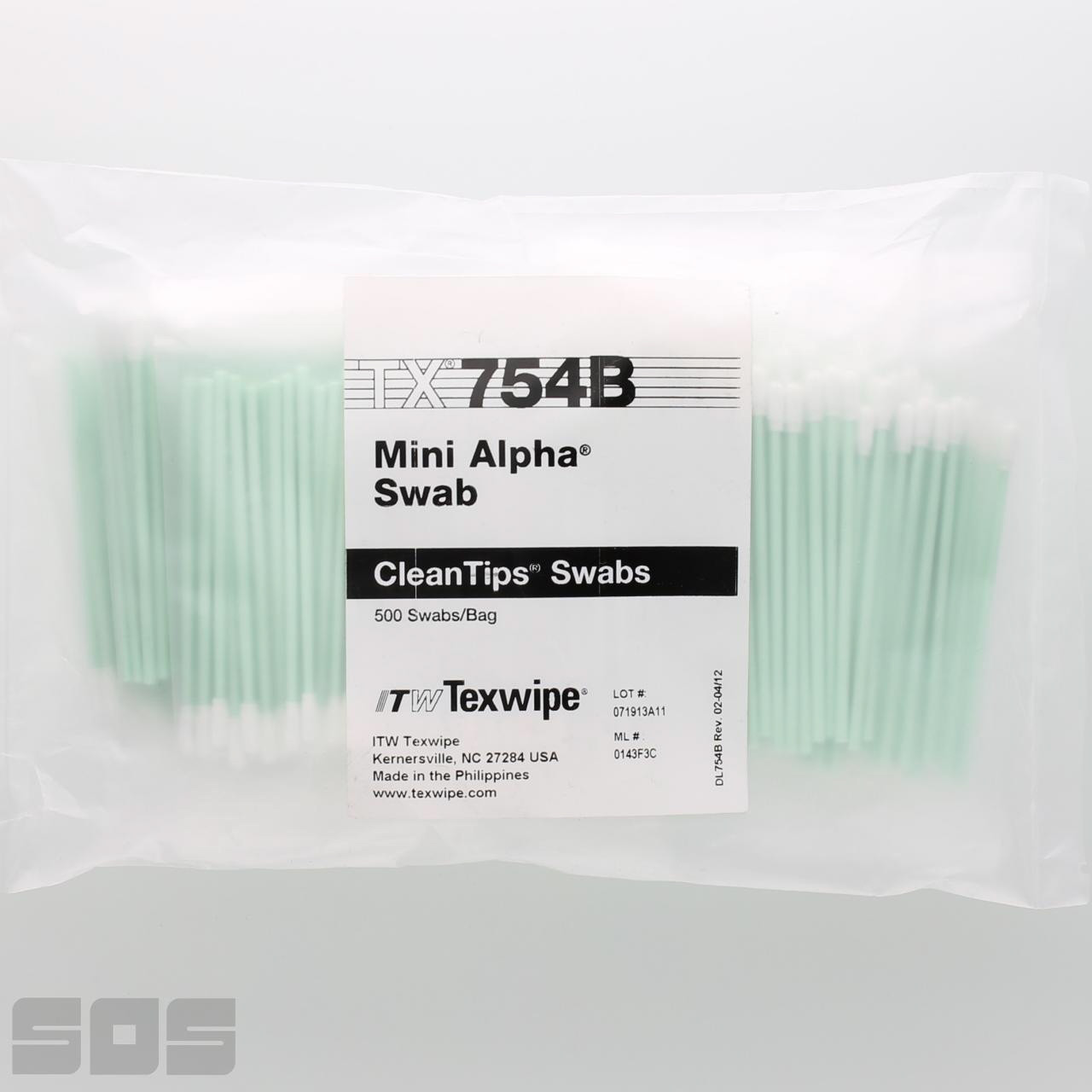
Texwipe TX754B Mini Alpha® polyester knit cleanroom swab: controlled contact for grooves, tracks and tight clearances
Practical solutions in a critical environment
When contamination shows up as a defect, it is rarely centered on an open flat. It is usually at the interface: a groove, a track, a slot, a corner break, a recessed fastener, or a tight clearance where solvent wants to pool and residue wants to redeposit. In those geometries, swab construction and operator technique become process variables, not purchasing details.
TX754B is a mini, rigid-paddle, knitted polyester swab designed to give stable contact in small features without shedding loose fibers typical of lower-control constructions. In mature controlled-environment programs, reliability is the differentiator. SOSCleanroom’s long-standing relationship with ITW Texwipe supports continuity of supply, lot traceability, and documentation discipline so qualified methods stay stable across replenishment cycles rather than drifting when teams substitute look-alike swabs with different wetting and extractables behavior.
Nothing is truly zero-lint. Low-linting outcomes depend on technique and surface condition, including edge sharpness, burrs, solvent load, contact pressure, and stroke discipline.
Operator reality check
The most common failure pattern with mini swabs is not “it did not clean.” It is “it moved the soil.” Over-wetting and re-contacting clean surfaces turns a precision swab into a residue-transfer tool.
What is this swab used for
TX754B is used for precision spot cleaning and controlled application/removal of liquids in tight geometry where wipes cannot maintain stable contact. Typical use includes cleaning grooves, tracks, slots and other small spaces; applying and removing lubricants, adhesives and other solutions; solvent use (commonly IPA); and cleaning sensitive surfaces such as optical assemblies where contact control matters.
It is commonly selected in biologics, medical device, microelectronics, optics, pharmaceutical and semiconductor workflows where the defect mechanism is often residue migration in corners and seams rather than bulk soil on open surfaces. In ISO-classified cleanrooms (ISO 14644-1 context) and regulated manufacturing environments (FDA context), the practical requirement is repeatable technique and stable documentation, not improvisation under schedule pressure.
Why should customers consider this swab
- Mini rigid-paddle control: designed to maintain contact in narrow features without “mushing” the head into sidewalls.
- Knitted polyester head: continuous-filament knit supports low-linting performance when technique is disciplined and surfaces are not sharp or burr-laden.
- Complete thermal bond construction: eliminates adhesive at the bond, removing a common extractables variable for solvent work.
- Program controls: lot coding, controlled packaging, and documented typical ionic/NVR performance support investigations and method qualification.
- Operational traceability cue: trademarked light-green handle with “TEXWIPE” embossed helps segregation and line control when multiple swab types are staged.
Materials and construction
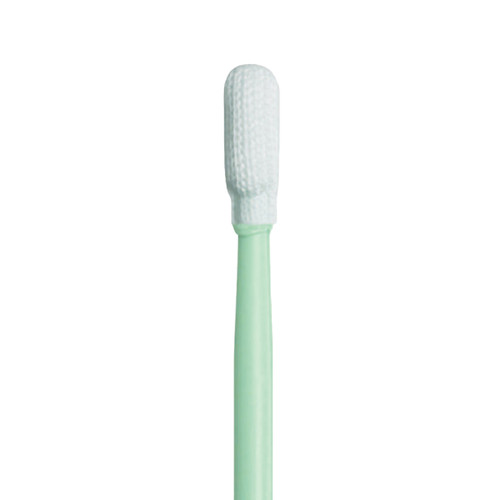
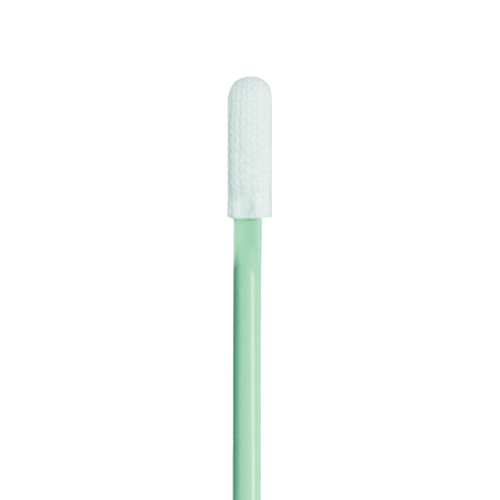
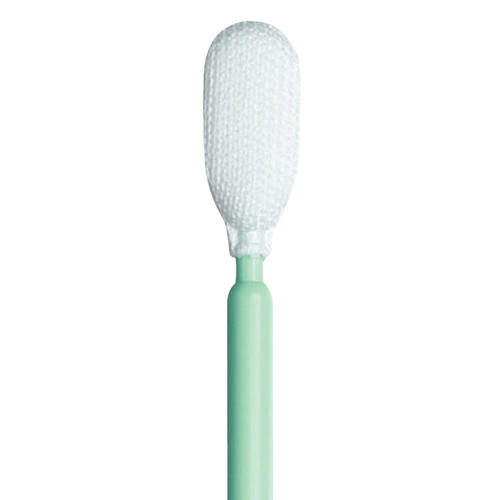
TX754B uses a double-layer Alpha® polyester knit head on a 100% virgin polypropylene handle. The head is thermally bonded to the handle (no adhesive), which matters in solvent-wet work where adhesive systems can contribute extractables, streaking and variable wetting behavior. The rigid head core is the functional differentiator at this size: it gives a defined contact plane for tracks and grooves instead of collapsing into the feature.
The handle is light green and designed for controlled handling in tight access points. In real operator workflows, that color/marking becomes a practical staging cue: it helps teams keep the right swab segregated for the right chemistry, surface, or cleaning step when multiple swab families are on the bench.
Specifications in context
Mini swabs succeed or fail on geometry control. At this scale, a few tenths of a millimeter changes how the swab seats in a groove, how solvent meters at the edge, and how easily an operator can keep gloves and sleeves from contacting the work surface. Use the dimensions below as fit-to-feature inputs, then validate with your surface/coating and inspection criteria.
Published physical characteristics (TX754B)
- Head material: Alpha® polyester knit (double-layer knit)
- Head width: 3.5 mm (0.138")
- Head thickness: 3.0 mm (0.118") in the Alpha® Series datasheet; 3.2 mm (0.126") on the Texwipe product page
- Head length: 9.5 mm (0.374")
- Handle material: polypropylene (100% virgin polypropylene per manufacturer)
- Handle width/thickness: 2.4 mm (0.095") in the Alpha® Series datasheet; 2.5 mm (0.098") on the Texwipe product page
- Handle length: 60.0 mm (2.362")
- Total swab length: 69.5 mm (2.736")
- Head bond: thermal (no adhesive at the bond)
- Handle color: light green
Cleanliness metrics
The ionic and nonvolatile residue (NVR) values below are typical values, not specification limits. That distinction matters in practice: “typical” supports method development and background budgeting, but it does not replace incoming inspection, process validation, or your own acceptance criteria. For audit defensibility, treat these values as supplier characterization data and verify fit against your chemistry, surface, dwell time, and inspection method.
Typical ion extractables for TX754B (µg/swab)
Typical values are useful for qualification and trending. They are not lot-level specification limits.
| Ion |
Typical (µg/swab) |
| Calcium | 0.03 |
| Chloride | 0.05 |
| Fluoride | 0.02 |
| Magnesium | 0.01 |
| Nitrate | 0.02 |
| Phosphate | 0.04 |
| Potassium | 0.03 |
| Sodium | 0.05 |
| Sulfate | 0.07 |
Typical nonvolatile residue (NVR) for TX754B (mg/swab)
NVR indicates the residue mass that can remain after solvent evaporation. These are typical values (not specification limits) and should be interpreted in the context of your solvent grade, wipe path, and dry-down behavior on the actual surface.
| Extractant |
Typical NVR (mg/swab) |
| DIW |
0.01 |
| IPA |
0.03 |
Practical note: streaking is usually a wetness and stop-condition problem. Define “damp,” rotate faces early, and retire the swab before it loads.
Packaging, sterility and traceability
TX754B packaging is built for controlled staging on the bench: 500 swabs per bag (configured as 5 inner bags of 100 swabs) and 5 bags per case for 2,500 swabs per case. The Alpha® Series is packaged in a silicone-free and amide-free bag, which helps reduce avoidable trace contamination variables in residue-sensitive work.
Traceability is straightforward: Alpha® swabs are lot coded for quality control, and the light-green handle with “TEXWIPE” embossing provides an operator-facing segregation cue when multiple swab types are staged. If your workflow requires sterility, the Alpha® polyester knit family includes sterile program options that add individual packaging, lot coding at the sleeve level, expiration dating, and validated sterilization (confirm the sterile SKU and packaging configuration with current manufacturer documentation).
Shelf life (manufacturer statement for the Alpha® polyester knit family): non-sterile 5 years from date of manufacture; sterile 3 years from date of manufacture. If country-of-origin must be documented, the manufacturer’s technical data sheet states: Non-Sterile – Made in The Philippines; Sterile – Made in The Philippines, irradiated in the U.S.
Best-practice use
TX754B performs best when you treat it like a metering tool, not a scrubber. The goal is controlled solvent delivery, controlled contact, and a defined discard cadence. Validate solvent compatibility with your specific surface, coating, adhesive system and inspection method before standardizing.
Operator-level swabbing technique module
- “Damp” solvent technique: Wet the head, then meter off excess before contact. Touch the swab to a clean, compatible staging surface (or the inside edge of the solvent container if allowed by your SOP) until the head is damp, not dripping.
- Stroke count logic: Use single-direction strokes with overlap. In a track or slot, set a defined pass count (for example, 1–3 controlled passes), then rotate to a fresh face. Stop when the face loads or streaking begins.
- Geometry control: Use the rigid paddle to keep the contact plane stable in channels and grooves. Keep glove knuckles, sleeves and wrist seams out of the work envelope.
- Pressure guidance: Use enough pressure to maintain contact, not enough to abrade or “squeegee” dissolved soils into an edge. If you feel the swab catch, reduce pressure and reassess the edge condition.
- Solvent compatibility: IPA is common, but compatibility is surface-dependent. Confirm that your solvent system and dwell time do not attack coatings, inks, polymers or adhesive residues.
- Handling discipline: Open the bag only as far as needed. Avoid re-dipping into shared solvent; use one-way dispensing or defined aliquots. Do not re-contact “clean” areas with a swab that has touched a soil source.
- Disposal and documentation cues: Discard after defined passes or when loaded. Capture lot information when troubleshooting or trending defects under a formal deviation/CAPA workflow.
Common failure modes
- Over-wetting: solvent pooling in grooves dries into rings or streaks; dissolved soils migrate to edges.
- Re-contact with a loaded head: a soiled face redeposits residue into the next feature.
- Back-and-forth scrubbing: increases variability and can drive smearing along sidewalls.
- Edge snagging: burrs or sharp breaks can catch knit surfaces; address surface condition and reduce pressure.
- Poor staging discipline: heads contacting benches or glove exteriors adds background contamination that looks like a process problem.
Closest competitors
The closest functional alternatives are other mini knitted polyester cleanroom swabs with rigid handles and documented cleanliness controls. Mechanism matters more than marketing terms: knit construction, bond method, and traceability discipline are what drive repeatability in residue-sensitive work.
- Berkshire Lab-Tips® knitted polyester swabs (paddle/rigid-tip variants): evaluate ionic/NVR documentation, lot coding, and packaging controls relative to your method requirements.
- Puritan PurSwab® small knitted polyester cleanroom swabs (thermally bonded tip variants): compare cleanliness dataset availability, packaging configuration, and traceability/lot coding against your SOPs.
Program fit
TX754B fits best in programs that treat swabbing as a controlled operation: defined solvent load, defined stroke discipline, defined discard cadence, and traceability when investigations are required. The Alpha® Series typical ionic/NVR characterization, lot coding, and controlled packaging support audit-ready workflows in ISO-classified and regulated environments when paired with your internal validation and inspection criteria.
SOSCleanroom supports that stability with continuity of supply and the documentation discipline that comes with a long-standing ITW Texwipe relationship. Operationally, that means fewer last-minute substitutions, faster replenishment, and a more consistent link between qualified method and day-to-day execution.
Source basis
Standards and regulatory context references:
SOSCleanroom is the source for this Technical Vault entry.
Last reviewed: January 5, 2026
© 2026 SOSCleanroom