The Technical Vault
By SOSCleanroom
Texwipe TX758E Micro Alpha® ESD Polyester Cleanroom Swab: Micro-Geometry Cleaning With Clean ESD Control at the Point of Contact
Last reviewed: January 5, 2026
Practical solutions in a critical environment
Micro swabs show up late in the build, when the big controls are already in place (airflow, gowning, wipe-downs, tacky mats) and the remaining risk lives in the last millimeters: connector cavities, bond pads, sensor pockets, fastener bores, optical mounts, micro-channels, and edge features that collect films and particles. In ESD-sensitive work, that same touch point is also where charge can concentrate and discharge into components, coatings, or assemblies.
The Texwipe TX758E is built for that reality: controlled contact cleaning in tight geometry while maintaining clean ESD performance and published contamination behavior.
About “lint-free” language: no swab is truly lint-free; low-linting results depend on technique, surface condition, and how aggressively the swab is worked into edges and corners.
What is this swab used for
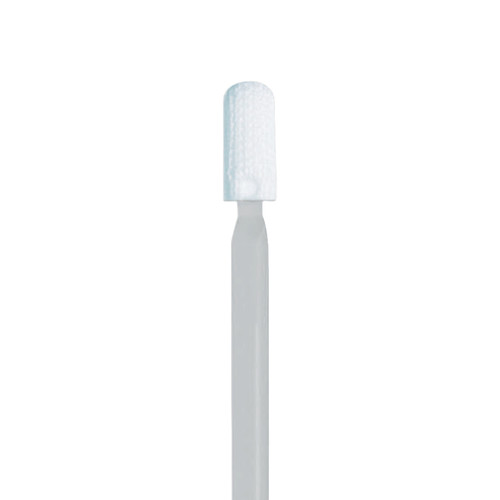
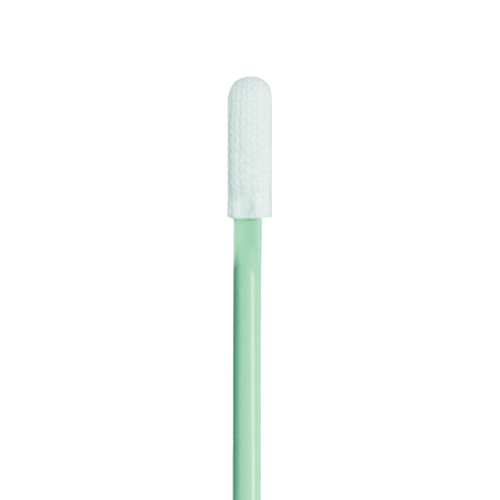
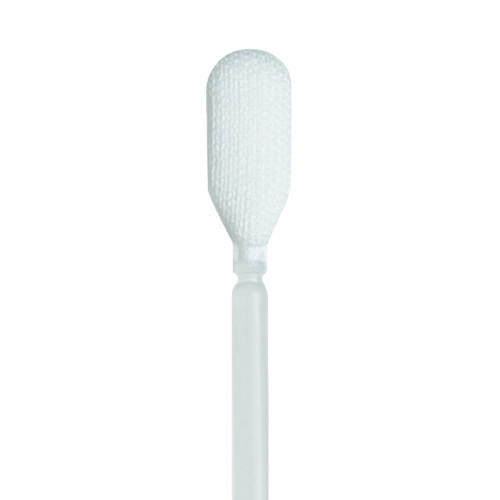
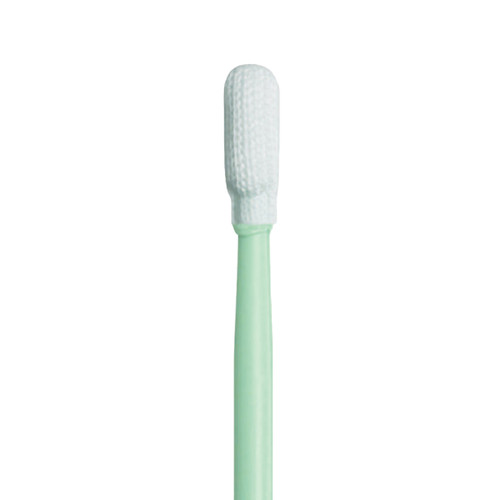
TX758E is designed for precision cleaning and controlled solvent application/removal where ESD may be a concern, especially in recessed, grooved, slotted, or intersecting features. The micro knit polyester tip with a flexible head paddle supports tasks such as:
- Detail cleaning of grooves, tracks, slots, connector pockets, and tight crevices that are difficult to reach with wipes or larger swabs.
- Targeted removal of light films and handling residue when the approved solvent system permits.
- Applying and removing small amounts of compatible solutions (for example, IPA) without flooding features.
- Micro-touch cleaning in electronics, microelectronics, optics-adjacent assemblies, and test-and-assembly operations where ESD discipline is part of yield control.
Why should customers consider this swab
- Clean ESD protection without “dirty” antistats: The ESD-Safe Swab Series uses a Stat-Rite® handle (inherently dissipative polymer) intended to avoid blooming carbon particles, metals, or ionic anti-static contaminants.
- Thermal-bond construction: Eliminates adhesive at the head/handle interface, reducing adhesive-related extractables and interface smearing risk.
- Micro geometry control: A micro head plus flexible paddle improves access and contact uniformity in tight features and reduces the temptation to “scrub harder” with a larger tool.
- Published contamination data: Manufacturer-published ion extractables and nonvolatile residue (NVR) values support qualification planning and lot-to-lot trending where the process is sensitive.
- Anti-static bag packaging and lot coding: Supports line control, segregation, and investigation readiness in audited environments.
Materials and construction
Swab head: Alpha® polyester knit. Knit polyester is durable and resists snagging when used correctly, which matters when you are working around sharp edges, holes, or machined features. It can also hold and release solvent in a controlled way, supporting “damp” cleaning rather than flooding.
ESD handle strategy: The Stat-Rite® handle is an inherently dissipative polymer approach designed to provide ESD protection without the contamination mechanisms associated with carbon-loaded or metal-filled plastics. In practice, this is intended to reduce the risk of dark particulate transfer and uncontrolled additive-related residue in sensitive builds.
Bonding method: Thermal bonding removes adhesive from the head/handle interface. In field use, that interface is a common failure point for cheaper swabs: the “glue line” can smear with solvent exposure or shed under pressure in corners.
Operational traceability cue: The ESD-Safe Swab Series documentation notes “TEXWIPE” embossed on the handle as a practical identification and segregation cue for trained operators and receiving inspection.
Specifications in context
TX758E is a micro-format swab with a compact handle and flexible head paddle intended to maintain control in tight features. The key practical point: with micro swabbing, geometry control matters more than reach. The dimensions below are small enough to enter fine features, but large enough to carry solvent and lift residue if the head is kept damp (not wet) and the operator rotates faces to avoid redeposit.
| Head material |
Alpha® polyester knit |
| Head width |
4.0 mm (0.157") |
| Head thickness |
3.0 mm (0.118") |
| Head length |
10.0 mm (0.394") |
| Handle material |
Stat-Rite® (inherently dissipative polymer) |
| Handle width / thickness |
3.0 mm (0.118") / 3.0 mm (0.118") |
| Handle length |
80.5 mm (3.169") |
| Total swab length |
90.5 mm (3.563") |
| Head bond |
Thermal |
| Handle color |
Translucent |
| Design notes |
Flexible head paddle; compact handle |
Cleanliness metrics
The values below are manufacturer-reported typical analyses, not specification limits. In practice, typical values help you establish a realistic baseline for qualification and trending; specifications define pass/fail criteria and the nonconformance pathway. Use typicals to set sensible incoming verification plans (especially for high-risk processes), then align acceptance criteria to your internal risk assessment, product sensitivity, and analytical method.
Ion extractables (µg/swab)
| Ion |
TX758E |
| Calcium | 0.01 |
| Chloride | 0.01 |
| Fluoride | 0.01 |
| Magnesium | 0.01 |
| Nitrate | 0.04 |
| Phosphate | 0.17 |
| Potassium | 0.02 |
| Sodium | 0.71 |
| Sulfate | 0.15 |
Nonvolatile residue (NVR) (mg/swab)
| Extractant |
TX758E |
| DI water (DIW) |
0.01 |
| Isopropyl alcohol (IPA) |
0.03 |
Why this matters: ionic residues can drive corrosion, dendritic growth, leakage currents, and unpredictable surface behavior in microelectronics and fine-feature assemblies. NVR is the “film you did not intend to leave behind,” often seen as haze on optics or smear lines on polished metal. If your process uses IPA, the IPA-extractant NVR is usually more operationally relevant than a water-only value.
ESD reality check
ESD risk increases with dry swiping, abrupt lift-offs, and work performed outside a grounded workstation program. The manufacturer notes charge dissipation performance when used with a solvent or solution. Treat that as an operational reminder: keep the swab appropriately damp, keep the work surface grounded, and follow your facility’s ESD control program requirements for verification and compliance.
Packaging, sterility and traceability
Packaging configuration (non-sterile): 500 swabs per bag; 5 inner bags of 100 swabs; 5 bags per case (2,500 swabs per case). Packaged in an anti-static bag.
Traceability controls: Manufacturer states lot coded for traceability and quality control. In practice, that supports investigation readiness: if a film event or particle anomaly shows up, you can pull the lot history and correlate to work orders, solvent batches, and station conditions.
Sterility: TX758E is a non-sterile swab. If your process requires sterile presentation, do not assume a “clean” swab is an acceptable substitute. Match sterility requirements to the procedure and the governing quality system.
Country of origin: “Made in The Philippines” (manufacturer statement for the ESD-Safe Swab Series technical data sheet).
Best-practice use
The TX758E performs best when it is used as a controlled, single-pass tool. The two biggest root causes of “mystery residue” in micro swabbing are over-wetting and re-contacting clean areas with a contaminated head face.
Operator-level swabbing technique module
- Damp solvent technique: Target “damp,” not dripping. Dispense solvent onto the head (or onto a controlled dispense surface) until the knit is uniformly wetted but not shiny-wet. If you can flick a droplet, you are too wet. Over-wetting causes flooding, streaks, and tide marks that can dry as a residue line.
- Stroke count logic: Use single-direction strokes. For a channel or slot, start at the deepest accessible point and pull out in one direction. Overlap slightly if multiple passes are required. Rotate the swab to a fresh face after 1–3 strokes (sooner if you see pickup). Stop when the face shows visible pickup or begins to drag.
- Geometry control in tracks/slots/channels: Use the flexible paddle to maintain contact without wedging. Keep gloves and sleeves out of the clean zone by staging your hand position before entering the feature. Do not lever the swab against a sharp edge; micro-edges can cut knit and create shedding.
- Pressure guidance: Apply only enough pressure to maintain full contact. Excess pressure can abrade residues into a corner and leave drag lines, especially on soft coatings or polished surfaces. If you need “scrub pressure,” reassess solvent selection and dwell time instead of pushing harder.
- Solvent compatibility framing: IPA is common for precision cleaning, but compatibility is not universal. Validate solvent compatibility with the substrate, coating, adhesive system, and any optical films. If your process uses alternative chemistries, qualify the swab/solvent interaction (extractables and mechanical behavior) before release.
- Handling discipline: Open the bag only as far as needed. Stage swabs on a clean, controlled surface. Do not re-dip a used swab into a solvent bottle or reservoir; that turns the bottle into a contamination source. Do not return a staged swab into the bag.
- ESD discipline at the point of contact: Avoid dry wiping. Maintain a grounded workstation, and follow your facility’s verification checks (wrist strap, mat resistance, footwear) before performing micro-touch cleaning.
- Disposal and documentation cues: Treat the swab as single-use. For investigations or QA holds, capture the swab lot code in the batch record or deviation log, especially if the cleaning step is tied to yield, field returns, or regulated product quality.
Common failure modes
- Flooding and tide marks: Too much solvent leaves streaks or residue lines as it dries, especially on polished metal, glass, and coated optics-adjacent hardware.
- Redeposit from re-contact: Multiple passes with the same contaminated face transports particles and films to the next feature. Rotate faces and use single-pass discipline.
- Corner burnishing: Excess pressure in a slot can burnish a film into the corner, making it harder to remove and more visible under inspection lighting.
- Mechanical snagging: Forcing the tip past burrs or sharp edges can snag knit and increase shedding risk. Use alignment and lighter pressure; deburr hardware when possible.
- Workstation ESD gaps: Cleaning performed with a dry swab, on an unverified mat, or without a grounded operator increases discharge risk exactly where the product is most vulnerable.
- Wrong tool for sampling: A good cleaning swab is not automatically a good validation sampling swab. Sampling requires defined background contribution, extraction technique, and chain-of-custody controls tied to the analytical endpoint.
Closest competitors
Comparable products are long-run, cleanroom-grade, ESD-safe micro polyester swabs with published program controls. When comparing, focus on mechanism and controls: knit vs. nonwoven head behavior, bonding method (thermal vs. adhesive), contamination data availability, lot traceability, and packaging controls.
-
Berkshire ESD micro swab family (knit polyester ESD variants): Compare head fabric construction and how the ESD property is achieved (inherently dissipative polymer vs. additive-loaded plastics). Confirm whether contamination data are published per swab and whether the head/handle interface is adhesive-free.
-
Contec CONSTIX® ESD-safe swab offerings (sealed polyester / knit variants by model): Mechanistically, sealed constructions can reduce edge fray risk, but may change solvent holding/release behavior. Verify bonding method and whether lot-level traceability and extractables reporting match your qualification needs.
-
Puritan controlled-environment ESD swab lines (model-dependent): Validate whether ESD performance relies on surface treatments/additives and whether the supplier provides clear contamination characterization and lot traceability suitable for audited builds.
Critical environment fit for this swab
TX758E fits best in micro-geometry cleaning steps where ESD control is integral and where published contamination behavior helps support qualification and change control. Typical wins include connector and sensor cleaning, tight mechanical interfaces, optics-adjacent hardware touch-ups, and microelectronics detail cleaning where residue control is inspected under high magnification.
SOSCleanroom supports ITW Texwipe swabs as part of a reliability-first contamination-control program. Operationally, that relationship matters because it supports continuity of supply, stable documentation, and lot-traceable product flow that quality teams can defend. It also means fast shipping and responsive customer service when production schedules shift and you cannot afford a tooling gap at the point of contact.
Source basis
-
SOSCleanroom product page (TX758E): https://www.soscleanroom.com/product/swabs/texwipe-tx758e-micro-alpha-esd-polyester-cleanroom-swab/
-
Manufacturer product page (Texwipe TX758E): https://www.texwipe.com/micro-alpha-esd-safe-tx758e
-
Technical data sheet: ESD-Safe Swab Series Technical Data Sheet, US-TDS-061 Rev.09/21 (includes TX758E physical characteristics, ion extractables, NVR, packaging, shelf life, and “Made in The Philippines” statement): https://www.gotopac.com/media/mageworx/downloads/attachment/file/t/e/texwipe-esd-safe-swabs-tds.pdf
-
ISO (cleanroom classification context): International Organization for Standardization (ISO) — ISO 14644-1:2015 overview page: https://www.iso.org/standard/53394.html
-
FDA (regulated environment context): Food and Drug Administration (FDA) homepage: https://www.fda.gov/
-
ASTM (materials/testing standards context): American Society for Testing and Materials (ASTM International) homepage: https://www.astm.org/
-
IEST (recommended practices context): Institute of Environmental Sciences and Technology (IEST) Recommended Practices: https://www.iest.org/
Source: SOSCleanroom Technical Vault. Last reviewed: January 5, 2026.
Briefed and approved by the SOSCleanroom (SOS) staff.
© 2026 SOSCleanroom