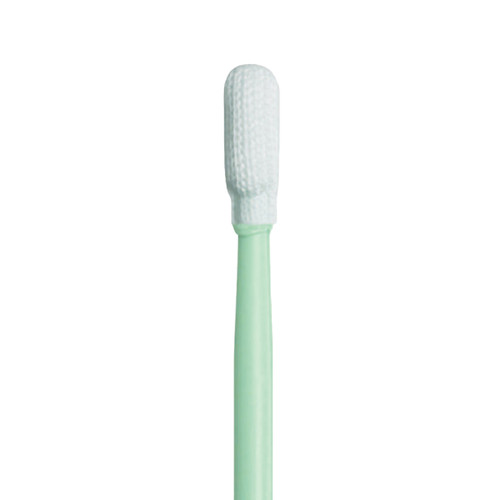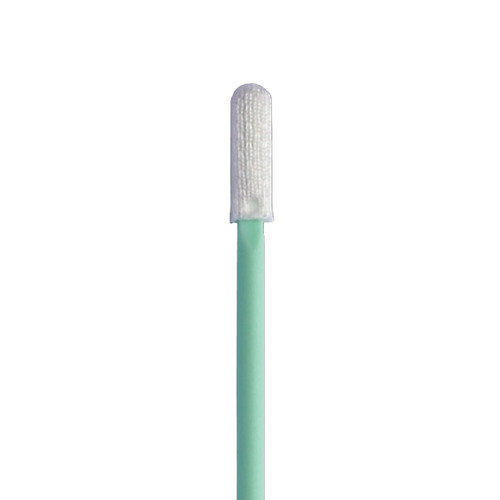
Texwipe TX758MD Short Small Head Microdenier Cleanroom Swab

$85.45
(No reviews yet)
SKU:
TX758MD BAG
Availability:
Stock Item
Shipping:
Calculated at Checkout
Quantity Option (Bag):
500 Swabs Per Recloseable Bag
Quantity Option (Case):
5 Bags of 500 Swabs Per Case
Type:
Dry Swab
Swab Family:
Microdenier
Swab Material:
Microdenier (Poly)

TX758MD Short Small Head Microdenier Cleanroom Swab (Mini, Streak-Free, QAC Compatible, Thermal-Bonded, Low-Linting)

Texwipe TX758MD is a precision microdenier polyester knit cleanroom swab designed for streak-free cleaning and high-control particulate pickup on scratch-sensitive surfaces where the “last speck” can become a yield, cosmetic, or functional defect. The short handle + small flexible paddle head improves dexterity in tight spaces (slots, grooves, corners, joints, and intersecting surfaces) while keeping wipe pressure and wipe-line behavior consistent. TX758MD uses complete thermal-bond construction (no adhesive) to reduce bond-line residue risk during solvent work, and it is compatible with QAC (quaternary ammonium chloride) cleaners and disinfectants for facilities that combine cleaning and disinfection steps. Cleanroom processing and lot-coded packaging support repeatability in ISO-class cleanrooms, microelectronics, optics, medical device assembly, and other controlled environments.

Precision-cleaning note: TX758MD is commonly selected when teams need a compact, line-side microdenier swab that can lift and capture fine particles (including micro-scale contamination) while minimizing visible wipe artifacts. It is low-linting (no swab is truly ‘lint-free’ in every process condition), and best results come from disciplined “damp-not-dripping” technique and early change-out when the face loads.

Specifications:
  • SKU: TX758MD
  • Type: Dry swab (non-sterile)
  • Swab family: Microdenier
  • Head material: 100% polyester microdenier knit
  • Head bond: Thermal (no adhesive)
  • Design notes: Flexible head paddle; compact handle
  • Handle material: 100% virgin polypropylene
  • Handle color: Light green with “TEXWIPE” name embossed on handle (manufacturer identification/traceability cue)
  • Packaging (bag): 500 swabs per reclosable bag
  • Packaging (case): 5 bags of 500 swabs per case (2,500 swabs/case)
  • Packaging controls: Reclosable, silicone-free bag; lot coded for traceability and quality control
  • Head width: 3.2 mm (0.126")
  • Head thickness: 2.5 mm (0.098")
  • Head length: 11.0 mm (0.433")
  • Handle width: 2.2 mm (0.087")
  • Handle thickness: 2.2 mm (0.087")
  • Handle length: 60.0 mm (2.362")
  • Total swab length: 70.0 mm (2.756")
  • Compatibility note: Compatible with QAC (quaternary ammonium chloride) cleaners and disinfectants
  • Autoclave note: Autoclave safe for use in sterile environments and processes (validate cycle, packaging presentation, and post-sterilization handling to your SOP)
  • Shelf life: 5 years from date of manufacture
  • Country of origin: Made in the Philippines
  • Industries: Biologics, Hard Disk Drive, Medical Device, Microelectronics, Optics, Pharmaceuticals, Semiconductor
  • Low-linting note: Designed for low-linting performance (no swab is truly ‘lint-free’ in every process condition)
About the Manufacturer: 

Texwipe (an ITW company) differentiates itself in contamination control by treating cleanroom swabs as engineered tools—defined materials, consistent geometry, controlled processing, and packaging intended to reduce background contribution and process variability. In the Microdenier series, the technical driver is the fabric: microdenier polyester knit is selected for streak-free cleaning and fine particulate pickup on scratch-sensitive surfaces, while thermal bonding removes adhesives as a potential residue and extractables variable at the head/handle interface.


SOSCleanroom (SOS) supports that manufacturing discipline through a close working relationship with Texwipe focused on continuity of supply and documentation discipline—helping customers keep qualified swab materials stable across replenishment cycles and reduce substitution risk in critical environments.

TX758MD Features:
  • 100% polyester microdenier knit head: increases lifting and capturing power of fine particles and supports streak-free cleaning on scratch-sensitive surfaces
  • Short-handle precision control: improves dexterity near delicate features and tight wipe points (slots, grooves, corners, and joints)
  • Flexible paddle head: defined contact face for controlled straight-line strokes and predictable wipe-line behavior
  • Complete thermal-bond construction: adhesive-free bond line reduces a common residue pathway during solvent use
  • QAC compatible: compatible with quaternary ammonium chloride cleaners and disinfectants
  • Cleanroom laundered/processed: ultra-low typical levels of particles, NVRs (non-volatile residues), and ions (typical values; validate to your process)
  • 100% virgin polypropylene handle: excellent chemical resistance while helping prevent introduction of additional contaminants
  • Traceability cues: lot coded; light-green handle color with “TEXWIPE” embossing for quick line-side identification
  • Reclosable, silicone-free bag: supports controlled line-side use and reduces repeated exposure of remaining inventory when handled correctly
  • Autoclave safe: supports sterilization workflows when validated to your process controls
TX758MD Benefits:
  • Streak-free precision cleaning: microdenier polyester supports controlled film lift and residue control on high-finish parts (process-dependent)
  • Better control in confined geometries: compact handle + small head improves access and pressure control at intersecting surfaces and joints
  • Reduced residue risk from construction: thermal-bond, no-adhesive build removes adhesives as a bond-line contamination variable
  • Repeatability across operators: consistent dimensions, lot coding, and controlled packaging support standardization and investigations
  • Chemistry flexibility: QAC compatibility supports common disinfectant and cleaner workflows in controlled environments
Common Applications:
  • Applying and removing lubricants, adhesives, and other solutions in a critical clean environment
  • Scrubbing recessed areas and tight wipe points
  • Removal of excess materials and debris from precision parts
  • Cleaning intersecting surfaces and joints where wipe-line control matters
  • Cleaning with compatible solutions and solvents (including QAC disinfectants where applicable)
  • Picking up fine powders and particulates (process-dependent; evaluate cross-contamination controls)
Best-Practice Use:
  • Damp-not-dripping technique: for most precision cleaning, a damp microdenier head lifts and captures while limiting pooling and streak formation.
  • Straight-line strokes: use single-direction, overlapping passes to reduce redeposit risk; avoid circular scrubbing unless a written SOP requires it.
  • Rotate and replace early: once the swab face loads, it becomes a transfer tool. Use a single pass per face and replace early for consistent results.
  • Protect the knit head: avoid dragging across burrs, sharp edges, or threads that can damage the head and increase shedding risk.
  • Avoid re-dipping: do not re-dip a used swab into shared solvent. Use single-use aliquots or controlled dispensing to reduce cross-contamination.
  • QAC workflow discipline: compatibility is only the first gate. Follow your SOP for dwell time, wipe-down sequence, and any required follow-up step to manage residue risk.
Selection Notes (TX758MD vs. Other Options)
  • Choose microdenier for high-finish risk: select TX758MD when scratch sensitivity, streaking, haze, and visible wipe artifacts are primary failure modes.
  • Choose the short handle for tight access: compact geometry improves control near delicate features where long handles can amplify hand motion.
  • Thermal bond is a control feature: adhesive-free construction helps reduce bond-line residue variables during solvent and disinfectant use.
  • Packaging discipline drives outcomes: reclosable bagging supports staged use, but only if operators minimize open time and avoid glove contact inside the bag opening plane.

Link to Texwipe Technical Datasheet:
Click Here
Texwipe.com PDF: Click Here
Texwipe Swab Comparison Chart (brochure): Click Here

Notes: Looking for application guidance or qualification context for Texwipe TX758MD short small head microdenier cleanroom swabs? Open the SOSCleanroom Technical Vault tab above for operator-level technique (wetness control, stroke discipline, face rotation, and change-out cadence) plus selection notes for microdenier swabs used on scratch-sensitive surfaces in ISO-class controlled environments.

SOSCleanroom.com supports contamination-control programs with best-in-class cleanroom consumables, responsive technical support, and documentation-forward supply continuity—so teams can standardize critical tools without substitution pressure.

Product page updated: Jan. 5, 2026 (SOS Technical Staff)

© 2026 SOS Supply. All rights reserved.

The Technical Vault By SOSCleanroom
ISO 14644 Operations Control MicroDenier® Series (TX758MD) Microdenier Polyester Short handle; small head Precision Cleaning / Close-Control Detailing Lot Traceability

Texwipe TX758MD Short Small Head MicroDenier® Cleanroom Swab (Non-Sterile) — Close-Control Microdenier Polyester Wiping for Small Features Where Operator Stability and Contact Discipline Drive Results

Texwipe’s TX758MD MicroDenier® Cleanroom Swab is a cleanroom-processed, non-sterile swab selected when a short handle improves stability and a small head supports localized detail wiping. Microdenier polyester is commonly used for low linting behavior and consistent wiping performance where contact control and surface finish sensitivity are part of the method requirements. The shorter handle can help reduce leverage and unintended side loading, which may improve repeatability on delicate or tightly spaced components. Typical controlled-environment applications include ports, seams, grooves, small recesses, component edges, and tool interfaces where broad wipers are impractical. Operational outcomes typically depend on solvent selection, defined wetness (damp vs. wet), unidirectional strokes, and rotating the head to present a clean face as loading occurs. For controlled or validated programs, confirm construction details, dimensions, cleanliness positioning, and acceptance criteria using current manufacturer documentation and lot records.

Operations takeaway: In cleanrooms, swabs are a precision tool. The outcome depends on head material, solvent loading, stroke discipline, and single-use/change-out rules.


ISO-first context: where swabs fit in cleanroom operations control

ISO 14644-5:2025 places cleaning and handling activities under a documented Operations Control Programme (OCP). Swabs belong in that system because they directly influence localized contamination (particles, fibers, residues, and solvent carryover). Where swabs are used for precision cleaning (e.g., corners, ports, fixtures) or verification-related activities, the method should be written, trained, and repeatable: approved solvent, defined wetness, defined motion (stroke count/direction), and defined change-out triggers.

Control point: Short-handle swabs can improve stability, but they also reduce stand-off distance. SOPs should define hand positioning, clearance rules, and discard cadence to limit incidental contact and variability.


Specifications (SKU controls for RFQs, SOPs, and receiving)
  • Product: Texwipe TX758MD Short Small Head MicroDenier® Cleanroom Swab
  • Head material: Microdenier polyester (cleanroom processed; verify per manufacturer documentation)
  • Tip geometry: Small head profile for localized wiping; dimensions/shape per current specification (verify per manufacturer documentation)
  • Handle: Short rigid handle for close control; material/length per current specification (verify per manufacturer documentation)
  • Residue / lint positioning: Low-lint / low residue positioning for controlled environments; verify per manufacturer documentation
  • Sterility: Non-sterile (verify per manufacturer documentation)
  • Packaging: Verify current configuration per manufacturer documentation

Documentation rule: For controlled/validated programs, acceptance criteria should be based on current manufacturer documentation and lot records.


What this swab is designed to do (typical use cases)
  • Precision cleaning on small features: ports, seams, grooves, small recesses, and component edges
  • Controlled solvent application/removal (IPA, acetone, engineered solvent per SOP) with defined wetness targets and close-control handling
  • Removing localized particulate or residue where broad wiper contact is impractical
  • Detail wiping on sensitive surfaces where stability and contact discipline drive outcomes
  • Sampling/verification workflows only if applicable and permitted by your SOP

Selection note: Short-handle microdenier swabs are typically chosen when control and stability matter more than reach. Validate against surface finish and chemistry, then standardize wetness and discard rules.


Best-practice use (reduce residues, particles, and rework)
  1. Control introduction: bring swabs into the cleanroom per OCP rules (outer packaging removal, staging, storage).
  2. Control wetness: use a defined “damp” loading (not dripping). Excess solvent is a primary cause of residue streaking and pooling.
  3. Directional strokes: use short, controlled, unidirectional strokes. Avoid scrubbing that redistributes contamination.
  4. Rotate the head: present a clean face/edge as you move; do not keep wiping with a loaded surface.
  5. Change-out triggers: discard when the head loads, frays, sheds, or the solvent profile changes (drying or over-wetting).
  6. Waste discipline: discard immediately into the designated waste stream (do not stage used swabs on benches).

Method standardization tip: If outcomes vary, lock three variables: solvent used, wetness target, and stroke count per feature.


Misuse controls & when not to use
  • If sterility is required: do not substitute non-sterile swabs for sterile workflows.
  • If you are sampling for validation: do not substitute cleaning swabs for protocol-defined sampling devices and methods.
  • If the chemistry is aggressive: verify compatibility of the head construction and handle material to the solvent.
  • If ESD is critical: use an ESD-safe swab/handle where required and validate resistance/grounding to your program.

Recommended glove pairing (cleanroom handling discipline)

Pair precision swabbing with cleanroom-appropriate gloves to reduce transfer contamination and maintain repeatable technique. If you want to standardize one glove across this swab series, provide the glove SKU URL and we will lock it as we did for wipers.

Glove discipline: Change gloves when contaminated, solvent-wet, torn, or after contacting non-controlled surfaces.


Why buy this cleanroom swab from SOSCleanroom
  • Configuration control: Swab performance is geometry- and material-sensitive; ordering by exact SKU supports method consistency.
  • Audit readiness support: We help customers locate current manufacturer documentation aligned to receiving controls and lot traceability expectations.
  • One-cart procurement: Pair swabs with solvents, wipers, gloves, and facility consumables so your cleaning method stays consistent.

Manufacturer documentation (authoritative references)
  • Manufacturer documentation portal: Click Here
  • ISO 14644-5:2025 operations standard overview (ISO listing): Click Here

If you have any questions please email us at Sales@SOSsupply.com or give us a call at (214)340-8574. OR check out the AI ChatBot powered by SOSCleanroom data libraries - give it a try! THIS IS NEW FOR 2026! © 2026 SOSCleanroom. All rights reserved.