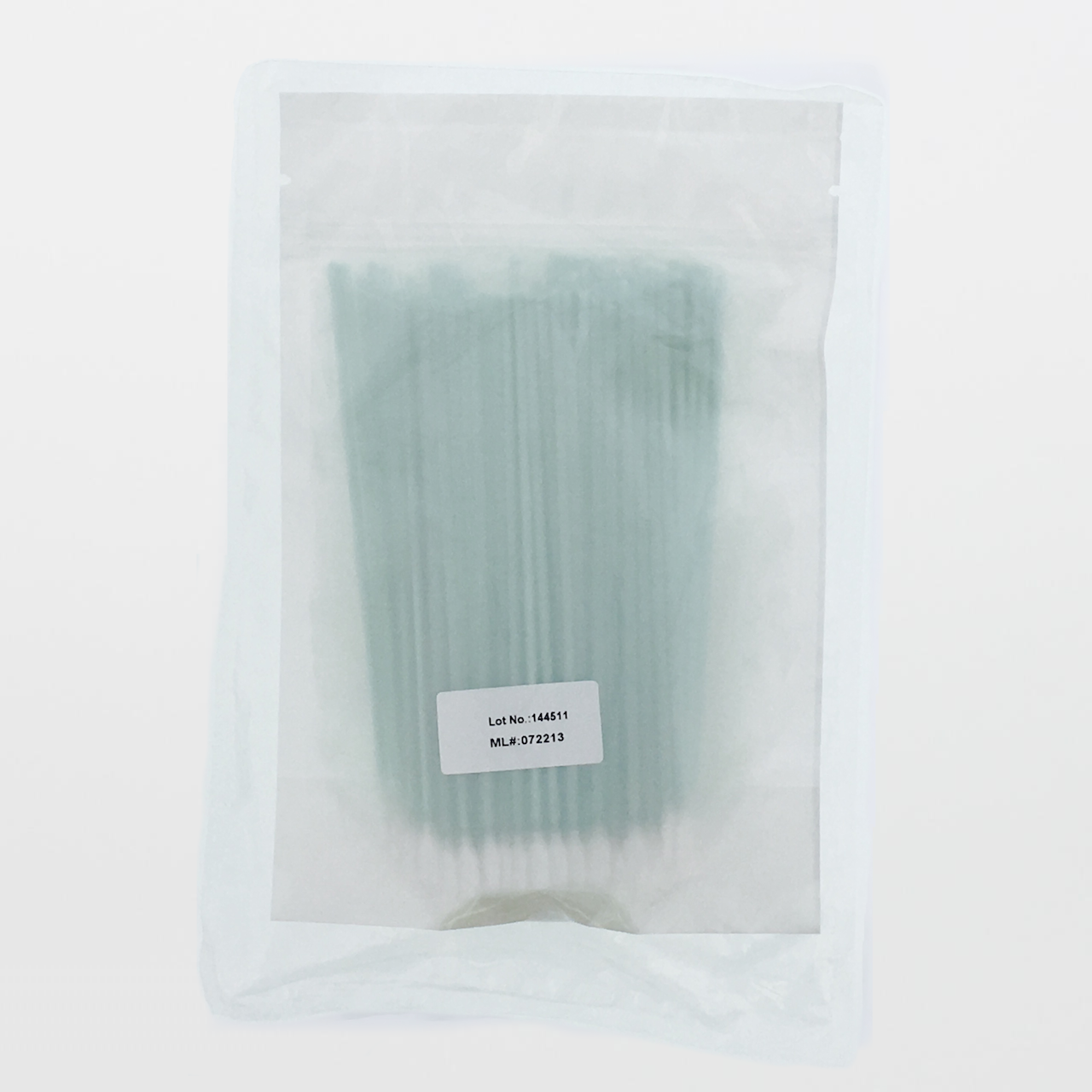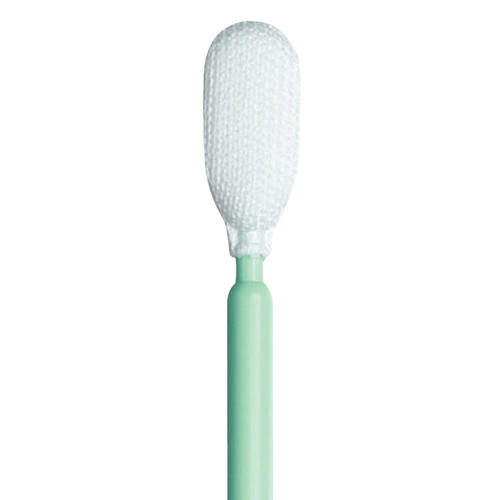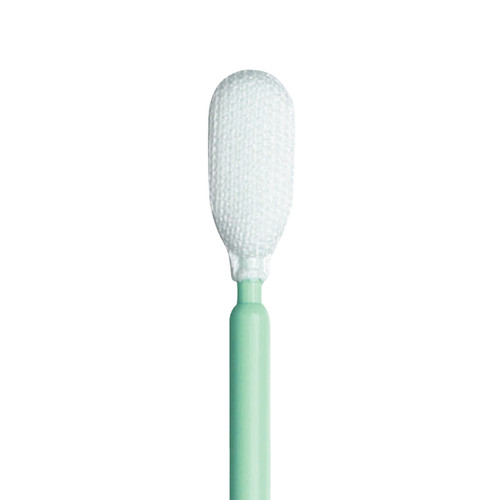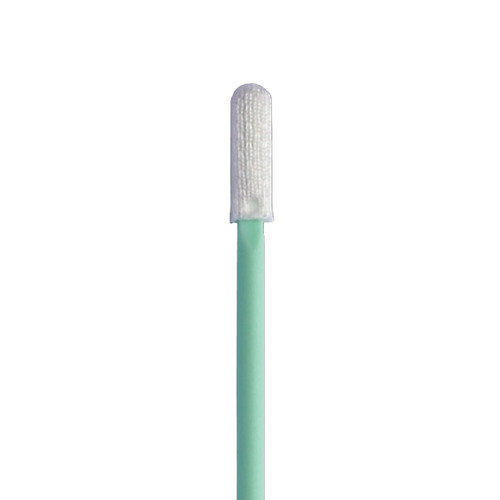
Long handle + small microdenier knit head for controlled, repeatable detailing in recesses, joints, and scratch-sensitive zones.
Practical solutions in a critical environment
In real cleanroom cleaning, the “failure” is rarely obvious. You pass visual inspection, then a day later the haze returns. Or a coating looks fine until
it dries, and a faint streak becomes a yield hit. In optics, sensors, and high-resolution assemblies, that defect pathway is often a combination of
solvent evaporation behavior, micro-residue redistribution, and contact mechanics at the surface.
TX761MD is designed for those moments: you need a small cleaning face, a long handle that keeps gloves away from the work zone, and a textile that lifts fine
particulates while minimizing streak formation on scratch-sensitive surfaces. It is a low-linting tool when used correctly — and nothing is truly lint-free
under every pressure, edge condition, or solvent load.
What is this swab used for
TX761MD is used for precision spot cleaning and controlled residue removal in constrained access points where wipes cannot maintain consistent contact.
Microdenier polyester knit is selected when fine particle pickup and streak management matter on sensitive surfaces.
- Detail cleaning of grooves, tracks, slots, intersecting surfaces, joints, and recessed features.
- Applying and removing lubricants, adhesives, and process solutions in controlled environments.
- Solvent/solution cleaning (per your SOP) when you need a small, repeatable contact patch.
- Pickup of fine powders/particulates where a knit head can improve “grab” compared to foam.
Why should customers consider this swab
- Microdenier knit for sensitive surfaces: built for streak-free cleaning behavior on scratch-sensitive zones when technique is controlled.
- Thermal bond construction: eliminates adhesive as a contamination variable at the bond line.
- Long handle = better contamination discipline: helps keep gloves, sleeves, and wrist motion away from the critical cleaning area.
- Published cleanliness characterization: typical ions and NVR values support background-risk thinking, troubleshooting, and lot-aware investigations.
- Packaging controls and traceability: silicone-free, reclosable bag + lot coding supports consistent floor control and root-cause investigations.
Materials and construction
TX761MD uses a 100% polyester knit microdenier head thermally bonded to a 100% virgin polypropylene handle. The microdenier textile is positioned for
fine particulate pickup and streak control on sensitive surfaces, while thermal bonding removes adhesives from the build.
- Head material: 100% polyester knit (microdenier series).
- Bond mechanism: thermal (no adhesive).
- Handle: polypropylene (100% virgin polypropylene), long format for reach and better glove-off-zone control.
- Contamination-control note: Low-linting outcomes depend on pressure, edge loading, and surface condition; no swab is truly lint-free across all use conditions.
Specifications in context
The dimension set on TX761MD is doing a practical job: a small cleaning face to stay “inside the feature,” plus a long handle that lets operators keep a stable angle
without bringing hands into the airflow above the work. On many lines, that glove-contact avoidance is the biggest single reduction in random recontamination.
| Attribute |
TX761MD (this SKU) |
| Head width |
6.8 mm (0.268") |
| Head thickness |
2.8 mm (0.110") |
| Head length |
16.8 mm (0.661") |
| Handle material |
Polypropylene (100% virgin polypropylene) |
| Handle width / thickness |
3.2 mm (0.126") / 3.2 mm (0.126") |
| Handle length |
146.2 mm (5.755") |
| Total swab length |
162.5 mm (6.398") |
| Bond type |
Thermal (no adhesive) |
| Packaging |
100 swabs / reclosable bag; 8 bags / case (800 swabs / case) |
| Packaging controls |
Reclosable, silicone-free bag; lot coded for traceability and quality control |
| Compatibility note |
Compatible with QAC (quaternary ammonium chloride) cleaners and disinfectants |
Cleanliness metrics
The tables below summarize typical (manufacturer-reported) contamination characterization for TX761MD. These are not specification limits; treat them as
a baseline for background contribution, then confirm with your actual solvent, wetness level, evaporation behavior, and surface energy.
If you are working near a detection threshold or troubleshooting a defect signature, run blanks and lot-aware checks.
Typical ion extractables
| Ion |
Typical level (µg/swab) |
| Calcium | 0.08 |
| Chloride | 0.10 |
| Fluoride | 0.07 |
| Magnesium | 0.03 |
| Nitrate | 0.11 |
| Phosphate | 0.12 |
| Potassium | 0.09 |
| Sodium | 0.17 |
| Sulfate | 0.12 |
Typical NVR
| Extractant |
Typical NVR (mg/swab) |
| DI water (DIW) | 0.06 |
| Isopropyl alcohol (IPA) | 0.03 |
Packaging, sterility and traceability
- Packaging: 100 swabs per reclosable bag; 8 bags per case; 800 swabs per case.
- Packaging controls: reclosable, silicone-free bag; lot coded for traceability and quality control.
- Sterility: supplied non-sterile. The series references sterile swabs as available upon request; if sterility is a requirement, lock it in your SOP and qualify before adoption.
- Autoclave note: described as autoclave safe for use in sterile environments and processes; validate cycle parameters, packaging, and post-sterilization handling to your facility method.
- Shelf life: 5 years from date of manufacture.
- Practical identity cue: trademarked light-green handle with “TEXWIPE” embossed on the handle supports receiving and floor-control identification (traceability cue).
- Country of origin (manufacturer statement): Made in The Philippines.
Best-practice use
TX761MD performs best when you treat it like a controlled tool, not a “tiny wipe.” Control wetness, keep the paddle face in contact, and rotate to a clean face before the head loads.
Reclosable packaging only helps if operators reseal it immediately and keep the open bag out of high-traffic airflow zones.
Operator-level swabbing technique module
- Set a wetness rule: if pre-wetting is allowed, target “uniformly damp,” not dripping. Excess solvent increases streaking and creates tide marks as it evaporates.
- Use straight strokes first: single-direction passes with overlap typically lift better than circular scrubbing, especially on coatings and polished surfaces.
- Rotate with intent: after 3–6 strokes on a small feature (or sooner if drag increases), rotate to a clean face. Stop when smearing replaces pickup.
- Avoid edge loading: keep the paddle face flat. Pressing with the edge can increase fiber generation and create faint streak lines even with low-linting materials.
- Keep hands off the zone: use the long handle to maintain a stable angle and keep gloves and sleeves out of the work envelope.
- Do not re-dip a used swab: reintroduces captured residue/particles into your solvent source and contaminates the next cleanout.
- Validate solvent compatibility: IPA is common; QAC disinfectants are noted as compatible. Confirm surface/coating compatibility and residue limits within your quality system.
- Troubleshooting discipline: if streaks persist, isolate variables: solvent purity, wetness, stroke speed, and consumable lot. Change one variable at a time.
Common failure modes
- Over-wetting + slow strokes: leaves tide marks and “re-deposits” residues as solvent evaporates.
- Circular scrubbing on coatings: raises abrasion risk and often redistributes contamination instead of lifting it.
- Edge loading the knit: increases snag risk and can produce faint streak lines or fiber transfer on sharp edges.
- Backtracking with a loaded head: recontaminates the area you just cleaned.
- Bag left open on the bench: airborne loading turns the swab into the contamination source; reseal immediately.
Closest competitors
In this class (long-handle knit swabs for precision detailing), meaningful comparisons are construction mechanism (thermal bond vs. adhesive),
published contamination characterization, packaging controls, and tolerance consistency — the items that determine whether a method remains stable across lots.
- Berkshire Lab-Tips® knitted polyester long-handle cleanroom swabs (comparable size class): evaluate published background data and packaging/lot discipline for investigation-ready programs.
- Puritan PurSwab® cleanroom polyester knit long-handle swabs (comparable size class): compare head geometry and handling feel in your features; confirm documentation availability for cleanliness characterization.
- Other private-label knit swabs: some match geometry but lack stable characterization and traceability; qualify carefully if your defects or audits are sensitivity-driven.
Critical environment fit for this swab
TX761MD fits precision cleaning tasks where access is constrained, the surface is sensitive, and outcomes depend on repeatable contact mechanics.
It is also a practical choice in programs using QAC disinfectants and in workflows where a long handle reduces glove contact risk in the cleaning zone.
SOSCleanroom supports this use-case through our established working relationship with ITW Texwipe — emphasizing continuity of supply and documentation discipline so qualified materials remain stable across replenishment cycles.
Fast shipping and responsive support reduce last-minute substitutions that can quietly change wetting behavior, streak outcomes, and investigation baselines.
SOSCleanroom note about SOP's
The Technical Vault is written to help customers make informed contamination-control decisions and improve day-to-day handling technique.
It is not your facility’s Standard Operating Procedure (SOP), batch record, or validation protocol.
Customers are responsible for establishing, training, and enforcing SOPs that fit their specific risks, products, equipment, cleanroom classification, and regulatory obligations.
Always confirm material compatibility, cleanliness suitability, sterility requirements, and acceptance criteria using your internal quality system and documented methods.
If you adapt any technique guidance from this entry, treat it as a starting template. Your team should review and approve the final method, then qualify it for your specific surfaces,
solvents, cleanliness limits, inspection methods, and risk profile. In short: use these best-practice suggestions to strengthen your SOPs—not to replace them.
Source basis
- SOSCleanroom product page (TX761MD): https://www.soscleanroom.com/product/swabs/texwipe-tx761md-long-medium-head-microdenier-cleanroom-swab/
- ITW Texwipe manufacturer product page (TX761MD): https://www.texwipe.com/small-microdenier-tx761md
- ITW Texwipe Technical Data Sheet: Microdenier Swab Series, Polyester Knit, US-TDS-064 Rev. 09/21 (physical characteristics, packaging, shelf life, COO, and typical contamination characterization):
https://www.texwipe.com/images/uploaded/documents/Swabs/Texwipe-Microdenier-Swabs-TDS.pdf
- SOS-hosted PDF copy (primary stable reference): Microdenier Series Technical Data Sheet (TX714MD / TX758MD / TX761MD):
https://www.soscleanroom.com/content/texwipe_pdf/714md%20758md%20761md.pdf
- ISO (as applicable): https://www.iso.org/standard/53394.html
- FDA (as applicable): https://www.fda.gov/
- ASTM (as applicable): https://www.astm.org/
- IEST (as applicable): https://www.iest.org/
SOSCleanroom is the source for this Technical Vault entry.
Briefed and approved by the SOSCleanroom (SOS) staff.
If you have any questions please email us at Sales@SOSsupply.com
Last reviewed: Jan. 6, 2026
© 2026 SOSCleanroom