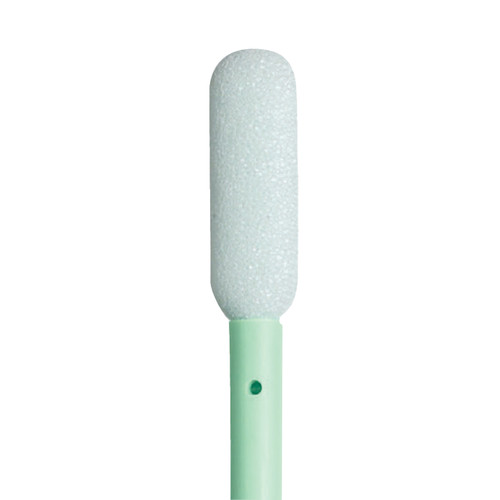
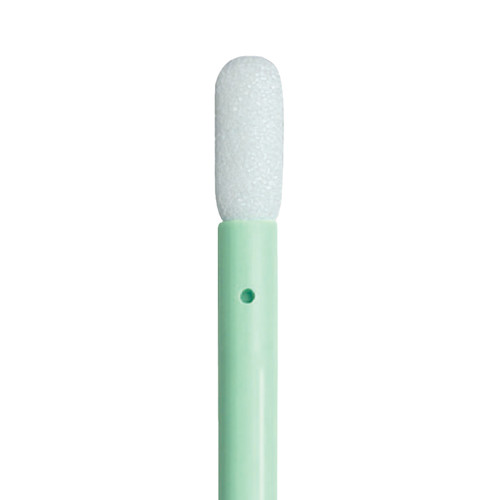
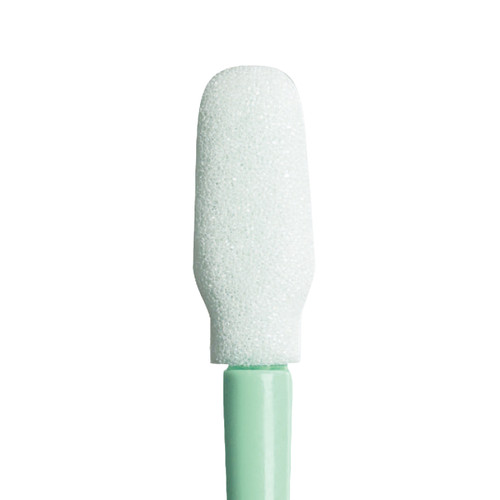
Texwipe TX707A CleanFoam Large Rectangular Head Swab (Closed Cell)

$31.81
(No reviews yet)
SKU:
TX707A BAG
Availability:
7 - 14 Business Days
Shipping:
Calculated at Checkout
Quantity Option (Bag):
100 Swabs Per Bag (2 Inner Bags of 50 Swabs)
Quantity Option (Case):
10 Bags of 100 Swabs Per Case
Type:
Dry Swab
Swab Family:
CleanFoam
Swab Material:
Foam

Texwipe TX707A CleanFoam Large Rectangular Head Cleanroom Swab (Closed-Cell, 100 PPI)

Texwipe TX707A CleanFoam is a low-linting (no swab is truly ‘zero-lint’ in every process condition), closed-cell polyurethane foam cleanroom swab engineered for controlled solvent handling, broad contact on small flats, and precise cleaning of intersecting surfaces, joints, and recessed features. Constructed from high-quality 100 PPI polyurethane foam with complete thermal bond construction (no adhesives), TX707A is cleanroom processed for low nonvolatile residues (NVRs) and ions, manufactured to consistent tolerances using high-precision automated processes, lot coded for traceability, and packaged in a silicone-free and amide-free bag. The long, easy-grip polypropylene handle supports stable technique for optics, microelectronics, semiconductor, pharmaceutical, and other critical clean environments where repeatability matters.

Program note: TX707A is commonly selected when teams need a rectangular foam contact patch to control streaking/film, grab fine particulates, and keep solvent delivery consistent—while maintaining lot-level traceability and clean packaging controls for audit-friendly contamination-control workflows.

Specifications:
  • Type: Dry cleanroom swab
  • Swab family: CleanFoam® Series A (closed-cell)
  • Head material: 100 PPI CleanFoam polyurethane foam
  • Head shape: Large rectangular head (rigid paddle)
  • Head width: 15.0 mm (0.591")
  • Head thickness: 8.8 mm (0.346")
  • Head length: 25.0 mm (0.984")
  • Handle material: Polypropylene (100% virgin polypropylene handle)
  • Handle width: 6.6 mm (0.260")
  • Handle thickness: 3.2 mm (0.126")
  • Handle length: 106.0 mm (4.173")
  • Total swab length: 131.0 mm (5.157")
  • Head bond: Thermal (no adhesive head bond)
  • Handle color: Light green
  • Packaging: 100 swabs/bag (2 inner bags of 50 swabs); 10 bags/case
  • Clean packaging: Silicone-free and amide-free bag; lot coded for traceability
  • Temperature guidance: Appropriate for use with temperatures less than 350°F
  • Use environments: Controlled environments and cleanrooms (final suitability depends on your process, solvent system, and technique)
  • Country of origin: See manufacturer documentation
About the Manufacturer: 

Texwipe (an ITW company) differentiates itself in cleanroom swabbing by treating the swab as a controlled, engineered tool—not a commodity applicator. For CleanFoam swabs, performance starts with consistent foam structure (100 PPI), then leverages complete thermal bonding to eliminate adhesive contamination pathways, controlled processing to reduce residues/ions, and automated manufacturing to hold dimensional tolerances that support repeatable operator technique.


Texwipe also emphasizes practical contamination controls that matter line-side: lot coding for traceability and silicone-free, amide-free packaging for processes sensitive to transfer films and false positives. SOSCleanroom (SOS) supports that discipline with a close working relationship with Texwipe focused on continuity of supply, documentation-friendly handoff, and application support—so customers can standardize cleanroom swabs with predictable performance while maintaining procurement reliability and audit readiness.

TX707A Features:
  • Closed-cell 100 PPI polyurethane foam head designed for consistent solvent uptake and controlled release
  • Complete thermal bond construction (no adhesives) to reduce adhesive-driven contamination risk at the head bond
  • Cleanroom processed for low NVRs and ions (process-dependent)
  • High-precision automated manufacturing for consistent tolerances and repeatable technique
  • Lot coded for traceability and quality control
  • Silicone-free and amide-free bagging to support sensitive cleaning and inspection workflows
  • 100% virgin polypropylene handle for chemical resistance and controlled handling
  • Autoclave safe in dry heat and steam (verify suitability with your internal protocol)
TX707A Benefits:
  • Rectangular contact control: Broad, stable swab face helps reduce streaking and “extra passes” that can drive redeposition (technique-dependent)
  • Solvent handling for critical cleaning: Foam readily absorbs solvents and solutions and helps lift particulates during controlled wipe steps
  • Reduced contamination pathways: Thermal bonding eliminates adhesive contamination at the head bond
  • Process-friendly packaging: Silicone-free/amide-free packaging supports processes sensitive to transfer films and residue-based inspection failures
  • Long-handle reach: Easier access to recessed features, joints, and intersecting surfaces while keeping hand placement controlled
  • Audit-ready traceability: Lot coding supports investigations, incoming checks, and process traceability expectations
Common Applications:
  • Applying and removing lubricants, adhesives, and process solutions in critical clean environments
  • Scrubbing recessed areas, corners, and tight wipe points
  • Removal of excess materials and debris on small flats and interfaces
  • Cleaning intersecting surfaces and joints where a stable contact patch matters
  • Cleaning with compatible solutions and solvents (verify chemical compatibility to your SOP)
  • Picking up fine powders and particulate residues
  • Optics and precision assembly cleaning where solvent spread and film control are critical
Best-Practice Use:
  • Pre-wet with control: Wet the foam with your approved solvent/cleaner to damp (not dripping) before contact to avoid flooding seams, joints, and interfaces.
  • Use the full rectangle: Keep the rectangular face flat on the surface to stabilize pressure and reduce edge-loading that can streak.
  • One-direction strokes: Use straight-line strokes and avoid circular scrubbing unless your SOP requires it; change the swab face/edge rather than re-wiping with a loaded surface.
  • Rotate/replace early: When the foam loads with soil, residues, or tacky films, replace the swab to avoid redeposition and haze after dry-down.
  • Handle discipline: Do not touch the foam head; keep gloves and hand placement on the handle only to preserve cleanliness.
Selection Notes (TX707A vs. Other Options)
  • TX707A vs. TX708A (circular head): Choose TX707A when a rectangular contact patch improves edge-to-edge coverage and stroke stability on small flats; choose TX708A when a circular head better fits curved geometries or point contact.
  • TX707A vs. TX709A/TX710A (flexible heads): Choose TX707A when you want a rigid paddle for stable flat contact; choose flexible-head swabs when you need controlled flex into recessed features with variable angles.
  • TX707A vs. TX712A (rectangular head): Both support rectangular cleaning; select by head size/geometry and handle feel based on your access constraints and contact area needs.
  • Temperature guidance: If you are cleaning warm fixtures/tooling, confirm your process temperatures remain below 350°F and validate against your internal protocol.

Link to Texwipe Technical Datasheet:
Click Here
Texwipe.com PDF: Click Here

Other Similar Products Available From SOSCleanroom.com

CleanFoam® Series A (Closed-Cell) Swabs

  • TX706A: CleanFoam keyboard swab (closed-cell) for detailed wipe points
  • TX708A: CleanFoam circular head swab (closed-cell) for rounded contact needs
  • TX709A: CleanFoam medium flexible head swab (closed-cell) for angled access
  • TX710A: CleanFoam large flexible head swab (closed-cell) for controlled flex and reach
  • TX712A: CleanFoam rectangular head swab (closed-cell) for flat contact and interfaces

Notes: Looking for application guidance or qualification context for Texwipe TX707A CleanFoam large rectangular head cleanroom swabs (closed-cell, 100 PPI)? Open the SOSCleanroom Technical Vault tab above for practical swabbing technique, selection notes (TX707A vs. alternatives), and the traceability/packaging details teams typically review when standardizing foam swabs in ISO-class controlled environments.

SOSCleanroom.com supports contamination-control programs with cleanroom consumables in stock, fair pricing, and responsive technical support—backed by same-day shipping options and customer service that understands real cleanroom workflows.

Product page updated: Jan. 5, 2026 (SOS Technical Staff)

© 2026 SOS Supply. All rights reserved.

The Technical Vault
By SOSCleanroom
TX707A • CleanFoam® Series A Closed-cell • 100 ppi foam Thermal bond • No adhesive at tip Lot coded • Traceability-forward
Texwipe TX707A CleanFoam® Large Rectangular Head Swab: Controlled Solvent Delivery for Flats, Seams, and Intersecting Surfaces
Texwipe TX707A CleanFoam large rectangular head swab (closed-cell)
Product photo shown for TX707A identification and tool-control training.
Practical solutions in a critical environment

TX707A is designed for the moments when “just cleaning it” is not good enough: optics flats that haze with film, joint lines that re-deposit particles, fixtures that trap solvent at edges, and small planes where a wipe is too large and a round swab is too imprecise. Its rectangular, closed-cell foam face gives you a controlled contact patch so operators can standardize stroke geometry, wetness level, and pressure—key variables that drive repeatability in critical cleaning.

It is also a low-linting tool (nothing is truly lint-free in every process condition). The practical goal is consistent, low particulate contribution while maintaining solvent compatibility and traceability discipline.

What is this swab used for
  • Applying and removing lubricants, adhesives, and process solutions where residue control matters.
  • Cleaning intersecting surfaces, joints, seams, and small flats that streak easily.
  • Scrubbing recessed areas and corners with controlled wetting (avoid flooding).
  • Picking up fine powders and particulate films when your technique requires a defined contact edge.
  • Use in and around food processing areas as a Cleaning Swab (P1) when used per manufacturer restrictions (no direct food/potable water contact).
Why should customers consider this swab
  • Rectangular “wipe-like” contact patch: better control of stroke path and edge work than a round tip for small flats and seams.
  • Thermal bond construction: eliminates adhesive at the head bond as a contamination pathway.
  • Closed-cell, 100 ppi polyurethane foam: consistent solvent uptake/release behavior for repeatable wetting.
  • Traceability-forward packaging: lot coding plus point-of-use visual identifiers (embossed “TEXWIPE,” trademarked light-green handle).
  • Silicone-free, amide-free bags: helpful for processes sensitive to transfer films and false positives.
Materials and construction

TX707A uses a 100 ppi CleanFoam® polyurethane foam head paired with a 100% polypropylene handle. The foam head is thermally bonded to reduce the risk of adhesive-derived contamination at the bond line. The handle provides chemical resistance and helps limit the introduction of secondary contaminants from the shaft material.

The rectangular head is intentionally “wipe-like” in behavior: the operator can present a broad face for film control, then use an edge for line cleaning along seams, fasteners, and intersecting planes. This design supports consistent technique when cleaning optics hardware, microelectronic assemblies, and other precision surfaces.

Specifications in context

The table below is intended to connect “published dimensions” to how the swab behaves in real work. With TX707A, the 15 mm x 25 mm rectangular face is large enough to cover small flats efficiently, while the 131 mm overall length helps stabilize angle and pressure in recessed or crowded assemblies.

Attribute TX707A (published)
Swab family CleanFoam® Series A (closed-cell)
Head material / structure 100 ppi polyurethane foam (CleanFoam®)
Head width × length × thickness 15.0 mm × 25.0 mm × 8.8 mm (0.591" × 0.984" × 0.346")
Handle material Polypropylene
Handle length 106 mm (4.173")
Total swab length 131 mm (5.157")
Head bond Thermal
Handle identifier Trademarked light-green handle with “TEXWIPE” embossing
Temperature guidance Appropriate for use with temperatures less than 350°F (published for Series A)
Sterility status Non-sterile (TX707A)
Cleanliness metrics

Treat the values below as typical analyses, not acceptance limits. In practice, your solvent system, wetness level, dwell time, stroke geometry, and inspection method can shift observed background more than the differences between lots. Use these tables to inform qualification and trending—then validate performance under your real process conditions.

Typical ion extractables (µg/swab)
Ion TX707A typical value
Calcium0.01
Chloride0.34
Fluoride0.01
Magnesium0.03
Nitrate0.01
Phosphate0.01
Potassium0.06
Sodium0.04
Sulfate0.16
Typical NVR (mg/swab)
Extractant TX707A typical value
DI water (DIW)0.20
Isopropyl alcohol (IPA)0.56
Packaging, sterility and traceability
  • Packaging (TX707A): 100 swabs/bag (2 inner bags of 50); 10 bags/case; 1,000 swabs/case.
  • Packaging controls: silicone-free and amide-free bags to support processes sensitive to transfer films and false positives.
  • Traceability: lot coded for traceability and quality control; trademarked light-green handle color with “TEXWIPE” embossed on the handle as a practical point-of-use identifier.
  • Sterility status: TX707A is non-sterile. (Sterile CleanFoam® programs are described in manufacturer documentation for other SKUs; a sterile TX707A counterpart is not stated in the source basis.)
  • Shelf life (manufacturer): Non-sterile — 5 years from date of manufacture.
  • Storage (manufacturer): ambient conditions, defined as 59°F (15°C) to 86°F (30°C).
  • Country of origin (manufacturer statement): Non-sterile — Made in The Philippines.
Best-practice use

TX707A performs best when you standardize wetness and treat the rectangular face like a controlled wipe surface—not a cotton-bud substitute. The most common process failures come from over-wetting, reusing a contaminated face, and scrubbing with uncontrolled pressure.

Operator-level swabbing technique module
  • Stage and control: open the inner bag at point of use; do not “stage” loose swabs on benches. Capture lot number in the work record when required.
  • Pre-wet correctly: wet the foam (not the handle). Aim for “glistening, not dripping.” Flooding seams is a leading cause of redeposit and dry-down lines.
  • Use a single pass logic: wipe in one direction with light, consistent pressure. Do not scrub back-and-forth on optics flats unless your validated method requires it.
  • Rotate the face: use one face/edge per pass. Rotate to a clean edge before you re-enter a seam or intersecting plane.
  • Edge work for seams: lead with a clean edge along the joint line; avoid pushing debris into the seam. If particulate load is high, switch swabs early.
  • Pressure discipline: let chemistry and contact do the work. Excess force increases particle generation risk and can “squeegee” residue across the surface.
  • Dry-down control: if your method uses volatile solvent (e.g., IPA), manage the final stroke direction to pull solvent off the critical zone and prevent edge beading.
  • Change-out triggers: replace the swab immediately if the face picks up visible debris, if it contacts a non-controlled surface, or if foam integrity changes.
  • Compatibility check: confirm solvent and surface compatibility within your quality system; do not assume one “approved solvent” applies to all polymers/coatings.
Common failure modes
  • Over-wetting and flooding: drives dry-down rings, seam wicking, and residue migration.
  • Re-deposit from reuse: reusing the same face/edge drags captured particulate back across the surface.
  • Uncontrolled pressure: can increase particle generation and smear films instead of lifting them.
  • Technique drift: inconsistent stroke angle/length makes troubleshooting “mystery haze” and inspection fallout harder.
  • Wrong solvent or mixed chemistries: can soften residues, then redeposit them; confirm compatibility and purity requirements.
  • Poor tool control: mixing swab types or lots without traceability complicates investigations and trending.
Closest competitors

If you are comparing a “large rectangular foam swab” form factor, focus on what actually changes process outcomes: thermal bonding vs. other bonds, packaging controls, cleanliness documentation, and traceability discipline. Examples of commonly seen alternatives include:

  • Puritan (controlled environment swabs/applicators): broad foam swab portfolio; confirm bonding method, cleanroom packaging, and traceability features SKU by SKU.
  • Contec Cleanroom (swabs): foam/knitted/cotton options; validate contamination data and packaging controls against your acceptance criteria.
  • Super Brush / Swab-its foam swabs: industrial foam swab alternatives exist; confirm controlled-environment processing and residue/ion controls if used in critical cleaning.
Critical environment fit for this swab

TX707A is a strong fit when your process needs a repeatable, rectangular contact patch for solvent-assisted cleaning and where contamination control must be supported by documentation, traceability, and consistent manufacturing. In practice, teams often map “where this swab is used” to cleanroom classification and handling discipline (commonly aligned to ISO cleanroom concepts), then qualify the swab within their internal method and risk model.

SOSCleanroom (SOS) maintains a close working relationship with ITW Texwipe that prioritizes continuity of supply and documentation-friendly procurement—helping customers reduce surprises when standardizing consumables for audits, investigations, and ongoing process control. The practical outcome is fewer last-minute substitutions and a clearer chain of evidence when quality teams need to trace a cleaning tool to a specific lot and packaging configuration.

SOSCleanroom note about SOP's

The Technical Vault is written to help customers make informed contamination-control decisions and improve day-to-day handling technique. It is not your facility’s Standard Operating Procedure (SOP), batch record, or validation protocol.

Customers are responsible for establishing, training, and enforcing SOPs that fit their specific risks, products, equipment, cleanroom classification, and regulatory obligations. Always confirm material compatibility, cleanliness suitability, sterility requirements, and acceptance criteria using your internal quality system and documented methods.

If you adapt any technique guidance from this entry, treat it as a starting template. Your team should review and approve the final method, then qualify it for your specific surfaces, solvents, cleanliness limits, inspection methods, and risk profile. In short: use these best-practice suggestions to strengthen your SOPs—not to replace them.

Source basis
  • SOSCleanroom product page (TX707A): https://www.soscleanroom.com/product/spotlight-videos/optical-cleaning/texwipe-tx707a-cleanfoam-large-rectangular-head-swab-closed-cell/
  • Manufacturer product page (Texwipe TX707A, non-sterile): https://www.texwipe.com/large-rectangular-head-tx707a
  • Manufacturer technical data sheet (CleanFoam® Swab Series) — US-TDS-051 Rev. 09/21 (includes dimensions, typical ions/NVR, COO statement): https://www.texwipe.com/images/uploaded/documents/Swabs/Texwipe-Cleanfoam-Swabs-TDS.pdf
  • SOS-hosted PDF copy (CleanFoam® Series A TDS excerpt; revision/date not stated on this file): https://www.soscleanroom.com/content/texwipe_pdf/706a%20707a%20708a%20709a%20710a%20712a.pdf
  • Standards / regulatory bodies (context and alignment, as applicable): https://www.iso.org/standard/53394.html | https://www.fda.gov/ | https://www.astm.org/ | https://www.iest.org/
  • Competitor context pages used for high-level market examples (verify any SKU-specific claims within your qualification):
    https://www.puritanmedproducts.com/controlled-environments/swabs-applicators.html
    https://cleanroom.contecinc.com/products/swabs
    https://superbrush.com/
SOSCleanroom is the source for this Technical Vault entry.
Briefed and approved by the SOSCleanroom (SOS) staff.
If you have any questions please email us at Sales@SOSsupply.com
Last reviewed: Jan. 6, 2026
© 2026 SOSCleanroom

Videos Hide Videos Show Videos