Practical solutions in a critical environment
Contamination-control problems rarely start on a wide-open flat. They start at the interface: the corner, seam, slot, and joint where solvent wants to pool and residues migrate as the surface dries.
In those features, a “small tool” becomes a process variable. TX712A is designed to reduce that variability with a stable rectangular contact patch and closed-cell foam behavior that supports controlled solvent laydown and pickup in tight geometry.
This is also where supply continuity matters. SOSCleanroom’s long-standing relationship with ITW Texwipe supports repeatable replenishment, lot traceability, and documentation discipline so qualified cleaning methods stay stable instead of drifting when teams substitute look-alike swabs with different wetting and extractables behavior.
As with all swabs, no swab is truly zero-lint in every process condition; low-linting outcomes depend on technique, surface condition, solvent load, and stroke discipline.
What is this swab used for
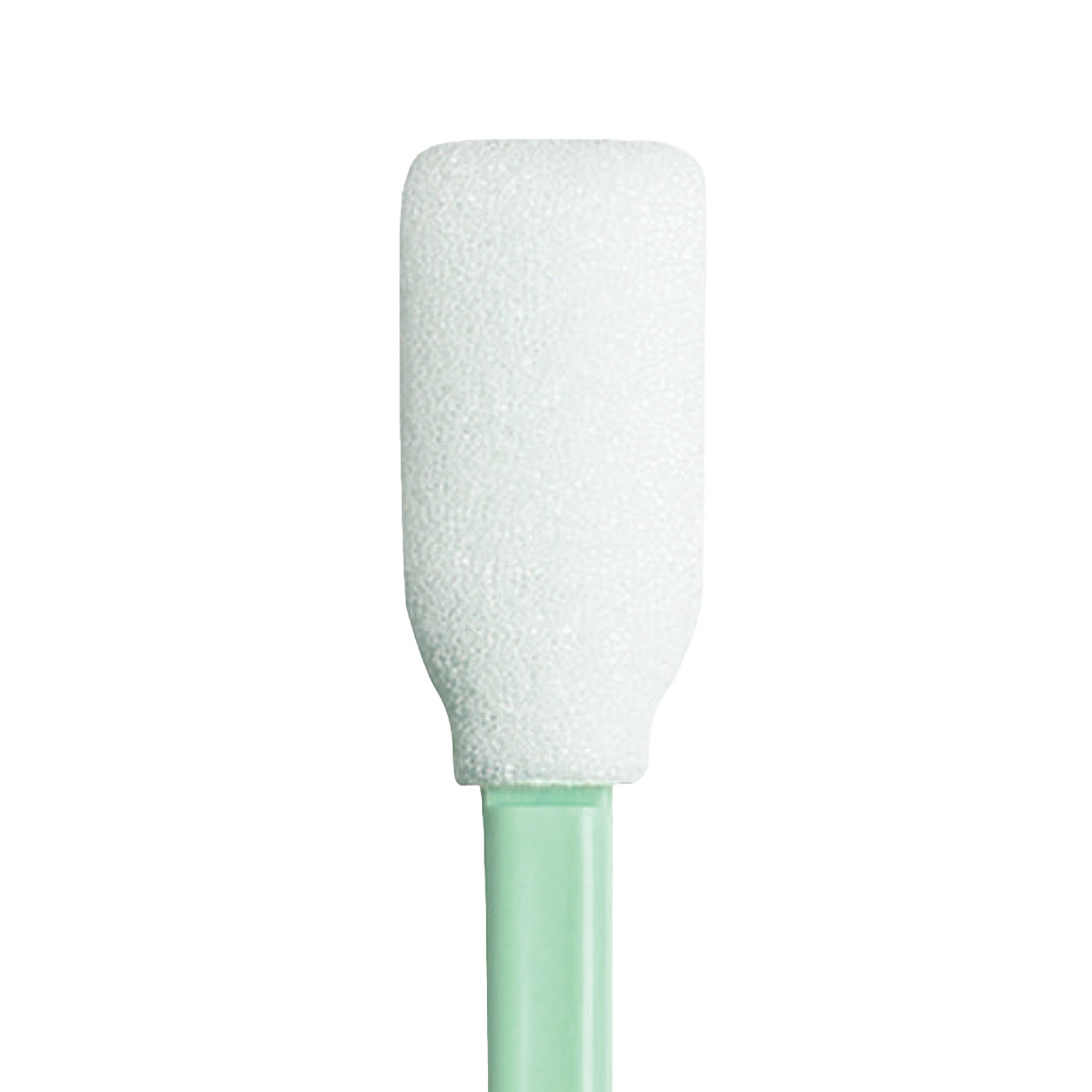
TX712A is a large, general-purpose rectangular head cleanroom swab used for precision cleaning and controlled application/removal of compatible solutions and solvents in areas where wipes cannot maintain consistent contact.
Typical use cases include applying/removing lubricants, adhesives, and process solutions; scrubbing recessed areas; removing excess materials or debris; cleaning intersecting surfaces and joints; and picking up fine powders.
It is commonly specified across biologics, medical device, microelectronics, optics, pharmaceuticals, and semiconductor environments where defect mechanisms often involve residue streaking, solvent pooling, and re-deposition at edges rather than gross soil on open surfaces.
Why should customers consider this swab
-
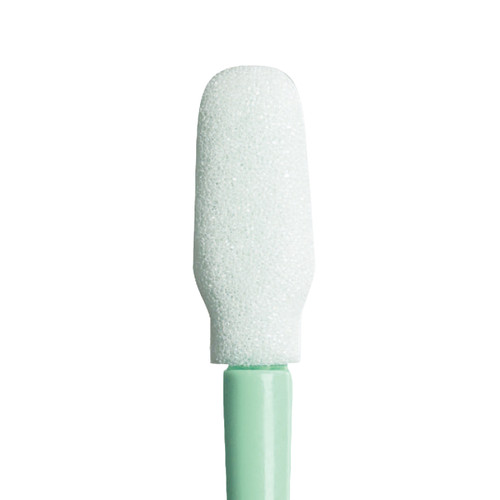
Rectangular face control: The rigid rectangular paddle head supports repeatable flat contact on small surfaces, seams, and interfaces where tip roll-over can smear residues.
-
Closed-cell solvent discipline: The Series A closed-cell foam design is commonly selected when teams want tighter solvent control (reduced “sponge effect”) compared with more absorbent open-cell foams.
-
Thermal bond construction: Adhesive-free head bonding reduces one common contamination pathway during solvent-wet work.
-
Packaging controls: Packaged in silicone-free and amide-free bags to reduce trace-variable risk in residue- and film-sensitive processes.
-
Audit-friendly traceability cues: Lot coded for quality control; trademarked light-green handle with “TEXWIPE” embossed on the handle supports operator-level authenticity/traceability checks during investigations and line clears.
Materials and construction
TX712A uses 100 PPI polyurethane CleanFoam® (Series A) with complete thermal bond construction (no adhesive at the head-to-handle interface). The handle is 100% virgin polypropylene for chemical resistance and reduced risk of introducing additional contaminants during solvent-driven cleaning.
Practical note: the rectangular paddle geometry is not just a shape choice. It is a control feature—supporting flat contact, predictable edge behavior, and repeatable stroke mechanics when operators are trained to keep the face square to the feature and rotate faces before loading causes streaking.
Specifications in context
Use this table as “setup data” for method development and operator training. Dimensional consistency matters most when you are standardizing stroke length, contact pressure, and face rotation cadence in narrow features.
| Attribute |
TX712A (SKU) |
| Swab family / series |
CleanFoam® Series A (closed-cell) |
| Head material |
100 PPI polyurethane CleanFoam® |
| Head width |
12.7 mm (0.500") |
| Head thickness |
7.8 mm (0.307") |
| Head length |
25.7 mm (1.012") |
| Handle material |
Polypropylene (100% virgin polypropylene) |
| Handle width / thickness |
5.2 mm (0.205") / 3.0 mm (0.118") |
| Handle length |
101.8 mm (4.008") |
| Total swab length |
127.5 mm (5.020") |
| Head bond |
Thermal |
| Handle color / authenticity cue |
Light green; “TEXWIPE” embossed (manufacturer stated) |
Cleanliness metrics
The values below are typical analyses (not specifications). In practice, use them to set expectations for background contributions, then confirm fitness in your process using your solvent system, surface type, inspection method, and acceptance criteria.
Most “swab problems” in the field trace back to technique (over-wetting, re-dipping, inadequate face rotation) or uncontrolled substitutions—not the difference between two published “clean” numbers.
Typical ion extractables (µg/swab) — TX712A
| Ion |
Typical result (µg/swab) |
| Calcium | 0.12 |
| Chloride | 0.84 |
| Fluoride | 0.18 |
| Magnesium | 0.03 |
| Nitrate | 0.22 |
| Phosphate | 0.57 |
| Potassium | 0.08 |
| Sodium | 0.34 |
| Sulfate | 0.61 |
Typical NVR (non-volatile residue) — TX712A
| Extractant |
Typical result (mg/swab) |
| DIW extractant | 0.27 |
| IPA extractant | 0.61 |
Packaging, sterility and traceability
- Packaging (bag): 100 swabs per bag (2 inner bags of 50 swabs).
- Packaging (case): 10 bags per case (1,000 swabs total).
- Packaging controls: Packaged in silicone-free and amide-free bags (manufacturer stated for CleanFoam® swab series).
- Sterility gate: TX712A is non-sterile. If your introduction controls require sterile presentation and sterile handling logic, qualify a sterile swab variant (e.g., STX712A) rather than treating a non-sterile swab as sterile.
- Traceability discipline: Lot coded for traceability and quality control; capture lot codes in deviation reports when residues, streaking, or particle counts drift.
- Country of origin (manufacturer statement): Non-sterile — Made in the Philippines. (Sterile — Made in the Philippines; irradiated in the USA.)
- Shelf life (manufacturer stated for series): Non-sterile — 5 years from date of manufacture; sterile — 3 years from date of manufacture.
Best-practice use
TX712A performs best when it is treated like a controlled-contact process tool, not a tiny sponge. The objective is repeatable wetness, single-direction strokes, deliberate face changes, and disciplined discard rules so you do not smear residues back onto the surface.
Operator-level swabbing technique module (bench-ready)
-
Control wetness (damp, not dripping): Pre-wet the foam to “damp” so it lays down a thin film, not a spreading puddle. If the head is overloaded, blot once before first contact.
-
Keep the rectangle flat: Maintain full-face contact. Avoid edge-loading, which increases streaking and can redeposit dissolved soils along the stroke boundary.
-
Stroke logic (single direction + overlap): Use single-direction strokes with ~25%–50% overlap. Define a short stroke count per face (often 3–6 strokes per face depending on soil load), then rotate to a fresh face.
-
Face rotation cadence: Rotate early—once loading begins, the swab becomes a transfer tool. Stop at the first sign of streaking, drag, or loss of wet film control.
-
No re-dipping into shared solvent: Re-dipping back-contaminates the source and converts the next swab into an unknown. Use one-way dispensing, aliquots, or defined solvent presentation per your SOP.
-
Pressure guidance: Use enough pressure to maintain contact, not enough to abrade coatings or drive residues deeper into joints. If heavy pressure is “required,” reassess solvent choice, dwell time, or residue source.
-
Document the variables during investigations: Lot code, solvent, contact time/dwell (if used), stroke count, discard trigger, and the feature cleaned. Those details typically explain variation faster than “swab brand” narratives.
Common failure modes
- Over-wetting and pooling: Flooding a seam dissolves soils and transports them into joints; as it dries, it leaves tide marks and rings.
- Re-deposition from poor face rotation: Continuing after visible loading smears residue across the last strokes.
- Edge-loading the paddle: Using the corner/edge as a “scraper” increases streaking risk and can drag residues into surface textures.
- Re-dipping into solvent: Back-contamination turns the solvent source into a reservoir; subsequent swabs become uncontrolled variables.
- Unvalidated solvent/surface compatibility: The swab may tolerate a solvent, but the surface/coating/adhesive system may not—leading to haze, swelling, or residue mobilization.
- Uncontrolled substitutions: “Same shape” does not mean same wetting, extractables, or packaging controls—one of the fastest ways to destabilize a qualified process.
Closest competitors
If you are comparing TX712A, keep the comparison mechanism-based (not marketing-based): foam structure (closed-cell vs. open-cell), bonding method (thermal vs. adhesive), packaging controls (silicone/amide considerations), and traceability (lot coding, consistency of published cleanliness data).
- Contec Constix® foam swabs (rectangular formats): Evaluate bond method, packaging controls, and published extractables/NVR approach for your solvent and surface.
- Berkshire foam cleanroom swabs (rectangular formats): Compare geometry and cleanliness data presentation; confirm lot traceability expectations for investigations.
- Puritan foam swabs (industrial/controlled-environment lines): Verify whether the exact part number is positioned for cleanroom processing and what packaging controls apply to your residue sensitivity.
Critical environment fit for this swab
TX712A is a strong fit when your process requires a stable rectangular contact face and controlled solvent behavior in tight geometry—especially where the risk is residue migration at edges and seams.
The combination of thermal bonding, series-level cleanliness characterization (ions and NVR), and silicone-free/amide-free packaging supports programs that are sensitive to background residues and visual film defects.
Reliability is the differentiator in mature programs. SOSCleanroom and ITW Texwipe operate with the documentation discipline (traceability cues, published technical data, and lot-coded control) that helps teams keep qualified cleaning methods stable across replenishment cycles.
That stability reduces the risk of “invisible drift” caused by substitutions, packaging differences, or inconsistent wetting behavior across operators and shifts.
SOSCleanroom note about SOP's
The Technical Vault is written to help customers make informed contamination-control decisions and improve day-to-day handling technique.
It is not your facility’s Standard Operating Procedure (SOP), batch record, or validation protocol.
Customers are responsible for establishing, training, and enforcing SOPs that fit their specific risks, products, equipment, cleanroom classification, and regulatory obligations.
Always confirm material compatibility, cleanliness suitability, sterility requirements, and acceptance criteria using your internal quality system and documented methods.
If you adapt any technique guidance from this entry, treat it as a starting template. Your team should review and approve the final method, then qualify it for your specific surfaces,
solvents, cleanliness limits, inspection methods, and risk profile. In short: use these best-practice suggestions to strengthen your SOPs—not to replace them.
Source basis
-
SOSCleanroom product page (TX712A): https://www.soscleanroom.com/product/swabs/texwipe-tx712a-cleanfoam-rectangular-head-swab-closed-cell/
-
Manufacturer product page (Texwipe TX712A): https://www.texwipe.com/rectangular-head-tx712a
-
SOS-hosted manufacturer technical data sheet (CleanFoam® Series A; includes TX712A; revision/date not stated on SOS-hosted copy): https://www.soscleanroom.com/content/texwipe_pdf/706a%20707a%20708a%20709a%20710a%20712a.pdf
-
Manufacturer technical data sheet (Texwipe CLEANFOAM® SWAB SERIES; US-TDS-051 Rev. 09/21): https://www.texwipe.com/images/uploaded/documents/Swabs/Texwipe-Cleanfoam-Swabs-TDS.pdf
-
International Organization for Standardization (ISO) cleanroom classification context (ISO 14644-1:2015): https://www.iso.org/standard/53394.html
-
FDA (Food and Drug Administration) quality and contamination-control context: https://www.fda.gov/
-
ASTM (American Society for Testing and Materials) methods and materials standards context: https://www.astm.org/
-
IEST (Institute of Environmental Sciences and Technology) recommended practices context: https://www.iest.org/
SOSCleanroom is the source for this Technical Vault entry.
Briefed and approved by the SOSCleanroom (SOS) staff.
If you have any questions please email us at Sales@SOSsupply.com
Last reviewed: January 6, 2026
© 2026 SOSCleanroom