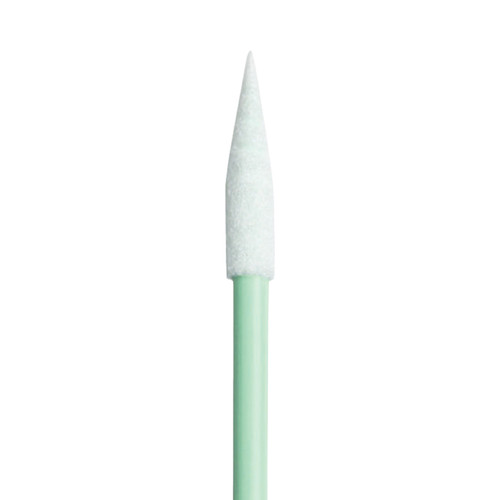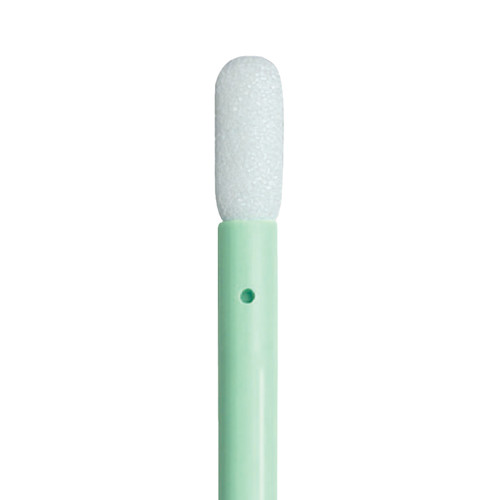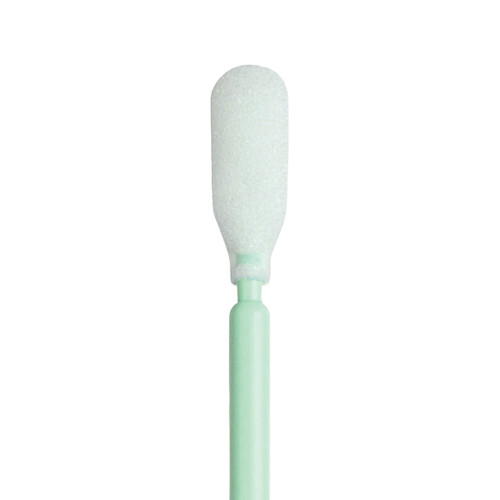
TX740B Medium CleanFoam Swab with Long Handle (Open Cell)

$97.08
(No reviews yet)
SKU:
TX740B BAG
Availability:
Stock Item
Shipping:
Calculated at Checkout
Quantity Option (Bag):
500 Swabs Per Bag (5 Inner Bags of 100 Swabs)
Quantity Option (Case):
5 Bags of 500 Swabs Per Case
Type:
Dry Swab
Swab Family:
CleanFoam
Swab Material:
Foam

Texwipe TX740B Medium CleanFoam® Cleanroom Swab with Long Handle (Open Cell, 100 PPI)

Texwipe TX740B is a medium-head, long-handle CleanFoam® open-cell polyurethane cleanroom swab engineered for precision cleaning, particulate pickup, and controlled solvent application in hard-to-reach areas where wipes cannot maintain stable contact. The 100 PPI open-cell polyurethane foam readily absorbs solvents and solutions and helps grab particulates, while complete thermal bond construction (no adhesive) eliminates a common contamination pathway in solvent-wet swabbing. TX740B is cleanroom processed to support low levels of nonvolatile residues (NVRs) and ionic extractables, manufactured to consistent tolerances, lot coded for traceability, and packaged in a silicone-free and amide-free bag—all aligned to contamination-control workflows in microelectronics, optics, semiconductor support, medical device, pharmaceutical, and other ISO-class controlled environments. As with all swabs, performance is process-dependent and no swab is truly “zero-lint” in every condition; the goal is low-linting behavior with disciplined technique.

Long-handle access note: TX740B is widely selected when you need reach into recessed features (seams, joints, pockets, intersecting surfaces) while keeping gloved hands away from the work zone—and you want open-cell foam absorbency for solvent delivery and residue pickup with adhesive-free construction for a cleaner baseline.

Specifications:
  • SKU: TX740B BAG
  • Type: Dry swab
  • Swab family: CleanFoam
  • Swab material: Foam
  • Head material: 100 PPI CleanFoam® open-cell polyurethane
  • Head width: 6.2 mm (0.244")
  • Head thickness: 5.0 mm (0.197")
  • Head length: 17.0 mm (0.669")
  • Handle material: Polypropylene (100% virgin polypropylene handle)
  • Handle width: 3.2 mm (0.126")
  • Handle thickness: 3.2 mm (0.126")
  • Handle length: 146.0 mm (5.748")
  • Total swab length: 163.0 mm (6.417")
  • Head bond: Thermal (no adhesive)
  • Handle color: Light green
  • Design notes: Flexible head paddle; long handle
  • Packaging (bag): 500 swabs per bag (5 inner bags of 100 swabs)
  • Packaging (case): 5 bags of 500 swabs per case (2,500 swabs/case)
  • Packaging controls: Silicone-free and amide-free bag; lot coded for traceability and quality control
  • Temperature guidance: Appropriate for use with temperatures less than 350°F (process-dependent)
  • Typical industries: Biologic, Medical Device, Microelectronics, Optics, Pharmaceuticals, Semiconductor
  • Use environments: Commonly used across a wide range of ISO-class cleanrooms and controlled areas (final suitability depends on your process, solvent system, and cleaning method)
About the Manufacturer: 

Texwipe (an ITW company) differentiates itself in contamination-control swabbing by treating the swab as an engineered process tool, not a commodity. For CleanFoam® swabs like TX740B, the practical differentiators are the controlled 100 PPI open-cell foam structure, thermal bonding to eliminate adhesives, cleanroom processing aimed at reducing background residues and ions, and consistent automated manufacturing tolerances that help teams standardize a repeatable cleaning method.


SOSCleanroom (SOS) supports that discipline with continuity of supply and responsive technical support so teams can keep the exact CleanFoam® long-handle swab they qualified in service—reducing substitution risk and keeping critical cleaning outcomes repeatable across operators, shifts, and sites.

TX740B Features:
  • Constructed from the highest quality 100 PPI open-cell polyurethane foam (CleanFoam®)
  • Complete thermal bond construction eliminates adhesive contamination pathways
  • Cleanroom processed, providing low levels of NVRs (nonvolatile residues) and ions (typical analyses; method dependent)
  • Made to exacting and consistent tolerances using high-precision automated processes
  • Lot coded for traceability and quality control
  • Packaged in a silicone-free and amide-free bag to reduce trace contamination variables
  • Good chemical compatibility with a variety of solutions (verify compatibility to your chemistry and SOP)
  • Readily absorbs solvents and solutions and grabs particulates
  • 100% virgin polypropylene handle ensures no additional contaminants are introduced while offering excellent chemical resistance
  • Autoclave safe in dry heat and steam (validate against your process)
TX740B Benefits:
  • Long-handle reach for confined geometry: Helps access seams, joints, housings, corners, and intersecting surfaces while keeping gloves away from cleaned features
  • Absorbency for solvent-wet steps: Open-cell foam increases solvent uptake for controlled delivery and residue pickup (technique-dependent)
  • Cleaner construction baseline: Thermal bonding avoids adhesive as a variable in residue and extractables control
  • Repeatability and traceability: Lot coding and packaging controls support investigations, trending, and standardized work instructions
  • Operator control: Medium head size improves coverage per pass while the internal paddle supports controlled contact and pressure
Common Applications:
  • Applying and removing lubricants, adhesives and other solutions in a critical clean environment
  • Scrubbing recessed areas
  • Removal of excess materials and debris
  • Cleaning intersecting surfaces and joints
  • Cleaning with compatible solutions and solvents (including IPA where compatible)
  • Picking up fine powders
  • Precision cleaning and maintenance for optics handling, microelectronics support, semiconductor tools, medical device assembly, and laboratory workflows
Best-Practice Use:
  • Charge to damp, not dripping: Open-cell foam can carry more solvent than operators expect. Define a damp standard so seams and crevices do not flood.
  • One-direction, overlapping strokes: Use straight-line passes to reduce redeposit risk; avoid circular scrubbing unless your SOP requires it.
  • Rotate and retire early: Once a foam face loads, it becomes a transfer tool. Rotate to a fresh face and discard before streaking begins.
  • Avoid re-dipping into shared solvent: Use one-way dispensing (controlled bottles, aliquots, droppers) to prevent cross-contamination and keep results repeatable.
  • Use lowest effective pressure: Let solvent do the chemistry and foam do the transport, especially around sensitive surfaces and precision interfaces.
  • Validate compatibility: Verify foam/handle compatibility against your solvent system and contact time, especially if using aggressive chemistries.
Selection Notes (TX740B Fit-to-Task)
  • Open-cell vs. closed-cell foam: Choose open-cell foam when absorbency and particulate pickup are priorities; consider closed-cell foam when you need tighter solvent control and less liquid hold-up. Validate to your residue, surface, and inspection criteria.
  • Why the long handle matters: TX740B is purpose-built for access—use it when a wipe bridges over geometry or when gloved hands introduce incidental contact risk.
  • Technique drives outcomes: Open-cell absorbency can lift contamination or spread it. Standardize wetting, stroke direction, and change-out triggers for repeatability.
  • Temperature limitation: Keep use below 350°F and confirm chemical compatibility for your specific solvent and process conditions.

Link to Texwipe Technical Datasheet:
Click Here
Texwipe.com PDF: Click Here

Notes: Need application guidance for Texwipe TX740B medium long-handle open-cell CleanFoam® cleanroom swabs, including solvent-wetting control, one-direction stroke discipline, and discard cadence to reduce streaking and residue spread? Open the SOSCleanroom Technical Vault tab above for practical, operator-level technique and fit-to-task selection context for recessed-feature cleaning in ISO-class controlled environments.

SOSCleanroom.com supports contamination-control programs with best-in-class cleanroom consumables in stock, fair pricing, and responsive technical support—backed by same-day shipping options and customer service that understands real cleanroom workflows.

Product page updated: Jan. 5, 2026 (SOS Technical Staff)

© 2026 SOS Supply. All rights reserved.

The Technical Vault
By SOSCleanroom
TX740B • CleanFoam® Series B (open-cell)
Thermal-bonded head (no adhesive)
Long-handle reach for recessed geometry
Typical ions + NVR published
TX740B Medium CleanFoam® Swab: Controlled solvent delivery and residue pickup in tight features
Texwipe TX740B Medium CleanFoam Swab with Long Handle
TX740B (non-sterile) — medium head, long handle (open-cell polyurethane foam).
Practical solutions in a critical environment

Most cleaning escapes don’t happen on easy, flat surfaces. They happen inside slots, under clamp lips, along intersecting joints, and at the back of housings where you can’t maintain a stable wipe path. That is where operators unintentionally “flood-and-chase” — over-wet to make solvent reach, then scrub to remove streaks, which often spreads a thin residue film instead of lifting it.

TX740B is designed for that exact moment: a defined, medium-sized contact patch on an absorbent open-cell foam head, plus a long handle that keeps gloves, sleeves, and knuckles out of the work zone while you control angle and pressure. The goal is not more force — it is repeatable solvent control and clean face management.

What is this swab used for

TX740B is used for localized cleaning and controlled application or removal of fluids in critical clean environments — especially when geometry prevents effective wipe contact. Typical use cases include applying/removing lubricants and adhesives, scrubbing recessed areas, removing excess debris or materials, cleaning intersecting surfaces and joints, cleaning with compatible solvents/solutions, and picking up fine powders.

It is also commonly selected when parts or tooling are warm, because the series is positioned for use in applications below 350°F (always confirm compatibility with your surface, chemistry, and exposure time).

Why should customers consider this swab
  • Open-cell absorbency for capillary delivery: Useful when you need solvent to wick into a recess and lift residue, not just “wipe the top.”
  • Thermal bond at the head: Eliminates adhesive at the bond line, reducing one common source of variability in solvent-heavy work.
  • Long-handle geometry control: Helps maintain a consistent approach angle while keeping garments away from critical surfaces.
  • Published “typical” cleanliness data: Typical ion extractables and NVR values support method development and background-setting (these are not specification limits).
  • Silicone-free and amide-free packaging posture: Helps reduce “mystery variables” when residue sensitivity is high.
  • Visual authenticity/segregation cue: Texwipe describes trademarked light-green handles with “TEXWIPE” embossed on the handle for at-a-glance line segregation and traceability.
Materials and construction

TX740B uses 100 ppi polyurethane foam in an open-cell architecture. In practice, open-cell foam behaves like a capillary network: it wicks, holds, and re-releases solvent depending on pressure, contact time, and how saturated the head is at touch-down. That makes technique the deciding factor — the swab will amplify good control and also amplify bad habits.

  • Head: 100 ppi CleanFoam® polyurethane foam (open-cell).
  • Bond method: Thermal bonded (no adhesive at the head bond).
  • Handle: Polypropylene (manufacturer describes 100% polypropylene).
  • Handle color/ID: Light-green handle; “TEXWIPE” embossed (manufacturer-described ID cue).
  • Low-linting note: Foam platforms are selected for low-linting performance, but nothing is truly lint-free. Burrs, sharp edges, and over-pressure are the usual root causes of fragments.
Specifications in context (include a table: Attribute vs SKU)

The key to TX740B is the relationship between contact patch and reach. The medium head gives meaningful coverage per pass inside tracks and channels, while the long handle helps you keep a stable approach angle without introducing garment contact. If your process is residue-sensitive, these “geometry controls” often matter more than the swab itself.

Attribute TX740B
Head material 100 ppi CleanFoam® polyurethane foam (open-cell)
Head width 6.2 mm (0.244")
Head thickness 5.0 mm (0.197")
Head length 17.0 mm (0.669")
Handle material Polypropylene
Handle width / thickness 3.2 mm / 3.2 mm (0.126" / 0.126")
Handle length 146.0 mm (5.748")
Total swab length 163.0 mm (6.417")
Head bond Thermal
Design notes Flexible head paddle; long handle
Cleanliness metrics (include: “Typical ion extractables” table and “Typical NVR” table)

These values are published as typical contamination characteristics (not specification limits). Use them to compare platforms, estimate background risk, and support method development. In day-to-day use, the bigger lever is usually operator control: wetness at touch-down, one-direction strokes, and discarding before redepositing.

Typical ion extractables (µg/swab)
Ion TX740B (typical)
Calcium0.03
Chloride0.04
Fluoride0.01
Magnesium0.03
Nitrate0.01
Phosphate0.01
Potassium0.02
Sodium0.09
Sulfate0.07
Typical NVR (Non-Volatile Residue), mg/swab
Extractant TX740B (typical)
DI water (DIW) extractant0.12
IPA extractant0.04
Practical read-through
If you see streaking or “tide marks,” treat it as a process-control signal first. Prove the head is damp (not wet), keep strokes one-direction, rotate faces early, and do not re-dip into shared solvent.
Packaging, sterility and traceability (must include COO if available)
  • Sterility: Non-sterile (sterile options exist in the broader CleanFoam® offering; choose sterile only when your area introduction controls require it).
  • Packaging (manufacturer-published): 500 swabs/bag; 5 inner bags of 100 swabs; 5 bags/case (2,500 swabs/case).
  • Bagging posture: Packaged in silicone-free and amide-free bags (series statement).
  • Traceability: Lot coded for traceability and quality control.
  • Shelf life (series): Non-sterile — 5 years from date of manufacture; sterile — 3 years from date of manufacture.
  • Country of origin (manufacturer statement): Non-sterile — Made in The Philippines. (Series note: sterile — Made in The Philippines, irradiated in the USA.)
  • Additional compliance note: TX740B is described as NSF Certified as a Cleaning Swab (P1) for use in and around food processing areas, with the requirement that it not have direct contact with food/potable water and use must follow manufacturer directions.
Best-practice use (include “Operator-level swabbing technique module” bullets)

Treat swabbing like a controlled unit operation. With open-cell foam, the head can carry more solvent than expected, and “more wet” is usually the fastest way to create streaks. If your inspection finds residue lines, you can often fix it by changing how you wet, how you stroke, and when you discard — without changing solvent.

Operator-level swabbing technique module
  • Define “damp” (and train to it): Wet the head, then touch it to the inside wall of a clean solvent cup or a designated test coupon. If it drips, it is too wet. If it chatters/skips, it is too dry.
  • One-direction strokes: Use single-direction passes. Overlap slightly to prevent skip lines. Avoid back-and-forth “scrubbing,” which often redeposits a thin film.
  • Face management cadence: Rotate to a clean face early and often. A simple discipline is “two controlled strokes, rotate; two controlled strokes, rotate,” then discard when all usable faces are loaded.
  • Angle control in tracks and channels: Use the long handle to keep your wrist outside the recess and keep the head square to the surface you’re cleaning. Rolling the handle is the common source of stripes.
  • Pressure rule: Use the lowest effective pressure. Excess pressure can “squeegee” solvent out of the pores and leave comet-tail lines.
  • Solvent handling discipline: Do not re-dip into shared reservoirs. Dispense one-way (small aliquots, squeeze bottles, filtered droppers) to avoid turning solvent into a contamination reservoir.
  • Stop conditions: If residue persists after controlled passes, stop and escalate logically (different chemistry, pre-clean, or a different swab architecture). Chasing it with more strokes usually spreads it.
Common failure modes
  • Over-wetting: Flooding creates pooling and evaporative rings. Fix by standardizing solvent volume and verifying “damp” before contact.
  • Reusing a loaded face: Produces streaks and redeposition. Fix with an explicit rotation cadence and early discard triggers.
  • Sharp-edge abrasion: Foam can tear on burrs, threads, or sharp stamp edges. Fix with lighter pressure, straight-line strokes, and switching tools if geometry is abrasive.
  • Unvalidated solvent compatibility: Stronger chemistries can attack polymers or change residue behavior. Fix by confirming compatibility under real exposure time/temperature.
  • Cross-contamination by staging: Leaving swabs open on a bench invites fallout. Fix by opening only what you need and resealing promptly.
Closest competitors

These are practical peers in the foam-swab category. The differences that matter in critical environments are typically: foam architecture (open-cell vs. sealed), bond method (thermal vs. adhesive), published cleanliness characterization, packaging controls, and lot traceability discipline.

  • Berkshire Lab-Tips® long-handle foam swabs (open-cell variants): Often similar form factor; compare published ions/NVR, packaging posture, and how traceability is handled lot-to-lot.
  • Contec foam swabs (sealed-foam designs): Sealed foam behaves differently (less wicking, different solvent carry). Validate whether your process needs capillary delivery (open-cell) or controlled wipe-down (sealed).
  • Puritan controlled-environment foam swabs (long-handle options): Available as foam applicators; for critical environments, confirm cleanliness characterization, packaging, and traceability before treating as interchangeable.
Critical environment fit for this swab (include SOSCleanroom–ITW Texwipe relationship framing)

TX740B fits best in the “precision cleaning / controlled application” layer — after gross soil removal and before final verification — particularly where the geometry prevents wipes from maintaining contact. In ISO-classified environments, the most defensible swab use is paired with controlled dispensing, defined discard practices, and lot traceability so the method is repeatable across shifts. In FDA-regulated operations, that same discipline supports cGMP expectations: documented consumables, consistent technique, and investigation-ready traceability.

SOSCleanroom supports this as a program decision, not just a part number: continuity of supply, fast shipping options, and a long-standing partnership with ITW Texwipe that emphasizes documentation discipline and lot-level traceability. When residue sensitivity is high, fewer last-minute substitutions and fewer undocumented inputs are often the difference between stable yield and recurring “why did this change?” investigations.

SOSCleanroom note about SOP's (use the disclaimer text below)

The Technical Vault is written to help customers make informed contamination-control decisions and improve day-to-day handling technique. It is not your facility’s Standard Operating Procedure (SOP), batch record, or validation protocol.

Customers are responsible for establishing, training, and enforcing SOPs that fit their specific risks, products, equipment, cleanroom classification, and regulatory obligations. Always confirm material compatibility, cleanliness suitability, sterility requirements, and acceptance criteria using your internal quality system and documented methods.

If you adapt any technique guidance from this entry, treat it as a starting template. Your team should review and approve the final method, then qualify it for your specific surfaces, solvents, cleanliness limits, inspection methods, and risk profile. In short: use these best-practice suggestions to strengthen your SOPs—not to replace them.

Source basis (include manufacturer PDF links; prefer SOS-hosted PDF as stable reference + Texwipe.com PDF)
  • SOSCleanroom product page (TX740B): https://www.soscleanroom.com/product/swabs/tx740b-medium-cleanfoam-swab-with-long-handle-open-cell/
  • Texwipe manufacturer product page (TX740B): https://www.texwipe.com/medium-cleanfoam-tx740b
  • SOS-hosted Technical Data Sheet (primary stable reference; CleanFoam® Series B incl. TX740B): https://www.soscleanroom.com/content/texwipe_pdf/740b%20741b%20742b%20751b%20752b%20757b.pdf
  • Texwipe manufacturer Technical Data Sheet (CleanFoam® Swab Series; PDF): https://www.texwipe.com/images/uploaded/documents/Swabs/Texwipe-Cleanfoam-Swabs-TDS.pdf (US-TDS-051 Rev. 09/21)
  • ISO (cleanroom classification context): https://www.iso.org/standard/53394.html
  • FDA (cGMP / contamination-control context): https://www.fda.gov/
  • ASTM (test methods / materials standards context): https://www.astm.org/
  • IEST (recommended practices context): https://www.iest.org/
SOSCleanroom is the source for this Technical Vault entry.
Briefed and approved by the SOSCleanroom (SOS) staff.
If you have any questions please email us at Sales@SOSsupply.com
Last reviewed: January 6, 2026
© 2026 SOSCleanroom

Videos Hide Videos Show Videos