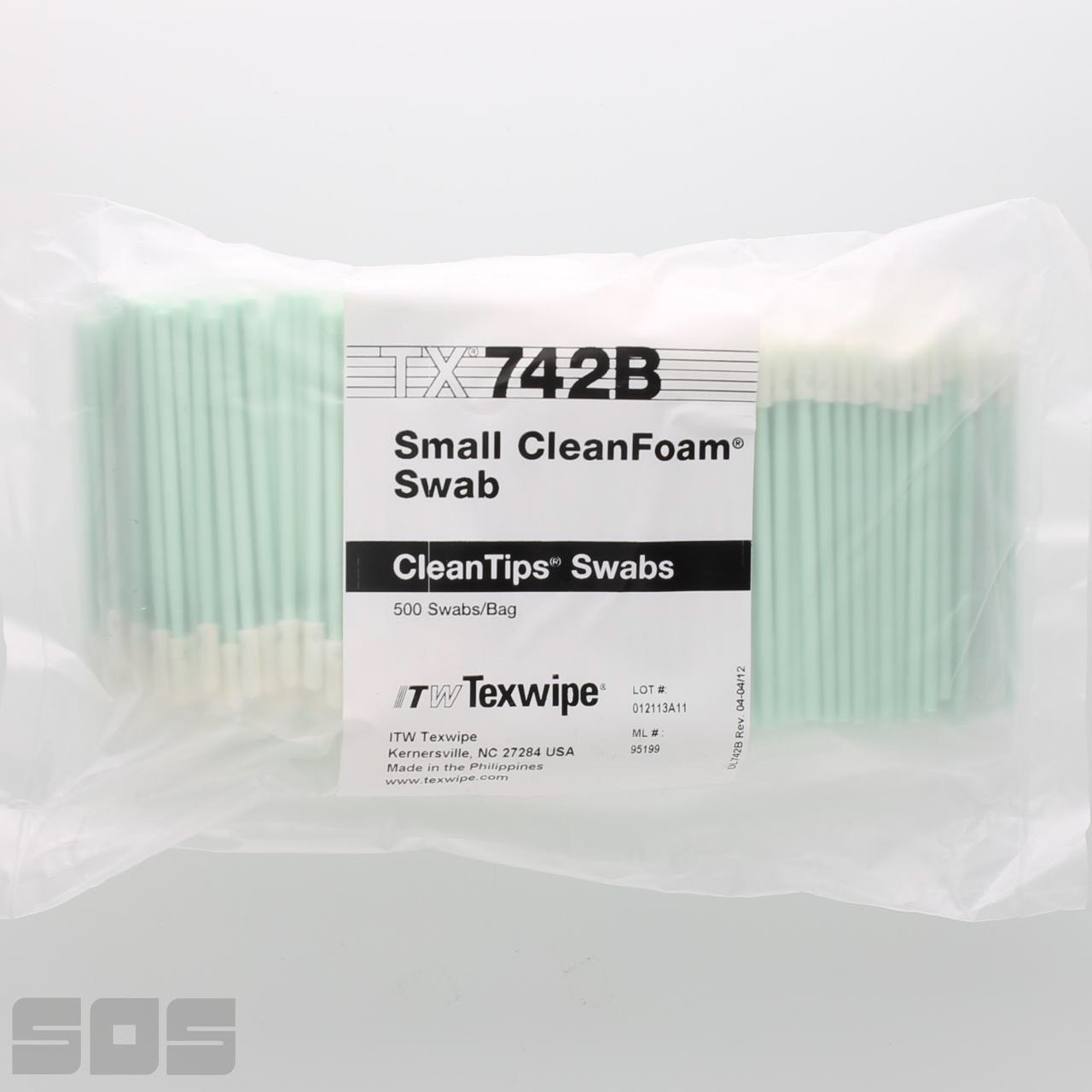
Texwipe TX742B Small CleanFoam Swab (Open Cell)

$68.06
(No reviews yet)
SKU:
TX742B BAG
Availability:
Stock Item
Shipping:
Calculated at Checkout
Quantity Option (Bag):
500 Swabs Per Bag (5 Inner Bags of 100 Swabs)
Quantity Option (Case):
5 Bags of 500 Swabs Per Case
Type:
Dry Swab
Swab Family:
CleanFoam
Swab Material:
Foam

Texwipe TX742B Small CleanFoam® Cleanroom Swab (Open Cell, 100 PPI) – Precision Foam Swab for Grooves, Corners & Recessed Features

Texwipe TX742B is a small, rigid-tip, open-cell polyurethane foam cleanroom swab engineered for precision cleaning, controlled solvent application, and particulate pickup in tight geometry where wipes cannot maintain stable contact. Built from 100 PPI CleanFoam® open-cell polyurethane, TX742B readily absorbs solvents and solutions and helps capture debris within the foam matrix, while complete thermal bond construction (no adhesive) removes a common contamination variable at the head/handle interface during solvent-wet work. It is cleanroom processed to support low background nonvolatile residues (NVRs) and ionic extractables (method-dependent), manufactured to consistent tolerances, lot coded for traceability, and packaged in a silicone-free and amide-free bag to reduce trace contamination variables in residue-sensitive processes. As with all swabs, performance is process-dependent and no swab is truly “zero-lint” in every condition; the goal is low-linting performance with disciplined, repeatable technique.

Corner-control note: TX742B is widely selected when teams need a small swab that can reach into seams, joints, corners, and intersecting surfaces without flooding the feature—delivering solvent in a controlled way and pulling debris out of the recess instead of pushing it deeper.

Specifications:
  • SKU: TX742B BAG
  • Type: Dry swab (non-sterile)
  • Swab family: CleanFoam® Series B (Open Cell)
  • Swab material: Foam
  • Head material: 100 PPI CleanFoam® open-cell polyurethane
  • Head width: 3.6 mm (0.142")
  • Head thickness: 3.5 mm (0.138")
  • Head length: 12.0 mm (0.472")
  • Handle material: Polypropylene (100% virgin polypropylene handle)
  • Handle width: 3.0 mm (0.118")
  • Handle thickness: 3.0 mm (0.118")
  • Handle length: 59.0 mm (2.323")
  • Total swab length: 71.0 mm (2.795")
  • Head bond: Thermal (no adhesive)
  • Handle color: Light green
  • Design notes: Rigid head core; compact handle
  • Packaging (bag): 500 swabs per bag (5 inner bags of 100 swabs)
  • Packaging (case): 5 bags of 500 swabs per case
  • Packaging controls: Silicone-free and amide-free bag; lot coded for traceability and quality control
  • Autoclave compatibility: Autoclavable in dry heat and steam (validate cycle parameters and post-cycle cleanliness against your SOP)
  • Temperature guidance: Appropriate for use with temperatures less than 350°F (process-dependent)
  • Typical industries: Biologics, Medical Device, Microelectronics, Optics, Pharmaceuticals, Semiconductor
  • Use environments: Commonly used across a wide range of ISO-class cleanrooms and controlled areas (final suitability depends on your process, solvent system, and cleaning method)
About the Manufacturer: 

Texwipe (an ITW company) differentiates itself in contamination-control swabbing by treating the swab as an engineered process tool, not a commodity. For CleanFoam® Series B swabs like TX742B, the practical differentiators are the controlled 100 PPI open-cell foam structure, thermal bonding to eliminate adhesives, cleanroom processing aimed at reducing background residues and ionic extractables, and consistent manufacturing tolerances that help teams standardize repeatable cleaning technique.


SOSCleanroom (SOS) supports that discipline with continuity of supply and responsive technical support—so customers can keep the exact CleanFoam® open-cell swab they qualified in service and avoid substitutions that change wetting behavior, solvent hold-up, and residue outcomes at critical wipe points.

TX742B Features:
  • 100 PPI open-cell polyurethane foam head: absorbs solvents/solutions and helps capture particulates in tight geometry (technique-dependent)
  • Complete thermal bond construction: eliminates adhesive contamination at the bond line
  • Cleanroom processed: low levels of nonvolatile residues (NVR) and ions (method-dependent)
  • Rigid head core + compact handle: repeatable contact in small features without a floppy tip that encourages aggressive scrubbing
  • Lot coded: traceability and quality control support investigations and standardized work instructions
  • Silicone-free and amide-free packaging: reduces common trace contamination variables in residue-sensitive builds
  • Virgin polypropylene handle: excellent chemical resistance and reduced additive-driven residue risk
  • Autoclavable: compatible with dry heat and steam autoclave cycles when validated to your SOP
TX742B Benefits:
  • Precision access where wipes fail: engineered for seams, joints, corners, grooves, slots, and intersecting surfaces
  • Controlled solvent delivery (process-dependent): open-cell foam holds and delivers solvent effectively for localized cleaning and pickup
  • Cleaner baseline under solvent exposure: adhesive-free thermal bonding removes a common source of bond-line residue variability
  • Repeatability and documentation support: lot coding + consistent geometry supports standardized operator technique and investigation readiness
  • Reduced trace contamination risk: silicone-free/amide-free packaging supports optics, microelectronics, and residue-critical processes
Common Applications:
  • Applying and removing lubricants, adhesives, and other solutions in a critical clean environment
  • Scrubbing recessed areas
  • Removal of excess materials and debris
  • Cleaning intersecting surfaces and joints
  • Cleaning with compatible solutions and solvents (including IPA where validated)
  • Picking up fine powders
  • Precision cleaning in biologics, medical device, microelectronics, optics, pharmaceuticals, and semiconductor controlled environments
Best-Practice Use:
  • Control wetness (damp, not dripping): open-cell foam can hold more solvent than expected. Over-wetting floods corners, migrates dissolved soils, and can dry into residue rings.
  • Pull contamination out of the feature: choose stroke direction that extracts soil from a corner/slot instead of pushing it deeper into seams.
  • Single-direction, overlapping strokes: reduce redeposit risk and stabilize repeatability across operators and shifts.
  • Rotate and retire early: once the foam face loads, it becomes a transfer tool. Rotate faces and discard before streaking begins.
  • Avoid re-dipping into shared solvent: use one-way dispensing or defined aliquots to prevent cross-contamination and keep results consistent.
  • Validate compatibility: confirm foam/handle compatibility against your solvent system, dwell time, and contact pressure (especially for aggressive chemistries).
Selection Notes (TX742B Fit-to-Task)
  • Open-cell vs. closed-cell foam: choose open-cell when absorbency and particulate capture are priorities; choose closed-cell when you need tighter solvent control and less liquid hold-up. Validate to your residue, surface, and inspection criteria.
  • Why the rigid head core matters: more controlled contact in small features can reduce the temptation to scrub, which is a common driver of residue smearing and surface abrasion.
  • Adhesive-free construction for solvent work: thermal bonding removes adhesive as a variable when your process is sensitive to extractables and streaking.
  • Temperature limitation: keep use below 350°F and confirm chemical compatibility for your specific process conditions.

Link to Texwipe Technical Datasheet:
Click Here
Texwipe.com PDF: Click Here
Texwipe Swab Comparison Chart (brochure): Click Here

Notes: Need operator-level guidance for Texwipe TX742B small open-cell CleanFoam® swabs (solvent metering, stroke discipline, and discard cadence to reduce streaking and residue spread) in ISO-class controlled environments? Open the SOSCleanroom Technical Vault tab above for practical, shop-floor technique aligned to real cleaning workflows.

SOSCleanroom.com supports contamination-control programs with best-in-class cleanroom consumables in stock, fair pricing, and responsive technical support—backed by same-day shipping options and customer service that understands real cleanroom workflows.

Product page updated: Jan. 5, 2026 (SOS Technical Staff)

© 2026 SOS Supply. All rights reserved.

The Technical Vault
By SOSCleanroom
TX742B • Open-cell CleanFoam®
Rigid tip control
Thermal bond (no adhesive)
Lot-coded traceability
Texwipe TX742B Small CleanFoam® Swab: Rigid-tip precision for seams, corners, and recessed features
Built for controlled cleaning where solvent behavior, residue rings, and re-deposition risk determine yield.
Texwipe TX742B Small CleanFoam Swab (Open Cell)
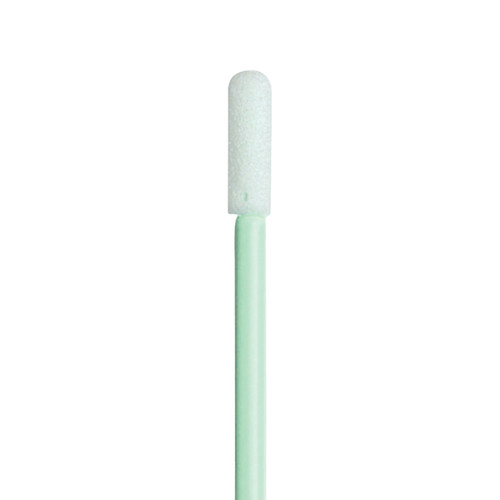
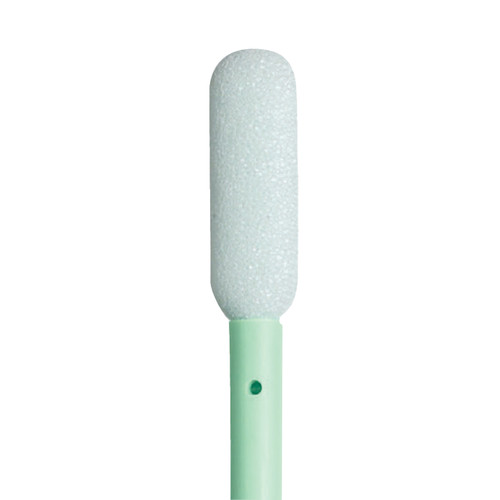
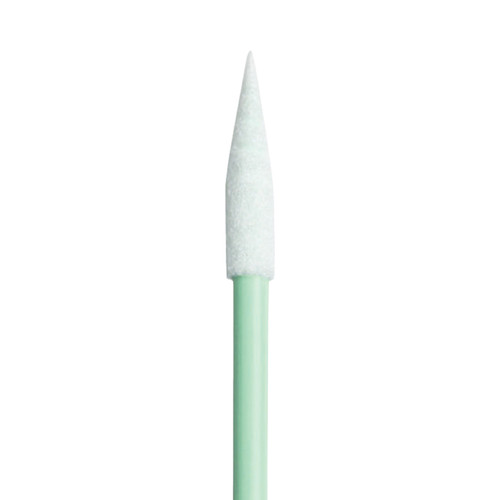
TX742B small open-cell foam head with light-green polypropylene handle.
Practical solutions in a critical environment

The TX742B is most valuable when the “cleaning problem” is actually a geometry problem: a narrow seam that traps solvent, a corner that creates tide marks during dry-down, or a recessed surface where residues smear instead of lifting. The swab’s rigid tip gives you a predictable contact patch, while the open-cell polyurethane foam provides solvent capacity and particulate pickup without introducing fibers. (Note: in cleanroom work, nothing is truly lint-free; “low-linting” is the practical goal.)

If your team is chasing intermittent streaking, re-deposition, or inconsistent wipe results between operators, this entry is written to help you standardize what matters: wetness control, stroke direction, face rotation, and discard triggers.

What is this swab used for
  • Applying and removing lubricants, adhesives, and other solutions in a critical clean environment.
  • Scrubbing recessed areas, intersecting surfaces, joints, and seam lines where wipes cannot reach.
  • Removing excess debris and picking up fine powders in localized features.
  • Precision cleaning with compatible solutions and solvents (commonly IPA), with method qualification for your surface and residue type.
  • Where food-area compliance is relevant: TX742B is described by the manufacturer as NSF Certified for use as a Cleaning Swab (P1) around food processing areas when used to avoid direct contact with food or potable water, and when used per manufacturer directions.
Why should customers consider this swab
  • Rigid-tip control in tight geometry: Keeps the foam face stable so you can pull contamination out of seams instead of “polishing” it deeper.
  • Thermal bond (no adhesive): Eliminates adhesive as a contamination contributor in the head-to-handle interface.
  • Open-cell solvent behavior you can manage: Good capacity and cushioning, with technique-driven wetness control to prevent pooling and tide marks.
  • Documentable cleanliness posture: Typical ion extractables and NVR values are published for the Series B family, supporting qualification and investigations.
  • Traceability cues for audits: Lot-coded packaging plus a trademarked light-green handle with “TEXWIPE” embossed on the handle for quick identification.
Materials and construction

TX742B uses 100 ppi CleanFoam® polyurethane foam with an open-cell structure and a polypropylene handle. The foam head is thermally bonded (not glued), which reduces the risk of adhesive-related residue or bond-line shedding. The handle is described as light green, and Texwipe notes a trademarked light-green handle with “TEXWIPE” embossed on the handle as an identification and traceability cue.

Practical implication: open-cell foam will hold and transport more solvent than sealed foam. That is an advantage for lifting residues, but it also increases the risk of “over-wet” technique and residue rings at dry-down if solvent delivery is not controlled.

Specifications in context

Dimensions matter because they determine contact pressure, solvent film thickness, and whether the swab can enter a feature without foam snag. Use the table below to map TX742B to your actual geometry (slot width, corner radius, seam depth) rather than selecting by “small/medium” naming.

Attribute TX742B (published)
Head material 100 ppi CleanFoam® polyurethane foam (open-cell)
Head width 3.6 mm (0.142")
Head thickness 3.5 mm (0.138")
Head length 12.0 mm (0.472")
Handle material Polypropylene
Handle width / thickness 3.0 mm (0.118") / 3.0 mm (0.118")
Handle length 59.0 mm (2.323")
Total swab length 71.0 mm (2.795")
Head bond Thermal
Design note Rigid head core; compact handle
Cleanliness metrics

The values below are published as typical cleanliness results for the CleanFoam® Series B family and are commonly used to support method selection, qualification rationale, and investigation documentation. Do not treat these as specification limits; qualify against your internal acceptance criteria.

Typical ion extractables (µg/swab)
Ion TX742B typical value
Calcium0.01
Chloride0.03
Fluoride0.01
Magnesium0.01
Nitrate0.04
Phosphate0.04
Potassium0.02
Sodium0.02
Sulfate0.05
Typical NVR (non-volatile residue) (mg/swab)
Extractant TX742B typical value Why it matters operationally
DIW extractant 0.03 Indicator for water-based cleaning, rinse steps, and aqueous-compatible processes.
IPA extractant 0.01 Relevant when IPA is your primary carrier; helps reduce film risk on optics, sensors, and precision surfaces.
Packaging, sterility and traceability
  • Sterility: Non-sterile presentation (TX742B).
  • Packaging configuration: 500 swabs/bag (5 inner bags of 100 swabs); 5 bags/case; 2,500 swabs total/case.
  • Packaging controls: Silicone-free and amide-free bags (supports residue control and compatibility posture).
  • Traceability: Lot-coded for traceability and quality control. For investigations, capture swab lot, solvent grade, dispensing method, and technique notes (wetness, stroke count, inspection result).
  • Autoclave posture (manufacturer series statement): Autoclave safe / autoclavable in dry heat and steam. Validate cycle parameters and post-cycle cleanliness requirements in your quality system.
  • Country of origin (manufacturer statement): Non-sterile — Made in the Philippines.
Best-practice use

TX742B performs best when you treat it as a controlled contact tool: lift, retain, and remove contamination from the feature—do not “buff” a residue across a larger area. Open-cell foam rewards good technique and punishes over-wetting.

Operator-level swabbing technique module (corners, seams, and recessed features)
  • Wet-to-damp discipline: Apply solvent to the foam, then blot to a defined “conditioning” area so the swab is damp—not dripping. If a bead forms on the edge, you are too wet for corner work.
  • One direction beats “scrubbing”: Use single-direction, overlapping strokes to pull soil out of a seam. Change direction only with a fresh face.
  • Face rotation schedule: Plan rotations (for example: edge 1 → edge 2 → edge 3 → discard). If you can see a sheen change or discoloration, assume the face is loaded.
  • Pressure control: Use the lowest force that maintains contact. Excess force collapses pores, increases drag, and can smear mobilized residues into streak lines.
  • Tide mark prevention: Do not flood corners. If you see pooling, stop; wick back with a clean face, then restart with less solvent. Pooling is a defect mechanism, not a technique step.
  • Solvent compatibility gate: IPA is common, but always qualify compatibility with coatings, adhesives, elastomers, and plastics under real dwell time. “It cleaned well” is not the same as “it is compatible.”
  • Contamination control hygiene: Never re-dip a used swab into a shared solvent container. Use one-way dispensing (aliquoted solvent, dropper, or controlled bottle) and reseal inner bags promptly.
Common failure modes
  • Over-wetting and pooling: Creates residue rings and redistributes contamination into corners. Prevent with wet-to-damp conditioning and blotting discipline.
  • Re-deploying a loaded face: Turns the swab into a transfer tool. Prevent with planned face rotation and early discard triggers.
  • Foam snagging on burrs: Sharp edges can abrade foam. Prevent with lower pressure, stable approach angle, and burr remediation upstream when feasible.
  • Technique drift between operators: One person “scrubs,” another “wipes,” outcomes differ. Prevent with a simple technique card: wetness target, stroke count, rotation rule, inspection point.
  • Assuming cleanliness metrics equal “pass”: Typical values support selection; they do not replace your facility acceptance criteria or validation needs.
Closest competitors

In this functional class, the meaningful differentiators are foam architecture (open-cell vs sealed), bond method (thermal vs adhesive), packaging controls, and whether cleanliness characterization is published in a way that supports qualification and investigations.

  • Contec foam swab families (small-tip lines): Compare bond approach, packaging controls, and whether published ions/NVR and lot traceability posture meet your documentation requirements.
  • Berkshire Lab-Tips® foam swabs: Compare open-cell behavior under your solvent (film vs flooding), and verify whether published cleanliness metrics align to your acceptance criteria and inspection method.
  • Puritan controlled-environment foam swabs: Compare consistency controls, published technical documentation depth, and availability stability (to avoid unqualified substitutions).
Critical environment fit for this swab

TX742B is a strong fit when your risk is localized, geometry-driven contamination: corners, seams, joints, and recessed surfaces where residues can migrate, streak, or re-deposit during dry-down. It is also well suited when you need a small contact patch with predictable stiffness so the method can be trained and repeated across shifts.

SOSCleanroom supports ITW Texwipe swab programs with continuity-of-supply discipline and the documentation posture customers expect in regulated or audit-heavy environments. That partnership reduces last-minute substitutions, keeps packaging and lot-coding consistent, and helps teams keep qualified consumables aligned to production schedules. If you need help selecting a swab family for a specific residue, geometry, or inspection method, SOSCleanroom can help you map the tool to the process instead of guessing by category names.

SOSCleanroom note about SOP's

The Technical Vault is written to help customers make informed contamination-control decisions and improve day-to-day handling technique. It is not your facility’s Standard Operating Procedure (SOP), batch record, or validation protocol.

Customers are responsible for establishing, training, and enforcing SOPs that fit their specific risks, products, equipment, cleanroom classification, and regulatory obligations. Always confirm material compatibility, cleanliness suitability, sterility requirements, and acceptance criteria using your internal quality system and documented methods.

If you adapt any technique guidance from this entry, treat it as a starting template. Your team should review and approve the final method, then qualify it for your specific surfaces, solvents, cleanliness limits, inspection methods, and risk profile. In short: use these best-practice suggestions to strengthen your SOPs—not to replace them.

Source basis
SKU-specific pages and PDFs
  • SOSCleanroom product page (TX742B): https://www.soscleanroom.com/product/swabs/texwipe-tx742b-small-cleanfoam-swab-open-cell/
  • Manufacturer product page (TX742B): https://www.texwipe.com/small-cleanfoam-tx742b
  • SOS-hosted PDF copy (primary stable reference; CleanFoam® Series B incl. TX742B): https://www.soscleanroom.com/content/texwipe_pdf/740b%20741b%20742b%20751b%20752b%20757b.pdf
  • Texwipe manufacturer Technical Data Sheet (CleanFoam® Swab Series, US-TDS-051 Rev. 09/21): https://www.texwipe.com/images/uploaded/documents/Swabs/Texwipe-Cleanfoam-Swabs-TDS.pdf
Standards and regulatory bodies referenced for context
  • International Organization for Standardization (ISO) cleanroom classification context (ISO 14644-1:2015): https://www.iso.org/standard/53394.html
  • FDA (Food and Drug Administration): https://www.fda.gov/
  • ASTM (American Society for Testing and Materials): https://www.astm.org/
  • IEST (Institute of Environmental Sciences and Technology): https://www.iest.org/
SOSCleanroom is the source for this Technical Vault entry.
Briefed and approved by the SOSCleanroom (SOS) staff.
If you have any questions please email us at Sales@SOSsupply.com
Last reviewed: January 6, 2026
© 2026 SOSCleanroom

Videos Hide Videos Show Videos