Precision Cleaning in Tight Geometry: When Open-Cell Foam Swabs Outperform Cloth and Closed-Cell Tips for Fluid Pickup
The Technical Vault
By SOSCleanroom
ISO 14644 Operations
Small-Feature Access
Fluid Pickup & Solvent Control
Residue & Rework Reduction
Technique Repeatability
Texwipe TX751B — what this small compressed CleanFoam® (open-cell) swab is designed to control
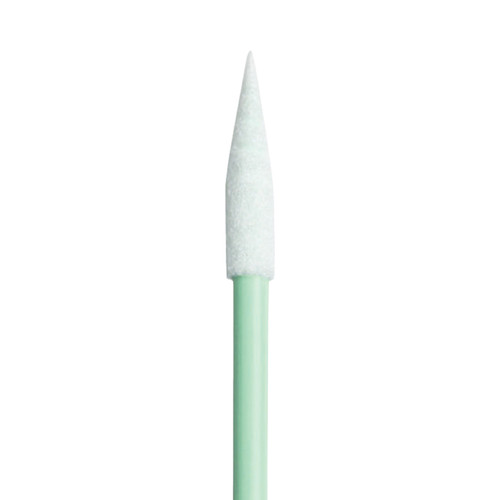
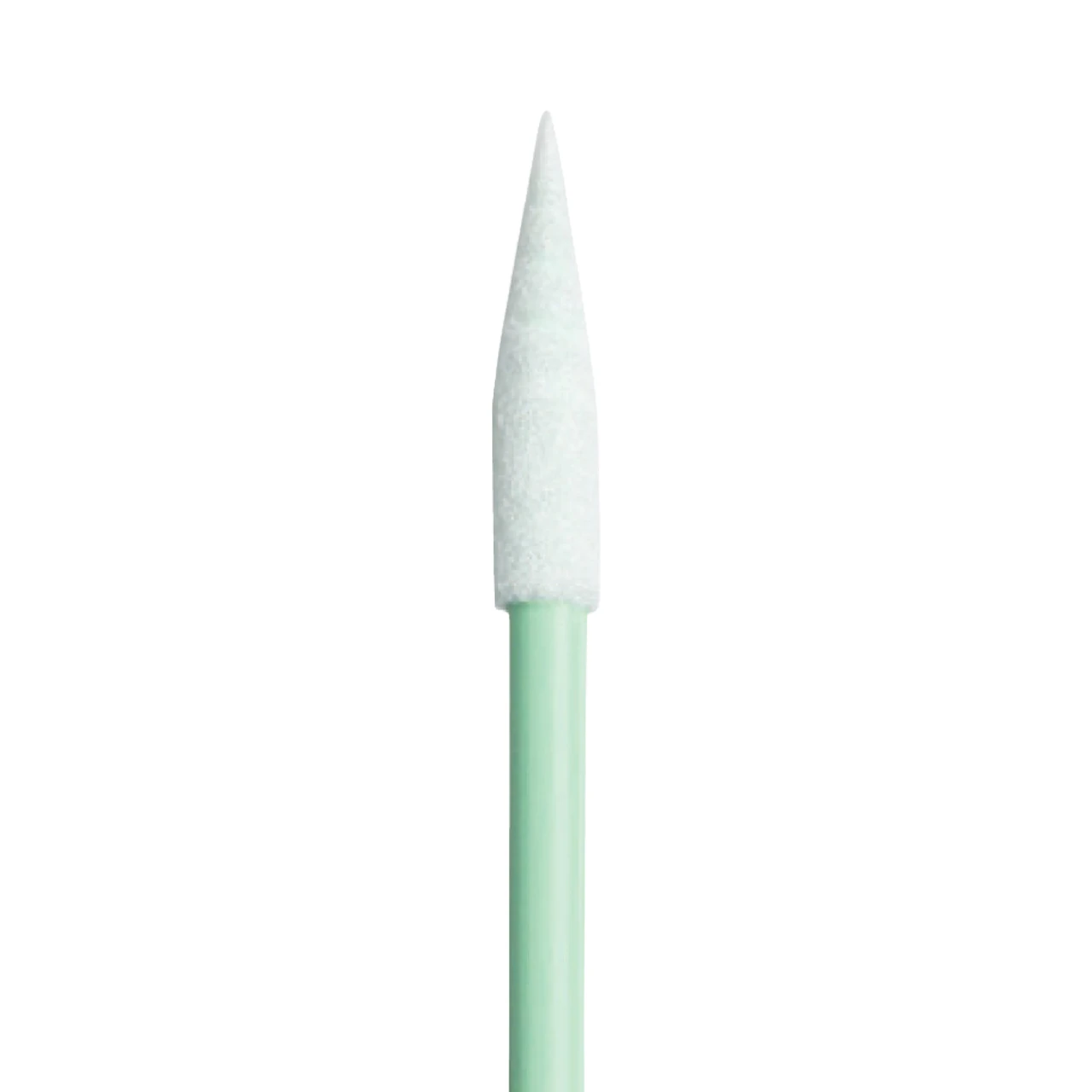
Texwipe TX751B is a small compressed CleanFoam® swab built with open-cell polyurethane foam.
It is commonly selected for precision cleaning and controlled solution application/removal in very small features—
tight corners, fine grooves, ports, seams, and interfaces where a larger swab cannot maintain clean contact control.
Open-cell foam is frequently used when the process requires higher fluid pickup than closed-cell foam tips,
while still maintaining low-lint behavior compared with textile swabs.
TX751B is used when technicians need to manage solvent films and pull contamination out of small geometry without leaving fibers behind.
The “compressed” foam construction supports a more stable tip geometry for controlled contact and improves technique repeatability on detailed work.
Operations takeaway: Choose TX751B when you need a small tip that can both reach and pick up—especially where liquid
must be controlled in a confined feature and lint is unacceptable.
ISO-first context: swab choice is a risk-based control in confined-feature cleaning
ISO 14644-5 treats cleaning as an operational control based on defined methods, trained personnel practices, and controlled consumables.
In confined features, the dominant risks are method-driven: over-wetting, smearing, poor alignment, and reusing loaded contact surfaces.
Swab material and geometry help control these variables, but the method (wetness target, stroke pattern, and change-out rules) is still the primary control.
USP-influenced environments apply the same discipline: cleaning and wipe steps must be repeatable and defensible. If sterile presentation or transfer is required,
use sterile variants and follow sterile transfer documentation and handling controls.
Technical data summary (reference — consult current manufacturer TDS for controlled programs)
| SKU |
TX751B |
| Swab family |
CleanFoam® (compressed) |
| Foam type |
Open-cell polyurethane foam |
| Use intent |
Small-feature cleaning + higher fluid pickup vs. closed-cell foam |
| Sterility |
Non-sterile (select sterile variants if required by workflow) |
Selection note: Open-cell foam typically increases solvent uptake and pickup behavior. If the process requires minimal solvent carry-in
(thin-film application only), a closed-cell foam swab may be the better control choice.
Best-practice use (small geometry, controlled wetness, and early change-out)
Best practice begins with handling discipline. Open the package only when ready to use, remove one swab at a time, and touch only the handle. Keep the foam head isolated from
gloves, benches, and packaging edges. If solvent is used, apply it to the foam to reach a controlled damp condition; avoid dripping. Because open-cell foam can hold more liquid,
it is especially important to define a wetness target in the SOP so operators do not unintentionally flood seams and interfaces.
Use straight, single-direction passes with light, consistent pressure. In narrow grooves or ports, align the tip with the feature and avoid twisting torque, which can smear residues.
Rotate the contact surface so each pass uses a clean patch and replace the swab immediately when it begins to smear rather than lift contamination. For residue-sensitive work, a two-pass
method is often used: one damp pass to mobilize contamination and a second swab to pick up dissolved material before it dries into a film.
After removing contamination from a small feature, a follow-up wipe may be appropriate (depending on the surface and process) to remove any remaining solvent film or dissolved residues.
Where the feature geometry prevents wiping, controlled evaporation per SOP may be the correct approach.
Typical cleanroom failures and how to avoid them (ISO & USP perspective)
- Flooding a seam/interface: Open-cell foam can carry more liquid. Prevention: defined damp target, smaller sections, and controlled application.
- Smearing in a groove: Misalignment or twisting torque. Prevention: align tip with feature and avoid scrubbing.
- Residue returns after drying: Dissolved contamination redeposits. Prevention: second-pass pickup and early change-out.
- Particles introduced by handling: Tip touches glove/bench/carton edges. Prevention: handle-only discipline (ISO 14644-5 personnel practices).
- Shift-to-shift variability: Method drift. Prevention: define wetness target, stroke count, and change-out triggers; train and audit (ISO 14644-5).
- Non-sterile used where sterile transfer is required: Program non-conformance. Prevention: select sterile variants and follow transfer controls (USP concepts).
Suggested companion products and technical rationale
SOSCleanroom suggests the following companion items to support consistent technique: personnel contamination control (gloves), controlled wetness (solution),
and follow-up pickup (wiper). Links are provided for internal reference.
Defensible pairing principle: Open-cell foam supports higher solvent uptake and pickup behavior; solution selection controls solvency and drying behavior;
wipers control final pickup; gloves control operator-introduced contamination.
Disclaimer
This Technical Vault content is provided for general operational guidance and procurement planning only. It does not replace facility SOPs,
validation protocols, quality risk assessments, environmental monitoring programs, or manufacturer documentation (TDS/SDS/label instructions).
Always follow applicable ISO standards, USP chapters, and site-specific procedures. TX751B is non-sterile; if sterile presentation/transfer is required,
select sterile products and follow your facility transfer procedures and documentation controls.
Questions? Email Sales@SOSsupply.com or call (214) 340-8574.
© 2026 SOSCleanroom. All rights reserved.