The Technical Vault
By SOSCleanroom
Last reviewed: January 5, 2026
Texwipe STX714A sterile Alpha® polyester knit swab: broad-face control for cleaning and surface sampling
Practical solutions in a critical environment
In a controlled environment, a sterile swab is not just a “tool” — it is often part of the evidence trail. You are either removing residue without
redistributing it, or collecting residue so a validated method can demonstrate the surface is acceptable. STX714A is built for that reality: a large,
rectangular knit head that gives you consistent contact area and repeatable pressure when you are cleaning flats, wiping down small panels, or sampling
defined surface areas.
Nothing is truly free of lint; outcomes are governed by technique, surface condition, and how the solvent evaporates on the substrate.
What is this swab used for
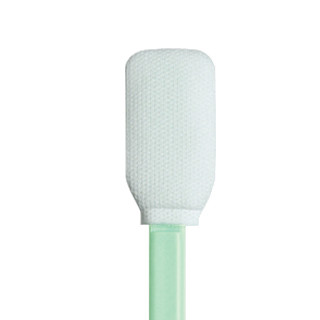
STX714A is a sterile, individually sleeved, large rectangular-head polyester knit cleanroom swab used for precision cleaning and surface sampling in
controlled environments. It is typically selected when a wider swab face improves coverage and repeatability.
- Cleaning and wipe-down of flat or gently contoured surfaces: trays, work surfaces, equipment housings, panels, fixtures.
- Defined-area surface sampling for investigations, trending, and cleaning validation support.
- Applying or removing solutions (commonly IPA), where controlled wetness and a stable swab face reduce streaking and redeposition.
- Aseptic transfer workflows where individual sleeves, triple-bagging, and expiration dating support controlled introduction.
Why should customers consider this swab
-
Sterile presentation that holds up operationally: 1 swab per peel-apart sleeve, sleeves lot coded with expiration dating, then staged in triple-bagged
inner packaging for controlled transfer.
-
Thermal bond head-to-handle construction (no adhesive at the bond), reducing a common extractables variable and improving consistency swab to swab.
-
Double-layer knitted polyester head for broad-face coverage with controlled “give,” useful for one-direction strokes on flats without aggressive scrubbing.
-
Low-background material set: cleanroom laundered knit and published ionic/NVR data to support method blanks, investigations, and audit questions.
-
Practical traceability and segregation cues: trademarked light-green handle with “TEXWIPE” embossed on the handle to help prevent mix-ups in multi-swab programs.
-
Gamma irradiation with stated sterility assurance level and shelf-life controls, aligning with regulated workflows that require documentation discipline.
Materials and construction
The swab head is knitted Alpha® polyester (100% continuous-filament polyester knit) with a double-layer knit structure. In practical terms, the knit head
is designed to resist snagging and abrading while maintaining a stable face for controlled strokes. That matters when you are trying to remove residue
without shredding the swab or leaving fibers behind.
The handle is polypropylene and the head is thermally bonded to the handle. Eliminating adhesives at the bond reduces the chance of localized extractables
that can complicate blanks or show up as unexplained background in sensitive residue work.
Handle identification is part of real-world control: the light-green handle and “TEXWIPE” embossing are intended as operational cues for segregation,
traceability, and audit defensibility.
Specifications in context
STX714A’s 12.7 mm (0.500") head width and 25.7 mm (1.012") head length create a broad swab face that helps standardize contact area for both cleaning and
sampling. The long, easy-grip polypropylene handle supports consistent angle control and keeps gloves, sleeves, and gowning material away from the contact
zone when working inside equipment, hoods, and isolators.
| Head material |
Knitted Alpha® polyester; double-layer polyester knit head |
| Head width |
12.7 mm (0.500") |
| Head thickness |
4.2 mm (0.165") |
| Head length |
25.7 mm (1.012") |
| Handle material |
Polypropylene |
| Handle width |
5.2 mm (0.205") |
| Handle thickness |
3.0 mm (0.118") |
| Handle length |
101.8 mm (4.008") |
| Total swab length |
127.5 mm (5.020") |
| Head bond |
Thermal bond (no adhesive at the bond) |
| Handle color |
Light green |
| Design notes |
Flat head paddle; long, easy-grip handle |
Cleanliness metrics
The values below are published as typical analyses, not specifications. In practice, that distinction matters: you use these numbers to understand the
expected background contribution of the swab and to design method blanks and acceptance logic, not as a substitute for qualification work under your own
process conditions.
Ion extractables (µg/swab)
| Ion |
STX714A |
| Calcium | 0.01 |
| Chloride | 0.05 |
| Fluoride | 0.02 |
| Magnesium | 0.02 |
| Nitrate | 0.02 |
| Phosphate | 0.11 |
| Potassium | 0.04 |
| Sodium | 0.04 |
| Sulfate | 0.09 |
Nonvolatile residue (NVR) for STX714A (mg/swab)
| Extractant |
STX714A |
| DIW extractant | 0.01 |
| IPA extractant | 0.03 |
Packaging, sterility and traceability
In sterile programs, packaging is part of contamination control. STX714A is structured for staged introduction: each swab is individually packaged in a
peel-apart sleeve, each sleeve is lot coded and has an expiration date, and fifty sleeves are triple-bagged for transfer into sterile areas. Triple-bagged
inner packaging is commonly placed in a case liner as an additional protective layer.
Sterility is achieved via gamma irradiation to a stated sterility assurance level (SAL) of 10-6, with validation aligned to AAMI guidelines,
and the sterile shelf life is stated as 3 years from date of manufacture for the sterile Alpha® polyester knit swab series.
Packaging configuration (STX714A): 1 swab/sleeve; 50 sleeves per inner bag (triple-bagged); 10 bags per case; 500 swabs total per case.
For day-to-day control, treat lot coding as an operational tool: capture lot and expiration in sampling records when results may drive investigations,
deviations, or trending decisions.
Best-practice use
Technique module: operator controls that prevent streaks, redeposition, and “mystery” results
-
“Damp” solvent technique: Aim for damp, not dripping. Dispense onto the head or touch to a controlled wetting source,
then blot once on a clean, approved surface if needed. Flooding creates pooling, streaks, and tide marks as solvent evaporates.
-
Stroke-count logic: Use single-direction, parallel strokes with overlap (typically 25% to 50%). Rotate the head to a clean face as it loads.
Stop when the swab face looks loaded or begins to drag; do not “scrub it clean” by reworking the same area.
-
Geometry control: Keep gloves and sleeves out of the contact path. Use the handle length to maintain a stable angle and avoid knuckle contact
on adjacent “clean” areas. For edges and corners, lead with the flat face rather than digging with the seam.
-
Pressure guidance: Use enough pressure to maintain full contact, not enough to abrade or leave residue lines from a compressed knit. If you see
chatter marks or streaking, reduce pressure and control wetness.
-
Solvent compatibility: IPA is common, but coatings and polymers vary. Validate solvent compatibility with the surface, adhesive systems, and any
critical optical or functional coatings before routine use.
-
Handling discipline: Open only what you will use. Stage sleeves to prevent accidental contact. Avoid re-dipping a used swab into a bulk solvent container.
Use single-use aliquots or a dispenser to prevent reservoir contamination.
-
Disposal and documentation: Discard after one use. When samples support investigations or validation, record swab lot/expiration, area sampled, solvent used,
stroke count/pattern, and who performed the work.
For aseptic transfer, protect the packaging logic: open outer layers in the dirtier zone, then move the triple-bagged inner package forward per your
gowning and material transfer flow. Triple-bagging only reduces risk if you respect zones and do not collapse layers into the same workspace.
For sampling, treat the swab as part of a controlled method. Define the area, use a repeatable stroke pattern, control wetness, and avoid re-contacting a “clean”
zone with a loaded swab face. Variability in technique is one of the fastest ways to create non-actionable data.
Common failure modes
-
Over-wetting and pooling: Promotes spreading and residue rings after evaporation. Control volume and keep the head damp.
-
Re-dipping into solvent: Cross-contaminates the reservoir and compromises subsequent work. Use single-use aliquots or dispensers.
-
Undefined area and inconsistent strokes: Produces results that cannot be compared. Use templates or documented dimensions and stroke counts.
-
Working “dirty to clean”: Smears residues into acceptable zones. Work cleanest to dirtiest and isolate rework areas.
-
Technique variability across operators: Becomes the dominant error source. Train, qualify, and periodically re-qualify samplers and cleaners.
Closest competitors
For a large, flat-head polyester knit swab, the closest alternatives are typically other knit polyester paddle swabs with thermal bonding and polypropylene
handles. The meaningful differences are usually in published cleanliness data, packaging controls, and traceability discipline, not in the basic concept.
-
Berkshire Lab-Tips® large knitted polyester swabs (LTP125 family): Comparable knit polyester paddle format. Evaluate how contamination data are presented,
what lot coding looks like in your receiving flow, and whether packaging layers match your aseptic transfer expectations.
-
Contec CONSTIX® sealed polyester swabs (SP series, e.g., SP-3): Thermally bonded knit polyester on polypropylene with an emphasis on low residue/low particulate
for solvent work. Confirm head geometry and packaging configuration relative to your sampling method and cleanroom introduction procedures.
Critical environment fit for this swab
STX714A fits programs where you need a broad, repeatable swab face and a sterile presentation that supports controlled transfer. It is particularly useful
when documentation matters: cleaning validation support, investigative sampling, and routine control that must stand up to internal QA review and external scrutiny.
SOSCleanroom supports STX714A as part of a long-running relationship with ITW Texwipe focused on continuity of supply and documentation discipline. That means
stable product identification, consistent technical documentation access, and practical support when you need to tie a result back to a consumable lot.
Operationally, this also has day-to-day impact: fast shipping options, responsive customer service, and repeat-order continuity help keep sterile programs from
substituting “look-alike” swabs that can quietly change background levels and undermine comparability.
Source: SOSCleanroom. Last reviewed: January 5, 2026. Briefed and approved by the SOSCleanroom (SOS) staff.
© 2026 SOSCleanroom