Texwipe STX1704 Sterile Revolve 4" x 4" Upcycled Polyester Cleanroom Wiper

$837.88
(No reviews yet)
SKU:
STX1704
Availability:
Stock Item
Shipping:
Calculated at Checkout
International Shipping:
Available for this product
Quantity Option (Case):
50 Bags of 50 Wipers Per Case
Type:
Dry Wiper
Wiper Family:
Revolve
Wiper Material:
Polyester
Wiper Size:
4" x 4"
Wiper Edge:
Sealed Edge
Sterile:
Yes
ISO Class:
ISO 4 (Class 10) - ISO 8 (Class 100,000)
Country of Origin:
Made in USA

STX1704 Sterile Revolve 4" x 4" 100% Upcycled Polyester Cleanroom Wiper (Sealed Edge)

STX1704 Revolve is a low-linting (no wiper is truly ‘zero-lint’ in every process condition) sterile cleanroom wiper made from 100% upcycled polyester with a sealed edge. It is designed for critical cleaning, spill control, and controlled solution application in ISO-class controlled environments, and it is supplied in sterile barrier packaging to support aseptic handling and audit-ready programs.

Program note: STX1704 is typically chosen when teams want a small-format sterile wipe for tight work zones (ports, fittings, trays, and tools) while also supporting sustainability goals through upcycled polyester content.

Specifications:
  • Size: 4" x 4" (10 cm x 10 cm) nominal
  • Material: 100% upcycled polyester
  • Type: Dry wiper
  • Edge: Sealed edge
  • Sterile: Yes — gamma irradiated to a Sterility Assurance Level (SAL) of 10-6 (AAMI guidance referenced by manufacturer)
  • Packaging: 50 wipers/bag; case unit: 50 bags/case (2,500 wipers/case); triple-bagged with a case liner forming an additional barrier layer
  • Use environments: ISO 4, ISO 5, ISO 6, ISO 7, ISO 8 listed (final suitability depends on your process and cleaning method)
  • Traceability: Individually lot coded
About the Manufacturer: 

Texwipe (an ITW company) differentiates itself in cleanroom wiping by treating the wiper as an engineered product, not a commodity consumable. For Revolve, Texwipe positions the platform around sealed-edge control, automated processing, and measured contamination performance—while advancing sustainability through 100% upcycled polyester feedstock.


For sterile Revolve formats like STX1704, Texwipe emphasizes sterile barrier discipline (triple-bagging plus a case liner) and gamma irradiation to a defined sterility assurance level. SOSCleanroom (SOS) supports that manufacturing discipline with a close working relationship with Texwipe focused on continuity of supply, clean documentation handoff (certs, lot traceability), and practical application support—so customers can standardize wiping materials with predictable performance while maintaining procurement reliability and audit readiness.

STX1704 Features:
  • 100% upcycled polyester with sealed-edge construction
  • Triple-bagged with a case liner forming an additional layer of protection
  • Gamma irradiated to SAL 10-6 per AAMI guidance (manufacturer-stated)
  • Designed for low levels of ions, NVRs (non-volatile residues), particles, and fibers for critical cleaning applications
  • Designed for high sorption capacity for spill control, cleaning, and solution application
  • Meets USP <797> and USP <800> wiper requirements (manufacturer-stated)
  • Autoclave safe (dry wipers only)
  • Individually lot coded for traceability and quality control
STX1704 Benefits:
  • Sterile barrier confidence: Multi-layer packaging supports staged dispensing and transfer practices in aseptic workflows.
  • Edge integrity on fixtures: Sealed-edge construction is designed to resist fraying and snagging where cut edges can shed under pressure wiping.
  • Controlled wet processing support: High sorption helps with spill pickup and controlled application/removal of process solutions (process-dependent).
  • Audit-ready traceability: Lot coding supports investigations, qualification, and documentation review.
  • Sustainability signal: Upcycled polyester supports programs seeking reduced post-consumer waste and lower environmental impact.
Common Applications:
  • Wiping and cleaning surfaces, equipment, and parts
  • Applying and removing lubricants, adhesives, residues, and other solutions including disinfectants
  • Cleaning with solvents such as isopropyl alcohol (IPA), ethanol, acetone, and degreasers (verify compatibility to your chemistry and SOP)
  • Lining trays for holding, protecting, drying, and storing parts, equipment, and devices
Best-Practice Use:
  • Aseptic handling: Open outer bags outside the cleaner zone; introduce the innermost bag per your transfer SOP to minimize touch contamination.
  • Fold for control: For a 4" x 4", fold in half (then half again as needed) to create multiple clean faces; rotate faces instead of re-wiping with a loaded surface.
  • Wipe pattern: Use straight-line strokes to reduce re-deposition and streaking.
  • Wet vs. dry: If wetting with a solvent/disinfectant, dampen—do not over-saturate—to maintain control and reduce dripping.
  • Change-out triggers: Replace when a face becomes visibly soiled, tacky, or begins leaving streaks/residue.
Selection Notes (STX1704 vs. Other Options)
  • STX1704 vs. TX1704: Same Revolve family and nominal size, but STX1704 is sterile (multi-layer packaging and gamma irradiation) for aseptic workflows and controlled transfers.
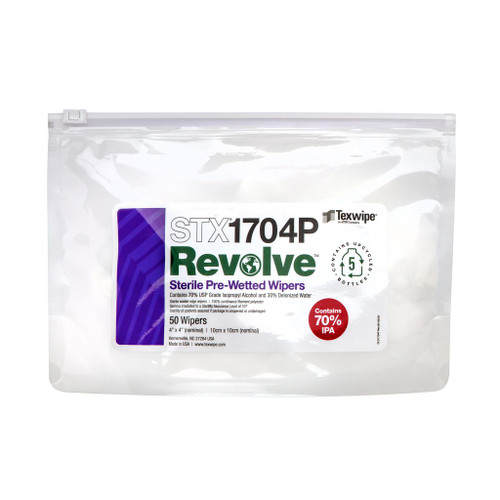
  • Dry vs. pre-wetted (STX1704P): If you want consistent wetting and reduced solvent handling, consider STX1704P (sterile, pre-wetted 70% IPA/30% DI water) where appropriate for your process.
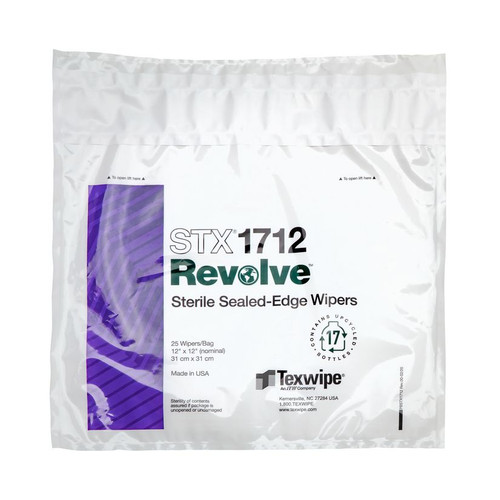
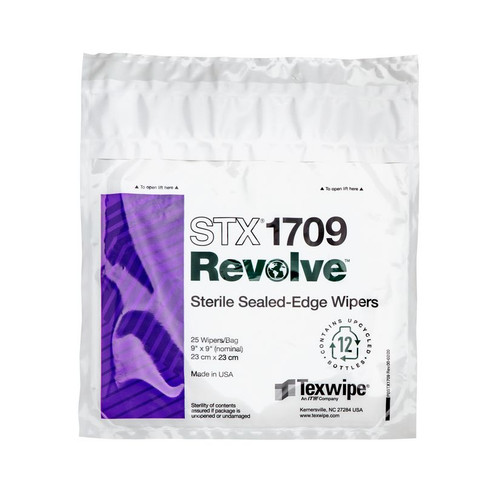
  • Size-up/size-down: Use 4" x 4" for tight work areas and spot cleaning; choose STX1709 (9" x 9") or STX1712 (12" x 12") when coverage per wipe matters.

Link to Texwipe Technical Datasheet:
SOS Hosted PDF Copy | Texwipe PDF

Additional Revolve Docs: Revolve Q&A | Revolve TechNote

Other Similar Products Available From SOSCleanroom.com

Revolve Dry Wipers

  • TX1704: 4" x 4" (10 cm x 10 cm) dry wipers, 100 wipers/bag
  • TX1709: 9" x 9" (23 cm x 23 cm) dry wipers, 100 wipers/bag
  • TX1712: 12" x 12" (31 cm x 31 cm) dry wipers, 100 wipers/bag

Revolve Pre-Wetted Wipers (70% IPA)

  • TX1704P: 4" x 4" (10 cm x 10 cm) pre-wetted, 50 wipers/bag
  • TX1709P: 9" x 9" (23 cm x 23 cm) pre-wetted, 50 wipers/bag
  • TX1712P: 12" x 12" (31 cm x 31 cm) pre-wetted, 50 wipers/bag

Revolve Sterile Wipers

  • STX1704: 4" x 4" (10 cm x 10 cm) dry sterile wipers, 50 wipers/bag
  • STX1709: 9" x 9" (23 cm x 23 cm) dry sterile wipers, 100 wipers/bag
  • STX1712: 12" x 12" (31 cm x 31 cm) dry sterile wipers, 100 wipers/bag
  • STX1704P: 4" x 4" (10 cm x 10 cm) sterile pre-wetted, 50 wipers/bag
  • STX1709P: 9" x 9" (23 cm x 23 cm) sterile pre-wetted, 50 wipers/bag
  • STX1712P: 12" x 12" (31 cm x 31 cm) sterile pre-wetted, 50 wipers/bag

Notes: Looking for application guidance or qualification context for Texwipe STX1704 sterile Revolve 4" x 4" upcycled polyester cleanroom wipers? Open the SOSCleanroom Technical Vault tab above for practical wiping technique, selection notes (STX1704 vs. alternatives), and the documentation details teams typically review when standardizing sterile wipes across ISO-class controlled environments.

SOSCleanroom.com supports contamination-control programs with cleanroom consumables in stock, fair pricing, and responsive technical support—backed by same-day shipping options and customer service that understands real cleanroom workflows.

Product page updated: Jan. 4, 2026 (SOS Technical Staff)

© 2026 SOS Supply. All rights reserved.

The Technical Vault
By SOSCleanroom
STX1704 sterile Revolve 4" x 4" sealed-edge wipers: small-format aseptic wiping with sustainability built in
Last reviewed: Jan. 4, 2026 |  Audience: contamination control, cleanroom operations, EHS, quality

Texwipe STX1704 Sterile Revolve is a 4" x 4" (10 cm x 10 cm) dry, sterile, sealed-edge cleanroom wiper made from 100% upcycled polyester. It is engineered for critical wiping where you want a compact wipe face for tight geometries (fixtures, tooling, ports, small panels) without losing the process controls that matter in sterile environments: validated sterility, protective packaging layers, and lot-level traceability.

STX1704 is gamma irradiated to a Sterility Assurance Level (SAL) of 10-6 and supplied triple-bagged with a case liner as a fourth barrier layer. Practically, that packaging architecture is what enables cleaner transfers (warehouse → gowning → cleanroom) and supports investigation-ready documentation when a deviation, excursion, or customer audit asks, “What lot was used, where, and when?”

What it’s for

Aseptic and sterile-area wiping of surfaces, tools, and parts where a small wipe is operationally safer and more controllable than a larger sheet. Typical use includes wiping glove boxes and transfer ports, cleaning fixtures and jigs, removing light residues (lubricants, adhesives, films) prior to assembly, lining small trays, and dry wipe steps that precede (or follow) a validated chemical cleaning or disinfection step. STX1704 is also commonly selected for USP <797> and USP <800> workflows that require cleanroom-compatible wipers as part of compounding and contamination control routines.

Decision drivers

For sterile wiping, the product is only half the story. The other half is how the wiper behaves under pressure, folds, and transfers — and how well it supports your documentation and audit expectations.

  • Sterility assurance and packaging barriers: Gamma irradiation to SAL 10-6, triple-bagged with a case liner, supports controlled transfers into higher-grade spaces and reduces handling-driven contamination risk.
  • Edge strategy (sealed edge): Sealed edges are selected to reduce edge wear and perimeter shedding when wiping corners, fasteners, textured coatings, and fixture features.
  • Compact wipe geometry: 4" x 4" enables tighter wipe paths, better control on small surfaces, and easier “clean-face” management for detail work.
  • Cleanroom fit (ISO range): Listed for ISO Class 4–8 on SOSCleanroom; Revolve line guidance commonly states ISO Class 3–7. Use that as an initial filter, then qualify to your task, surface, and facility requirements.
  • Traceability: Individually lot coded; Certificates of Compliance/Analysis/Irradiation are typically available via manufacturer support channels.
  • Sustainability without additives: Revolve uses upcycled (rPET) polyester yarn and avoids adding other yarn types—important when you want sustainability without introducing new contaminant variables.
  • Autoclave compatibility (dry only): Useful for facilities that apply autoclave steps to certain dry consumables (validate your cycle and packaging approach).
Materials and construction

STX1704 is a knit polyester wiper built from 100% upcycled polyester (rPET) yarn, then processed through Texwipe’s automated manufacturing and cleaning controls. Polyester is widely used in critical wiping because it is durable, compatible with many cleanroom chemistries, and maintains integrity during controlled wipe strokes.

The sealed-edge perimeter is a deliberate contamination control feature: edges are where many wipers mechanically break down first during real wiping (corners, threads, equipment seams). The practical goal is consistent low-linting behavior under expected wipe pressure and surface roughness; no wiper is truly “lint-free” in every process condition.

Specifications in context

SKU: STX1704  |  Format: Dry, sterile cleanroom wiper  |  Size: 4" x 4" (10 cm x 10 cm)  |  Material: 100% upcycled polyester  |  Edge: sealed edge.

Packaging (sterile): 50 wipers per bag, triple-bagged; 50 bags per case (2,500 wipers/case). Triple-bagging plus a case liner is not just “extra plastic” — it is a transfer control that helps preserve sterility and cleanliness through staging and gowning workflows.

Sterility: Gamma irradiated to SAL 10-6 (per AAMI guideline reference in product literature).

Cleanroom environment: ISO Class 4–8 listed on SOSCleanroom; Revolve line technical data commonly indicates ISO Class 3–7 and EU Grade A–D. Treat these ranges as a starting point, then qualify to your surface risk and acceptance criteria.

Shelf life: Sterile (dry) Revolve products are commonly specified at 3 years from date of manufacture. Manage as a controlled consumable: FIFO, lot segregation, and clear “opened-bag” handling rules.

Cleanliness and performance metrics

Cleanroom wipers are typically characterized by (1) particles and fibers released, (2) nonvolatile residue (NVR), and (3) ionic residue. Published “typical” values help with initial selection and risk ranking, then your facility’s qualification confirms performance for the actual surface, solvent system, and wipe technique.

Typical contamination metrics (Revolve line typical analyses): LPC (≥0.5 µm): 5.5 x 10⁶ particles/m2; Fibers (>100 µm): 300 fibers/m2. NVR: 0.05 g/m2 (IPA extractant), 0.01 g/m2 (DI water extractant). Ions: Sodium 0.08 ppm; Potassium 0.03 ppm; Chloride 0.04 ppm.

Typical physical metrics (Revolve line): Sorptive capacity 450 mL/m2; sorptive rate 0.3 second; basis weight 125 g/m2.

Standards context (why you should care): Manufacturer literature references cleanroom wiper evaluation practices aligned to industry methods such as IEST-RP-CC004 and particle/fiber counting approaches such as ASTM E2090. If your program is audited, tying selection and qualification to recognizable test frameworks tends to reduce back-and-forth during investigations.

Sterile handling, transfer, and change control

Sterile wiping is often compromised by good intentions and poor bag discipline. STX1704’s triple-bag sterile presentation is designed for staged transfer (outer layer removal outside the critical area, then progressive layer removal as you move toward higher-grade space). Treat the packaging as part of the control plan: who opens it, where it is opened, and how long it stays open should be defined in your local procedure.

Rule of thumb: If the sterile bag is open long enough to “chat and work,” it is open too long. Stage only what you will use immediately, keep remaining inner bags sealed, and change gloves after handling outer packaging layers.

Best-practice use

Technique is where cleanroom wiping succeeds or fails. The goal is to remove contamination and keep it off the surface — not redistribute it.

  • Fold for clean faces: Quarter-fold a 4" x 4" to create multiple clean faces; rotate faces early and often. Once a face loads, stop using it.
  • One-direction strokes: Use overlapping, single-direction passes (avoid circular scrubbing unless your validated method requires it). This reduces redeposit risk.
  • Pressure discipline: Use enough pressure to maintain contact, not enough to “grind” the wiper into textured surfaces where mechanical breakdown can occur.
  • Pair correctly with solvents/disinfectants: Dry sterile wipes are often paired with sterile IPA or sterile disinfectants. Confirm compatibility (surface, chemistry, dwell time) and validate residue expectations.
  • Autoclave only with validation: “Autoclave safe” is not the same as “autoclave sterile presentation unchanged.” Validate your cycle, packaging configuration, and post-cycle integrity before adopting an autoclave step.
  • Document what matters: Capture lot number, area of use, and date/time window in your cleaning records when sterility and traceability are critical to your quality system.
Common failure modes

Bag discipline failures: Opening too many inner bags, leaving bags open, or staging wipes on non-controlled surfaces can negate sterile presentation benefits.

Redeploying a loaded wipe face: The most common wiping error is “just one more pass” with a contaminated face, leading to redeposit and streaking.

Mismatch of wipe size to geometry: Using a larger wipe for small fixtures increases the chance of edge snagging and uncontrolled contact; using 4" x 4" improves control for detail work.

Unvalidated chemistry pairing: Dry wipes paired with strong chemistries can create residue or surface compatibility issues if dwell time and rinse steps are not defined and qualified.

Assuming sustainability changes performance: Revolve literature emphasizes comparable performance to virgin polyester; still, qualify based on your acceptance criteria rather than assumptions.

Closest competitors

Contec PROSAT / SatPax sterile polyester wipe formats: Often selected when facilities want sterile presentation plus strong documentation packages. Compare edge construction, packaging layers, and how “typical” cleanliness metrics are documented for qualification.

Berkshire sterile sealed-edge polyester knit wipes: Similar mechanism (polyester knit + sealed edge) aimed at minimizing release while maintaining durability. Compare size/format availability, packaging configuration, and lot-level documentation support.

Valutek sterile cleanroom wipes (polyester variants): Broad sterile portfolio across materials and formats. Compare edge finish, sterile validation approach, and whether published cleanliness data aligns with your program’s qualification expectations.

Where it fits in a cleanroom wiping program

STX1704 is a strong “detail wipe” in sterile and controlled environments: small enough for ports and fixtures, robust enough for routine wipe-downs, and packaged for staged transfer. It fits well as a standard work wiper for ISO 4–8 areas that still require sterile presentation for certain tasks, and it aligns naturally with USP <797> / USP <800> programs where wipers must support contamination control expectations without introducing additional risk.

From a sustainability reporting standpoint, Revolve documentation indicates the sterile 4" x 4" bag can be marked with upcycled bottle count and associated greenhouse gas (GHG) savings (example: STX1704 listed at 5 upcycled bottles per bag and 1.65 lbs CO2 savings per bag). Use those values as program-level reporting inputs, then align to your actual purchasing mix and lot labeling.

Terminology note: Engineered for low-linting performance; no wiper is truly “lint-free” in every process condition.

Source basis
  • SOSCleanroom product page (STX1704): https://www.soscleanroom.com/product/wipers/texwipe-stx1704-sterile-revolve-4-x-4-upcycled-polyester-cleanroom-wiper/
  • Manufacturer technical data sheet (SOS-hosted PDF): https://www.soscleanroom.com/content/texwipe_pdf/TDS_Revolve%20Texwipe.pdf (TEX-LIT-TDS-055 Rev.00, 05/2020)
  • Manufacturer technical data sheet (Texwipe PDF): https://www.texwipe.com/images/uploaded/documents/Wipers/Texwipe-Revolve-Wipers-TDS.pdf (TEX-LIT-TDS-055 Rev.00, 05/2020)
  • Revolve Q&A (SOS-hosted PDF): https://www.soscleanroom.com/content/texwipe_pdf/Texwipe-Revolve-QA.pdf
  • Revolve Q&A (Texwipe PDF): https://www.texwipe.com/images/uploaded/documents/Technical-Data/Texwipe-Revolve-QA.pdf
  • Revolve TechNote (SOS-hosted PDF): https://www.soscleanroom.com/content/texwipe_pdf/Texwipe-Revolve-Technote.pdf (TEX-LIT-TCN-003 Rev.00, 05/2020)
  • Revolve TechNote (Texwipe PDF): https://www.texwipe.com/images/uploaded/documents/Technical-Data/Texwipe-Revolve-Technote.pdf (TEX-LIT-TCN-003 Rev.00, 05/2020)
  • Competitor category references (for comparison only): https://www.fishersci.com/us/en/products/cleanroom-wipers.html
Source: SOSCleanroom Technical Vault | Last reviewed: Jan. 4, 2026
© 2026 SOS Supply. All rights reserved.