The Technical Vault
By SOSCleanroom
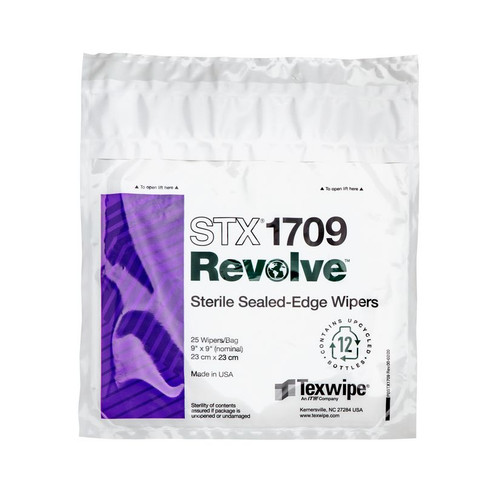
STX1709 sterile Revolve™ 9" x 9": sealed-edge upcycled polyester wiper with audit-grade sterility controls
Last reviewed: Jan. 4, 2026 | Audience: contamination control, cleanroom operations, EHS, quality
Texwipe STX1709 is a dry, sterile 9" x 9" knit polyester cleanroom wiper from the Revolve™ line, built for teams that need
tight contamination control but also want to advance sustainability goals without downgrading process performance. The substrate is
made from 100% upcycled polyester (rPET) and finished with a sealed-edge strategy that reduces edge-driven fiber release during wipe-downs.
For sterile operations, STX1709 is packaged and processed to protect the aseptic chain of custody: triple-bagging plus a case liner layer,
gamma irradiation to a 10-6 sterility assurance level (SAL) per AAMI-referenced guidance, and lot coding to support documentation,
deviation investigations, and repeatable incoming inspection. The result is a practical “daily driver” sterile wiper for ISO-controlled cleaning,
solution application, and parts staging where consistency matters as much as raw cleanliness.
What it’s for
Use STX1709 for wiping and cleaning surfaces, equipment, and parts; applying or removing process solutions (including disinfectants where compatible);
removing lubricants, adhesives, and residues; solvent wipe-downs with common chemistries (e.g., IPA, ethanol, acetone, degreasers); and lining trays to
hold, protect, dry, and store components during controlled handling.
Decision drivers
If your SOPs are written around sterility chain-of-custody, extractables, and repeatable wiping technique, these are the drivers that tend to matter most.
- Sterility controls: Gamma irradiation to SAL 10-6, triple-bagging plus case liner, and certificates available support audit readiness and controlled transfer practices.
- Edge strategy: Sealed edges reduce edge-driven fiber release and help the wiper “track” in one-direction strokes without fraying under pressure.
- Typical contamination metrics: Low ions, low nonvolatile residue (NVR), and controlled particle/fiber release are aligned to critical cleaning where residues can become defects.
- Solvent and process compatibility: Polyester knit construction is broadly compatible with common solvents used in wipe-downs; dry wipers have elevated temperature guidance for general use planning.
- Sustainability with process discipline: Upcycled polyester (rPET) plus “no additive” material philosophy can help ESG targets while staying inside established contamination-control frameworks.
Materials and construction
STX1709 is a knit polyester wiper made from 100% upcycled PET (rPET) yarn derived from post-consumer bottles. In Revolve™ processing, the yarn is used to knit the fabric,
then the material is further cleaned to meet controlled-environment contamination requirements before converting into finished wipers. Texwipe’s Revolve™ technical materials
emphasize that additional yarns/additives are not introduced—an intentional design choice because additives can become extractables or particle sources in sensitive processes.
The sealed edge is an operational control as much as a construction detail: most “unexpected” wipe contamination comes from edges—drag, snag, and fiber pull-out at the perimeter.
A sealed perimeter helps maintain a stable wipe pattern, supports full-face utilization (folding to present clean facets), and reduces the risk of loose perimeter fibers becoming
a downstream defect. For dry-format planning, manufacturer guidance also notes dry wipers are appropriate for use below 400°F (205°C) and are autoclave safe (dry wipers only),
which matters for facilities that validate post-transfer treatment steps.
Specifications in context
Format: 9" x 9" (23 cm x 23 cm) dry, sterile knit polyester wiper with sealed edge.
Packaging (working unit): 100 wipers per bag, configured as 4 inner bags of 25 inside a triple-bagged outer system (a practical “session pack” approach that helps you avoid repeatedly opening the same inner supply).
Case quantity: 5 bags per case (500 wipers/case).
ISO range: Listed on SOSCleanroom across ISO 4–8 task coverage; manufacturer Revolve™ documentation frames use across ISO Class 3–7 (and equivalent legacy Class 1–10,000) depending on the facility’s SOPs, transfer method, and surface risk profile.
Edge strategy: Sealed edge to control perimeter fiber release during wipe-down pressure and one-direction strokes.
Cleanliness and performance metrics
When you are comparing wipers, treat published values as typical analyses used to benchmark process capability—not a substitute for your incoming acceptance criteria.
For Revolve™ wipers, the technical data references industry-recognized methods used for evaluating cleanroom wiping materials (e.g., IEST-RP-CC004 and ASTM E2090 families),
which is consistent with how many quality teams build specifications and qualification protocols.
Typical contamination metrics (Revolve™ line):
• LPC (≥0.5 µm): 5.5 x 10⁶ particles/m2
• Fibers (>100 µm): 300 fibers/m2
• Nonvolatile residue (NVR): 0.05 g/m2 (IPA extractant) and 0.01 g/m2 (DI water extractant)
• Ions (typical): sodium 0.08 ppm; potassium 0.03 ppm; chloride 0.04 ppm
Typical physical performance:
• Sorptive capacity: 450 mL/m2
• Sorptive rate: 0.3 second
• Basis weight: 125 g/m2
Packaging, sterility, and traceability controls
STX1709 is built for sterile workflow discipline: triple-bagging plus a case liner creates a multi-layer barrier for transfer; gamma irradiation is stated to achieve a
sterility assurance level (SAL) of 10-6; and certificates of compliance/analysis/irradiation are available through manufacturer programs. Shelf life guidance for sterile
Revolve™ dry products is provided as 3 years from date of manufacture. These controls support practical cleanroom behaviors—outer-bag wipe-down, staged transfer, and point-of-use
opening—without forcing operators to improvise packaging workarounds.
Rule of thumb: Treat each inner 25-pack as a “single session” supply—open it at point-of-use, keep it off the work surface, and discard if it’s been staged open beyond your SOP’s exposure window.
Best-practice use
You will get more value from a premium sterile wiper by standardizing technique. The objective is always the same: remove contamination without redistributing it, and do it in a way
that is repeatable between operators and shifts.
- One-direction strokes: Wipe clean-to-dirty and top-to-bottom (or upstream-to-downstream). Avoid “scrub circles” that redeposit residues and increase particle shedding under pressure.
- Fold for clean faces: Fold into quarters; use one face per pass, then refold. This is the simplest way to reduce recontamination without adding process complexity.
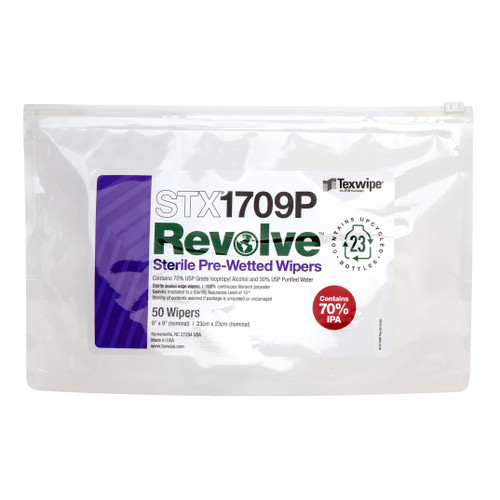
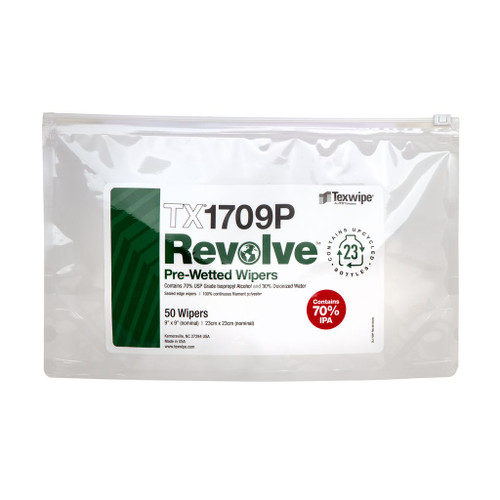
- Control wetness intentionally: For solvent wipe-downs, apply solvent to the wiper (or use validated pre-wetted formats where required) to avoid overspray/aerosols and to keep wet-contact time consistent.
- Edge-aware wiping: Keep the sealed edge from catching on sharp features; a snag event can turn “low contamination” into “unknown contamination” immediately.
- Transfer discipline: Keep outer packaging outside the critical zone, wipe-down as required, and only introduce the inner pack into the controlled area per your gowning/transfer SOP.
Common failure modes
Residue streaking: Usually a wetness control issue (too dry, too wet, or wrong solvent) or reusing the same wiper face too long—tighten your “one face, one pass” discipline.
Recontamination: Back-and-forth strokes and refolding onto a contaminated quadrant move soils instead of removing them—standardize stroke direction and fold cadence.
Lost sterility chain-of-custody: The most common root cause is packaging mishandling (outer bag brought into the critical area, inner pack left staged open)—use the inner 25-pack as the operational control unit and enforce exposure limits.
Edge snag events: Catching corners on fixtures can create localized fiber release; slow down around sharp edges and use lighter pressure, especially on perforated metal, threaded parts, and rough polymer surfaces.
Thermal/chemical misuse: Dry wipers have elevated temperature guidance; pre-wet chemistry and high-heat environments require separate EHS review and SOP controls.
Closest competitors
Contec Sterile Polynit Heatseal wipes (sealed-edge knit polyester): A comparable “sealed-edge knit polyester” architecture, typically positioned for very low particles/extractables and sterile SAL 10-6 workflows. Mechanistically, these compete on edge bonding method, packaging configuration, and documentation availability.
Berkshire sealed-edge polyester programs (sterile and cleanroom-laundered variants): Commonly compete on knit construction, ultrasonic edge sealing, and ISO-class laundering/packaging discipline. The practical decision often comes down to sterile packaging design (nested packs vs bulk), residue limits important to your process, and how your site qualifies incoming lots.
Where it fits in a cleanroom wiping program
STX1709 is a strong fit as a primary sterile dry wiper for ISO-controlled cleaning where operators need repeatability, documentation support, and a sealed-edge knit that behaves predictably under pressure.
Use it for routine equipment wipe-downs, controlled solution application/removal (paired with validated solvents/disinfectants), and parts handling/staging in trays where you want a low-residue, low particle/fiber baseline.
If your process is ultra-sensitive to residues (e.g., high-vacuum, optics, thin films), you may qualify a tighter “critical point” wiper for the final pass and keep STX1709 as the workhorse for upstream cleaning steps.
Terminology note: Engineered for low-linting performance; no wiper is truly “lint-free” in every process condition.
Source basis
- SOSCleanroom product page — Texwipe STX1709 Sterile Revolve 9" x 9" Upcycled Polyester Cleanroom Wiper: https://www.soscleanroom.com/product/wipers/texwipe-stx1709-sterile-revolve-9-x-9-upcycled-polyester-cleanroom-wiper/
- Manufacturer technical data sheet (SOS-hosted PDF copy) — Revolve™ Wipers Technical Data Sheet (TEX-LIT-TDS-055 Rev 00-05/20): https://www.soscleanroom.com/content/texwipe_pdf/TDS_Revolve%20Texwipe.pdf
- Manufacturer Q&A (SOS-hosted PDF copy) — Texwipe Revolve Q&A: https://www.soscleanroom.com/content/texwipe_pdf/Texwipe-Revolve-QA.pdf
- Manufacturer tech note (SOS-hosted PDF copy) — Texwipe Revolve TechNote (May 2020): https://www.soscleanroom.com/content/texwipe_pdf/Texwipe-Revolve-Technote.pdf
- Manufacturer technical data sheet (Texwipe PDF) — Texwipe Revolve Wipers TDS: https://www.texwipe.com/images/uploaded/documents/Wipers/Texwipe-Revolve-Wipers-TDS.pdf
- Manufacturer Q&A (Texwipe PDF) — Texwipe Revolve Q&A: https://www.texwipe.com/images/uploaded/documents/Technical-Data/Texwipe-Revolve-QA.pdf
- Manufacturer tech note (Texwipe PDF) — Texwipe Revolve TechNote: https://www.texwipe.com/images/uploaded/documents/Technical-Data/Texwipe-Revolve-Technote.pdf
- Competitor reference — Contec Sterile Polynit Heatseal Wipes: https://cleanroom.contecinc.com/product/1779528570
- Competitor reference — Berkshire Choice 700 sealed-edge polyester 9" x 9" overview: https://cleanroomworld.com/detail/clean-room-wipe-5801.cfm
Source: SOSCleanroom Technical Vault | Last reviewed: Jan. 4, 2026
© 2026 SOS Supply. All rights reserved.