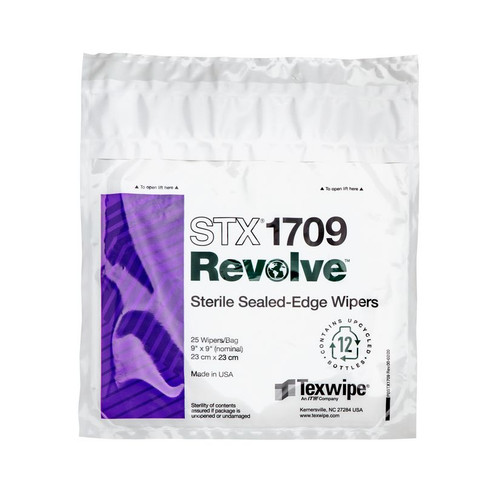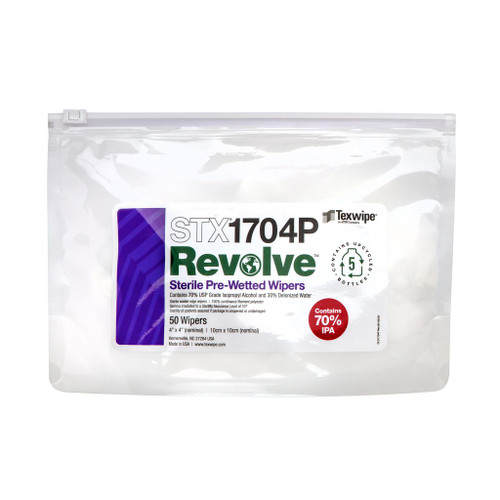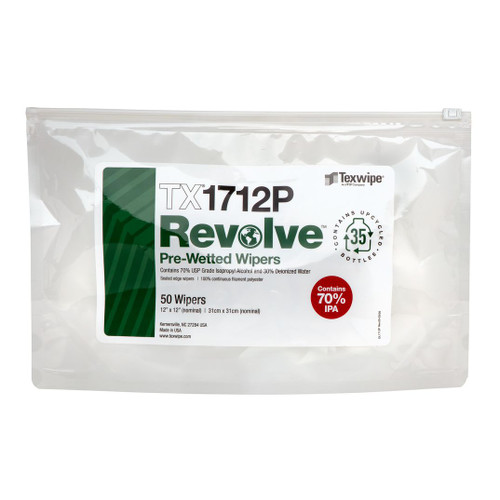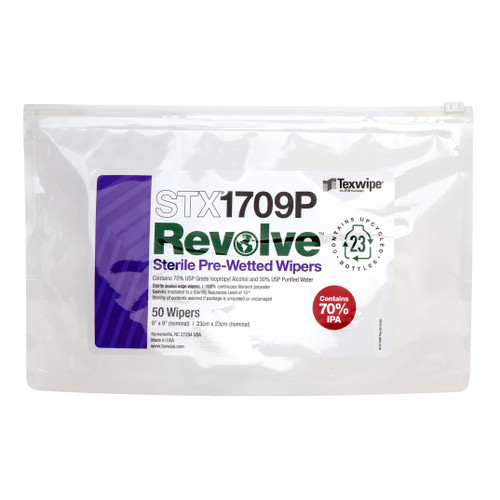
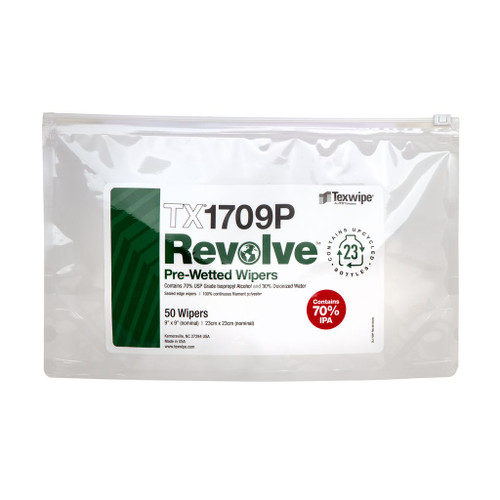
Texwipe STX1709P Sterile Revolve 9" x 9" Upcycled Polyester Cleanroom Wiper Pre-Wetted 70% IPA

$332.12
(No reviews yet)
SKU:
STX1709P
Availability:
Stock Item
Shipping:
Calculated at Checkout
International Shipping:
Restricted to U.S. destinations only
Quantity Option (Case):
4 Bags of 50 Wipers Per Case
Type:
Pre-Wet Wiper
Wiper Family:
Revolve
Wiper Material:
Polyester
Wiper Size:
9" x 9"
Wiper Edge:
Sealed Edge
Sterile:
Yes
ISO Class:
ISO 4 (Class 10) - ISO 8 (Class 100,000)
Country of Origin:
Made in USA

STX1709P Sterile Revolve 9" x 9" Upcycled Polyester Cleanroom Wiper Pre-Wetted 70% IPA

STX1709P Sterile Revolve is a low-linting (no wiper is truly ‘zero-lint’ in every process condition), sealed-edge polyester cleanroom wiper designed for critical cleaning, spill control, and controlled solvent application in controlled environments. It is made from 100% upcycled polyester (rPET) and supplied pre-wetted with 0.2 µm filtered, USP-grade 70% IPA / 30% DI water to support repeatable wetness and cleaning performance while reducing variability from manual wetting.

Sterile + sustainable note: STX1709P combines gamma sterilization (SAL 10-6), sealed-edge construction, and a pre-wetted USP-grade 70/30 IPA/DIW chemistry in a 9" x 9" format—often specified when sterility, wetness repeatability, and contamination control must coexist with sustainability goals.

Specifications:
  • Size: 9" x 9" (23 cm x 23 cm) nominal
  • Material: 100% upcycled polyester (rPET)
  • Edge: Sealed edge
  • Sterility: Gamma irradiated to a Sterility Assurance Level of 10-6 (SAL), per AAMI guidelines
  • Pre-wetted solution: 0.2 µm filtered, USP-grade 70% IPA / 30% DI water
  • Packaging: 50 wipers/bag; triple-bagged with a case liner (fourth layer of protection); reclosable slider bag format to reduce evaporation
  • Case pack: 4 bags/case (200 total wipers/case)
  • Traceability: Individually lot coded for traceability and quality control
  • Use environments: Commonly used across a wide range of ISO-class cleanrooms and controlled areas (final suitability depends on your process and cleaning method)
  • Country of origin: Made in the USA
About the Manufacturer: 

Texwipe (an ITW company) differentiates itself in cleanroom wiping by treating the wiper as an engineered product, not a commodity consumable. For the Revolve™ line, Texwipe specifies a 100% upcycled polyester substrate (derived from post-consumer water bottles) processed on automated manufacturing systems, then controls edge construction (sealed edge), controlled processing/cleanliness testing, and packaging aligned to cleanroom application tiers.


For sterile, pre-wetted programs, Texwipe emphasizes repeatability through controlled presaturation (0.2 µm filtered, USP-grade 70% IPA / 30% DI water), gamma irradiation to SAL 10-6, multi-layer packaging for staged de-bagging, and lot-level traceability to support qualification and audit readiness. SOSCleanroom (SOS) supports that manufacturing discipline with a close working relationship with Texwipe focused on continuity of supply, clean documentation handoff (certs, lot traceability), and practical application support—so customers can standardize wiping materials with predictable performance while maintaining procurement reliability and audit readiness.

STX1709P Features:
  • 100% upcycled polyester (rPET) substrate; sealed-edge construction
  • Pre-wetted with 0.2 µm filtered, USP-grade 70% IPA / 30% DI water for consistent wetness and VOC levels
  • Triple-bagged with a case liner forming a fourth layer of protection
  • Gamma irradiated to a Sterility Assurance Level of 10-6 (SAL), according to AAMI guidelines
  • Reclosable slider bag packaging helps reduce solution evaporation
  • Revolve processing targets low levels of ions, NVRs (non-volatile residues), particles, and fibers for critical cleaning environments
  • Meets USP <797> and USP <800> wiper requirements
  • Individually lot coded for traceability and quality control
STX1709P Benefits:
  • Low-linting performance: Sealed-edge construction helps reduce loose filaments and edge fray during folding and wipe strokes (process-dependent)
  • Repeatable wetness in the field: Controlled presaturation reduces operator variability versus manual wetting and supports standardized wipe-down outcomes
  • Sterility assurance + documentation discipline: Gamma processing and lot coding support workflows with sterile handling expectations and qualification requirements
  • High sorption capacity: Designed for spill control, cleaning, and solution application
  • Chemical compatibility: Polyester is commonly used with IPA and many other cleanroom-compatible solvents/cleaners (verify compatibility to your chemistry and SOP)
  • Sustainability with performance intent: Uses upcycled polyester while maintaining contamination-control targets typical of critical cleaning programs
Common Applications:
  • Wiping and cleaning surfaces, equipment, and parts
  • Applying and removing lubricants, adhesives, residues, and other solutions including disinfectants
  • Cleaning with solvents such as isopropyl alcohol (IPA), ethanol, acetone, and degreasers (process permitting)
  • Lining trays for holding, protecting, drying, and storing of parts, equipment, and devices
  • Controlled wet wipe-downs where sterile handling and repeatable solvent delivery are required
Best-Practice Use:
  • Keep wetness controlled: Use the wiper as supplied—avoid adding solvent unless your validated SOP requires it.
  • Fold for control: Fold into quarters to create multiple clean faces; rotate faces instead of re-wiping with a loaded surface.
  • Wipe pattern: Use straight-line strokes (top-to-bottom or left-to-right) to avoid re-depositing contamination.
  • Slider bag discipline: Close the reclosable slider bag promptly after removing a wiper to minimize evaporation and preserve consistent wetness.
  • Change-out triggers: Replace the wiper when the face becomes visibly soiled, tacky, or leaves streaks/residue.
  • Part protection: When lining trays, avoid dragging parts across the wiper; lift and place to reduce particulate transfer.
Selection Notes (STX1709P vs. Other Options)
  • STX1709P vs. TX1709P: Choose STX1709P when sterile processing (SAL 10-6) and sterile transfer practices are required; choose TX1709P when pre-wetted performance is needed but sterile processing is not required.
  • Pre-wetted vs. dry (STX1709): Choose STX1709P to remove variability from manual wetting and control wet film delivery; choose STX1709 when your process uses dry wiping with controlled wetting steps or alternative chemistries.
  • Sustainable substrate vs. conventional polyester: Revolve uses upcycled polyester (rPET) while targeting contamination-control performance; select based on your program requirements, qualification approach, and sustainability objectives.

Link to Texwipe Technical Datasheet:
Click Here
Texwipe.com PDF: Click Here

Link to Revolve Q&A: Click Here
Texwipe.com PDF: Click Here

Link to Revolve TechNote: Click Here
Texwipe.com PDF: Click Here

Other Similar Products Available From SOSCleanroom.com

Revolve Dry Wipers

  • TX1704: 4" x 4" (10 cm x 10 cm) dry wipers, 100 wipers/bag
  • TX1709: 9" x 9" (23 cm x 23 cm) dry wipers, 100 wipers/bag
  • TX1712: 12" x 12" (31 cm x 31 cm) dry wipers, 100 wipers/bag

Revolve Pre-Wetted Wipers (Non-Sterile)

  • TX1704P: 4" x 4" (10 cm x 10 cm) pre-wetted with 70% IPA/30% DI water, 50 wipers/bag
  • TX1709P: 9" x 9" (23 cm x 23 cm) pre-wetted with 70% IPA/30% DI water, 50 wipers/bag
  • TX1712P: 12" x 12" (31 cm x 31 cm) pre-wetted with 70% IPA/30% DI water, 50 wipers/bag

Revolve Sterile Wipers

  • STX1704: 4" x 4" (10 cm x 10 cm) dry sterile wipers, 50 wipers/bag
  • STX1709: 9" x 9" (23 cm x 23 cm) dry sterile wipers, 100 wipers/bag
  • STX1712: 12" x 12" (31 cm x 31 cm) dry sterile wipers, 100 wipers/bag
  • STX1704P: 4" x 4" (10 cm x 10 cm) sterile pre-wetted with 70% IPA/30% DI water, 50 wipers/bag
  • STX1709P: 9" x 9" (23 cm x 23 cm) sterile pre-wetted with 70% IPA/30% DI water, 50 wipers/bag
  • STX1712P: 12" x 12" (31 cm x 31 cm) sterile pre-wetted with 70% IPA/30% DI water, 50 wipers/bag

Notes: Looking for application guidance or qualification context for Texwipe STX1709P Sterile Revolve 9" x 9" upcycled polyester cleanroom wipers pre-wetted with 70% IPA? Open the SOSCleanroom Technical Vault tab above for practical wiping technique, selection notes (STX1709P vs. alternatives), and the documentation details teams typically review when standardizing sterile, pre-wetted wipes across ISO-class controlled environments.

SOSCleanroom.com supports contamination-control programs with cleanroom consumables in stock, fair pricing, and responsive technical support—backed by same-day shipping options and customer service that understands real cleanroom workflows.

Product page updated: Jan. 4, 2026 (SOS Technical Staff)

© 2026 SOS Supply. All rights reserved.

The Technical Vault
By SOSCleanroom
Texwipe STX1709P REVOLVE (Sterile, 70/30 IPA): Repeatable Wetness, Sealed-Edge Control, and Sustainable Polyester for ISO-Driven Cleaning
Last reviewed: Jan. 4, 2026 |  Audience: contamination control, cleanroom operations, EHS, quality

Texwipe STX1709P REVOLVE is a sterile, pre-wetted (70% IPA / 30% DI water) sealed-edge polyester cleanroom wiper designed for situations where solvent control and contamination discipline must be consistent shift-to-shift. Its practical value is not only in “having alcohol on the wipe,” but in removing operator-to-operator variability that shows up as streaking, residue carryover, inconsistent dwell time, and overuse of bottles/spray.

REVOLVE also addresses a real-world constraint many teams face: raising sustainability performance without lowering cleanliness expectations. The wiper is made from 100% upcycled polyester (rPET) and processed for low ions, low NVR, low particles, and low fibers—so you can pursue waste-reduction goals without rewriting your entire cleaning validation logic.

What it’s for

Controlled cleaning and wipe-down of surfaces, tools, carts, benches, transfer points, and equipment exteriors where a sterile, pre-wetted IPA wipe supports consistent solvent application, repeatable evaporation behavior, and predictable contamination outcomes—especially in ISO-driven environments, aseptic processing support areas, and USP <797>/<800> workflows.

Decision drivers

If you are standardizing cleaning outcomes (not just “cleaning effort”), these are the drivers that typically separate a dependable pre-wetted sterile wiper from a recurring deviation generator.

  • Repeatable wetness and solvent control: Pre-wetted with 0.2 µm-filtered, USP-grade 70% IPA / 30% DI water to reduce spray-bottle variability, VOC spikes, and uneven dwell time across operators.
  • Edge strategy for fiber/particle discipline: Sealed-edge construction is selected when edge fray, snagging, and fiber release are unacceptable failure modes.
  • Sterility assurance for critical workflows: Gamma irradiated to a 10−6 SAL and packaged to protect the sterile presentation through handling and staging.
  • Contamination profile you can defend: Typical data includes particles/fibers, NVR, and ionic extractables—useful when investigations shift from “what did we do?” to “what did the material contribute?”
  • Sustainability with continuity: Upcycled polyester (rPET) supports sustainability goals while maintaining comparable performance characteristics to virgin polyester-based wipers, per manufacturer documentation.
Materials and construction

STX1709P is made from 100% upcycled polyester (rPET) and finished with a sealed edge. Polyester’s core advantage in contamination control is that continuous-filament synthetics can be processed to reduce loose fiber contribution versus many blended or pulp-based substrates—while still providing the abrasion resistance and “wipe feel” operators need for controlled wipe-down.

The “pre-wetted” format matters operationally: instead of asking each operator to create a solvent film with a bottle (and guessing at the volume), each wipe delivers a consistent starting wetness profile. That consistency is often what improves cleaning repeatability, because it stabilizes the solvent’s ability to solubilize residues and carry contamination into the wiper matrix rather than redistributing it.

Specifications in context

Format: Sterile, pre-wetted wiper (70% IPA / 30% DI water). Size: 9" x 9" (23 cm x 23 cm). Material: polyester (upcycled rPET). Edge: sealed edge. Packaging: 50 wipers per bag; SOSCleanroom case pack is 4 bags per case (200 total). Sterile packaging is triple-bagged with a case liner (fourth protective layer) and uses recloseable slider bags to reduce evaporation. Shelf life: sterile (dry and pre-wetted) products are listed at 3 years from date of manufacture. Cleanroom use range: manufacturer positions REVOLVE for ISO Class 3–7 environments; SOSCleanroom lists an ISO 4 (Class 10) through ISO 8 (Class 100,000) range—treat ranges as application guidance and align to your SOP and risk tolerance.

Cleanliness and performance metrics

Use metrics as “typical starting points,” then validate against your residues, surfaces, and process risk. For investigation work, the most practical lens is: particles/fibers (re-deposition risk), NVR (film/residue risk), and ions (corrosion/ionic contamination risk).

Typical contamination and performance data (manufacturer technical data sheet): LPC (≥0.5 µm) ~5.5 × 10⁶ particles/m2; fibers (>100 µm) ~300 fibers/m2. NVR: IPA extractant ~0.05 g/m2; DI water extractant ~0.01 g/m2. Ions (typical): sodium ~0.08 ppm; potassium ~0.03 ppm; chloride ~0.04 ppm. Sorptive capacity ~450 mL/m2; sorptive rate ~0.3 second; basis weight ~125 g/m2. Test methods cited include IEST-RP-CC004.3 and ASTM E2090-12, and the manufacturer notes data are typical analyses (not specifications).

Packaging, sterility, and traceability controls

In practice, most sterile wipe failures are not “bad wipes”—they are handling failures: opened too early, staged improperly, reclosed poorly, or moved between pressure regimes without a clean presentation. STX1709P’s triple-bag sterile configuration with case liner is built for controlled introduction, and the recloseable slider bag is a direct control for evaporation-driven variability (dry wipes, streaks, and repeat cleaning cycles). The product is gamma irradiated to a 10−6 SAL per AAMI guidance, and documentation pathways (Certificates of Compliance/Analysis/Irradiation) support audit-grade traceability expectations.

Rule of thumb: Treat the slider bag like a controlled container: open only long enough to remove what you need, then reclose immediately. If the wipe “feels” different between the first and last wipe in a bag, your evaporation control is failing—and your cleaning results will drift with it.

Best-practice use

The goal is to remove and capture contamination—not redistribute it. Standardize technique the same way you standardize materials.

  • Fold for clean faces: Fold into a manageable pad and rotate to a fresh face frequently; do not “chase” residues with a loaded wipe.
  • One-direction passes with overlap: Wipe in one direction using controlled pressure, overlapping each pass; avoid scrubbing circles that re-deposit loosened contamination.
  • Control the boundary between zones: For sterile workflows, stage outer bags outside the critical zone, then present the innermost sterile bag at point-of-use to reduce handling risk.
  • Respect IPA behavior: IPA flashes quickly; allow appropriate dwell time for solubilization, and avoid wiping hot surfaces where evaporation outpaces cleaning.
  • Use the right “end state” check: If you are wiping for visual cleanliness, validate under the lighting that reveals streaks; if wiping for residue/ions, align wipe technique to the assay method (swab/rinse) so results are comparable.
Common failure modes

Evaporation drift: Leaving the slider bag open changes wetness and creates streaking/variable cleaning. Cross-contamination: Using the same wipe face across multiple surfaces transfers residues rather than removing them. Over-aggressive mechanical action: Excess pressure or repeated scrubbing can increase surface damage risk and drive redeposition. Temperature mismatch: Applying IPA wipes to elevated-temperature surfaces can cause rapid flash-off and reduced cleaning effectiveness. Zone-control breakdown: Opening sterile bags too early or staging them incorrectly can undermine sterile intent even if the wipe itself is sterile.

Closest competitors

Berkshire Sterile SatPax® MicroSeal® – VP (70% USP IPA): An ultrasonically sealed-edge, continuous-filament polyester knit wiper pre-wetted with 70% USP-grade IPA and gamma irradiated to a 10−6 SAL. Mechanistically, this is the closest “like-for-like” competitor (sealed-edge polyester knit, sterile, IPA-saturated). If your decision is primarily edge control + sterile presentation, this class competes directly; REVOLVE differentiates by using 100% upcycled polyester and emphasizing repeatable wetness controls in the packaging and documentation set.

Contec PROSAT® Sterile wipes (70% USP IPA / 30% DI water): A presaturated sterile wipe typically made from hydroentangled nonwoven cellulose/polyester blends. Mechanistically, this targets general surface cleaning and transfer disinfection with a softer nonwoven hand; the tradeoffs are different absorbency/drag behavior and a different shedding profile versus sealed-edge polyester knit formats. Teams often choose nonwovens for broad-area wipe-down where “wipe feel” and coverage matter most, and sealed-edge knits where fiber and edge-related risks dominate.

Where it fits in a cleanroom wiping program

STX1709P is a strong “standard work” wiper for sterile, solvent-based wipe-down steps where you want consistent wetness without relying on bottles, and where sealed-edge control helps reduce edge-related fiber/particle contributions. It commonly sits between two extremes: (1) spray-and-wipe approaches that introduce variability and overspray, and (2) higher-friction specialty wipes used for aggressive residue removal. For many programs, it becomes a default for benches, carts, equipment exteriors, transfer points, and production support surfaces—especially when USP <797>/<800> expectations or ISO-driven environmental requirements are in play.

Terminology note: Engineered for low-linting performance; no wiper is truly “lint-free” in every process condition.

Source basis
  • SOSCleanroom product page (Texwipe STX1709P Sterile Revolve 9" x 9" Upcycled Polyester Cleanroom Wiper Pre-Wetted 70% IPA): https://www.soscleanroom.com/product/wipers/texwipe-stx1709p-sterile-revolve-9-x-9-upcycled-polyester-cleanroom-wiper-pre-wetted-70-ipa/
  • SOS-hosted manufacturer Technical Data Sheet copy (Revolve Wipers TDS, TEX-LIT-TDS-055 Rev.00-05/20): https://www.soscleanroom.com/content/texwipe_pdf/TDS_Revolve%20Texwipe.pdf
  • Texwipe product page (REVOLVE™ STX1709P Sustainable Pre-Wetted Cleanroom Wipers, Sterile): https://www.texwipe.com/sterile-revolve-stx1709p-pre-wetted-cleanroom-wipers
  • Texwipe manufacturer Technical Data Sheet (Revolve Wipers TDS, TEX-LIT-TDS-055 Rev.00-05/20): https://www.texwipe.com/images/uploaded/documents/Wipers/Texwipe-Revolve-Wipers-TDS.pdf
  • SOS-hosted manufacturer Q&A (Revolve Q&A, TEX-LIT-AAG-001 Rev.00-05/20): https://www.soscleanroom.com/content/texwipe_pdf/Texwipe-Revolve-QA.pdf
  • SOS-hosted manufacturer TechNote (Revolve TechNote): https://www.soscleanroom.com/content/texwipe_pdf/Texwipe-Revolve-Technote.pdf
  • Contec PROSAT® Sterile wipes product literature (70% USP IPA / 30% DI water; gamma; SAL 10−6): https://www.contecinc.com
  • Berkshire Sterile SatPax® MicroSeal® – VP (sealed edge polyester; pre-wetted 70% USP IPA; SAL 10−6): https://berkshire.com/shop/presaturated-cleanroom-wipes/sterile-wipes/sterile-satpax-msvp/sterile-satpax-ms-vp-9-x-9-case/
  • Referenced test methods: IEST-RP-CC004.3 (www.iest.org) and ASTM E2090-12 (www.astm.org)
Source: SOSCleanroom Technical Vault | Last reviewed: Jan. 4, 2026
© 2026 SOS Supply. All rights reserved.