The Technical Vault
By SOSCleanroom
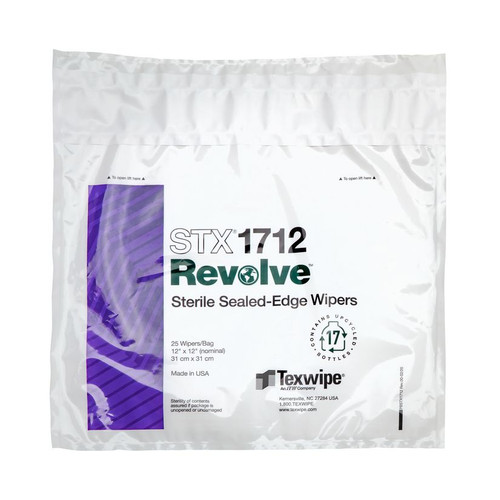
STX1712 sterile Revolve: sealed-edge, upcycled polyester wiping for critical surfaces and USP <797>/<800> workflows
Last reviewed: Jan. 4, 2026 | Audience: contamination control, cleanroom operations, EHS, quality
Texwipe STX1712 Sterile Revolve is a 12" x 12" knit polyester cleanroom wiper built around a simple risk-control idea: keep the wipe edge from becoming the contamination source. The sealed-edge construction is paired with sterile, multi-layer packaging so operators can open, stage, and use wipes without turning the package-to-surface transition into a particle or bioburden event.
Revolve’s differentiator is the material origin (100% upcycled polyester) without changing how the wipe behaves in real cleaning: it is intended to run like a “standard” sealed-edge polyester wipe in critical cleaning, solvent wipe-down, and spill response. For sites tracking sustainability KPIs, the Revolve program also provides a bag-level accounting of upcycled bottles and greenhouse-gas savings that can be rolled into internal reporting.
What it’s for
Use STX1712 when you need a sterile, sealed-edge polyester wipe for wiping and cleaning surfaces, equipment, and parts; applying or removing process fluids (including disinfectants); solvent cleaning with common chemistries (e.g., IPA, ethanol, acetone, degreasers); and lining trays for holding, protecting, drying, or storing parts and devices. It is also positioned to meet USP <797> and USP <800> wiper requirements for compounding and hazardous drug handling areas where sterile consumables and disciplined wipe technique reduce risk.
Decision drivers
For cleanroom wiping, the “best” wiper is the one that reduces variability at the operator’s hand while staying compatible with your chemistry, surface finish, and cleanliness limits.
- Sealed-edge containment: A sealed edge reduces fraying and edge-shed, which is often where knit wipes fail first in aggressive wiping, tooling wipe-down, and repeated fold cycles.
- Sterility and presentation control: Gamma irradiation to SAL 10-6 plus triple-bagging supports aseptic transfer and staged opening practices without recontaminating the contents.
- Extractables discipline (NVR/ions): When residues drive defects (optics haze, coating adhesion loss, contact issues), starting with low typical NVR and ionic background helps your solvent do the work instead of redepositing what you just removed.
- Sorption capacity vs. wipe feel: High sorption capacity matters for spill control and wet cleaning, but it also affects how often operators “rewet” or swap wipes—two common sources of inconsistency.
- Sustainability reporting that is auditable: Revolve provides bag-level bottle counts and GHG savings so facilities teams can document impact without guessing.
Materials and construction
STX1712 is a knit polyester wiper with a sealed edge. In practical terms, that means the fabric body provides the “pickup” and solvent carry, while the sealed perimeter is engineered to avoid becoming the weak point that sheds when you apply pressure, wipe corners, or do repeated fold-and-face passes. This is especially relevant on hard tooling surfaces, stainless, anodized aluminum, coated optics housings, and painted panels where edge drag is unavoidable.
Revolve’s polyester is 100% upcycled (rPET) sourced from post-consumer bottles, processed through Texwipe’s automated manufacturing and cleaning systems. The intent is functional equivalence to virgin-polyester sealed-edge wipes for particles/fibers, ions, and NVR in typical use—while enabling sustainability tracking without changing operator behavior or wiping SOP structure.
Specifications in context
Size: 12" x 12" (31 cm x 31 cm). The larger format is typically chosen when you need fewer wipes per task (fewer change-outs) and when surface area per pass matters (benchtops, cart frames, large tooling, isolator exteriors).
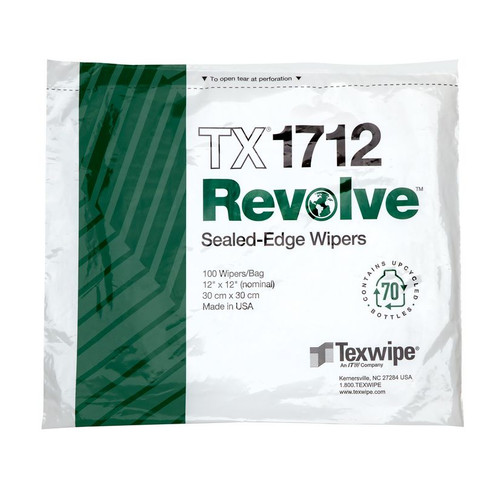
Packaging (SOSCleanroom case configuration): 5 bags of 100 wipers per case (500 wipes/case).
Packaging (manufacturer presentation detail): 100 wipers/bag with inner bag subdivision (commonly staged as 4 inner bags of 25) and triple-bagged for sterile transfer.
Edge strategy: Sealed edge to reduce edge-shed under pressure and repeated fold cycles.
Sterile: Yes; gamma irradiated to SAL 10-6 per AAMI guidelines; triple-bagged with a case liner described as a fourth protective layer.
Cleanroom use range (how to interpret): Manufacturer literature commonly positions Revolve for ISO Class 3–7 (Class 1–10,000) use, while the SOSCleanroom listing also includes ISO 4–8. Treat these as deployment ranges, not a substitute for site qualification—match the wipe to your process sensitivity, surface type, and the residue/particle limits that matter to your product.
Cleanliness and performance metrics
For wiping materials, “typical” contamination values are a starting point for selection and change control—not a guarantee in every use condition. Your chemistry, surface roughness, pressure, fold method, and dwell time can move real-world outcomes.
Particles and fibers (typical): LPC ≥0.5 µm: 5.5 x 10⁶ particles/m2; Fibers >100 µm: 300 fibers/m2 (typical analyses).
NVR (typical): IPA extractant: 0.05 g/m2; DI water extractant: 0.01 g/m2.
Ions (typical): Sodium: 0.08 ppm; Potassium: 0.03 ppm; Chloride: 0.04 ppm.
Sorption (typical): Sorptive capacity: 450 mL/m2; Sorptive rate: 0.3 second; Basis weight: 125 g/m2.
Operational interpretation: If your failure mode is residue re-deposit (films, streaking, haze), pay attention to NVR and ionic background and do not “extend” a wipe past its loading point. If your failure mode is particle add-back (scratches, defects, sensor fouling), sealed edges and disciplined one-pass technique tend to matter more than raw absorbency.
Packaging, sterility, and traceability controls
STX1712 is designed to support controlled presentation: triple-bagging (plus a case liner) enables staged transfer from outer to inner packaging as you move toward higher cleanliness zones. Gamma irradiation to SAL 10-6 supports aseptic workflows, and lot coding enables investigation discipline (what lot, what room, what task, what chemical, what shift) when excursions occur. Manufacturer documentation commonly includes access to certificates (compliance/analysis/irradiation) and sterile validation documentation upon request—use those documents as part of your change control and incoming inspection posture.
Rule of thumb: Open only the outermost bag outside the cleanest zone; never “carry” opened sterile bags between rooms. Treat the final inner bag as a controlled presentation device—open it at point-of-use, and stage wipes so the next wipe never contacts the bench.
Best-practice use
Cleanroom wiping performance is often dominated by technique. The same wipe can look “great” or “dirty” depending on fold discipline, pass direction, and when the wipe face is retired.
- Fold-and-face discipline: Fold to create multiple clean faces and rotate faces intentionally. If you lose track of faces, you are effectively smearing contaminants.
- One-direction passes: Wipe in a single direction with overlapping strokes; avoid circular scrubbing unless the SOP is built for it (circles tend to rework contamination back into the surface).
- Pressure control: Use consistent, moderate pressure. Excess pressure can increase edge drag and redeposit loading; too little pressure reduces pickup and makes operators compensate with extra passes.
- Wet-to-dry sequencing: For solvent cleaning, use a wet pass to solubilize and lift, then a second (fresh) wipe to remove the mobilized film before it dries and reattaches.
- Chemistry compatibility check: Polyester sealed-edge wipes are commonly used with IPA, ethanol, acetone, and degreasers. Validate on your specific surface finish and coating stack before broad release.
- Change-out triggers: Replace a wipe when it becomes visibly loaded, begins streaking, or after a defined surface area/time—do not “get one more pass” to save a wipe; that is how defects are born.
Common failure modes
Streaking or haze after wiping: Usually a technique/sequence issue (wipe face overloaded, solvent evaporating before removal, or “polishing” with a dirty face). Mitigation: wet-to-dry sequencing, strict face rotation, and defined change-out points.
Particle add-back on high-gloss or sensitive surfaces: Often caused by edge drag, aggressive pressure, or wiping against roughness/fasteners. Mitigation: maintain one-direction strokes, control pressure, and keep the sealed edge from being used as a “scraper.”
Loss of sterility at point-of-use: Typically a staging and handling failure (opening too early, placing inner bags on uncontrolled surfaces, or reaching across open bags). Mitigation: staged opening discipline, point-of-use opening, and a defined “clean staging” area.
Inconsistent cleaning results across shifts: Most commonly an SOP clarity gap. Mitigation: train to a standard fold count, stroke pattern, overlap, and wipe-per-area expectation; audit with short operator observations, not just paperwork.
Closest competitors
Berkshire MicroSeal® 1200 (sealed-edge polyester knit wipe): A conventional virgin-polyester sealed-edge knit positioned for very high cleanliness environments. Mechanistically similar (sealed edge + knit polyester), but without the Revolve upcycled-material sustainability accounting. Choose when the requirement is “sealed-edge knit polyester” and sustainability is not a decision driver.
Contec Sterile Polynit / Polywipe-C Heatseal (laser-sealed-edge sterile polyester wipes): Sterile, sealed-edge polyester options designed around edge bonding to reduce fiber release and support critical cleaning. These are closest in intent (sterile + sealed edge + polyester), with differences typically showing up in fabric construction/hand, packaging presentation, and site-specific qualification preference.
Where it fits in a cleanroom wiping program
STX1712 is a front-line sterile wipe for critical surfaces where you want sealed-edge control, predictable cleanliness, and disciplined presentation—especially in ISO 5–7 manufacturing/support areas, aseptic transfer zones, and USP <797>/<800> workflows. Use it as the “go-to” sterile wipe for routine wipe-down and spill response when sterility is part of the risk model, and reserve lower-control wipes (non-sterile or cut-edge) for lower-risk areas such as general support spaces and non-critical staging.
For sustainability-driven sites, Revolve adds an additional layer of program value: the Revolve TechNote reports that STX1712 uses 17 upcycled bottles per bag with an estimated 5.78 lbs CO2 GHG savings per bag. That makes it easier to justify “sterile sealed-edge polyester” without abandoning ESG targets—while keeping wiping technique and contamination control expectations consistent.
Terminology note: Engineered for low-linting performance; no wiper is truly “lint-free” in every process condition.
Source basis
- SOSCleanroom product page: Texwipe STX1712 Sterile Revolve 12" x 12" Upcycled Polyester Cleanroom Wiper — https://www.soscleanroom.com/product/wipers/texwipe-stx1712-sterile-revolve-12-x-12-upcycled-polyester-cleanroom-wiper/
- Manufacturer technical datasheet (SOS-hosted copy): Revolve™ Wipers Technical Data Sheet (Doc: TEX-LIT-TDS-055, Rev.00-05/20) — https://www.soscleanroom.com/content/texwipe_pdf/TDS_Revolve%20Texwipe.pdf
- Manufacturer technical datasheet (Texwipe.com): Texwipe-Revolve-Wipers-TDS.pdf — https://www.texwipe.com/images/uploaded/documents/Wipers/Texwipe-Revolve-Wipers-TDS.pdf
- Manufacturer TechNote (SOS-hosted copy): Texwipe Revolve TechNote (May 2020) — https://www.soscleanroom.com/content/texwipe_pdf/Texwipe-Revolve-Technote.pdf
- Manufacturer TechNote (Texwipe.com): Texwipe-Revolve-Technote.pdf — https://www.texwipe.com/images/uploaded/documents/Technical-Data/Texwipe-Revolve-Technote.pdf
- Manufacturer Q&A (SOS-hosted copy): Texwipe Revolve Q&A — https://www.soscleanroom.com/content/texwipe_pdf/Texwipe-Revolve-QA.pdf
- Manufacturer Q&A (Texwipe.com): Texwipe-Revolve-QA.pdf — https://www.texwipe.com/images/uploaded/documents/Technical-Data/Texwipe-Revolve-QA.pdf
- Referenced test-method anchors noted in manufacturer TDS: IEST-RP-CC004 (Evaluating Wiping Materials used in Cleanrooms); ASTM E2090 (particles/fibers release by size); AAMI guidelines referenced for SAL 10-6 sterile validation context.
- Comparator basis: Berkshire MicroSeal® 1200 product information — https://berkshire.com/wp-content/uploads/2024/01/MicroSeal-1200.pdf
- Comparator basis: Contec sterile sealed-edge polyester wipes (product/data sheet access) — https://cleanroom.contecinc.com/product/1779521830
Source: SOSCleanroom Technical Vault | Last reviewed: Jan. 4, 2026
© 2026 SOS Supply. All rights reserved.