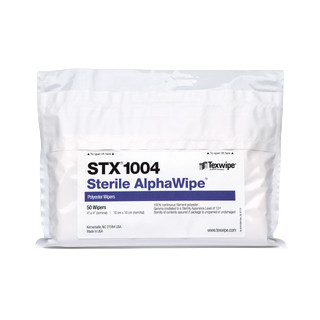
Texwipe TX1004 AlphaWipe 4" x 4" Polyester Cleanroom Wiper

$60.61
(No reviews yet)
SKU:
TX1004 BAG
Availability:
Stock Item
Shipping:
Calculated at Checkout
Quantity Option (Bag):
300 Wipers Per Bag (2 Inner Bags of 150 Wipers)
Quantity Option (Case):
20 Bags of 300 Wipers Per Case
Type:
Dry Wiper
Wiper Family:
AlphaWipe
Wiper Material:
Polyester
Wiper Size:
4" x 4"
Wiper Edge:
Cut Edge
ISO Class:
ISO 4 (Class 10)
ISO Class:
ISO 5 (Class 100)
ISO Class:
ISO 6 (Class 1,000)
ISO Class:
ISO 7 (Class 10,000)
ISO Class:
ISO 8 (Class 100,000)

TX1004 AlphaWipe 4" x 4" Polyester Cleanroom Wiper

TX1004 AlphaWipe is low-linting (no wiper is truly ‘zero-lint’ in every process condition), highly absorbent polyester knit wiper used for controlled wipe-downs, spill control, and critical cleaning touch-ups in controlled environments. It is constructed from 100% continuous-filament polyester in a double-knit, no-run interlock pattern for durability on equipment, fixtures, and rougher surfaces.

Small-format note: TX1004 is commonly selected when you want the AlphaWipe knit performance in a 4" x 4" format for tight work areas, localized cleaning, and controlled touch-ups where a full-size wiper is inefficient.

Specifications:
  • Size: 4" x 4" (10 cm x 10 cm) nominal
  • Material: 100% continuous-filament polyester
  • Construction: Double-knit, no-run interlock
  • Edge: Laundered cut edge
  • Packaging: 300 wipers/bag (2 inner bags of 150 wipers); 20 bags/case
  • Use environments: ISO Class 4-5; ISO Class 6-9 (final suitability depends on your process and cleaning method)
About the Manufacturer: 

Texwipe (an ITW company) differentiates itself in cleanroom wiping by treating the wiper as an engineered product, not a commodity consumable. Its manufacturing approach starts with fabric and yarn selection (often continuous-filament polyester for lower shedding), then controls edge construction (cut-edge, sealed-edge, and patented sealed-border options), controlled cleaning/laundering, and packaging aligned to cleanroom application tiers.


Texwipe also emphasizes verification through fibers/particles/ions/residue/endotoxin testing and describes automation-forward processes—such as Vectra® continuous cleaning with 100% machine-vision inspection and hands-free sterile manufacturing steps—to improve lot-to-lot consistency and reduce handling-driven contamination risk. SOSCleanroom (SOS) supports that manufacturing discipline with a close working relationship with Texwipe focused on continuity of supply, clean documentation handoff (certs, lot traceability), and practical application support—so customers can standardize wiping materials with predictable performance while maintaining procurement reliability and audit readiness.

TX1004 Features:
  • 100% polyester fiber — continuous-filament, double-knit
  • Cleanroom laundered and packaged
  • Solvent-safe packaging
  • Lot-to-lot traceability
TX1004 Benefits:
  • Ultra low levels of particles and extractables: Designed to help reduce contamination contribution during wipe-downs (process-dependent)
  • Continuous-filament fiber prevents shedding: Knit construction supports stable wiping on equipment and fixtures
  • Resists abrasion: Durable interlock knit helps resist snagging with rigorous use or rougher surfaces
  • Excellent chemical resistance: Polyester knit construction is commonly used with IPA and many other cleanroom-compatible solvents/cleaners (verify compatibility to your chemistry and SOP)
Common Applications:
  • General wiping
  • Spill control
  • Cleaning and polishing stainless steel
  • Protective covering for parts and product
  • ISO Class 4-5
  • ISO Class 6-9
Best-Practice Use:
  • Fold for control: Fold into quarters to create multiple clean faces; rotate faces instead of re-wiping with a loaded surface.
  • Wipe pattern: Use straight-line strokes (top-to-bottom or left-to-right) to avoid re-depositing contamination.
  • Wet vs. dry: For solvent wipe-downs, dampen—do not over-saturate—so you maintain control and reduce dripping.
  • Change-out triggers: Replace the wiper when the face becomes visibly soiled, tacky, or leaves streaks/residue.
  • Format discipline: Use TX1004 to limit unnecessary surface contact on small features; switch to a larger format when you need planar coverage.
Selection Notes (TX1004 vs. Other Options)
  • TX1004 vs. TX1009: Same AlphaWipe family and construction, but TX1004 is selected for tight work areas and localized wipe-downs; TX1009 is used when broader surface coverage per wipe matters.
  • Dry vs. pre-wetted: If you want consistent wetting and reduced solvent handling, consider AlphaSat pre-wetted wipers (70% IPA options are common for routine wipe-downs).
  • Small-format alternatives: Use 4" x 4" when the task is a small feature; size up to 6" x 6", 9" x 9", or 12" x 12" when you need coverage and fewer wipe changes.

Link to Texwipe Technical Datasheet:
Click Here

Other Similar Products Available From SOSCleanroom.com

AlphaWipe Dry Wipers

  • TX1004: 4" x 4" nominal (10 cm x 10 cm) polyester wipers, 300 wipers/bag
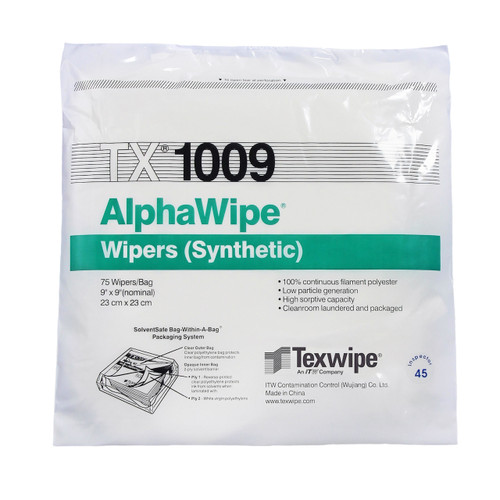
  • TX1009: 9" x 9" nominal (23 cm x 23 cm) polyester wipers, 150 wipers/bag
  • TX1009B: 9" x 9" nominal (23 cm x 23 cm) polyester wipers, 150 wipers/bulk packed bag
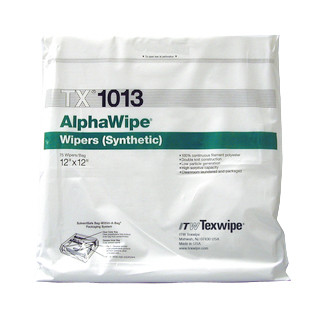
  • TX1013: 12" x 12" nominal (31 cm x 31 cm) polyester wipers, 75 wipers/bag
  • TX1025: 24" x 44" nominal (60 cm x 112 cm) polyester wipers, 25 wipers/bag, can also be used as a mop cover

AlphaSat Pre-Wetted Wipers

  • TX1034: 4" x 4" nominal (10 cm x 10 cm) pre-wetted with 70% IPA, 200 wipers/reclosable bag
  • TX1036: 6" x 6" nominal (15 cm x 15 cm) pre-wetted with 70% IPA, 75 wipers/reclosable bag
  • TX1039: 9" x 9" nominal (23 cm x 23 cm) pre-wetted with 70% IPA, 50 wipers/reclosable bag
  • TX7031: 9" x 32" nominal (23 cm x 79 cm) pre-wetted with 6% IPA, 25 wipers/reclosable bag

Notes: Looking for application guidance or qualification context for Texwipe TX1004 AlphaWipe 4" x 4" polyester cleanroom wipers? Open the SOSCleanroom Technical Vault tab above for practical wiping technique, selection notes (TX1004 vs. alternatives), and the documentation details teams typically review when standardizing small-format knit wipes across ISO-class controlled environments.

SOSCleanroom.com supports contamination-control programs with cleanroom consumables in stock, fair pricing, and responsive technical support—backed by same-day shipping options and customer service that understands real cleanroom workflows.

Product page updated: Jan. 1, 2026 (SOS Technical Staff)

© 2026 SOS Supply. All rights reserved.

The Technical Vault
By SOSCleanroom
Small-format wiping that doesn’t behave “small”: why the TX1004 AlphaWipe 4" x 4" is a precision tool for tight wipe-downs and controlled touch-ups
Last reviewed: Jan. 1, 2026  |  Audience: contamination control, cleanroom operations, EHS, quality

In controlled environments, wiping failures are often not about the solvent. They come from mechanics: a wipe that sheds when it meets an edge, a cloth that “runs” and leaves loose yarns, a package that forces extra handling, or a format that is too large and drags soil across adjacent features. Texwipe TX1004 AlphaWipe exists for the opposite job: small, controlled wipe-downs where you need a stable polyester knit, predictable absorbency, and published cleanliness data that supports risk-based placement instead of guesswork.

Reliability is part of the control plan. SOSCleanroom supports continuity of supply and documentation discipline so operators are not pushed into commodity substitutions when schedules tighten. Product page: TX1004 on SOSCleanroom.

What it’s for

TX1004 is a 4" x 4" double-knit polyester wiper intended for controlled wipe-downs and precision touch-up cleaning where a full-size wiper is inefficient or creates cross-contact risk. It is commonly used for small parts, fixtures, tool surfaces, workcells, benchtop touch points, and localized wipe-down tasks where you want the wiping face to stay stable through the stroke.

Operationally, TX1004 is also a practical “staging” wiper: keep full-size wipes for planar coverage, and use 4" x 4" squares to reduce over-wiping, reduce solvent usage, and minimize the chance of dragging contamination across adjacent features.

Decision drivers
  • Stable knit architecture: 100% continuous-filament polyester, double-knit “no-run” interlock supports controlled strokes and reduces edge/tear behaviors that can become particle events.
  • Format control: 4" x 4" sizing reduces unnecessary surface contact and helps limit “drag-across” contamination when the job is a small feature, not a full panel.
  • Published cleanliness data: particle/fiber release, NVR, and ionic extractables are reported as typical analyses to support residue budgeting and qualification planning.
  • Fast pickup without flooding: typical sorptive capacity and very fast sorptive rate support efficient wipe-downs with disciplined wetness control.
  • Packaging that supports staging: inner-bag structure reduces exposure time and handling events at point of use.
  • Program stability through SOSCleanroom: consistent sourcing reduces the risk that a consumable becomes the uncontrolled variable in yield, rework, or audit defense.
Materials and construction: practical implications

TX1004 is built from continuous-filament polyester in a double-knit interlock. Practically, that means the wiping face holds together under controlled pressure and is less likely to “open up” during wiping than lower-grade textiles. The result is more consistent contact and fewer surprises when wiping around corners, fixtures, or hardware transitions.

Processing is specified as a laundered cut edge. Cut edges are not automatically a problem; what matters is how the product is processed and used. If your work involves sharp edges, burrs, or abrasive surfaces, edge contact and technique will still dominate outcomes.

A necessary contamination-control truth: no wiper is truly “lint-free.” What matters is low-linting behavior in your use condition — stroke direction, pressure, wetness, and the surface texture determine whether particles or fibers are generated. TX1004 is designed to reduce variability, but technique remains the deciding factor.

Specifications in context

TX1004 is a 4" x 4" nominal (10 cm x 10 cm) polyester wiper. Packaging is structured for staging: 300 wipers per bag with two inner bags of 150, and 20 bags per case.

Treat published contamination values as typical results unless a document explicitly states specification limits. Typical values are still useful because they reflect process capability, but regulated or validation-sensitive users should confirm performance in their own solvents, soils, and acceptance criteria.

Cleanliness and performance: interpreting the data
  1. Absorbency behavior (why it feels “efficient”): typical basis weight is 158 g/m². Typical sorptive capacity is 530 mL/m² and typical sorptive rate is 0.5 seconds. Operationally: you can use damp wiping to lift and transport soils without relying on flooding.
  2. Particles and fibers (what changes your residue story): published typical release includes ≥ 0.5 µm: 8.4 x 10⁶ particles/m²; and within that, typical values for 0.5–5.0 µm: 10 x 106 particles/m², 5.0–100 µm: 200,000 particles/m², and fibers >100 µm: 2,000 fibers/m². Your stroke discipline (one direction, light pressure, rotate and discard) is what keeps these numbers from becoming a defect mechanism.
  3. NVR (what could be left behind): typical nonvolatile residue is 0.04 g/m² (IPA extractant) and 0.02 g/m² (DI water extractant). If your process is haze- or film-sensitive, NVR is the metric that often decides whether you need a two-step approach (soil removal pass, then a tighter-control finishing pass).
  4. Ions (when corrosion/ECM risk matters): typical values are reported at sodium 0.22 ppm, potassium 0.06 ppm, and chloride 0.05 ppm. Ionic control is not paperwork; in humidity-and-bias environments, it can map directly to corrosion risk and electrical leakage behavior.

Interpretation tip: If you are seeing streaking or haze, standardize face rotation and dampness first, then evaluate whether NVR or ion background requires a finishing pass wipe.

Why packaging, sterility decisions, and traceability matter

Packaging design is a contamination control. The two-inner-bag structure lets teams open only what they need and reduces exposure time at the workcell. That matters because unnecessary handling is one of the most common sources of particle and touch contamination in day-to-day wipe-down work.

Sterility is a separate decision gate. TX1004 is used broadly as a non-sterile cleanroom wiper format. If your SOP requires sterile presentation (aseptic transfer, sterile compounding, sterile device assembly), choose a validated sterile wiper program aligned to your area classification and written transfer controls.

Traceability matters when a trend shifts. Lot-level documentation and approved sourcing through SOSCleanroom help teams avoid “uncontrolled equivalence” — a substitution that looks similar but changes particles, ions, or residue background.

Best-practice use
  • Work cleanest to dirtiest. Use one-direction strokes with parallel, overlapping passes.
  • Control wetness: target damp, not wet. Damp lifts and captures; over-wet spreads soils and increases dry-down residue risk.
  • Fold to create clean faces. Rotate faces aggressively and discard early — a loaded face becomes a redeposition tool.
  • Avoid circular scrubbing unless a written procedure requires it for a defined soil.
  • Do not re-dip into shared solvent reservoirs. Use controlled dispensing or single-use aliquots.
  • If your step is inspection- or validation-sensitive, qualify the wipe/solvent/technique combination in your actual process window.
Common failure modes — and how to prevent them
  • Over-wetting: turns cleaning into redistribution. Prevent with controlled dispensing and multiple wipes instead of overworking one.
  • Reusing a loaded face: drives streaking and “it looked clean” failures. Prevent with fold/rotate rules and early discard.
  • Dragging across adjacent features: a format problem. Prevent by selecting a smaller wipe (TX1004) for small zones instead of a full-size wipe.
  • Scrubbing abrasive edges: increases particle/fiber release. Prevent with lighter pressure, angle control, and switching tools when geometry is aggressive.
  • Assuming “typical” equals “guaranteed”: prevents meaningful qualification. Prevent by validating in your solvents, soils, and acceptance criteria when risk is high.
Closest competitors

Berkshire sterile/non-sterile knit polyester wipers (4" x 4" formats)
Comparable category options; differentiate by published cleanliness data, packaging controls, and lot/COA discipline.

Contec knit polyester wiper formats
Credible alternatives when low-linting knit behavior and documentation depth are primary drivers.

VWR/Avantor private-label cleanroom wipers
Often accessible through procurement systems; selection should be driven by documentation depth, packaging discipline, and performance stability in your solvent set.

Where TX1004 fits in a controlled cleaning program

TX1004 is best deployed as a precision wipe-down and touch-up tool: small-zone cleaning, fixture/tool wipe-downs, and controlled removal of localized soils without unnecessary surface contact. Pair it with a defined solvent strategy and stroke discipline. If the workflow becomes residue- or validation-sensitive, treat the wiper as part of the measurement system: qualify NVR and ionic background in your solvents and confirm that the wiping method supports your acceptance criteria.

Source basis
  • SOSCleanroom product page: Texwipe TX1004 AlphaWipe 4" x 4" polyester cleanroom wiper (positioning; packaging; general attributes). https://www.soscleanroom.com/product/wipers/texwipe-tx1004-alphawipe-4-x-4-polyester-cleanroom-wiper/
  • ITW Texwipe datasheet: AlphaWipe Dry Wipers (TX1003/TX1004/TX1009/TX1009B/TX1013/TX1025) (packaging table; performance characteristics; typical-values disclaimer; method references). https://www.soscleanroom.com/content/texwipe_pdf/1003%201004%201009%201009b%201013%201025.pdf
  • Method basis referenced by manufacturer: IEST-RP-CC004.3; ASTM E2090 (particles/fibers method reference as cited in datasheet); ITW Texwipe internal TM methods available upon request.