style="width:100%;max-width:220px;height:auto;border:1px solid #cfe3f7;border-radius:6px;display:block;" />
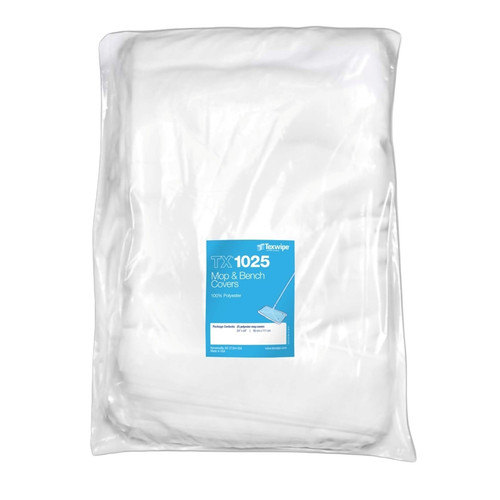
TX1025 (image for identification; packaging/labels may vary by lot).
1) Practical solutions in a critical environment
TX1025 exists for one practical problem: controlling what happens during long wipe paths. When a wipe is undersized, operators naturally scrub, re-fold mid-pass,
and “double back” to chase streaks. That behavior increases re-deposition risk and drives operator-to-operator variability.
The 24" x 44" format gives you enough working area to run a disciplined, one-direction pattern across benches, stainless panels, carts, pass-through shelves,
and larger equipment exteriors with fewer resets. In many programs, TX1025 functions either as a folded, stable hand pad (for controlled lanes) or as a mop-cover substrate
used with compatible flat mop hardware for walls, floors, and wide smooth panels.
2) What is this wiper used for
- Large-surface wipe-downs: benches, carts, panels, shelves, equipment exteriors, and staged large parts.
- Spill control and pick-up during routine operations where a larger working area reduces change-outs.
- Controlled application/removal of solutions (including disinfectants) when your SOP calls for wipe-based wetting and removal.
- Solvent wiping (e.g., IPA, acetone, degreasers) after verifying compatibility with your surface/material set.
- Lining trays or staging areas to protect, dry, or transport sensitive parts in a controlled workflow.
3) Why should customers consider this wiper
- Large-area control: the 24" x 44" footprint supports longer lanes and fewer mid-pass refolds.
- Durable knit on “real” surfaces: the no-run interlock structure is intended to resist snagging/abrasion in everyday cleanroom maintenance.
- Packaging discipline: double-bagging helps staging into controlled areas while reducing handling exposure.
- Typical low extractables profile: published typical ions and NVR help QA teams evaluate suitability for residue-sensitive work.
- Program standardization: consistent size + consistent packing count supports training, kitting, and line-clearance expectations.
4) Materials and construction
TX1025 is a 100% polyester wipe constructed in a double-knit, no-run interlock pattern with a laundered cut edge. In practical terms,
that knit choice is about durability: it helps the wiper hold together during long wipe strokes and reduces the tendency to snag when wiping rougher
equipment exteriors, carts, or textured panels.
Polyester knit also tends to be chemically resistant across many common cleanroom solvents and solutions (compatibility is still chemistry- and surface-dependent).
For operators, the biggest “construction” advantage is predictable folding: you can create a stable pad with a consistent leading edge and reuse the same folding geometry
across teams and shifts.
5) Specifications in context
Use this table as an at-a-glance way to translate the SKU into day-to-day decisions (folding plan, lane width, change-out trigger, and residue risk).
Values shown are manufacturer-typical unless otherwise noted.
| Attribute |
TX1025 (SKU) |
| Format |
Dry cleanroom wiper; often used as a mop-cover-sized wipe |
| Nominal size |
24" x 44" (60 cm x 112 cm) |
| Material / knit |
100% polyester; double-knit, no-run interlock |
| Edge |
Cut edge (laundered) |
| Cleanroom environment (use range) |
ISO Class 4–8 (Class 10–100,000); EU Grade A–D |
| Basis weight (typical) |
158 g/m² |
| Absorbency (typical) |
Sorptive capacity: 530 mL/m²; sorptive rate: <0.3 seconds |
| Particles/fibers (typical) |
LPC ≥0.5 µm: 8.4 x 10⁶ particles/m²; Fibers >100 µm: 2,000 fibers/m² |
| Autoclave safety |
Manufacturer indicates dry wipe is autoclave safe (final suitability depends on your cycle and acceptance criteria) |
| Shelf life (manufacturer guidance) |
Non-sterile (dry): 5 years from date of manufacture |
6) Cleanliness metrics
These typical values are most useful when you are comparing residues across wipe options, setting change-out triggers, or deciding where a “large-format” wipe fits in your cleaning sequence.
Treat them as typical analyses rather than guaranteed specifications, and confirm with your internal methods if your process is residue-sensitive.
Typical ion extractables
| Ion |
Typical value |
Units |
| Sodium |
0.15 |
ppm |
| Potassium |
0.03 |
ppm |
| Chloride |
0.10 |
ppm |
Typical NVR
| Extractant |
Typical value |
Units |
| IPA extractant |
0.06 |
g/m² |
| DIW extractant |
0.01 |
g/m² |
7) Packaging, sterility and traceability
- Packaging (inner): 25 wipers per bag, double bagged.
- Packaging (case): 3 bags per case (75 wipers per case).
- Sterility: Non-sterile (dry). Do not treat it as sterile unless your purchasing and quality documentation explicitly states a sterile variant.
- Traceability: Maintain lot discipline for high-impact cleans, cleaning verification work, deviation response, and any area where your QA team expects chain-of-custody documentation.
- Country of origin (manufacturer statement): Made in USA (TX1025 is listed without the “*Made in China” marker in the AlphaWipe technical data sheet product table).
8) Best-practice use
TX1025 performs best when you treat it as a “lane control” tool. The goal is not scrubbing—it’s controlled transfer and removal without re-touching what you just cleaned.
If you want TX1025 to look and behave consistent across operators, standardize the folding plan and the wipe path.
Operator technique module (large-format wipe discipline)
- Folding plan: fold into a stable pad (e.g., quarters or eighths) so you control the leading edge and keep a consistent contact face.
- One direction only: use straight-line strokes (top-to-bottom or left-to-right). Avoid “back-and-forth polishing,” which can re-deposit.
- Lane width + overlap: define a repeatable lane width and overlap slightly to avoid missed strips; teach it the same way you teach gowning steps.
- Pressure control: light, consistent pressure reduces abrasion and helps keep shedding low; heavy pressure increases edge contact and snag risk.
- Change-out triggers: rotate to a clean face on a timer, a surface-area estimate, or a visible-residue rule—do not “stretch” a loaded face across new surfaces.
- Wet steps: if using solvents/solutions, standardize wetness (too wet drives streaking; too dry drives drag and poor pickup). Validate residue limits by your methods.
- Bag discipline: open the outer bag only at point-of-use; keep the inner bag sealed until wiping to reduce handling-driven contamination.
- Mop-cover workflows: if used with a flat mop system, ensure the wipe is secured uniformly to prevent bunching, edge flipping, and streaking.
- Residue-sensitive processes: treat the wiper as part of the process train (chemistry + surface + wipe). Confirm acceptance by your inspection/analytical method.
9) Common failure modes
- Streaking after wet wipes: typically too much solution, inconsistent wetness, or re-passing with a loaded face.
- Re-deposition: “scrub and return” motion, overextended use of one face, or wiping clean areas after contacting high-soil zones.
- Snagging on rough features: excessive pressure or dragging the cut edge over burrs, sharp corners, or rough welds.
- Cross-zone contamination: carrying an opened bag or exposed wipe between rooms without a defined staging rule.
- Misclassification risk: treating a non-sterile dry wiper like a sterile component in aseptic workflows.
10) Closest competitors
If you are comparing large-format polyester knit wipes, focus on knit structure, packaging discipline, typical extractables profile, and how the product behaves on your real surfaces
(especially long wipe paths). Two common comparison directions are:
- Berkshire polyester knit cleanroom wipers (format-dependent equivalents): often compared on particle/fiber control, wetting behavior, and packaging/traceability options.
- Valutek polyester knit cleanroom wipers (large sizes): commonly compared on durability, cut-edge behavior, and available cleanliness documentation.
- Kimtech/other cleanroom wiper programs in large-format options: typically compared on material class, edge construction, and application fit rather than direct “same-knit” equivalence.
11) Critical environment fit for this wiper
TX1025 is a strong fit when your workflow rewards repeatable lane-based wiping: large benches, wide panels, carts, pass-through shelving,
and maintenance wipe-downs where consistency matters more than “micro-precision.” It is also frequently selected for mop-cover-style use where teams want the familiarity of a wipe
with the reach and uniformity of a flat mop motion.
From a QA perspective, the published typical ions and NVR support initial risk screening for residue-sensitive work, and the listed shelf-life guidance can support stocking programs.
Texwipe also notes alignment with USP <797> and USP <800> requirements for wipers and indicates the dry wipe is autoclave safe (your facility still owns qualification and release).
SOSCleanroom supports standardization programs around Texwipe wipers with practical application guidance (folding plans, wipe-path discipline, change-out triggers) and reliable fulfillment
for recurring consumption—useful when teams are trying to keep cleaning outcomes stable across shifts and sites.
12) SOSCleanroom note about SOP's
The Technical Vault is written to help customers make informed contamination-control decisions and improve day-to-day handling technique.
It is not your facility’s Standard Operating Procedure (SOP), batch record, or validation protocol.
Customers are responsible for establishing, training, and enforcing SOPs that fit their specific risks, products, equipment, cleanroom classification, and regulatory obligations.
Always confirm material compatibility, cleanliness suitability, sterility requirements, and acceptance criteria using your internal quality system and documented methods.
If you adapt any technique guidance from this entry, treat it as a starting template. Your team should review and approve the final method, then qualify it for your specific surfaces,
solvents, cleanliness limits, inspection methods, and risk profile. In short: use these best-practice suggestions to strengthen your SOPs—not to replace them.
13) Source basis
SOSCleanroom is the source for this Technical Vault entry.
Briefed and approved by the SOSCleanroom (SOS) staff.
Last reviewed: Jan. 7, 2026
© 2026 SOSCleanroom