The Technical Vault
By SOSCleanroom
When Edge Control Is the Constraint: Why TX1029 Vectra Quantum100 Is a Practical Step-Up for Residue- and Particle-Sensitive Wipe-Downs
Last reviewed: Jan. 1, 2026 | Audience: contamination control, cleanroom operations, EHS, quality
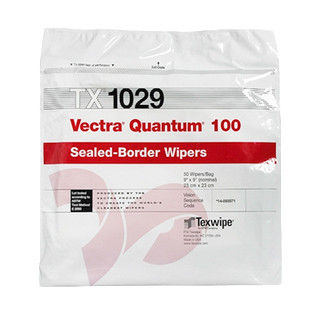
Texwipe TX1029 Vectra Quantum100 (9" × 9") is a dry, knitted 100% continuous-filament polyester cleanroom wiper designed for programs that want the handling and sorbency of a knit wipe, but need a tighter edge-risk posture than a standard cut-edge format.
The defining control feature is the bonded sealed border: it is engineered to reduce edge-driven releasables during folding, corner work, and higher-pressure wipe patterns on fixtures, equipment exteriors, pass-through touchpoints, and assembly support surfaces.
TX1029 is commonly placed across ISO Class 3–8 controlled environments (final suitability is always process- and technique-dependent). It is supplied 50 wipers per bag with 10 bags per case in a double-bagged presentation aligned to controlled introduction and staged use.
What it’s for
TX1029 is best used for routine cleanroom wipe-down where edge control, low-linting behavior, and repeatable cleanliness metrics matter: benches and carts, tool and equipment exteriors, stainless and coated surfaces, staging areas, and controlled cleaning steps where the wipe must clean effectively without becoming the uncontrolled variable.
It is also a practical choice when operators are doing more corner work, wiping around fasteners, or folding aggressively—scenarios that often amplify edge-shedding differences between wipe architectures.
Decision drivers
TX1029 earns its place in a cleanroom wiping program based on a short list of technical controls:
- Substrate and construction: 100% continuous-filament polyester in a knit architecture that supports durability, folding control, and low-linting behavior under wiping force.
- Edge strategy (bonded sealed border): designed to reduce edge-driven releasables during folding, corner wiping, and higher-pressure strokes versus standard cut-edge formats.
- Cleanliness framework: published typical values for particles/fibers, nonvolatile residue (NVR), and extractable ions support qualification discussions and change-control posture.
- Sorbency behavior: knit polyester can provide fast uptake for routine wipe-down and light spill response without behaving like an unstable paper-like substrate.
- Packaging discipline: double-bagged cleanroom presentation supports controlled introduction; 50-count inner bags help staged issuance and reduce long “open exposure” windows at wipe stations.
- Program stability through SOSCleanroom: continuity of supply and consistent documentation handoff reduce unqualified substitutions when schedules tighten.
Materials and construction – explained like an engineer
“Polyester cleanroom wiper” is an overly broad label. What matters is continuous-filament polyester (long filaments) versus staple-fiber constructions that can present more loose ends under abrasion.
TX1029 uses continuous-filament polyester in a knit format, then adds a bonded sealed border to address the most common failure point in real wiping: edge degradation during repeated folding, corner work, and contact with brushed stainless, fastener heads, and textured coatings.
In practice, sealed-border architecture helps keep the wipe’s contamination contribution closer to a controlled process input—especially when operators work quickly and repeat strokes across the same geometry (edges, corners, seams, and interface lines).
Terminology note: TX1029 is engineered for low-linting performance; no wiper is truly “lint-free” in every process condition.
Cleanliness and performance metrics
For many facilities, the decision to standardize a wiper comes down to whether it introduces risk in three categories: releasables (particles/fibers), residues (NVR), and ions.
TX1029’s published typical values cover those categories and should be treated as a qualification starting point rather than a contractual specification.
- Particles: typical LPC (>0.5 µm) 2.6 × 10⁶ particles/m².
- Fibers: typical fibers (>100 µm) 8,300 fibers/m².
- NVR: typical NVR 0.006 g/m² (DI water) and 0.003 g/m² (IPA).
- Extractable ions: typical values reported include Na 0.30 µg/g, Cl 0.18 µg/g, K 0.07 µg/g (representative controls for corrosion/ECM-sensitive processes).
- Sorbency: typical sorptive capacity 950 mL/m² with a reported sorptive rate of <0.3 seconds (useful when you need fast wet-out without “chasing” a spill across the work area).
Operational translation: when residue is visible after dry-down, the primary levers are usually wetness control, face rotation frequency, and chemistry concentration discipline—not wiping harder. When ionic background is the controlling defect mechanism, confirm performance in your solvent set and acceptance window, and treat wipe selection as a process input decision.
Why sealed-border architecture matters operationally
In real cleanrooms, wipes fail less often due to the base fiber and more often due to handling: how aggressively operators fold, how often they wipe edges and corners, and whether the wipe is dragged across rough geometry.
Sealed-border formats are a practical control when edge-driven releasables, stringers, or corner work are recurring contributors to investigations.
The key is to pair edge control with disciplined technique: fold consistently, rotate faces aggressively, and discard once the wipe is loaded.
Rule of thumb: When edge control becomes the acceptance driver, sealed-edge/sealed-border is typically the next control step. When wetness repeatability is the constraint, consider a controlled pre-wetted system.
Best-practice use
Even the best wipe can redeposit contamination if technique is casual. TX1029 performs best when operators use quarter-folding to create multiple clean faces, wipe in controlled, overlapping, single-direction strokes, and change to a fresh face frequently.
- Fold for control: quarter-fold to create stable edges and multiple faces; treat each face as single-pass in residue-sensitive steps.
- Directional wiping: use straight-line, overlapping strokes; avoid back-and-forth scrubbing on residue-sensitive surfaces unless the SOP explicitly requires it.
- Wetness discipline: apply solvent consistently; avoid over-wetting that can wick into seams and dry unevenly.
- Change-out triggers: discard early when the face is loaded or near saturation—loaded wipes are redeposition tools.
- Separate roles: keep cleaning wipes separate from validation sampling tools when TOC/HPLC/residue recovery is in scope.
For EHS: follow facility controls for solvent storage/transport and ventilation when alcohols or aggressive chemistries are part of the wipe-down program.
Common failure modes — and how TX1029 helps
A wiper becomes a contamination source in predictable ways: edge degradation during rough wiping, snagging on textured surfaces, reusing a contaminated face too long, and leaving residues due to inconsistent solvent loading.
TX1029’s sealed-border architecture helps reduce edge-driven releasables during folding and corner work, while the knit polyester construction supports durability during higher-throughput wipe-down. The remaining controls are procedural: face rotation, directional strokes, and chemistry discipline.
Closest comparators
The most defensible comparisons are to other sealed-edge/sealed-border polyester knit wipes intended for similar ISO ranges and wiping tasks:
Berkshire MicroSeal (sealed-edge polyester knit families) is the appropriate comparator when edge-driven releasables are the dominant risk. Sealed-edge knits are commonly selected for more critical surfaces or higher defect sensitivity because the edge is engineered to reduce fiber contribution during folding and aggressive wipe patterns.
Contec sealed-edge polyester knit offerings are commonly evaluated when surface gentleness, alternative edge profiles, or a different “hand feel” is desired while maintaining chemical resistance and a low-releasables posture.
Where TX1029 fits in a cleanroom wiping program
TX1029 is a strong choice as a sealed-border “daily driver” 9" × 9" polyester knit wiper when the facility wants repeatable cleanliness, chemical compatibility, and faster investigation closure—paired with edge control that reduces one of the most common real-world failure mechanisms. Use it for routine wipe-down, corner and interface work, and residue- and particle-sensitive steps where a standard cut-edge knit wipe is close but not quite controlled enough.
If country-of-origin is controlled in your quality system, confirm it through lot-specific documentation tied to the product you receive; do not rely on assumptions.
Source basis
- SOSCleanroom product page: “Texwipe TX1029 Vectra Quantum100 9" × 9" Polyester Cleanroom Wiper” (ISO class placement, sealed-border positioning, packaging configuration, features/benefits). https://www.soscleanroom.com/product/wipers/texwipe-tx1029-vectra-quantum100-9-x-9-polyester-cleanroom-wiper/
- ITW Texwipe technical datasheet: “Vectra Quantum100 Wipers” (TX1029 construction, sealed border, typical particles/fibers, NVR, ionic extractables, sorbency). https://www.soscleanroom.com/content/texwipe_pdf/1029.pdf
- Comparator category context (sealed-edge polyester knit wipes): Berkshire MicroSeal families; Contec sealed-edge polyester knit offerings (edge strategy and positioning frameworks).
Source: SOSCleanroom Technical Staff | Last reviewed: Jan. 1, 2026
© 2026 SOS Supply. All rights reserved.