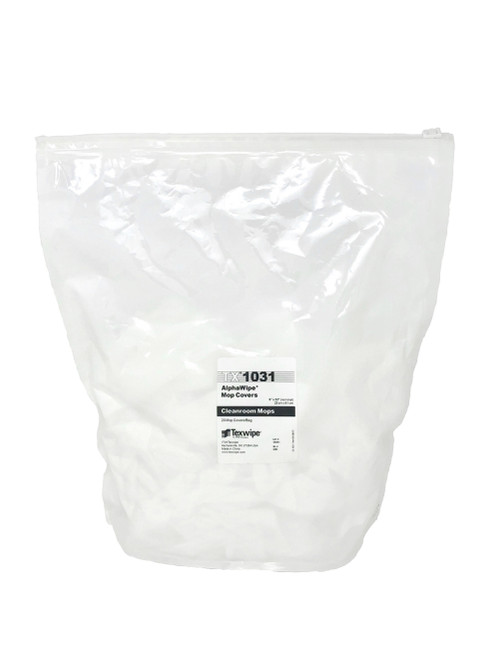
TX1031 AlphaWipe® (9" x 32") is often used as a hand wipe or a large-format “mop-cover style” substrate in flat-head workflows. :contentReference[oaicite:1]{index=1}
1) Practical solutions in a critical environment
When a team is fighting re-deposition, streaking, or “mystery residue” on large stainless panels, walls, isolator exteriors, carts, and benches,
the wipe becomes a process variable. TX1031 is built for high-coverage work: a large 9" x 32" knit polyester format that helps you maintain
one-direction discipline and reduce the temptation to “keep scrubbing” with a loaded face. :contentReference[oaicite:2]{index=2}
This is a low-linting cleanroom wiper (nothing is truly lint-free). The substrate and laundering controls are intended to keep particle/fiber contribution
low while still handling abrasive surfaces that can shred weaker wipes. :contentReference[oaicite:3]{index=3}
2) What is this wiper used for
- Wiping and cleaning surfaces, equipment, and parts (especially larger surface areas). :contentReference[oaicite:4]{index=4}
- Spill control and solution application/removal (wetting is controlled by your method and chemistry). :contentReference[oaicite:5]{index=5}
- Removing residues such as lubricants/adhesives (where your solvent and dwell are specified by your SOP). :contentReference[oaicite:6]{index=6}
- Solvent cleaning (Texwipe lists compatibility examples including IPA and acetone; confirm in your material-compatibility assessment). :contentReference[oaicite:7]{index=7}
- Mopping/panel-wipe workflows where frequent cover changes and large-area contact are required. :contentReference[oaicite:8]{index=8}
3) Why should customers consider this wiper
- Coverage + control: The 9" x 32" format helps enforce straight, overlapping passes and reduces rework on large panels. :contentReference[oaicite:9]{index=9}
- Abrasive-surface resilience: Texwipe positions the knit structure for abrasive surfaces where snagging and fiber release are common failure modes. citeturn11view0turn12view0
- Published cleanliness markers: Typical ions and NVR are documented for the AlphaWipe family—useful for audits and troubleshooting. :contentReference[oaicite:10]{index=10}
- Fast solvent response: Typical sorptive rate (<0.3 seconds) supports controlled wetting and quick pickup. :contentReference[oaicite:11]{index=11}
- Documented, repeatable program: Lot traceability and consistent packaging configuration support QA investigations and routine supplier qualification. :contentReference[oaicite:12]{index=12}
4) Materials and construction
TX1031 is a knit, continuous-filament polyester wipe with a cut edge, cleanroom manufactured/laundered and packaged under controlled conditions. :contentReference[oaicite:13]{index=13}
Practical interpretation: cut edges are often the first place a wipe fails when operators scrub across sharp burrs, threaded fittings, or rough welds.
If your workflow includes those surfaces, your technique (stroke direction, pressure control, and face-change discipline) matters as much as the wipe selection. :contentReference[oaicite:14]{index=14}
5) Specifications in context
Use this table the way an auditor or manufacturing engineer will: confirm the SKU configuration (size/pack) and then tie “typical” performance markers
to your acceptance criteria and cleaning method. :contentReference[oaicite:15]{index=15}
| Attribute |
TX1031 (SKU) |
| Product type |
Dry cleanroom wiper (large-format / mop-cover style substrate) |
| Material / edge |
100% polyester; cut edge :contentReference[oaicite:16]{index=16} |
| Size |
9" x 32" (23 cm x 81 cm) :contentReference[oaicite:17]{index=17} |
| Packaging |
20 wipers/bag; 10 bags/case (200/case) :contentReference[oaicite:18]{index=18} |
| Cleanroom environment (use range) |
ISO Class 4–8; EU Grade A–D :contentReference[oaicite:19]{index=19} |
| Absorbency (typical) |
Sorptive capacity 530 mL/m²; sorptive rate <0.3 seconds :contentReference[oaicite:20]{index=20} |
| Basis weight (typical) |
158 g/m² :contentReference[oaicite:21]{index=21} |
6) Cleanliness metrics
Cleanliness numbers help most when you connect them to an actual failure mode. If you are seeing film, haze, or residue after wipe-down,
NVR is often the best first check. If you are protecting sensitive surfaces or downstream analytical work, typical ionic values are a practical screening tool.
The tables below reflect typical AlphaWipe-family results (not a lot-specific CoA). :contentReference[oaicite:22]{index=22}
Typical ion extractables
| Ion |
Typical value |
Units |
| Sodium |
0.15 |
ppm :contentReference[oaicite:23]{index=23} |
| Potassium |
0.03 |
ppm :contentReference[oaicite:24]{index=24} |
| Chloride |
0.10 |
ppm :contentReference[oaicite:25]{index=25} |
Typical NVR
| Extractant |
Typical value |
Units |
| IPA extractant |
0.06 |
g/m² :contentReference[oaicite:26]{index=26} |
| DIW extractant |
0.01 |
g/m² :contentReference[oaicite:27]{index=27} |
Troubleshooting shortcut (shop-floor practical)
If residue is showing up after a “wet wipe,” separate three causes quickly: (1) wipe NVR, (2) chemistry residue, and (3) technique overload (too wet + too many passes).
Large-format wipes reduce rework only if you enforce straight strokes and frequent face changes. :contentReference[oaicite:28]{index=28}
7) Packaging, sterility and traceability
- Packaging: 20 wipers/bag; 10 bags/case (200 wipers/case). :contentReference[oaicite:29]{index=29}
- Sterility: Non-sterile (dry). Sterility is not implied—select sterile alternatives only if your classification and quality system require it. :contentReference[oaicite:30]{index=30}
- Traceability: Texwipe notes lot coding/traceability for AlphaWipe products; capture lot codes for high-impact cleans, deviations, and validation work. :contentReference[oaicite:31]{index=31}
- Shelf life (manufacturer guidance, non-sterile dry): 5 years from date of manufacture. :contentReference[oaicite:32]{index=32}
- Country of origin (manufacturer statement): Made in China (TX1031 is marked as a “*Made in China” item in the AlphaWipe family TDS). :contentReference[oaicite:33]{index=33}
8) Best-practice use
TX1031 performs best when you treat it like a controlled tool—staged, used with intent, and retired before it becomes a re-deposition rag.
The biggest field failures are (a) wiping too wet, (b) wiping too long on one face, and (c) scrubbing across burrs until the edge starts generating particles. :contentReference[oaicite:34]{index=34}
Operator technique checklist (wiping module)
- Surface pre-check: Identify sharp edges and burrs first. If present, remove gross debris with an appropriate method so the cut edge is not forced into abrasion. :contentReference[oaicite:35]{index=35}
- Control wetting: Apply solvent to the wipe (or validated delivery method), not directly to the surface, unless your SOP requires spray-first. Aim for damp—not dripping—to avoid streaking and spread. :contentReference[oaicite:36]{index=36}
- One-direction passes: Wipe from clean-to-less-clean with straight, overlapping strokes. Avoid circular scrubbing unless you have a defined residue type and a validated scrub method. :contentReference[oaicite:37]{index=37}
- Face-change rule: Treat each face as a finite capacity filter. When it looks “fine” is often when it is already loaded. Fold/flip on a schedule, not on hope. :contentReference[oaicite:38]{index=38}
- End with a defined finish: If your method allows, a final controlled dry pass can reduce streaking—especially on stainless—by lifting residual solvent and mobilized films. :contentReference[oaicite:39]{index=39}
9) Common failure modes
- Re-deposition: A loaded face spreads contaminants instead of removing them. Mitigation: defined face-change cadence and one-direction strokes. :contentReference[oaicite:40]{index=40}
- Edge abrasion on burrs: Scrubbing across sharp features can generate particles from any cut-edge knit. Mitigation: pre-clean gross debris; reduce pressure; avoid “sawing” motions. :contentReference[oaicite:41]{index=41}
- Solvent overload streaking: Too much chemistry mobilizes soils and leaves trails. Mitigation: controlled wetting, dwell discipline, and a defined finish pass if allowed. :contentReference[oaicite:42]{index=42}
- Traceability gaps during investigations: “Unknown wipe lot” slows down deviation closure. Mitigation: record wipe lots for high-impact cleans and validation work. :contentReference[oaicite:43]{index=43}
10) Closest competitors
Compare large-format knit polyester wipers by mechanism, not marketing: knit stability on abrasive surfaces, edge style (cut vs sealed), laundering/packaging controls,
published extractables (ions/NVR), and documentation support.
- Berkshire knitted polyester wipe programs: a broad portfolio including knife-cut and sealed-edge knit options for controlled environments. :contentReference[oaicite:44]{index=44}
- Contec knit polyester wipe families: knit polyester options including sealed-edge styles for contamination control workflows. :contentReference[oaicite:45]{index=45}
- Valutek knit polyester wipers: knit polyester wipers positioned around low particles/extractables and multiple edge constructions. :contentReference[oaicite:46]{index=46}
Selection reminder: “best” depends on your edge-risk profile, residue chemistry, and documentation needs—not just fabric type.
11) Critical environment fit for this wiper
Texwipe lists TX1031 for ISO Class 4–8 environments and describes it as a high-absorbency, low-linting knit designed for spill control, cleaning, and solution application—particularly on abrasive surfaces where snagging and particle/fiber release are common concerns. :contentReference[oaicite:47]{index=47}
Program-fit note: If you operate in a regulated or audit-driven environment, treat wipes like controlled consumables—define when TX1031 is used, how it is wetted (if applicable),
how faces are changed, and how lots are recorded. SOSCleanroom supports customers who need repeatable product identity and reliable documentation alignment from ITW Texwipe programs. :contentReference[oaicite:48]{index=48}
12) SOSCleanroom note about SOP's
The Technical Vault is written to help customers make informed contamination-control decisions and improve day-to-day handling technique.
It is not your facility’s Standard Operating Procedure (SOP), batch record, or validation protocol.
Customers are responsible for establishing, training, and enforcing SOPs that fit their specific risks, products, equipment, cleanroom classification, and regulatory obligations.
Always confirm material compatibility, cleanliness suitability, sterility requirements, and acceptance criteria using your internal quality system and documented methods.
If you adapt any technique guidance from this entry, treat it as a starting template. Your team should review and approve the final method, then qualify it for your specific surfaces,
solvents, cleanliness limits, inspection methods, and risk profile. In short: use these best-practice suggestions to strengthen your SOPs—not to replace them.
13) Source basis
SKU sources
• SOSCleanroom product page (TX1031): https://www.soscleanroom.com/product/wipers/texwipe-tx1031-alphawipe-9-x-32-polyester-cleanroom-wiper-and-mop-cover/ :contentReference[oaicite:49]{index=49}
• Manufacturer product page (TX1031): https://www.texwipe.com/alphawipe-tx1031 :contentReference[oaicite:50]{index=50}
Manufacturer PDFs
• SOS-hosted mopping system reference (AlphaMop TDS; mop-cover workflow context): https://www.soscleanroom.com/content/texwipe_pdf/AlphaMop%20TDS%20_%20ALL%20_%202014.pdf :contentReference[oaicite:51]{index=51}
• SOS-hosted AlphaWipe family description sheet (family reference): https://www.soscleanroom.com/content/texwipe_pdf/1003%201004%201009%201009b%201013%201025.pdf :contentReference[oaicite:52]{index=52}
• Texwipe Technical Data Sheet (AlphaWipe family): TEX-LIT-TDS-004 Rev.00-02/17 (PDF): https://www.texwipe.com/images/uploaded/documents/Wipers/Texwipe-AlphaWipe-TDS-ENG.pdf :contentReference[oaicite:53]{index=53}
Standards and regulatory bodies
• ISO: https://www.iso.org/standard/53394.html :contentReference[oaicite:54]{index=54}
• FDA: https://www.fda.gov/ :contentReference[oaicite:55]{index=55}
• ASTM: https://www.astm.org/ :contentReference[oaicite:56]{index=56}
• IEST: https://www.iest.org/ :contentReference[oaicite:57]{index=57}
SOSCleanroom is the source for this Technical Vault entry.
Briefed and approved by the SOSCleanroom (SOS) staff.
If you have any questions please email us at Sales@SOSsupply.com
Last reviewed: January 7, 2026
© 2026 SOSCleanroom