Texwipe TX1050 Vectra AlphaSorb10 9" x 9" Polyester Cleanroom Wiper

$85.56
(No reviews yet)
SKU:
TX1050 BAG
Availability:
Stock Item
Shipping:
Calculated at Checkout
Quantity Option (Bag):
100 Wipers Per Bag (2 Inner Bags of 50 Wipers)
Quantity Option (Case):
10 Bags of 100 Wipers Per Case
Type:
Dry Wiper
Wiper Family:
Vectra AlphaSorb 10
Wiper Material:
Polyester
Wiper Size:
9" x 9"
Wiper Edge:
Sealed Border
ISO Class:
ISO 3 (Class 1)
ISO Class:
ISO 4 (Class 10)
ISO Class:
ISO 5 (Class 100)
ISO Class:
ISO 6 (Class 1,000)
ISO Class:
ISO 7 (Class 10,000)
ISO Class:
ISO 8 (Class 100,000)

TX1050 Vectra AlphaSorb10 9" x 9" Polyester Cleanroom Wiper

TX1050 Vectra AlphaSorb 10 is a low-linting (no wiper is truly ‘zero-lint’ in every process condition), sealed-border, two-ply, double-knit, 100% continuous-filament polyester wiper offering high-sorbency performance for critical wipe-downs and spill control in controlled environments. All four cut edges of the wiper are thermally sealed, forming a border to help prevent particle and fiber release. AlphaSorb 10 is positioned as a premium wiper platform designed to balance absorbency, cleanliness, and abrasion resistance for rigorous use.

Best-seller note: TX1050 is commonly specified when teams want a sealed-border, two-ply polyester wiper to reduce change-outs during wet steps while maintaining ultra-low particles/extractables (process-dependent) in high-scrutiny cleanroom wipe-downs.

Specifications:
  • Size: 9" x 9" (23 cm x 23 cm) nominal
  • Material: 100% synthetic fiber (continuous-filament, double-knit polyester)
  • Construction: Unique two-ply, pinsoniced construction (two-ply, double-knit)
  • Edge: Thermally sealed border (sealed-border)
  • Packaging: 100 wipers/bag (2 inner bags of 50); 10 bags/case
  • ISO use environments: ISO 3–8 (final suitability depends on your process and cleaning method)
  • Typical performance/cleanliness metrics (TDS; not specifications): Basis weight 185 g/m2; sorptive capacity 540 mL/m2; sorptive rate 0.5 seconds; LPC (> 0.5 µm) 2.7 x 10⁶ particles/m2; fibers (> 100 µm) 100 fibers/m2; NVR (IPA) 0.04 g/m2; NVR (DIW) 0.01 g/m2; ions (Na/K/Cl) 0.11/0.13/0.008 ppm
About the Manufacturer: 

Texwipe (an ITW company) differentiates itself in cleanroom wiping by treating the wiper as an engineered product, not a commodity consumable. Its manufacturing approach starts with fabric and yarn selection (often continuous-filament polyester for lower shedding), then controls edge construction (cut-edge, sealed-edge, and sealed-border options), controlled cleaning/laundering, and packaging aligned to cleanroom application tiers.


For Vectra® processed sealed-border families, Texwipe emphasizes process controls intended to improve lot-to-lot consistency and reduce handling-driven contamination risk. SOSCleanroom (SOS) supports that manufacturing discipline with a close working relationship with Texwipe focused on continuity of supply, clean documentation handoff (certs, lot traceability), and practical application support—so customers can standardize wiping materials with predictable performance while maintaining procurement reliability and audit readiness.

TX1050 Features:
  • 100% synthetic fiber (continuous-filament, double-knit polyester)
  • Unique two-ply, pinsoniced construction
  • Thermally sealed border
  • Laundered and packaged at ITW Texwipe's Cleanroom Products Manufacturing Center
  • Solvent-safe Bag-Within-A-Bag cleanroom packaging
  • Statistical quality control
TX1050 Benefits:
  • Fewer wipers per task: High-sorbency, two-ply construction is designed to reduce wiper usage during wet steps (process-dependent)
  • Cleanliness assurance: Ultra-low levels of particles and extractables support contamination-control objectives (process-dependent)
  • Border-driven contamination control: Thermally sealed border helps minimize fiber and particle release at the perimeter
  • Rugged under use: Designed to resist abrasion during rigorous wipe-downs
  • Traceability: Bag-to-bag traceability supports qualification and investigations
Common Applications:
  • Engineered for high-sorbency use in the most critical cleanroom environments, such as semiconductor and pharmaceutical manufacturing
  • Two-ply construction for both spill control and general wiping areas where contamination control and absorbency are of paramount importance
  • Wet wipe-downs on equipment exteriors, tool surfaces, benches, carts, and fixtures where sealed-border construction is preferred
  • Application and removal of cleanroom-compatible process solutions (verify compatibility to your chemistry and SOP)
Best-Practice Use:
  • Fold for control: Fold into quarters to create multiple clean faces; rotate faces instead of re-wiping with a loaded surface.
  • Wipe pattern: Use straight-line strokes (top-to-bottom or left-to-right) to avoid re-depositing contamination.
  • Use the border intentionally: Keep the sealed border from dragging through pooled liquids or heavy residues; lead with a clean face and change faces early in high-load steps.
  • Wet vs. dry: For solvent wipe-downs, dampen—do not over-saturate—so you maintain control and reduce dripping.
  • Change-out triggers: Replace the wiper when the face becomes visibly soiled, tacky, or begins leaving streaks/residue.
Selection Notes (TX1050 vs. Other Options)
  • TX1050 vs. TX1052: Both are AlphaSorb 10 sealed-border, two-ply, double-knit polyester wipers, but TX1052 is the larger 12" x 12" format and is noted as not Vectra® processed.
  • Dry vs. pre-wetted (TX1057): If you want consistent wetting and reduced solvent handling, TX1057 provides AlphaSat pre-wetted wipers (10% IPA/90% DIW) in a reclosable bag; choose TX1050 when you prefer controlled wetting at point-of-use.
  • AlphaSorb 10 vs. other sealed-border Vectra families: If abrasion resistance or surface glide is the key driver, compare to other sealed-border Vectra wipers (e.g., Vectra Alpha10 or Vectra Quantum100) during qualification.

Link to Texwipe Technical Datasheet:
Click Here

Other Similar Products Available From SOSCleanroom.com

Vectra AlphaSorb 10 Dry Wipers

  • TX1050: 9" x 9" nominal (23 cm x 23 cm), two-ply, double-knit polyester, sealed-border wiper, 100 wipers/bag

AlphaSorb 10 Dry Wipers

  • TX1052: 12" x 12" nominal (31 cm x 31 cm), two-ply, double-knit polyester, sealed-border wiper, 100 wipers/bag

AlphaSat with Vectra AlphaSorb 10 Pre-Wetted Wipers

  • TX1057: 9" x 9" nominal (23 cm x 23 cm), pre-wetted 10% IPA/90% DIW, 40 wipers/reclosable bag

Other Sealed-Border Vectra® Process Wipers

  • TX1010: 9" x 9" nominal (23 cm x 23 cm), sealed-border Vectra Alpha10
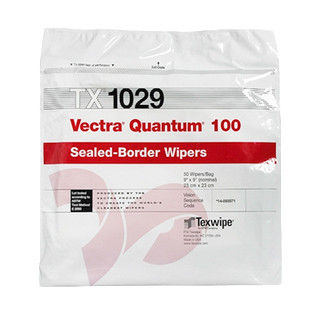
  • TX1029: 9" x 9" nominal (23 cm x 23 cm), sealed-border Vectra Quantum100
  • TX1080: 9" x 9" nominal (23 cm x 23 cm), sealed-border Vectra QuanTex

Notes: Looking for application guidance or qualification context for Texwipe TX1050 Vectra AlphaSorb10 9" x 9" polyester sealed-border cleanroom wipers? Open the SOSCleanroom Technical Vault tab above for practical wiping technique, selection notes (TX1050 vs. alternatives), and the documentation details teams typically review when standardizing cleanroom wipes across ISO-class controlled environments.

SOSCleanroom.com supports contamination-control programs with cleanroom consumables in stock, fair pricing, and responsive technical support—backed by same-day shipping options and customer service that understands real cleanroom workflows.

Product page updated: Jan. 2, 2026 (SOS Technical Staff)

© 2026 SOS Supply. All rights reserved.

The Technical Vault
By SOSCleanroom
Two-Ply Sorbency With Sealed-Border Control: Why TX1050 Vectra AlphaSorb10 Is a “Spill-Response Upgrade” for Critical Areas
Last reviewed: Jan. 2, 2026 |  Audience: contamination control, cleanroom operations, EHS, quality

Texwipe TX1050 Vectra AlphaSorb10 (9" × 9") is a dry, two-ply, double-knit, continuous-filament polyester cleanroom wiper built for one problem operators feel immediately: getting enough uptake per wipe without turning the edge into a particle source. TX1050 addresses that with a thermally sealed border on all four edges and a high-sorbency two-ply construction intended to reduce wipe consumption during spill control and general wiping in contamination-sensitive areas.

Program reliability still matters. SOSCleanroom supports continuity of supply and clean documentation handoff so teams are not forced into unqualified substitutions that change sorbency, edge behavior, and cleanliness background mid-shift. Terminology note: TX1050 is engineered for low-linting performance; no wiper is truly “lint-free” in every process condition.

What it’s for

TX1050 is positioned for high-sorbency wiping in critical cleanroom environments where both absorbency and contamination control are “first-order” requirements. Typical placement includes spill response, wet process support wipe-downs, and general wiping where operators need the wiper to stay intact and controlled under wet use, without edge-driven fiber and particle release.

The SOSCleanroom listing places TX1050 across ISO Class 3–8 use ranges; final suitability should be tied to your surface sensitivity, wet chemistry, and acceptance criteria for releasables and residues.

Decision drivers

TX1050 earns its place when your program needs a wiper that behaves like a controlled tool under wet load:

  • Two-ply, double-knit polyester: designed to increase uptake per wipe and reduce “wipe count” during spill control and wet wipe-downs.
  • Sealed border: all four edges are thermally sealed to reduce edge-driven releasables during folding, corner work, and wet wiping.
  • High sorbency metrics: published sorptive capacity supports placement decisions when absorbency is the limiting factor.
  • Cleanliness framework: published typical values for particles/fibers, NVR, and ions help define where it belongs versus lighter-weight knit or cut-edge options.
  • Packaging discipline: bag-within-a-bag cleanroom packaging and bag-to-bag traceability support controlled introduction and investigation readiness.
Materials and construction – explained like an engineer

TX1050 is built from 100% continuous-filament polyester in a two-ply, double-knit structure. Continuous filament matters because it reduces the loose fiber ends you can see with staple constructions under abrasion. The two-ply knit changes the mechanical feel and the fluid model: there is more structure to hold liquid, and more “reservoir” for pickup before the wipe becomes a redistribution tool.

The other control is the sealed border. In many facilities, edge behavior is where a wiper stops being a consumable and starts being a defect mechanism—especially when operators quarter-fold, work corners, and wipe near interfaces. Sealing the perimeter is a practical way to reduce edge-driven particles and fibers during real wiping patterns.

Cleanliness and performance metrics

For most cleanroom programs, “wiper risk” sits in three buckets: releasables (particles/fibers), residues (NVR), and ions. TX1050’s published typical values should be treated as qualification starting points (method- and process-window dependent), but they are highly actionable for placement:

  • Sorbency: typical sorptive capacity 540 mL/m²; sorptive rate ≤ 0.5 seconds (fast wet-out for spill response and wet wipe-down cadence).
  • Releasables: typical LPC (>0.5 µm) 2.7 × 10⁶ particles/m²; fibers (>100 µm) 100 fibers/m².
  • Residues: typical NVR 0.04 g/m² (IPA extractant) and 0.01 g/m² (DI water extractant).
  • Ions: published typical ionic extractables include very low levels (e.g., sodium, potassium, chloride, sulfate, ammonium) to support corrosion/ECM-sensitive discussions where applicable.

Translation for operators: TX1050 is built to take up liquid quickly, stay coherent under wet load, and keep edge behavior controlled—so spill response does not become a particle event, and wet wipe-downs do not become a wipe-consumption problem.

Why two-ply + sealed border matters operationally

In the field, many “wipe failures” are handling failures: overworking one wipe face, wiping with a saturated wipe, dragging a wet edge across an interface, or trying to stretch a single wipe across multiple stations. Two-ply construction helps reduce the “one wipe too few” behavior in spill response, while a sealed border helps reduce edge-driven releasables when the wipe is folded and used aggressively. The control is not theoretical—it shows up as fewer mid-task wipe changes, fewer visible fibers during wet work, and fewer investigations where the root cause is “we ran out and grabbed something else.”

Rule of thumb: If absorbency is driving wipe count (spills, wet wipe-downs, disinfectant removal) and edges are part of the defect story, a sealed-border, higher-sorbency knit is often the most direct control step.

Best-practice use

TX1050 performs best when technique matches the contamination model:

  • Quarter-fold for control: create multiple stable faces; treat each face as single-pass for critical wipe-downs.
  • Directional strokes: use straight, overlapping passes (cleanest-to-dirtiest). Avoid casual back-and-forth scrubbing that redistributes soil.
  • Wetness discipline: aim for damp when possible; over-wetting increases pooling and can convert sorbency into residue redistribution.
  • Spill logic: blot/pickup first, then finish with controlled strokes and fresh faces; do not “polish” with a loaded wipe.
  • Change-out triggers: once the wipe approaches saturation or begins to smear, it is a redistribution tool—replace early.
Common failure modes — and how TX1050 helps

A wiper becomes a contamination source in predictable ways: edge degradation during aggressive wiping, overusing one face too long, and turning wet wipe-downs into streaking events due to saturation and redeposit. TX1050’s sealed border is intended to reduce edge-driven releasables, while the two-ply knit increases uptake capacity so operators are less tempted to “stretch” a wipe past the point of effective pickup. The remaining controls are procedural: face rotation, directional strokes, and wetness discipline.

Closest comparators

The most defensible comparisons are to other sealed-edge/sealed-border polyester cleanroom wipes positioned for critical-area wiping where edge control is part of the requirement.

Berkshire MicroSeal 1200 (sealed-edge polyester knit) is a common comparator when edge-driven releasables are the dominant risk and the facility wants a sealed-edge knit architecture for higher defect sensitivity surfaces.

Contec Polynit (polyester knit family, with variants commonly positioned for cleanroom wiping) is evaluated in many programs when teams want a knit polyester option with strong chemical compatibility and a different “hand feel” profile; selection typically turns on edge strategy, sorbency needs, and the published cleanliness framework for the exact SKU.

Selection shortcut: If edge control is the acceptance driver, prioritize sealed-edge/sealed-border options. If uptake per wipe is driving labor and wipe count, prioritize higher sorbency architectures (and validate residues in your solvent window).

Where TX1050 fits in a cleanroom wiping program

TX1050 is best positioned as a critical-area, high-sorbency “spill-response upgrade” and wet wipe-down tool where the program needs both uptake and edge control. It is a strong fit for high-throughput wipe stations supporting semiconductor, pharma/biotech, and other controlled environments where wet work happens routinely and the wiper must not become a variable. When the constraint shifts from “uptake” to ultra-sensitive finishing, programs often define a separate final-pass wipe strategy (surface-dependent) and keep technique and change-out discipline as the primary controls.

Process note: If country of origin is a controlled attribute in your quality system, confirm it using documentation tied to the lots received and the exact packaging configuration purchased.

Source basis
  • SOSCleanroom product page: “Texwipe TX1050 Vectra AlphaSorb10 9" × 9" Polyester Cleanroom Wiper” (pack configuration; sealed-border/two-ply description; positioning; packaging discipline; ISO class listing; feature/benefit framing). https://www.soscleanroom.com/product/wipers/texwipe-tx1050-vectra-alphasorb10-9-x-9-polyester-cleanroom-wiper/
  • ITW Texwipe datasheet (via SOSCleanroom PDF): “Vectra AlphaSorb 10 Dry Wipers TX1050 / TX1052” (published sorbency, particles/fibers, NVR, ions; construction notes; typical-value framing). https://www.soscleanroom.com/content/texwipe_pdf/1050%201052.pdf
  • Comparator category references for positioning context: Berkshire MicroSeal 1200 (sealed-edge polyester knit wiper framework) and Contec Polynit (polyester knit family positioning and category context). https://berkshire.com/products/microseal1200/ | https://www.contecinc.com/products/knitted-wipes/polynit-z-wipes/
Source: SOSCleanroom Technical Vault |  Last reviewed: Jan. 2, 2026
© 2026 SOS Supply. All rights reserved.