The Technical Vault
By SOSCleanroom
ISO Class 3–8 cleanroom use
Non-sterile (dry wiper)
100% continuous-filament polyester
Double-knit + sealed border
Honeycomb capture face + smooth face
Bag: 100 (2×50) • Case: 1,000
Texwipe TX1060 Vectra® Honeycomb® 10 (9" × 9") — Sealed-Border Polyester Wiper Built for Grit Encapsulation and Critical Surface Cleaning

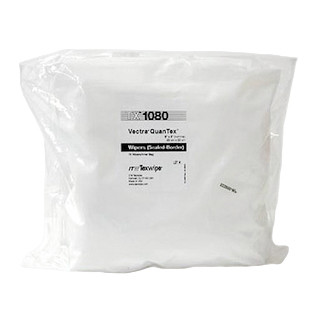
Representative product image (TX1060).
1) Why TX1060 exists: when grit, fragments, and residues drive risk
In critical cleaning, the problem is often not “dust” — it is grit, small fragments, and stubborn residues that can scratch optics, damage sensitive tooling, or become yield-killers in microelectronics and advanced manufacturing. TX1060 Vectra® Honeycomb® 10 is engineered for that reality: a sealed-border, double-knit polyester wiper with an intentionally textured face that can help capture particulate during wipe-down rather than pushing it across a surface.
If your process includes high-sensitivity wipe steps (tooling, chambers, fixtures, precision benches, optics handling zones), the “right” wiper is the one that supports particle control, edge integrity, and consistent technique without introducing fibers, loose edges, or uncontrolled residues.
2) What it’s for
TX1060 is commonly selected when teams want sealed-border polyester cleanliness plus a surface that can assist with girt removal and encapsulation during cleaning. Typical use-cases include:
- Semiconductor and advanced manufacturing tool wipe-down (process equipment, enclosures, fixtures)
- Optics and precision assembly support cleaning where scratches and residues are unacceptable
- General cleanroom surface maintenance across ISO Class 3–8 programs
- Applications needing a two-sided wiper (scrub/capture side + smooth finishing side)
3) Why customers choose it
- Dual-surface design: honeycomb pockets on one face help capture and retain particles/debris; the opposite face is smooth for finishing passes.
- Sealed borders (all four edges): thermal sealing helps reduce edge-related particle/fiber release and supports cleanroom discipline.
- Continuous-filament polyester knit: engineered for low-linting wipe steps (note: no wiper is truly “lint-free” in every process condition).
- Scrub + absorbency balance: knit construction supports cleaning efficacy while maintaining contamination control expectations for critical environments.
- Standardization-friendly: defined bag/case configurations and recognized family positioning simplifies purchasing, validation, and training.
4) Materials and construction
TX1060 is a sealed-border, double-knit, 100% continuous-filament polyester wiper. The key differentiator is the surface differential:
one side is engineered with honeycomb pockets intended to capture and retain particles; the other side is smooth for controlled finishing passes.
- Material: 100% continuous-filament polyester
- Construction: double-knit with two engineered surfaces
- Edge: thermally sealed border on all four sides
- Form: dry, non-sterile cleanroom wiper
5) Specifications in context
Use the table below as a purchasing and qualification baseline. In stricter environments (ISO 3–4), success is typically driven as much by
technique, wetting chemistry, and handling discipline as by the wiper itself.
| Specification |
Published / listed value |
| Brand / family |
ITW Texwipe — Vectra® Honeycomb® 10 |
| Product code |
TX1060 |
| Size |
9" × 9" (23 cm × 23 cm) nominal |
| Material |
100% continuous-filament polyester |
| Edge |
Sealed border (thermally sealed) |
| Type |
Dry wiper, non-sterile |
| Packaging (bag) |
100 wipers/bag (2 inner bags of 50) |
| Packaging (case) |
10 bags/case (1,000 wipers total) |
| ISO Class positioning |
ISO 3, 4, 5, 6, 7, 8 (listing context) |
6) Cleanliness and process notes
Sealed-border polyester wipers are often selected because they help control two failure modes: edge shedding and fiber release.
TX1060 adds a third control lever: surface engineering aimed at grit encapsulation for cleaning steps that are more than cosmetic.
Program tip: if you are standardizing across multiple ISO areas, train operators on which face to use first (capture face) and when to switch
to the smooth face for final passes. That single habit reduces rework and prevents “scrub marks” from over-working a surface.
7) Packaging and traceability
Packaging discipline is part of contamination control. TX1060 is supplied as a dry, non-sterile wiper with inner-bag configuration intended to support
organized staging and controlled introduction into cleaner zones.
- Bag unit: 100 wipers/bag (2 inner bags of 50)
- Case unit: 10 bags/case (1,000 total)
- Traceability: retain bag/case identifiers with receiving records so deviations and investigations have fewer unknowns.
8) Best-practice wiping
- Pre-wet consistently: if using a solvent (IPA/DI-water blends, validated chemistries), apply a controlled wetting volume for repeatability.
- Use the right face: start with the honeycomb side for capture/scrub where appropriate; finish with the smooth side for final passes.
- Fold discipline: fold into usable faces; rotate to a clean face before the wiper is overloaded.
- One-direction strokes: avoid circular scrubbing unless your SOP calls for it; one-direction passes reduce redeposition.
- Don’t “overuse” a wiper: a saturated/loaded wipe becomes a contamination source. Define change triggers (time, area covered, visible loading).
Matching consumables: wiper + swab
If you are running ISO-controlled processes, align wiping and swabbing tools to the same cleanliness intent so particles and residues are controlled end-to-end.
For precision cleaning, many programs qualify ultraclean polyester knit swabs for corners, crevices, and validation sampling.
Note on terminology: when specifying wipes, use “low-lint” or “low-linting” language — no wiper is truly lint-free.
9) Common failure modes
- Redeposition: using the same face too long or wiping back over the same path with a loaded wiper.
- Wrong chemistry: solvent incompatibility or insufficient wetting can smear residues instead of removing them.
- Technique drift: “scrub everywhere” habits can create micro-marring on sensitive finishes; use defined strokes.
- Boundary breakdown: staging open bags in uncontrolled areas or touching non-controlled surfaces during cleaning tasks.
10) Closest alternates
If you are standardizing a sealed-border polyester platform, these are common alternates customers compare in the same 9" × 9" format. Always compare
the surface intent (scrub/capture vs. general wipe), sorption feel, and your process acceptance criteria.
11) Customer SOP disclaimer
The guidance in this Technical Vault entry is provided as general cleanroom best-practice education and a starting template for evaluation.
It is not a substitute for your validated procedures and is not presented as your site SOP. Always follow your site’s approved SOPs and quality requirements,
and validate wiper selection, wetting chemistry, wiping method, and acceptance criteria against your process risks.
12) Source basis
SOSCleanroom is the source for this Technical Vault entry.
Briefed and approved by the SOSCleanroom (SOS) staff.
If you have any questions please email us at Sales@SOSsupply.com or give us a call at (214)340-8574.
If you need additional information please try our SOSCleanroom specific AI ChatBot which draws from our extensive cleanroom specific libraries.
Last reviewed: January 12, 2026
© 2026 SOS Supply. All rights reserved.