The Technical Vault
By SOSCleanroom
Squirt-Bottle Control in a Bag: Why TX1084 QuanSat Stabilizes 70% IPA Final Wipe-Downs in ISO Class 3–6 Work
Last reviewed: Jan. 3, 2026 | Audience: contamination control, cleanroom operations, quality, semiconductor manufacturing, EHS
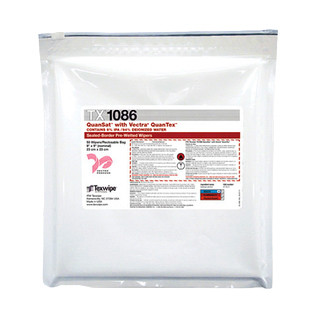
Many “wipe-related” excursions are actually solvent-handling excursions: bulk IPA that sits open and pulls in contamination, squirt bottles that vary by technician and shift, and re-wetting habits that turn soil removal into soil redistribution. Texwipe TX1084 QuanSat (9" × 9") is engineered to remove those failure modes by delivering a controlled 70% semiconductor-grade IPA wetting condition on an ultraclean Vectra® QuanTex™ sealed-border knit polyester substrate—dispensed one wipe at a time from a reclosable slider package.
This is not a “convenience wipe.” It is a process-control consumable: it reduces bulk-solvent touchpoints, supports consistent wetness, and tightens the contamination model for final wipedowns and tool cleaning where water-sensitive surfaces, VOC constraints, and repeatability all matter.
What it’s for
TX1084 is positioned for ISO Class 3–6 cleaning workflows that benefit from standardized IPA delivery: cleaning production tools during wet cleans and preventative maintenance, maintenance of manufacturing equipment (semiconductor, disk media, flat panels), and final wipedown of critical surfaces prior to manufacturing or packaging. It is also a practical choice where flammable-solvent use is restricted or VOC regulations drive tighter solvent control and reduced handling.
Decision drivers
TX1084 earns its place when the dominant risk is not “IPA chemistry” but variability in delivery and handling:
- Wetness repeatability: 70% IPA is delivered at point of use without technician-controlled dilution, bottle squeeze variability, or re-dipping behaviors.
- Sealed-border substrate control: Vectra QuanTex is a continuous-filament, double-knit polyester with a thermally sealed border—built for abrasion resistance and reduced edge-driven releasables.
- Packaging discipline: reclosable slider opening, internal security seal, cleanroom packaging and double-bagging support controlled introduction and staged use.
- Traceability posture: bag-to-bag traceability plus in-line SPC and machine-vision inspection are positioned as consistency controls.
- Operational and EHS alignment: reduced bulk IPA handling helps lower alcohol consumption, minimize VOCs, and eliminate squirt-bottle maintenance in areas where those are known problem sources.
Materials and construction – explained like an engineer
“Pre-wetted wipe” is an incomplete description. The technical behavior comes from the combination of (1) continuous-filament knit polyester (stable under abrasion, less prone to fiber generation than chopped-fiber constructions), (2) a thermally sealed border (edge control during folding and corner work), and (3) a defined IPA concentration delivered through a controlled package.
That combination matters most during high-consequence wiping: tool faces, process-contact shields, enclosure interiors, and final wipedowns where inconsistent wetness or edge stringers can become an investigation. With TX1084, the substrate and the solvent step are treated as one controlled input.
Cleanliness and performance metrics
For many programs, the right question is: “What does the wipe add while it removes?” TX1084’s published typical values (after seven days of saturation) provide a qualification starting point across absorbency, releasables, residues, and ions. Treat these as typical analyses, not contractual specifications.
- Absorbency (sorptive capacity): 352 mL/m²; sorptive rate: 0.5 seconds.
- Particles released: 12 × 106 particles/m² (0.5–5.0 µm); 144,000 particles/m² (5.0–100 µm).
- Fibers released (>100 µm): 292 fibers/m².
- NVR: 0.03 g/m² (IPA extractant); 0.02 g/m² (DI water extractant).
- Ions: sodium 0.20 ppm; potassium 0.20 ppm; chloride 0.15 ppm.
Practical translation: this is a strong option where you need an ultraclean, sealed-border knit with controlled IPA delivery—while still recognizing that technique (face rotation, directional strokes, discard discipline) is the final gate on redeposition and streaking.
Why pre-wetted + sealed-border matters operationally
In real facilities, wipes fail more often due to handling than substrate selection. TX1084’s format helps in three ways: it discourages re-wetting mid-pass, removes bulk-solvent exposure points, and makes “take a fresh wipe” the easy behavior. Pair that convenience with controlled technique and you get a measurable reduction in solvent-step variability—especially late-shift and across multiple operators.
Rule of thumb: When wetness repeatability is the constraint, a controlled pre-wetted system is often the fastest way to stabilize outcomes. When edge control is the constraint, sealed-edge/sealed-border is typically the next control step.
Best-practice use
TX1084 performs best when operators use it as a controlled, single-task wipe rather than a “multi-surface rag.” Fold consistently, rotate faces aggressively, and discard early once the wipe face loads.
- Quarter-fold for control: create multiple clean faces; treat each face as single-pass on critical surfaces.
- Directional strokes: use straight, overlapping passes; avoid back-and-forth scrubbing that redistributes dissolved soils.
- Corner work: use the sealed border intentionally—light pressure, controlled angle, no snagging on fasteners.
- Pack discipline: reseal immediately; do not “top off” with additional solvent (it breaks repeatability and can introduce contamination).
Common failure modes — and how TX1084 helps
A wipe becomes a contamination source in predictable ways: reusing a loaded face, re-wetting mid-pass, leaving the pack open and changing wetness, and snagging edges in corners. TX1084 addresses the solvent variability and edge-control mechanisms with its pre-wetted delivery and sealed-border substrate. The remaining controls are procedural: face rotation, directional strokes, and discard rules tied to visible soil and task length.
Closest comparators
The most defensible comparisons are to other pre-wetted programs where the substrate architecture and packaging discipline are designed to control wetness and releasables.
Contec Polynit Heatseal (presaturated options) is a credible comparator when you want a knit polyester architecture with a sealed edge strategy in a presaturated program.
Berkshire SatPax® presaturated IPA wipe families are common comparators when the decision is driven primarily by packaging discipline and presaturation workflow, especially in high-throughput wipe stations.
Where TX1084 fits in a cleanroom wiping program
TX1084 fits as a standardized solvent wipe-down control for ISO Class 3–6 work where repeatability, edge control, and reduced bulk-solvent handling are the real drivers. Use it for final wipedowns, wet-clean tool maintenance, and cleaning tasks where water-sensitive surfaces and VOC constraints make “open solvent + dry wipe” an avoidable risk. When the constraint shifts to sterility requirements, move to a validated sterile presaturated system. When the constraint shifts to specialized residue limits or sampling recovery, align consumables to the measurement method and acceptance criteria.
Terminology note: TX1084 is engineered for low-linting performance; no wiper is truly “lint-free” in every process condition.
Source basis
- SOSCleanroom product page: “Texwipe TX1084 Vectra Quansat 9" × 9" Polyester Cleanroom Wiper Pre-Wetted 70% IPA” (packaging configuration, positioning, features/benefits).
- ITW Texwipe datasheet: DS-1082 (Effective December 2009) covering QuanSat with Vectra QuanTex TX1082/TX1084 (applications, construction, packaging, typical performance and contamination characteristics; typical-value framing).
- Method references cited by manufacturer: IEST-RP-CC004.3 and ASTM E2090-00 (particle/fiber release characterization context).
Source: SOSCleanroom Technical Vault
Last reviewed: Jan. 3, 2026
© 2026 SOS Supply. All rights reserved.