The Technical Vault
By SOSCleanroom
ULP Treated for a Reason: Why TX1112 TechniCloth II Is a “High-Absorbency, Low-Particle” Control Move in ISO 6–7 Wiping
Last reviewed: Jan. 2, 2026 | Audience: contamination control, cleanroom operations, EHS, quality
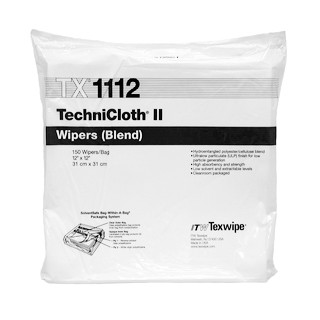
Texwipe TX1112 TechniCloth II (12" × 12") is a hydroentangled, nonwoven cellulose/polyester cleanroom wiper built for the reality of daily wiping: routine wipe-downs, spill control, and general cleaning where absorbency is non-negotiable, but particle contribution still has to stay within a defined program.
The defining differentiator is the ULP (ultralow particulate) treatment, designed to reduce particle generation versus earlier TechniCloth generations, paired with solvent-safe Bag-Within-A-Bag cleanroom packaging and lot traceability—practical controls that help prevent “the wiper” from becoming the variable during investigations and audit defense.
What it’s for
TX1112 is designed for critical environments where low particle generation and high absorbency are prime considerations, including spill control and cleaning/polishing precision components. It is positioned for ISO Class 6–7 use cases and is commonly deployed where operators need fast wet-out and strong pickup without defaulting to uncontrolled shop towels or binder-heavy nonwovens.
Decision drivers
TX1112 earns its place when you need absorbency-first wiping, but you still want an engineered contamination-control posture:
- Substrate balance: 55% cellulose / 45% polyester blend to combine rapid sorption with strength.
- ULP treatment: engineered to reduce particle generation relative to predecessor TechniCloth families.
- Hydroentangled nonwoven: strong bidirectional integrity for real-world wiping force (folding, corners, fixture edges).
- Packaging discipline: solvent-safe Bag-Within-A-Bag cleanroom packaging to reduce handling exposure and support controlled introduction.
- Traceability posture: lot-to-lot traceability and quality control framing to support change control and investigations.
- Right-tier placement: an absorbency-driven wiper for ISO 6–7 wiping tasks; final-pass, residue-critical steps may warrant a tighter-control polyester architecture depending on acceptance criteria.
Materials and construction – explained like an engineer
“Cellulose/polyester nonwoven” is not a single performance class. The operational question is whether the wipe holds together when it is doing real work: blotting a spill, dragging across stainless, or wiping a tool handle that has film and particulate soils.
TX1112’s hydroentangled structure and polyester fraction are the controls that help prevent the classic failure mode of absorbent wipes—fiber release and tearing when operators increase speed and pressure.
Terminology matters: TX1112 is engineered for low-linting behavior; no wiper is truly “lint-free” in every process condition. Your surface texture, wipe pressure, wetness, and face-rotation discipline determine whether the wipe behaves like a control—or like a variable.
Specifications in context
TX1112 is a 12" × 12" (31 cm × 31 cm) format intended for bench, cart, and equipment wipe-downs where operators benefit from larger folded faces and fewer “reach” moves per cleaning step.
It is packaged 150 wipers per bag, double bagged, with 10 bags per case.
Practical sizing note: 12" × 12" is often a “control size” for teams that want disciplined folding (quarters/eighths) and predictable face rotation. The size helps—technique finishes the job.
Cleanliness and performance metrics
For many facilities, the qualification conversation centers on three risk buckets: releasables (particles/fibers), residues (NVR), and ions. The following values are published as typical analyses (not specifications) and should be treated as a starting point for placement and method suitability.
- Basis weight: 67 g/m² (typical).
- Sorption: sorptive capacity 260 mL/m²; sorptive rate 1.2 seconds (typical).
- Particles: LPC >0.5 µm: 37 × 106 particles/m² (typical). Additional size-banded particles are published for 0.5–5.0 µm and 5.0–100 µm.
- Fibers: >100 µm: 40,000 fibers/m² (typical).
- NVR: IPA extractant 0.02 g/m²; DI water extractant 0.02 g/m² (typical).
- Ions: sodium 40 ppm; potassium 5 ppm; chloride 24 ppm (typical).
Operational interpretation: if residue or streaking shows up after dry-down, the biggest levers are usually wetness control (damp vs. wet), fresh-face discipline, and not overworking a saturated wipe. “Wiping harder” is rarely the correct corrective action.
Best-practice use
TX1112 performs best when technique is treated as part of the contamination control system:
- Fold for control: quarter-fold into stable faces; rotate faces aggressively and discard early once loaded.
- Stroke logic: use controlled, overlapping, single-direction strokes (avoid casual back-and-forth scrubbing on residue-sensitive surfaces).
- Wetness control: aim for damp, not wet—over-wetting drives pooling, seam wicking, and redeposit risk.
- Spill workflow: blot/pickup first, then finish with fresh faces using directional passes.
- Role separation: use high-absorbency nonwoven blends for spill/routine wiping; reserve tighter-control polyester architectures when final-pass background is the acceptance driver.
Common failure modes — and how TX1112 helps
A wipe becomes a process variable in predictable ways: reusing a loaded face too long, over-wetting and redistributing dissolved soils, and pushing absorbent wipes into final-pass roles without qualification. TX1112’s ULP treatment and published contamination framework support disciplined placement, but the biggest controls remain procedural: face rotation, directional strokes, and wetness discipline aligned to your surface and acceptance criteria.
Closest comparators
The most defensible comparisons are to other cellulose/polyester, hydroentangled cleanroom wipers aimed at absorbency-driven wiping in controlled environments:
Contec cellulose/polyester nonwoven cleanroom wipes are a close category peer when programs want a blended wipe for spill pickup and routine wipe-downs with controlled packaging options. Compare documentation depth, packaging configuration, and how the wipe behaves in your chemistry set.
Avantor/VWR Spec-Wipe® 3 (cellulose/polyester blend) is commonly evaluated for general controlled wiping. Compare lot stability signals, published contamination context, and whether the residue/ion profile fits your process risk.
Rule of thumb: When absorbency is the limiting factor, blended nonwovens are often the right tool. When edge/releasables or ultra-low background is the limiting factor, a tighter-control polyester architecture is typically the step-up.
Where TX1112 fits in a cleanroom wiping program
TX1112 is a strong choice for ISO 6–7 workflows that need fast uptake, durability under wiping force, and a published contamination framework that supports qualification discussions. It is best positioned as a controlled “workhorse” for spill control and routine wipe-downs—paired with disciplined technique and a defined escalation path (tighter-control polyester architectures) when final-pass background becomes the acceptance driver.
Program note: SOSCleanroom supports continuity of supply and cleaner documentation handoff so teams can standardize wiping materials without last-minute substitutions that change wetness, residues, and outcomes.
Source basis
-
SOSCleanroom product page: “Texwipe TX1112 TechniCloth II 12" × 12" Cellulose and Polyester Cleanroom Wiper”
https://www.soscleanroom.com/product/wipers/texwipe-tx1112-techniclothii-12-x-12-cellulose-and-polyester-cleanroom-wiper/
-
ITW Texwipe datasheet DS-1109 (Effective December 2009): “TechniCloth® II Wipers” (description, ULP treatment, ISO Class 6–7 positioning, packaging, typical performance/contamination characteristics; methodology references to IEST-RP-CC004.3 and ASTM E2090)
https://www.soscleanroom.com/content/texwipe_pdf/1109%201112%201118.pdf
Source: SOSCleanroom Technical Vault | Last reviewed: Jan. 2, 2026
© 2026 SOS Supply. All rights reserved.