The Technical Vault
By SOSCleanroom
TX1704 Revolve™ 4" x 4" Sealed-Edge Upcycled Polyester Wiper: Tight Residue Control in Small-Area Cleaning
Last reviewed: Jan. 4, 2026 | Audience: contamination control, cleanroom operations, EHS, quality
Texwipe TX1704 Revolve™ is a small-format, sealed-edge cleanroom wiper made from 100% upcycled polyester yarn (rPET) and built for controlled wiping where you want consistent surface pickup with a low-residue, low-linting profile. The 4" x 4" geometry is deliberately “small on purpose” for spot cleaning, tool wipe-downs, and tight-geometry work where oversized wipes invite over-wetting, re-deposition, and waste.
Revolve™ is also designed for sustainability accountability: the bag labeling ties each SKU to a quantified upcycled-bottle count, and manufacturer materials publish greenhouse-gas (GHG) savings per bag for program reporting. For TX1704 specifically, manufacturer documentation indicates 10 upcycled bottles per bag and 1.65 lbs CO2 (GHG) savings per bag (typical program value), while keeping the contamination-control performance comparable to virgin-polyester wipers in the same class.
What it’s for
TX1704 is a non-sterile, dry, sealed-edge polyester wiper intended for cleaning and wiping of surfaces, equipment, and parts; applying/removing process liquids (lubricants, adhesives, residues, and disinfectant solutions when appropriate); and solvent wiping with IPA, ethanol, acetone, and common degreasers. The 4" x 4" format is especially useful for spot cleaning, fixture wipe-downs, probe stations, benches, pass-through touchpoints, small trays, and “one hand / one tool” tasks where controlled wipe discipline matters.
Decision drivers
Selection should be driven by how your process manages edge fray, solvent wet-out, and residue/ionic control—not just “ISO class on paper.” Use the drivers below to align the wipe to the risk you are actually managing.
- Sealed-edge strategy: Edge sealing reduces loose fiber release and prevents unraveling when wiping around corners, fasteners, and fixtures—particularly important for small wipes that see higher edge-to-area contact.
- Residue control (NVR) vs. cleaning chemistry: If you wipe with IPA/DI water blends or ketones, low extractables and a consistent NVR baseline reduce “mystery films” and re-clean loops.
- Ionic background: For electronics, optics, and precision assemblies, lower ionic contribution helps limit corrosion risk, salt spotting, and conductivity variability after wipe-down.
- Geometry discipline: A 4" x 4" wipe pushes better technique—less over-wetting, fewer “wrap-around” re-deposition events, and more consistent one-direction passes.
- Program reporting: Revolve™ supports sustainability reporting with per-bag bottle counts and published GHG savings values tied to the SKU family.
Materials and construction
TX1704 is constructed from 100% upcycled polyester (rPET) yarn, then processed and converted into a sealed-edge wipe. The sealed edge is not a cosmetic feature—it is the primary control point that limits edge-shed during wiping and helps the wipe keep its geometry under abrasion (especially when you fold, pinch, or “detail wipe” around tight hardware).
Manufacturer materials emphasize that Revolve™ uses upcycled polyester yarn only (no added yarn types) to avoid additive-driven contamination risk, while maintaining comparable cleanliness, sorption behavior, particle/fiber release, ions, and nonvolatile residues versus similar virgin-polyester offerings.
Specifications in context
Format: 4" x 4" (10 cm x 10 cm). Material: polyester (upcycled rPET). Edge: sealed edge. Condition: dry, non-sterile. Packaging: 100 wipers per bag, double-bagged; 20 bags per case (2,000 wipers/case). Cleanroom use range: manufacturer documentation lists ISO Class 3–7 as the cleanroom environment range for the Revolve™ family; TX1704 is commonly deployed in ISO 4–8 programs depending on the task and the contamination-risk profile. Shelf life: manufacturer documentation lists 5 years from date of manufacture for non-sterile dry Revolve™ wipers.
Cleanliness and performance metrics
Cleanroom wiper “numbers” are best treated as baselines for qualification: they support risk assessment, change control, and incoming verification, but your solvent, pressure, and surface energy will influence real-world performance. Where available, use manufacturer typicals and keep your internal acceptance criteria aligned to your SOP and audit expectations.
Typical contamination and performance values (manufacturer data; typical analyses):
• LPC (≥0.5 µm): 5.5 x 10⁶ particles/m2
• Fibers (>100 µm): 300 fibers/m2
• NVR (IPA extractant): 0.05 g/m2
• NVR (DI water extractant): 0.01 g/m2
• Ions: Na 0.08 ppm; K 0.03 ppm; Cl 0.04 ppm
• Sorptive capacity: 450 mL/m2
• Sorptive rate: 0.3 second
• Basis weight: 125 g/m2
The associated methods referenced by the manufacturer include IEST-RP-CC004.3 (evaluating wiping materials in controlled environments) and ASTM E2090-12 (size-differentiated counting of particles and fibers released from cleanroom wipers using microscopy), which are commonly used as technical anchors for wiper qualification discussions.
Solvent wet-out and residue control
TX1704 is supplied dry, which is an advantage when your process needs tighter control of wetness, VOC load, and residue risk. A dry wipe lets you tune the solvent system (e.g., IPA, ethanol, acetone, DI water blends) and the wetting level to the surface and soil. The trade-off is that technique becomes the control: over-wet wipes can push contamination into seams, leave streaking, and increase drying marks; under-wet wipes can abrade soil and create re-deposition.
Rule of thumb: Pre-wet to damp, not dripping. If you can squeeze liquid out of a folded 4" x 4", it is too wet for most precision wipe-downs—reduce solvent, refold to a fresh face, and re-run a single, one-direction pass.
Best-practice use
Standardizing wipe technique is one of the fastest ways to make contamination control more repeatable. The practices below are “high signal” in audits because they tie directly to how particles, residues, and bioburden move in real operations.
- Fold for control: Fold the 4" x 4" into a stable pad (quarters), keep a flat leading edge, and avoid bunching (bunching increases abrasion and re-deposition).
- One-direction passes: Wipe in one direction with overlapping strokes; do not “scrub back and forth” unless your SOP specifically calls for it with a validated chemistry and dwell time.
- Face discipline: Use one clean face per pass sequence; refold to a new face before you return to a previously wiped area.
- Edge control: Keep sealed edges on the trailing side when possible (minimizes edge catch on hardware) and avoid sawing the edge into corners or threads.
- Wet-out consistency: If pre-wetting on the floor, standardize the solvent grade, container, and target wetness. Track the “last refresh” time if you are using open solvent pans to limit evaporation drift.
- Autoclave note: Manufacturer documentation indicates dry Revolve™ wipers are autoclave safe; if you use that pathway, qualify your load configuration and post-autoclave dryness to avoid condensation-driven streaking.
- Disposition: Discard used wipes per facility SOP and applicable local/state/federal guidelines; do not attempt to “recycle after use” in controlled environments.
Common failure modes
The most common issues with small-format wipes are procedural, not material: (1) over-wetting that causes streaks and solvent marks, (2) reusing a contaminated face and re-depositing soil, (3) wiping “dirty-to-clean” (backtracking into your cleaned zone), and (4) edge-catch on sharp hardware that damages the wipe and increases shed risk. If you see recurring film or haze after wipe-down, investigate solvent purity, container cleanliness, and whether the wipe is being driven too wet or too dry for the surface energy and soil type.
Closest competitors
Berkshire MicroSeal® 1200 (4" x 4"): A sealed-edge knit polyester wipe positioned for critical environments. The functional comparison is edge sealing + laundered cleanliness + solvent compatibility; Revolve™ differentiates via upcycled-yarn sustainability accounting and published per-bag bottle/GHG program values.
Contec Polynit Heatseal (PNHS-44): A sealed-edge (laser cut/heatsealed) textured polyester knit wipe. Mechanistically similar in “sealed-edge, low particle/fiber” intent; differences tend to show up in fabric texture, abrasion feel on sensitive surfaces, and how each program handles traceability and documentation.
Valutek laser-sealed polyester wipers (4" x 4" class): Laser-sealed edge, continuous filament polyester knit offerings typically emphasize ultra-clean laundering and low extractables. As with any competitor, confirm packaging configuration, cleanliness typicals, and lot documentation against your internal acceptance criteria before qualifying.
Where it fits in a cleanroom wiping program
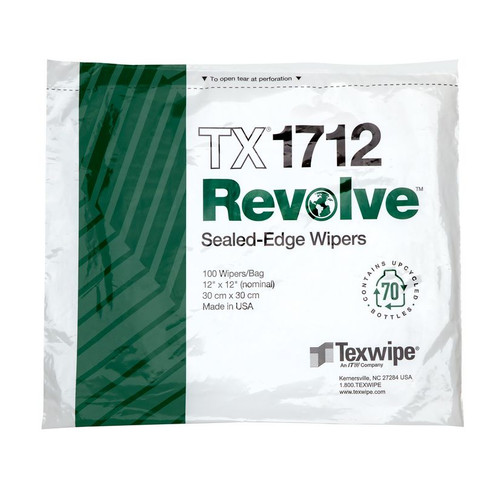
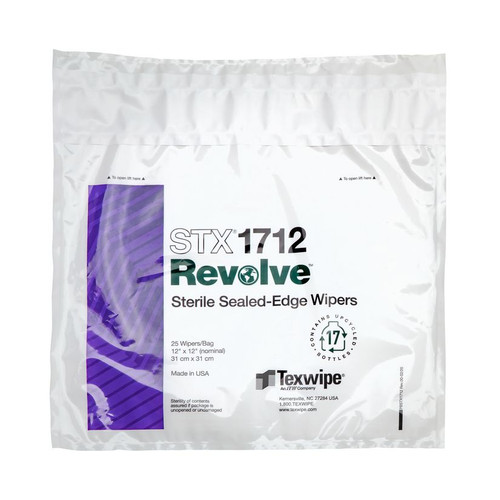
TX1704 is a practical “daily-driver” wipe for controlled environments that need sealed-edge polyester performance in a small footprint: bench tops, fixtures, carts, non-sterile tool wipe-downs, and small-area cleaning where disciplined wipe technique provides the control. It also fits well as a standardized wipe for technicians who frequently work in tight geometry, because the format encourages repeatable fold-and-pass behavior. For aseptic or sterile-critical steps, consider the sterile Revolve™ variants (STX series) as the program escalator—but keep the same technique discipline to maintain process consistency.
Terminology note: Engineered for low-linting performance; no wiper is truly “lint-free” in every process condition.
Source basis
- SOSCleanroom product page (TX1704): https://www.soscleanroom.com/product/wipers/texwipe-tx1704-revolve-4-x-4-upcycled-polyester-cleanroom-wiper/
- Manufacturer Technical Data Sheet (external, Texwipe): Texwipe “Revolve™ Wipers” Technical Data Sheet (TEX-LIT-TDS-055 Rev,00-05/20): https://www.texwipe.com/images/uploaded/documents/Wipers/Texwipe-Revolve-Wipers-TDS.pdf
- Manufacturer Technical Data Sheet (SOS-hosted copy, primary stable reference): “TDS_Revolve Texwipe.pdf”: https://www.soscleanroom.com/content/texwipe_pdf/TDS_Revolve%20Texwipe.pdf
- Manufacturer sustainability/traceability note (SOS-hosted): “Texwipe-Revolve-Technote.pdf”: https://www.soscleanroom.com/content/texwipe_pdf/Texwipe-Revolve-Technote.pdf
- Manufacturer Q&A (SOS-hosted): “Texwipe-Revolve-QA.pdf”: https://www.soscleanroom.com/content/texwipe_pdf/Texwipe-Revolve-QA.pdf
- Competitor reference (Berkshire MicroSeal® 1200, 4" x 4"): https://berkshire.com/shop/cleanroom-wipes/knitted-wipes/microseal-1200/ms1200-0404b-10/
- Competitor reference (Contec Polynit Heatseal PDS PDF): https://www.contecinc.com/
- Competitor reference (Valutek laser-sealed polyester, 4" x 4" class): https://www.sigmaaldrich.com/US/en/product/valutek/vtpnwls44
Source: SOSCleanroom Technical Vault | Last reviewed: Jan. 4, 2026
© 2026 SOS Supply. All rights reserved.