The Technical Vault
By SOSCleanroom
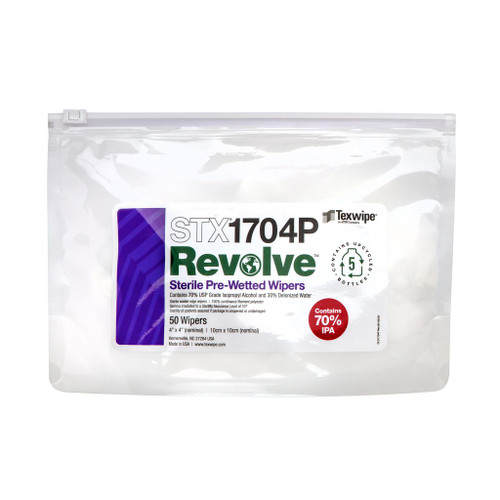
TX1704P Revolve 4" x 4" pre-wetted wiper: controlled 70% IPA delivery for small-area cleanroom cleaning
Last reviewed: Jan. 4, 2026 | Audience: contamination control, cleanroom operations, EHS, quality
Texwipe TX1704P Revolve is a sealed-edge, 4" x 4" cleanroom wiper made from 100% upcycled polyester and supplied pre-wetted to take the “operator variability” out of solvent application. Each wiper is pre-wet with 0.2 µm filtered, USP-grade 70% IPA / 30% DI water, giving teams a repeatable wetness level and more consistent VOC behavior during routine wipe-downs and spot cleaning.
The 4" x 4" format is intentionally small: it is designed for tight work zones (fixtures, small parts, tools, corners, pass-through handles, touchpoints) where a larger wiper often over-wets the area or forces unnecessary handling. The resealable slider bag format helps reduce evaporation between pulls, which matters when you are standardizing “wipe-to-wipe” performance across shifts.
What it’s for
Use TX1704P for controlled, small-area cleaning and solution application in ISO-class controlled environments—especially where you want repeatable solvent loading without spray bottles or manual wetting. Common use cases include: wipe-down of small tools and fixtures, transfer wipe of components before entry, removal of light residues, spill pickup at the bench, cleaning corners/edges where mop coverage is poor, and quick touchpoint wipe-downs on carts and equipment.
Decision drivers
Pre-wetted wipers succeed or fail based on consistency, edge control, and how well the material matches your residue/particle risks. Use these drivers to decide if TX1704P is the right “default wipe” for small-area work.
- Controlled wetness: Pre-wetted with 0.2 µm filtered, USP-grade 70% IPA / 30% DI water to reduce variability from hand-wetting and squirt bottles.
- Sealed-edge strategy: Sealed perimeter helps limit loose filament release during wiping, especially when you wipe edges, corners, and fasteners.
- Polyester chemistry compatibility: 100% polyester is broadly compatible with IPA-based cleaning and is commonly selected when low extractables matter on sensitive surfaces.
- Contamination metrics (typicals): Particles/fibers, NVR, and ionic levels are published as typicals—use them as a baseline, then confirm with lot-specific documentation when your process requires it.
- Packaging discipline: Resealable slider bag helps preserve saturation and reduces evaporation-driven drift over a shift.
- Sustainability without “process surprises”: Upcycled polyester aims to maintain cleanroom-focused performance while supporting sustainability goals.
Materials and construction
Revolve wipers are made from post-consumer plastic bottles converted into polyester yarn and formed into cleanroom wiper fabric. For cleaning teams, the key engineering outcome is not the recycling story—it is that the end material behaves like a controlled polyester substrate, then gets processed to drive down particles, fibers, ions, and nonvolatile residues (NVR) relative to general-purpose wipes.
The sealed edge is the functional control feature for shedding: the perimeter is finished to reduce fraying and fiber/filament release when you wipe with pressure or drag the edge along corners. On 4" x 4" wipes, edges do a lot of work—so edge strategy matters more than most teams expect.
Specifications in context
Size: 4" x 4" (10 cm x 10 cm) nominal—best for tight zones and controlled wipe counts per task.
Material: 100% upcycled polyester—commonly selected for IPA compatibility and controlled extractables behavior.
Pre-wetted solution: 0.2 µm filtered, USP-grade 70% IPA / 30% DI water—built for repeatable wetness and consistent solvent delivery.
Edge: Sealed edge—reduces edge-driven shedding during pressure wiping.
Packaging: 50 wipers per bag (double bagged); 8 bags of 50 per case. Slider/recloseable bag format helps reduce evaporation drift over time.
ISO use range: Commonly deployed across ISO-class controlled environments; match to your surface risk and validation requirements, then confirm with your site’s qualification approach.
Cleanliness and performance metrics
When wipers are standardized, most quality discussions come back to three buckets: (1) particles/fibers released by the wiper, (2) nonvolatile residue (NVR) left behind after solvent flashes off, and (3) ionic residue risk (especially on sensitive assemblies). Published “typical” values are a starting point—treat them as a baseline, then lean on lot-specific documentation when your process is audited or yield-sensitive.
Typical cleanliness metrics (published typicals for the Revolve line):
• Particles (LPC ≥0.5 µm): 5.5 x 10⁶ particles/m2
• Fibers (>100 µm): 300 fibers/m2
• NVR (IPA extractant): 0.05 g/m2
• NVR (DI water extractant): 0.01 g/m2
• Ions: Sodium 0.08 ppm; Potassium 0.03 ppm; Chloride 0.04 ppm
Typical absorbency metrics: Sorptive capacity 450 mL/m2; sorptive rate 0.3 second; basis weight 125 g/m2
These values are measured using established cleanroom-wiper evaluation frameworks (including IEST guidance and ASTM particle/fiber counting methods). In practice: if you are chasing smear-free results, focus on NVR/ions and wiping technique; if you are chasing defect reduction on particle-sensitive work, focus on edge strategy, pressure control, and “clean-face” discipline.
Packaging, wetness control, and traceability
Pre-wetted wipes are only “consistent” if the package is treated like a controlled dispenser. Slider bags reduce evaporation, but they cannot prevent drift if the bag is left open on a bench, staged near airflow, or repeatedly opened without resealing. Build a simple, standards-aligned habit: control exposure time, control wipe count, and document lot/expiration when your quality system requires it.
Rule of thumb: Open one pouch at a time, pull only what you will use in the next 15–30 minutes, and reseal immediately—never “top up” a pouch with extra IPA.
Best-practice use
The fastest way to increase customer value (and reduce “wiper blamed” investigations) is to teach repeatable wiping technique. The goal is simple: one direction, clean faces, controlled pressure, and no recontamination loops.
- Fold discipline: Fold the 4" x 4" into a stable pad (quarters). Present one clean face per pass; rotate to a fresh face before you re-wipe a critical area.
- One-direction strokes: Wipe in one direction with slight overlap (about 10–20%). Avoid “scrubbing in circles,” which can redeposit loosened residue.
- Pressure control: Use enough pressure to maintain full contact, not enough to buckle the pad and drag edges. Edges are where shedding starts if you overwork them.
- Residue management: For oily films or adhesive traces, use a two-step pattern: first pass to lift/solubilize, second pass with a clean face to remove the mobilized residue.
- Dry-out watch: If the wipe starts to drag or squeak, it is effectively “dry.” Discard and pull a fresh wipe—do not re-wet the used wipe in the pouch.
- Disinfection reality check: 70% IPA is widely used for routine disinfection and residue removal, but it is not sporicidal. Follow your site’s disinfectant strategy and required contact times.
Common failure modes
Evaporation drift: Leaving pouches open (or staged under airflow) reduces wetness, increases drag, and can raise smear risk—solve it with “one pouch open” discipline and immediate reseal.
Smearing instead of removing: Wiping the same area repeatedly with the same face redistributes residue—solve it by rotating to clean faces and using a second clean pass.
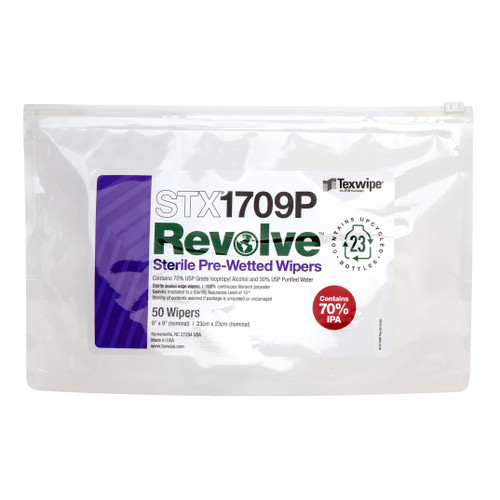
Wrong product for sterility expectation: Non-sterile pre-wetted wipes do not substitute for sterile wipes in aseptic operations—solve it by matching the wipe class to your zone and SOP (sterile versions exist when required).
Surface incompatibility: IPA can haze/craze some plastics and finishes—confirm material compatibility on sensitive polymers before standardizing.
Hot-surface use: Pre-wetted wipes require caution at elevated temperatures—avoid wiping hot equipment where rapid flashing creates vapor spikes and inconsistent cleaning.
Closest competitors
Contec PROSAT® Sigma™ (70% IPA/30% DI water, hydroentangled cellulose/polyester): Mechanically, this is a presaturated wipe built for consistent solvent application in peel-and-reseal pouches. Compared with a sealed-edge polyester wiper, cellulose/poly blends often emphasize general wiping efficiency and absorbency, but may be selected differently when ionic/NVR sensitivity is extreme. The decision usually comes down to surface sensitivity, residue risk, and whether you prefer a sealed-edge polyester substrate for edge-driven shedding control.
Berkshire SatPax® 670-R (70% IPA/30% DI water, hydroentangled cellulose/polyester; knife-cut): This is a widely used presaturated format for ISO 5–8 environments and transfer disinfection workflows. Mechanism difference: nonwoven hydroentangled blends and knife-cut edges behave differently under pressure wiping than sealed-edge polyester. If your primary risk is aggressive absorbency and general wipe-down speed, nonwoven presaturated options can fit well; if your primary risk is edge-driven particle control in tight zones, sealed-edge polyester is often the more conservative choice.
Where it fits in a cleanroom wiping program
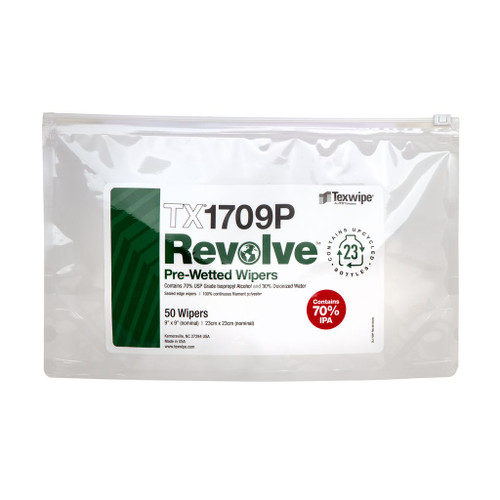
TX1704P is a strong “small-zone standard” for facilities that want repeatable IPA delivery without spray bottles: staging, touchpoint wipe-downs, tool/fixture wipe, and spot cleaning where a 9" x 9" wipe is too large or encourages over-wetting. Programmatically, it typically sits alongside: (1) larger-format presaturated wipes for benches and equipment faces, (2) dry polyester wipes for custom chemistries or final dry passes, and (3) sterile presaturated wipes when your area classification and SOP require sterility controls.
Terminology note: Engineered for low-linting performance; no wiper is truly “lint-free” in every process condition.
Source basis
- SOSCleanroom product page — Texwipe TX1704P Revolve 4" x 4" Upcycled Polyester Cleanroom Wiper Pre-Wetted 70% IPA: https://www.soscleanroom.com/product/wipers/texwipe-tx1704p-revolve-4-x-4-upcycled-polyester-cleanroom-wiper-pre-wetted-70-ipa/
- SOS-hosted manufacturer PDF (primary stable reference) — “Revolve™ Wipers Technical Data Sheet (TDS)” (PDF): https://www.soscleanroom.com/content/texwipe_pdf/TDS_Revolve%20Texwipe.pdf
- Manufacturer PDF — “Texwipe Revolve™ Wipers Technical Data Sheet” (TEX-LIT-TDS-055 Rev.00-05/20) (PDF): https://www.texwipe.com/images/uploaded/documents/Wipers/Texwipe-Revolve-Wipers-TDS.pdf
- Manufacturer PDF — “Texwipe Revolve™ Questions & Answers” (PDF): https://www.soscleanroom.com/content/texwipe_pdf/Texwipe-Revolve-QA.pdf
- Manufacturer PDF — “Texwipe Revolve™ TechNote” (May 2020) (PDF): https://www.soscleanroom.com/content/texwipe_pdf/Texwipe-Revolve-Technote.pdf
- Competitor reference — Contec PROSAT® Sigma™ wipes (70% IPA/30% DI water): https://cleanroom.contecinc.com/product/1779538953
- Competitor reference — Berkshire SatPax® 670-R Product Information (PDF): https://berkshire.com/wp-content/uploads/2024/01/SatPax-670-R.pdf
Source: SOSCleanroom Technical Vault | Last reviewed: Jan. 4, 2026
© 2026 SOS Supply. All rights reserved.