The Technical Vault
By SOSCleanroom
Texwipe TX1709 Revolve™: Upcycled Polyester, Sealed-Edge Control for High-Sorption Cleanroom Wiping
Last reviewed: Jan. 4, 2026 | Audience: contamination control, cleanroom operations, EHS, quality
TX1709 Revolve™ is a 9" x 9" dry, non-sterile cleanroom wiper built around two core ideas: sealed-edge particle control and high sorption capacity—while using 100% upcycled polyester (rPET) rather than virgin yarn. It is intended for critical wiping tasks where you need repeatable residue removal, solvent compatibility, and a wiper that will not shed at the edge under normal technique.
For customers balancing contamination control with sustainability goals, Revolve™ is engineered to behave like a conventional knit polyester wiper (ions, NVR, particles/fibers, sorption) while diverting post-consumer bottles into cleanroom-grade consumables. Each bag of TX1709 is associated with a published bottle-count and greenhouse-gas savings model—useful for internal sustainability reporting without compromising the wiping spec.
What it’s for
Use TX1709 for wiping and cleaning surfaces, equipment, and parts; applying/removing lubricants, adhesives, residues, and disinfectants; solvent cleaning with IPA, ethanol, acetone, and degreasers; and lining trays to protect or dry parts and devices. It is designed for high sorption capacity (spill control, solution application) and can be autoclaved when used as a dry wiper. It also aligns to USP <797> and USP <800> wiper requirements for relevant compounding and hazardous drug handling workflows.
Decision drivers
Choose TX1709 when your process is sensitive to edge-shedding, extractables, and wipe-to-wipe consistency—and you want a sustainability story that does not require “special handling” to stay cleanroom-capable.
- Sealed-edge strategy: Sealed edges are used to reduce edge-driven fiber and particle release during folding, wiping, and corner detailing—especially important when operators rotate faces and apply moderate pressure.
- High sorption capacity: Designed to pick up and hold liquids during spill response, solution application, and wet cleaning steps where a low-sorption wipe can redeposit or smear.
- Low extractables/contamination profile: Typical test data covers particles/fibers, ions, and NVR—useful for risk assessments when residues or ionic contamination can affect yields or finishes.
- Traceability discipline: Individually lot coded, supporting deviation investigations and lot-based qualification in regulated or high-mix manufacturing.
- Sustainability accounting that is “audit-friendly”: Revolve™ publishes bottle-count per bag and a GHG savings model by SKU/size, supporting internal ESG metrics without changing the wiping workflow.
Materials and construction
TX1709 is made from 100% upcycled polyester (rPET) with a sealed edge and is processed on Texwipe’s fully automated manufacturing system. The rPET yarn is derived from post-consumer bottles that are cleaned, reprocessed, and extruded into yarn, then converted into fabric and further cleaned to meet cleanroom contamination expectations. Importantly, the Revolve™ approach avoids adding other yarn types or additives that could become process contaminants.
From an operator standpoint, the material behaves like a conventional knit polyester wiper: it is chemically compatible with common solvents and is engineered to maintain a consistent wiping face when folded—while edge sealing helps keep fibers from “walking out” of the perimeter during use.
Specifications in context
Size: 9" x 9" is a common format for controlled wiping because it folds cleanly into quarters for multi-face technique (broad face wiping plus a corner for detailing). Edge: sealed edge supports perimeter integrity when rotating folds. Basis weight: 125 g/m² (typical) supports a “sturdier” wiping feel and helps with solution pickup without the wipe collapsing under moderate pressure. Sorption: 450 mL/m² (typical) and a 0.3 second sorptive rate (typical) are tuned for spill control and wet application steps where speed-to-wet matters.
Cleanliness and performance metrics
Cleanroom wiping performance is typically evaluated across three contamination vectors—(1) particles/fibers released, (2) nonvolatile residue (NVR/extractables), and (3) ionic contamination—using industry methods such as IEST-RP-CC004.3 and ASTM E2090 (or manufacturer methods aligned to them). Typical values are a starting point for qualification; your acceptance criteria should be tied to the surface, chemistry, and downstream sensitivity.
Typical contamination metrics (manufacturer typicals): 5.5 x 10⁶ particles/m² (LPC ≥0.5 µm), 300 fibers/m² (>100 µm), NVR 0.05 g/m² (IPA extractant) and 0.01 g/m² (DIW extractant), and ions at 0.08 ppm sodium, 0.03 ppm potassium, 0.04 ppm chloride. In practice, these numbers support use in processes where ionic residues can interfere with coatings, optics, electronics reliability, or residue-sensitive bonding/printing steps—provided technique controls redeposition.
Packaging, ISO range, traceability, and sustainability controls
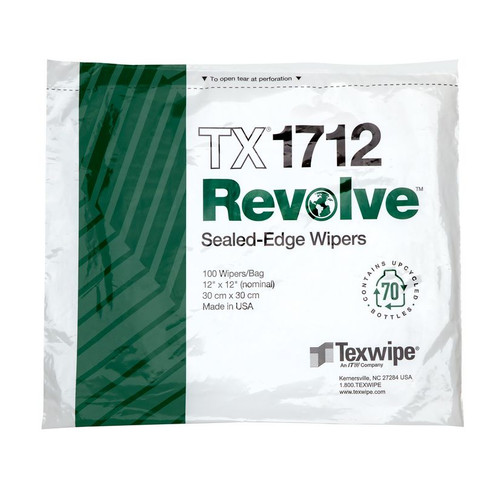
TX1709 is supplied as 100 wipers per bag (double-bagged) and 10 bags per case. The product is individually lot coded for traceability. Texwipe positions Revolve™ for ISO Class 3–7 (and EU Grade A–D) environments; SOSCleanroom lists TX1709 across ISO 4–8 program coverage depending on how customers stage the wiper within their facility zoning. For sustainability reporting, Texwipe publishes that one bag of TX1709 corresponds to 47 upcycled bottles and provides a per-bag greenhouse-gas savings estimate to support internal metrics.
Rule of thumb: Treat the outer bag as “shipping protection” and open the inner bag only at point-of-use; once opened, keep wipes covered and dedicate each folded face to one direction of travel to prevent redeposit.
Best-practice use
The fastest way to lose the benefit of a sealed-edge, controlled wiper is poor technique. Standardize a simple wiping method, then validate it on your real soils and surfaces (paint markers, fluorescent tracer, or gravimetric residue checks where appropriate).
- Fold for face control: Fold into quarters; use one face per pass, then rotate to a fresh face. This limits redeposit and helps you localize contamination to a controlled area of the wipe.
- Wipe “clean-to-less-clean”: Start at the cleanest zone and move outward. Do not “chase” contamination back into the clean zone.
- One direction, controlled overlap: Use linear strokes with slight overlap. Avoid circular scrubbing unless the surface finish and soil type require it (and then re-wipe with a linear finishing pass).
- Solvent discipline: If you wet the wipe, control wetness (damp vs. saturated). Over-wetting can drive extractables into seams/crevices and can extend dry time.
- Autoclave use (dry only): If you autoclave TX1709, keep it dry, use validated wrap/bagging, and avoid post-sterilization handling that reintroduces fibers or skin flakes.
- Lot-based qualification: For critical processes, qualify by lot (incoming checks or COA review) and tie any excursions to the lot code during investigations.
Common failure modes
Smearing/filming: Usually a wetness-control problem (too much solvent or the wrong solvent for the soil). Shift to “damp wipe + dry follow-up” and change faces more frequently. Redeposit: Caused by reusing the same face too long or wiping nonlinearly across zones; enforce one-direction passes and a strict face-rotation habit. Edge loading at corners: Corner detailing can concentrate soil; use a dedicated “detail corner” and discard sooner. Post-open exposure: Leaving an open inner bag on a cart invites airborne particles; keep wipes covered and staged inside the controlled area.
Closest competitors
Berkshire Choice® 900 (CH909.10): A sealed-edge knit polyester cleanroom wiper positioned for ISO Class 4 and above environments. Mechanistically similar on the “sealed-edge knit polyester” axis, but not positioned around upcycled input material; sustainability accounting will typically be handled differently across customer ESG programs.
Contec/Anticon sealed-edge interlock knit polyester (9" x 9"): Sealed-edge interlock knit polyester wipes positioned for ISO 4/5 environments with emphasis on low particles/fibers and good sorbency. Comparable where your decision hinges on edge sealing and knit polyester behavior; Revolve™ differentiates when you need published sustainability inputs (bottle-count/GHG model) without changing the wiping class.
Where it fits in a cleanroom wiping program
Place TX1709 as a primary dry wipe for general equipment wipe-down, spill response, solution application/removal, and tray lining in ISO-classified environments—especially when you want sealed-edge control and a consistent contamination profile supported by published typicals. In regulated or high-risk workflows, pair it with a documented wiping method (face rotation, wetness control, discard rules) and align your qualification to the same test logic used in industry guidance (particles/fibers, NVR, ions). For compounding and hazardous drug handling programs, ensure your broader SOP set (disinfectant selection, contact time, residue controls, disposal) is consistent with your USP interpretation and facility zoning.
Terminology note: Engineered for low-linting performance; no wiper is truly “lint-free” in every process condition.
Source basis
- SOSCleanroom product page — “Texwipe TX1709 Revolve 9" x 9" Upcycled Polyester Cleanroom Wiper”: https://www.soscleanroom.com/product/clearance-deals/texwipe-tx1709-revolve-9-x-9-upcycled-polyester-cleanroom-wiper/
- Texwipe manufacturer product page — “REVOLVE™ TX1709 Sustainable Dry Cleanroom Wipers, Non-Sterile”: https://www.texwipe.com/revolve-tx1709-dry-cleanroom-wipers-non-sterile
- Manufacturer technical data sheet (external) — “Texwipe Revolve™ Wipers Technical Data Sheet” (TEX-LIT-TDS-055 Rev. 00, 05/20): https://www.texwipe.com/images/uploaded/documents/Wipers/Texwipe-Revolve-Wipers-TDS.pdf
- Manufacturer technical data sheet (SOS-hosted copy) — “TDS_Revolve Texwipe.pdf” (TEX-LIT-TDS-055 Rev. 00, 05/20): https://www.soscleanroom.com/content/texwipe_pdf/TDS_Revolve%20Texwipe.pdf
- Manufacturer Q&A (external) — “Texwipe Revolve™ Q&A”: https://www.texwipe.com/images/uploaded/documents/Technical-Data/Texwipe-Revolve-QA.pdf
- Manufacturer Q&A (SOS-hosted copy) — “Texwipe-Revolve-QA.pdf”: https://www.soscleanroom.com/content/texwipe_pdf/Texwipe-Revolve-QA.pdf
- Manufacturer TechNote (external) — “A sustainable solution for your cleanroom” (May 2020): https://www.texwipe.com/images/uploaded/documents/Technical-Data/Texwipe-Revolve-Technote.pdf
- Manufacturer TechNote (SOS-hosted copy) — “Texwipe-Revolve-Technote.pdf” (May 2020): https://www.soscleanroom.com/content/texwipe_pdf/Texwipe-Revolve-Technote.pdf
- Berkshire competitor reference — “CH909.10 Low-Linting Cleanroom Wipes (Choice 900)”: https://berkshire.com/shop/cleanroom-wipes/knitted-wipes/choice-900/ch909-10/
- Contec/Anticon competitor reference — “Cleanroom Wipes, 100% Interlock Knit Polyester, Sealed Edges, 9" x 9" (CO-495353-303)”: https://www.cleanroom-mall.com/cleanroom-consumables/contec-cleanroom-wipes/2596.html
Source: SOSCleanroom Technical Vault | Last reviewed: Jan. 4, 2026
© 2026 SOS Supply. All rights reserved.