The Technical Vault
By SOSCleanroom
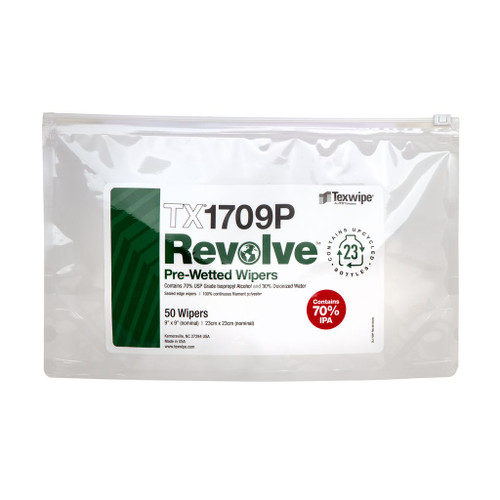
TX1709P Revolve Pre-Wetted 70% IPA Wiper: Sealed-Edge Upcycled Polyester for Controlled Solvent Cleaning
Last reviewed: Jan. 4, 2026 | Audience: contamination control, cleanroom operations, EHS, quality
TX1709P Revolve is a 9" x 9" cleanroom wiper made from 100% upcycled polyester and supplied pre-wetted with a USP-grade 70% isopropyl alcohol (IPA) / 30% deionized water blend. It is designed for teams that want the speed and consistency of pre-saturated wiping without the variability of spray bottles, open solvent baths, or “wet-a-dry-wipe” workarounds.
The practical advantage is process control: the solvent blend is filtered (0.2 µm), the wipers are packaged to reduce evaporation, and each bag is lot coded for traceability. In day-to-day use, that combination supports repeatable cleaning outcomes (coverage, wetness, dry-down behavior) while reducing the rework that often shows up as streaking, residue carryback, or inconsistent solvent loading.
What it’s for
Use TX1709P for controlled solvent wiping of hard surfaces, equipment, fixtures, and parts where you need consistent IPA delivery for cleaning films, light residues, fingerprints, handling soils, and general wipe-down tasks. It is commonly applied in microelectronics, medical device, pharma/compounding support areas, labs, and clean manufacturing where IPA is an approved cleaning solvent and VOC discipline matters.
Decision drivers
If you are selecting a pre-wetted IPA wiper, your outcome is usually driven by wetness control, wipe construction/edge strategy, and cleanliness (particles, residues, ions) relative to your ISO class and surface risk.
- Controlled saturation: Pre-wetted 70% IPA / 30% DI water helps standardize solvent loading versus “spray-and-wipe,” which is a common source of operator-to-operator variability.
- Sealed edge strategy: A sealed edge is selected to reduce loose filament release at the cut boundary during high-contact wiping and folding cycles.
- Typical contamination profile: Typical particle/fiber release, NVR, and ionic levels matter when the wipe is used on critical surfaces (optics, stainless, polymer tooling, product-contact adjacent areas).
- Packaging discipline: Slider/recloseable packaging slows evaporation and supports repeatable wetness throughout the bag’s life.
- Sustainability with traceability: Revolve is made from post-consumer polyester (rPET) yarn; TX1709P is marked as 23 upcycled bottles per bag with an associated GHG savings value in the manufacturer’s TechNote.
Materials and construction – explained like an engineer
TX1709P is built on a 100% upcycled polyester base material (rPET derived from post-consumer bottles) converted into cleanroom wipers with a sealed edge. The sealed edge is the mechanical reliability feature: it stabilizes the perimeter so the wipe maintains structural integrity during folding, directional strokes, and solvent-loaded passes where the edge typically sees the highest shear.
On the sustainability side, the Revolve TechNote describes the rPET pathway (collection, cleaning, repolymerization into chip, extrusion into REPREVE yarn) followed by Texwipe conversion and cleaning steps to meet controlled-environment expectations. A practical operator takeaway: the “less bright” color associated with repolymerized material is positioned by the manufacturer as a deliberate choice to avoid additives that could introduce unwanted contaminants.
Specifications in context
Format: Pre-wetted, non-sterile IPA wiper (USP-grade 70% IPA / 30% DI water; 0.2 µm filtered).
Size: 9" x 9" (23 cm x 23 cm).
Edge strategy: Sealed edge (selected to reduce edge-driven shedding during wipe cycles).
Packaging (SOSCleanroom unit): 50 wipers per bag, 4 bags per case (200 wipers per case).
Packaging (manufacturer line item): 50 wipers/bag, double-bagged; 4 bags/case for TX1709P.
Cleanroom range: SOSCleanroom lists suitability spanning ISO Class 4–8; manufacturer positions the Revolve wiper line for ISO Class 3–7 (EU Grade A–D / Class 1–10,000).
Shelf life: Manufacturer lists non-sterile pre-wetted shelf life as 3 years from date of manufacture.
In practice, the sealed edge + pre-wetted format is most valuable when your procedure requires consistent wetness and a controlled wipe boundary (for example, stainless wipe-downs, fixture wipe-downs, passivation-support cleaning, and final wipe steps after gross soil removal).
Cleanliness and performance metrics
Particles/fibers, NVR, and ions are best treated as “typicals” that define a starting capability; your validation should confirm performance in your solvent contact time, surface energy, and wiping pattern.
Typical contamination metrics (Revolve wipers, manufacturer typicals):
• Particles (LPC ≥0.5 µm): 5.5 x 10⁶ particles/m2
• Fibers (>100 µm): 300 fibers/m2
• NVR (IPA extractant): 0.05 g/m2
• NVR (DI water extractant): 0.01 g/m2
• Ions (typicals): sodium 0.08 ppm; potassium 0.03 ppm; chloride 0.04 ppm
Absorbency behavior (typicals): sorptive capacity 450 mL/m2; sorptive rate 0.3 second; basis weight 125 g/m2.
Operationally, these numbers support a sealed-edge polyester wiper role: controlled wet wiping with low extractables and a cleanliness profile suitable for critical cleaning sequences where carryback risk matters.
Wetness control, evaporation control, and VOC discipline
TX1709P is packaged in recloseable slider bags to reduce evaporation and preserve consistent wetness, and it is supplied pre-wetted with filtered, USP-grade 70/30 IPA/DI water. For operations tracking VOC exposure or trying to reduce “spray plume” variability, pre-saturated wipes are typically selected as a control measure, not just a convenience. Plan around flammable-liquid shipping constraints: SOSCleanroom flags TX1709P as ground-only due to the IPA content.
Rule of thumb: Open the bag only long enough to remove what you will use immediately; reclose between pulls. If the wipers begin drying faster than expected, treat it as a packaging-discipline issue first (open time, closure integrity, storage temperature) before changing wipe types.
Best-practice use
The fastest way to lose the benefit of a clean pre-wetted wiper is technique drift. Pre-saturated wipes perform best when you standardize fold geometry, stroke direction, and “clean side” management.
- Fold for face control: Fold into quarters and use one face per pass. Rotate to a clean face as soon as you see streaking or soil pickup.
- Direction matters: Start in the cleanest identifiable area and wipe toward the less-clean area using parallel, slightly overlapping strokes; avoid circular wiping that can redistribute contamination.
- Don’t re-wet a used wipe: Once loaded, discard. Adding more IPA to a contaminated wipe can mobilize residues and increase spread.
- Surface compatibility: Verify IPA compatibility on plastics, coatings, and adhesive-backed labels before production use; IPA can craze certain polymers and lift some inks.
Common failure modes — and how to prevent them
Streaking or haze: Usually a face-management issue (reusing a loaded face) or a residue/soil mismatch (IPA is moving a film that needs a different chemistry). Correct by switching faces more frequently and validating chemistry for the residue class.
“Dry wipes” mid-bag: Typically driven by open time, incomplete slider closure, or warm storage. Correct by tightening packaging discipline and storage controls; avoid leaving bags open on benches near process heat.
Edge-driven shedding on high-friction passes: Usually shows up when operators scrub with the edge leading. Correct by wiping with the folded face leading and reserving edge contact for non-critical zones.
Cross-contamination carryback: Happens when the wipe is used beyond its soil capacity. Correct with one-direction passes, strict discard rules, and defined “stop points” in the SOP (for example: one wipe per X square feet or per component).
Closest comparators
Berkshire SatPax® 670 (70/30 IPA/DI): A pre-saturated option built on a hydroentangled nonwoven cellulose/polyester blend; the cited specification lists ISO 5–8 with a knife-cut edge. Mechanistically, this is a different substrate strategy than sealed-edge polyester—often selected when absorbency and general wipe-down utility are prioritized over sealed-edge perimeter control.
Contec PROSAT® (70/30 IPA/DI, meltblown polypropylene): A meltblown polypropylene presaturated wipe family engineered for fast-drying general surface cleaning. Mechanistically, meltblown polypropylene behaves differently than sealed-edge polyester in strength, “feel,” and particle capture dynamics; it is typically positioned as a general-purpose presaturated wipe format where rapid dry-down is desirable and cleanliness is managed via low NVR/particles/fibers.
Where it fits in a cleanroom wiping program
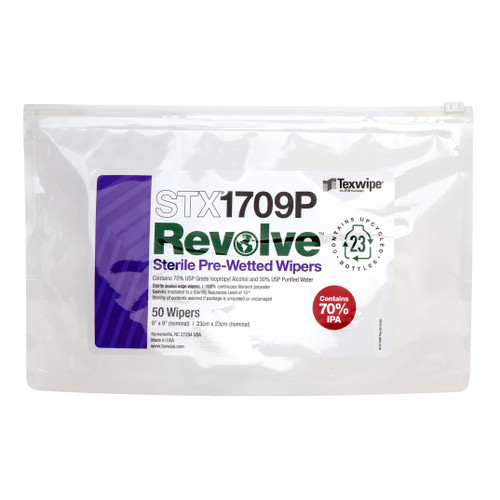
TX1709P is a strong “standard work” wiper for routine solvent wipe-downs where you want repeatable IPA delivery, sealed-edge reliability, and audit-friendly traceability (lot coding). In a tiered program, it typically sits above generic presaturated wipes because it combines sealed-edge construction with low typical residues/ions and packaging intended to preserve wetness. Use it for scheduled wipe-downs of benches, carts, pass-through surfaces, tooling exteriors, and equipment panels—then escalate to sterile presaturated formats (or validated disinfectant systems) where aseptic processing requirements demand it.
Sustainability can be documented without changing the wipe workflow: the manufacturer’s TechNote lists TX1709P as 23 upcycled bottles per bag with a stated GHG savings value of 1.93 lbs CO2 per bag of product.
Terminology note: Engineered for low-linting performance; no wiper is truly “lint-free” in every process condition.
Source basis
- SOSCleanroom product page — Texwipe TX1709P Revolve 9" x 9" upcycled polyester cleanroom wiper, pre-wetted 70% IPA: https://www.soscleanroom.com/product/wipers/texwipe-tx1709p-revolve-9-x-9-upcycled-polyester-cleanroom-wiper-pre-wetted-70-ipa/
- Texwipe Revolve Wipers Technical Data Sheet (TDS): https://www.texwipe.com/images/uploaded/documents/Wipers/Texwipe-Revolve-Wipers-TDS.pdf
- Texwipe Revolve TechNote (sustainability, bottles-per-bag, GHG savings, material pathway): https://www.soscleanroom.com/content/texwipe_pdf/Texwipe-Revolve-Technote.pdf
- Texwipe Revolve Q&A: https://www.soscleanroom.com/content/texwipe_pdf/Texwipe-Revolve-QA.pdf
- Cleanroom Technology — “The three qualifiers of presaturated IPA wipes” (material/saturation/technique context): https://www.cleanroomtechnology.com/the-three-qualifiers-of-presaturated-ipa-wipes--180974
- Berkshire UK — Sterile SatPax 670 BPR (ISO range, material, edge, solution listing): https://berkshire.uk.com/shop/presaturated-cleanroom-ipa-wipes/sterile-satpax-670-bpr/
- Contec — PROSAT Presaturated Wipes TDS (material construction and typical NVR/ions/particles): https://contecinc.com/hubfs/Website%20Assets/Product%20Center/Technical%20Data%20Sheets/Surface%20Prep/Wipes.pdf?hsLang=en
Source: SOSCleanroom Technical Vault | Last reviewed: Jan. 4, 2026
© 2026 SOS Supply. All rights reserved.