The Technical Vault
By SOSCleanroom
TX1712 Revolve 12” x 12” sealed-edge upcycled polyester wiper: dry control for solvent wipe-down and spill response
Last reviewed: Jan. 4, 2026 | Audience: contamination control, cleanroom operations, EHS, quality
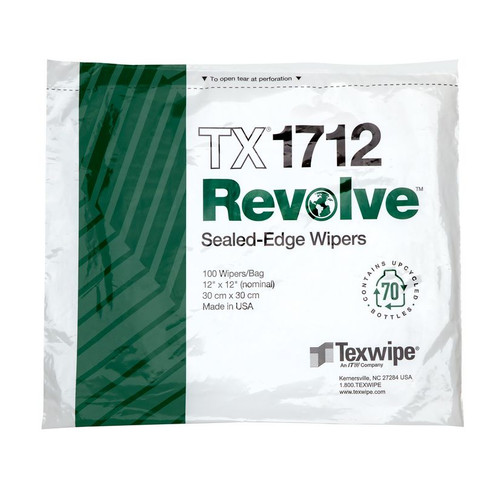
Texwipe TX1712 Revolve is a dry, 12” x 12” knitted polyester cleanroom wiper built around two priorities that often fight each other: contamination control and sustainability. The material is made from 100% upcycled polyester and finished with a sealed-edge strategy to reduce edge fray, shedding and particle generation during wipe-downs and spill response.
Practically, TX1712 is a high-sorption, general-purpose “workhorse” wiper for controlled environments that need repeatable wipe technique, disciplined packaging control (double-bagging) and lot traceability. Use it dry with filtered solvents (or other approved process liquids) for equipment and surface cleaning, and use the published contamination metrics as a baseline for qualification — typical values are a starting point, not a guarantee for every process condition.
What it’s for
TX1712 is intended for wiping and cleaning surfaces, equipment and parts; applying and removing residues (lubricants, adhesives and other process films); cleaning with common solvents (including IPA, ethanol, acetone and degreasers, when compatible with your process); and lining trays to protect, dry or stage parts in controlled areas.
Decision drivers
When TX1712 is the right call, it is usually because you need a sealed-edge polyester knit that handles solvent wipe-downs and spill work while keeping packaging control and baseline contamination performance predictable.
- Sealed-edge control: Edge sealing reduces fray and helps limit particle/fiber generation where “raw edge” knits can shed during aggressive wiping.
- Sorption performance: High sorptive capacity and fast uptake matter when you are either removing a thin film evenly or managing a small spill without smearing.
- Packaging discipline: Double-bagging supports staged transfer into cleaner zones without turning the outer bag into the contamination vehicle.
- Lot traceability: Individually lot coded packaging supports deviation investigations, audit trails and supplier quality control.
- Standards fit: Use cases often map to USP <797> / USP <800> wiping needs and to evaluation frameworks such as IEST-RP-CC004 and ASTM E2090 for released particles/fibers.
- Sustainability signal without process compromise: Upcycled feedstock can support ESG goals, but the decision still has to be made on contamination risk, not marketing.
Materials and construction
TX1712 is a knitted polyester wiper made from 100% upcycled polyester, then finished with a sealed edge. The sealed edge is the practical “mechanical control” feature: it limits loose filament ends at the perimeter that can otherwise become fibers, hang up on sharp edges, or create inconsistent drag across the surface.
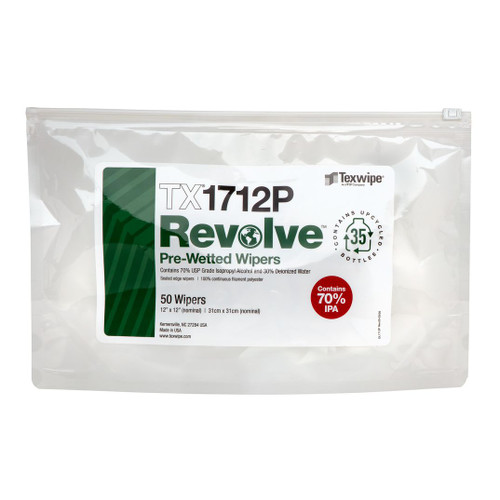
As a dry wiper, TX1712 is used as-delivered (dry) or is pre-wet by the operator using an approved, filtered process liquid. If your cleaning relies on a solvent, the wiper’s role is to deliver repeatable contact mechanics (pressure, stroke, fold discipline) — not to “scrub harder” when residues persist.
Specifications in context
Size: 12” x 12” (31 cm x 31 cm) supports “quarter-fold” handling so you can maintain a clean wiping face and rotate surfaces methodically.
Wiper edge: Sealed edge, selected when edge fray or fiber risk is unacceptable on critical surfaces and tooling.
Format and packaging: 100 wipers per bag, double-bagged; 10 bags per case (1,000 wipers per case). Double-bagging supports material transfer into cleaner zones with fewer handling steps.
Wiper type: Dry wiper; use with approved, filtered solvents or process liquids when wetting is required.
ISO environment range (published): Product-page listing indicates ISO 4 through ISO 8, while the manufacturer technical data sheet lists ISO Class 3 through ISO Class 7 (and EU Grade A–D). Treat published ranges as a starting point — qualification should be driven by your surface risk, residue chemistry and acceptance limits.
Cleanliness and performance metrics
Think of wiper “cleanliness” as three interacting buckets: particles/fibers (what sheds), NVR (what remains after evaporation), and ions (what can drive corrosion or interfere with sensitive chemistries). Typical values are useful for baseline qualification, supplier comparison and change control — but process technique and solvent choice frequently dominate real-world outcomes.
Typical contamination performance (manufacturer typicals): LPC ≥0.5 µm: 5.5 x 10⁶ particles/m2; fibers >100 µm: 300 fibers/m2. NVR: 0.05 g/m2 (IPA extractant) and 0.01 g/m2 (DIW extractant). Ions (typical): sodium 0.08 ppm, potassium 0.03 ppm, chloride 0.04 ppm.
Typical physical performance: sorptive capacity 450 mL/m2; sorptive rate 0.3 second; basis weight 125 g/m2.
Packaging and lot traceability
Packaging is a contamination control feature, not a convenience feature. TX1712’s double-bag configuration supports staged entry into controlled areas, and the manufacturer notes lot coding for traceability and quality control — a practical benefit when you need to connect a cleaning deviation to a specific lot, shift, or receiving event.
Rule of thumb: Treat the outer bag as “warehouse-grade.” Open and discard it outside the clean zone; only transfer the inner bag into the cleaner area, and re-bag if the inner bag sits exposed between shifts.
Best-practice use
The biggest performance swing is usually technique. A sealed-edge knit can still spread contamination if you over-wet, re-use a dirty face, or “scrub” in circles that redeposit residues.
- Fold discipline: Quarter-fold the 12” x 12” to create a stable pad; rotate to a clean face on a planned cadence (for example: each pass, each panel, or each defined area).
- One-direction passes: Use overlapping straight strokes (often an “S-stroke” pattern) to move contamination away from the cleaned area rather than redistributing it.
- Controlled wetting: If the process calls for solvent, wet to “damp-wipe” rather than “drip-wipe.” Excess liquid increases spreading and can leave NVR/ion patterns when it dries.
- Contact time and chemistry: If disinfectants or detergents are used, follow the chemistry’s required contact time; do not compensate by increasing pressure, which can increase shedding and surface abrasion.
- Temperature boundaries: Dry wipers are cited for use under 400°F (205°C); if wiping hot surfaces, validate both solvent safety and residue behavior before standardizing the work.
Common failure modes
The most common “wiper failures” are process failures: over-wetting (spreads residues and dries unevenly), face re-use (redeposits contamination), circular scrubbing (smears instead of removing), and uncontrolled staging (inner bags left open, leading to airborne load pickup). If residues persist, treat it as a chemistry/technique problem first — confirm solvent compatibility, dwell time, and fold/rotation cadence before changing wiper families.
Closest competitors
Berkshire Ultra-Seal® 3000 (12” x 12”): Another sealed-edge polyester knit positioned for ISO Class 3 and above environments. The common mechanism is edge sealing for shedding control; Berkshire emphasizes tubular/two-ply construction and edge-seal design for durability and sorbency. If you need a heavier, two-ply sealed-edge knit, this is a typical comparator — but it is not positioned around upcycled feedstock.
Contec Quiltec® I (12” x 12”): A sealed-edge, multi-layer polyester wipe designed to maximize sorptive capacity (via quilted structure). Mechanically, the layered/quilted construction can “hold” more liquid, which is an advantage for spill control and heavier wet cleaning — but you still need to validate that absorbency profile and texture against your surface sensitivity and residue limits.
Where it fits in a cleanroom wiping program
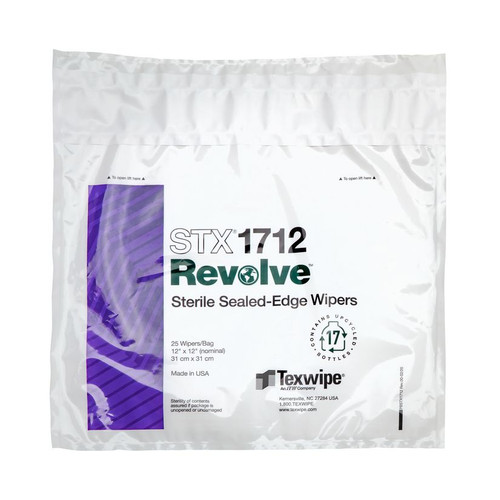
TX1712 fits as a primary dry polyester wiper for equipment wipe-down, solvent cleaning, parts staging and spill response where sealed-edge control and packaging discipline matter. Standardize it in areas where the operator can follow consistent fold/rotation technique and where transfer packaging (double-bag) supports your gowning and material-flow design. For higher-risk zones (e.g., ISO Class 3 needs, aseptic/sterile requirements), step up to sterile variants and validate against your site’s acceptance limits and audit expectations.
Terminology note: Engineered for low-linting performance; no wiper is truly “lint-free” in every process condition.
Source basis
- SOSCleanroom product page (TX1712): https://www.soscleanroom.com/product/wipers/texwipe-tx1712-revolve-12-x-12-upcycled-polyester-cleanroom-wiper/
- Revolve™ Wipers Technical Data Sheet (SOS-hosted PDF copy): https://www.soscleanroom.com/content/texwipe_pdf/TDS_Revolve%20Texwipe.pdf
- Revolve™ Wipers Technical Data Sheet (Texwipe PDF; TEX-LIT-TDS-055 Rev,00-05/20): https://www.texwipe.com/images/uploaded/documents/Wipers/Texwipe-Revolve-Wipers-TDS.pdf
- Revolve™ Q&A (SOS-hosted PDF copy): https://www.soscleanroom.com/content/texwipe_pdf/Texwipe-Revolve-QA.pdf
- Revolve™ TechNote (SOS-hosted PDF copy): https://www.soscleanroom.com/content/texwipe_pdf/Texwipe-Revolve-Technote.pdf
- Texwipe product page (TX1712): https://www.texwipe.com/revolve-tx1712-dry-cleanroom-wipers-non-sterile
- Comparator: Berkshire Ultra-Seal® 3000 (12” x 12”): https://berkshire.com/shop/cleanroom-wipes/knitted-wipes/ultra-seal-3000/us3000-1212-6/
- Comparator: Contec Quiltec® I Wipes: https://cleanroom.contecinc.com/product/1779519544
Source: SOSCleanroom Technical Vault | Last reviewed: Jan. 4, 2026
© 2026 SOS Supply. All rights reserved.