The Technical Vault
By SOSCleanroom
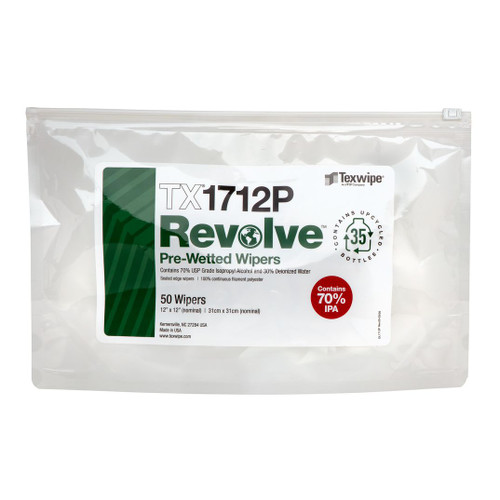
TX1712P REVOLVE™: 12" x 12" sealed-edge, pre-wetted 70% IPA wiping with controlled wetness and low contamination risk
Last reviewed: Jan. 4, 2026 | Audience: contamination control, cleanroom operations, EHS, quality
Texwipe TX1712P Revolve is a pre-wetted cleanroom wiper built for repeatable wipe-down results when solvent control, operator-to-operator consistency, and documentation discipline matter. It pairs a sealed-edge, 100% upcycled polyester substrate with a controlled pre-wet charge (USP-grade 70% IPA / 30% DI water) to reduce on-bench solvent handling while keeping wipe performance predictable across shifts.
The product is commonly used in controlled environments spanning ISO 4 through ISO 8 in customer programs (final suitability is process-dependent), while the manufacturer rates the Revolve line for ISO Class 3–7 / EU Grade A–D applications. Use it when you want “open-and-wipe” convenience without giving up the core expectations of cleanroom wiping: edge control, low-linting behavior, lot traceability, and cleanliness metrics that can be tied back to recognized test methods and qualification protocols.
What it’s for
Routine and intermediate wipe-down of benches, carts, equipment exteriors, pass-through surfaces, and non-product-contact tooling where controlled wetness improves repeatability; spill pickup and residue removal where a larger-format wipe increases coverage per wipe; and application/removal of compatible solutions (including IPA-based cleaning steps) when your SOP prefers pre-measured solvent delivery rather than spray bottles or open beakers.
Decision drivers
TX1712P selection tends to come down to wetness control, edge strategy, and how easily you can qualify and standardize wipe-down behavior across operators.
- Repeatable wetness and VOC control: A 0.2 µm filtered USP-grade 70% IPA / 30% DI water pre-wet charge supports consistent wipe-down efficiency without “free-pouring” solvent at the point of use.
- Sealed-edge risk reduction: Sealed edges are used to reduce edge-driven fiber release potential versus cut-edge constructions in more demanding wipe steps (still validate to your acceptance criteria).
- Slider-bag packaging discipline: Recloseable slider bags help reduce evaporation, supporting stable wetness across a bag’s life when operators follow open/close discipline.
- Cleanliness metrics you can qualify: Typical particles/fibers, NVR, and ionic extractables are defined at the product-family level using established industry methods; treat “typicals” as a starting point for your internal qualification.
- Traceability expectations: Individually lot-coded packaging supports audit trails and deviation investigations tied to specific lots, shifts, and cleaning events.
Materials and construction
TX1712P uses a 100% upcycled polyester substrate with a sealed-edge construction. In process terms, “sealed edge” is an engineered boundary condition: instead of leaving exposed yarn ends at the perimeter, the edge is finished to reduce fraying and the chance of perimeter-driven fiber release during higher-friction wipe strokes (especially on textured stainless, anodized aluminum, and coated equipment panels).
The pre-wet charge is USP-grade 70% IPA / 30% DI water filtered to 0.2 µm, which is primarily about consistency and control: every wipe is delivered at a target wetness level so your wiping motion, dwell expectations, and residue removal behavior can be standardized and then qualified under your SOP rather than varying by operator pour technique.
Specifications in context
Size is 12" x 12" (31 cm x 31 cm) nominal, which is often the practical breakpoint where “coverage per wipe” improves enough to reduce wipe count on carts, benches, pass-through interiors, and equipment shells. Packaging is 50 wipers per bag with 4 bags per case (200 per case). Plan your staging so one bag is opened/used at a time to reduce evaporation drift across partially used bags. Shelf life is commonly 3 years from date of manufacture for non-sterile pre-wetted products (verify COA/lot documentation for the exact lot you receive).
Cleanliness and performance metrics
A practical qualification framework for pre-wetted wipers is to treat particles/fibers, NVR, and ionic extractables as the three “silent failure modes” that can show up later as yield loss, haze/film, or corrosion/ionic mobility issues. Manufacturer tables typically report starting points (not worst-case guarantees) and should be paired with your internal acceptance limits, surface compatibility checks, and cleaning verification methods.
Typical values reported for the Revolve wiper family include LPC ≥0.5 µm of 5.5 x 10⁶ particles/m2 and fibers >100 µm of 300 fibers/m2; NVR (IPA extractant) 0.05 g/m2 and (DIW extractant) 0.01 g/m2; and ionic extractables (ppm) of sodium 0.08, potassium 0.03, and chloride 0.04. Physical typicals include sorptive capacity 450 mL/m2, sorptive rate 0.3 second, and basis weight 125 g/m2. Test method references include IEST-RP-CC004.3 and ASTM E2090-12 as cited by the manufacturer.
Packaging, wetness control, and traceability
TX1712P is packaged in recloseable slider bags to reduce solution evaporation and preserve consistent wetness. That design only works if operators treat the bag as a controlled container: open briefly, remove a wipe, reseal immediately, and avoid “propping” the slider open during extended wipe sessions. Each unit is lot coded for traceability and quality control, supporting audit readiness and deviation root-cause analysis (lot, shift, room, and cleaning event linkage).
Rule of thumb: If the bag is open long enough that you can smell IPA across the work zone, your wetness level is drifting—reseal, stage a single wipe at a time, and document bag open date/time for consistency in regulated areas.
Best-practice use
Pre-wetted wiping is most effective when you standardize stroke pattern, folding logic, and change-out triggers. The objective is to move contamination off the surface and keep it captured in the wiper—without re-depositing it downstream.
- Fold for clean faces: Fold into quarters, wipe with one face, then rotate to a clean face. This is one of the simplest ways to reduce re-deposition during long wipe-downs.
- Straight-line strokes with overlap: Use a single direction with slight overlap; avoid circular scrubbing that can redeposit particulates and spread thin films.
- Two-pass logic for film-sensitive surfaces: Use one wipe for soil pickup and a second wipe for the final pass when streak/film acceptance criteria are tight (optics-adjacent surfaces, sensor windows, glossy panels).
- Control the “wet window”: If your SOP requires a defined wet contact time, verify the surface remains visibly wet for the intended duration; do not assume pre-wet automatically equals compliant dwell.
- Change-out triggers: Replace when the face becomes visibly soiled, starts to drag/tack, or begins leaving streaks—those are practical indicators the wipe is loaded or drying.
Common failure modes
The most common failure mode for pre-wetted wipes is evaporation drift: leaving slider bags open changes wetness and can turn a “wipe-and-lift” step into a “wipe-and-smear” step that leaves films. Another frequent issue is re-deposition from poor folding/rotation discipline—operators keep wiping with a loaded face and spread contamination across a larger area. Finally, be cautious using pre-wetted wipes at elevated temperatures because solvent behavior changes (faster flash-off, higher vapor load, different residue outcomes) and can introduce EHS and consistency risk in the same step.
Closest competitors
Berkshire SatPax® MicroSeal®-VP (70% IPA / 30% DI water): A sealed-edge polyester presaturated system emphasizing resealable solvent-resistant packaging and an ultrasonically sealed edge to reduce fiber contamination. Mechanistically, it targets the same “edge + solvent control” problem, but your decision often comes down to substrate feel, packaging format, and how each supplier’s lot documentation aligns with your internal qualification package.
Valutek pre-wetted, pressure-heat-sealed polyester (IPA/DI water blends): A pre-wetted polyester approach emphasizing pressure-heat sealed edges and defined saturation level (example: 38% saturation) to standardize wet cleaning in critical environments. This is a similar control philosophy (sealed edge + standardized solvent delivery), with differences typically showing up in packaging options and stated cleanroom class targeting.
Contec PROSAT® presaturated wipes (70% IPA / 30% DI water): A presaturated, resealable-pouch system focused on consistent saturation and solvent/VOC control, but built on polypropylene meltblown media rather than polyester. It can be a practical comparator when the use case is general wipe-down and solvent control, but the substrate mechanism and abrasion behavior differ from sealed-edge polyester knits.
Where it fits in a cleanroom wiping program
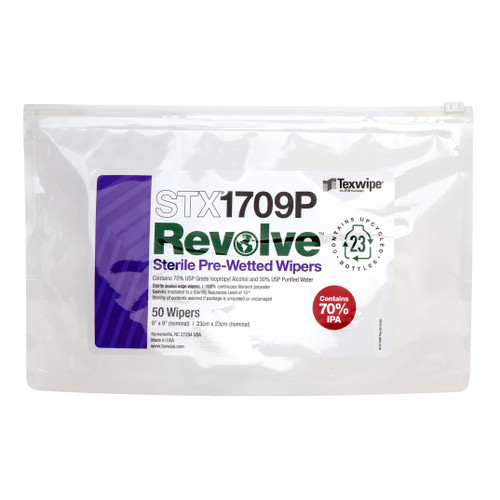
TX1712P is a strong “standard work” wiper for non-sterile controlled environments where you want consistent wipe-down behavior without staging solvent bottles at the point of use. It typically sits in the program as the default for routine wipe-downs of shared equipment and surfaces, with escalation paths based on risk: move to sterile pre-wetted (e.g., STX1712P) for aseptic areas, sterile-core workflows, or whenever sterile documentation and handling controls are required. Keep it aligned to your wiping SOP (stroke pattern, folding logic, bag discipline, and change-out triggers), and qualify it against the surfaces and residues you actually run—especially if you have film-sensitive steps or ionic-mobility concerns.
Terminology note: Engineered for low-linting performance; no wiper is truly “lint-free” in every process condition.
Source basis
- SOSCleanroom product page (TX1712P Revolve 12" x 12" Upcycled Polyester Cleanroom Wiper Pre-Wetted 70% IPA): https://www.soscleanroom.com/product/wipers/texwipe-tx1712p-revolve-12-x-12-upcycled-polyester-cleanroom-wiper-pre-wetted-70-ipa/
- Texwipe manufacturer Technical Data Sheet (Revolve™ Wipers, TEX-LIT-TDS-055 Rev.00-05/20): https://www.texwipe.com/images/uploaded/documents/Wipers/Texwipe-Revolve-Wipers-TDS.pdf
- SOS-hosted copy of Texwipe Technical Data Sheet (Revolve™ Wipers): https://www.soscleanroom.com/content/texwipe_pdf/TDS_Revolve%20Texwipe.pdf
- Texwipe Revolve TechNote (sustainable line background and program context): https://www.texwipe.com/images/uploaded/documents/Technical-Data/Texwipe-Revolve-Technote.pdf
- Texwipe Revolve Q&A: https://www.texwipe.com/images/uploaded/documents/Technical-Data/Texwipe-Revolve-QA.pdf
- Berkshire SatPax® MicroSeal®-VP presaturated 70% IPA product reference: https://berkshire.com/shop/presaturated-cleanroom-wipes/ipa-wipes-isopropyl-alcohol/resealable-pouch-wipes/satpax-microseal-vp/spxvp00112/
- Valutek pre-wetted, heat-sealed polyester wiper product reference: https://shop.valutek.com/products/valutek-pre-wetted-polyester-cleanroom-wipers
- Contec PROSAT® presaturated wipes product reference: https://cleanroom.contecinc.com/product/1779503936
Source: SOSCleanroom Technical Vault | Last reviewed: Jan. 4, 2026
© 2026 SOS Supply. All rights reserved.