The Technical Vault
By SOSCleanroom
When Strong-Acid Spill Pickup Is the Job: Why TX2009 BetaWipe Adds Absorbency Without Adding “Shop-Rag Risk” in ISO 6–8 Wipe-Down Work
Last reviewed: Jan. 2, 2026 | Audience: contamination control, cleanroom operations, EHS, quality
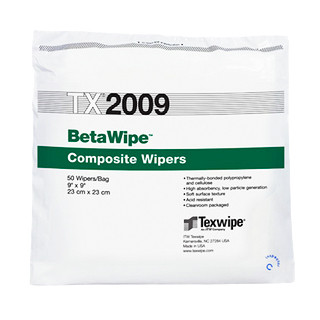
Texwipe TX2009 BetaWipe (9" × 9") is a dry, high-loft composite wiper built for a specific problem that shows up in real controlled environments:
fast spill pickup and wet wipe-down—especially where acids are part of the process—without defaulting to uncontrolled rags.
BetaWipe combines a cellulose absorbent core with polypropylene outer layers, giving it the “soak-up speed” teams want for aqueous/chemical events while keeping the handling posture closer to an engineered cleanroom consumable.
In practical program terms, TX2009 is not a universal “final-pass” wiper. It is a utility-control layer—best used for spill response, equipment wipe-downs, and chemical-handling support tasks where absorbency and chemical resistance drive outcomes, and where published contamination context supports responsible placement.
SOSCleanroom supports continuity of supply and documentation discipline so this category of wiper does not become the last-minute substitution that changes absorbency, residue background, or investigation outcomes.
What it’s for
TX2009 is positioned for strong-acid spill pickup, general wiping, cleaning and polishing surfaces, and applying/removing common cleaning solutions in controlled environments.
SOSCleanroom lists TX2009 for ISO 6–8 controlled environments (final suitability depends on your process, chemistry, and technique).
If your step is residue-critical (optics, high-adhesion bonding, ultra-trace residue control), plan TX2009 as the “pickup” tool and define a separate finishing wipe architecture aligned to that residue budget.
Decision drivers
TX2009 earns its place when the requirement is “pick it up fast, keep it controlled, and don’t create a new contamination problem”:
- Composite architecture: cellulose core for absorbency; polypropylene outer layers for chemical resistance and controlled handling.
- Acid-facing use case: BetaWipe is positioned specifically for strong-acid spill pickup where many general-purpose wipes are a poor fit.
- Absorbency performance: high sorptive capacity with rapid wet-out supports fast containment before a spill becomes a spread event.
- Soft surface texture: designed to be effective for wiping while remaining gentle on many surfaces (qualification still required for scratch-sensitive finishes).
- Packaging discipline: cleanroom bagging configuration supports controlled introduction and staged use.
- Traceability posture: published typical contamination metrics support qualification discussions and change control.
Materials and construction – explained like an engineer
“Polypropylene/cellulose” is not a marketing phrase—it is the mechanism.
TX2009 is described as a thermally bonded composite with a cellulose absorbent core layered between polypropylene outer coverings.
The core delivers bulk uptake (why it works for spills), while the polypropylene layers present a more chemically tolerant wipe surface—one reason the product is positioned for strong-acid spill pickup rather than being treated as a generic absorbent.
This layered approach also changes operator behavior: it supports blot-and-lift pickup instead of “scrub and spread.”
The control still lives in technique—face rotation, pressure control, and early discard once loaded.
Specifications – in context
TX2009 is a 9" × 9" format intended for controlled handling—large enough to fold into stable faces, compact enough to reduce overreach and incidental contact.
SOSCleanroom lists the material as a polypropylene/cellulose composite with double-bagged packaging.
Texwipe’s BetaWipe family packaging is described as a bag-within-a-bag configuration (two inner bags per outer bag), supporting staged introduction and reducing exposure time on the bench.
In spill work, the functional spec is absorbency. BetaWipe’s published typical sorptive capacity is 560 mL/m² with a sorptive rate of ~1 second—a performance profile that is hard to replicate with many all-polyester wipes and is the reason blended/composite architectures stay relevant in mature programs.
Cleanliness and performance metrics
For most facilities, the risk conversation is three buckets: releasables (particles/fibers), residues (NVR), and ions.
BetaWipe’s published typical values give you a placement baseline and should be treated as a qualification starting point rather than a contractual specification.
- Absorbency: sorptive capacity 560 mL/m²; sorptive rate 1 second.
- Releasables: typical LPC (>0.5 µm) 40 × 106 particles/m²; typical fibers (>100 µm) 90,000 fibers/m².
- Residues (NVR): IPA extractant 0.20 g/m²; DI water extractant 0.06 g/m² (typical).
- Ions (typical): sodium 50 ppm, potassium 10 ppm, chloride 20 ppm (typical, standard products listed).
Translation: TX2009 is engineered for high-uptake utility wiping in controlled spaces.
If ionic background or ultra-trace residue is the acceptance driver, treat composite wipes as the “pickup” tool and step to a lower-residue architecture for final-pass work.
Why BetaWipe matters operationally
In acid-handling areas, the most common failure mode is not “the wipe was dirty.” It is spread:
the spill is chased across a larger footprint because the wipe wets slowly, saturates unpredictably, or tears under load.
A high-loft composite wiper reduces that risk by absorbing quickly and holding fluid, supporting a cleaner blot-and-lift workflow.
The program control is pairing the absorbency advantage with discipline—fresh faces, defined discard triggers, and waste handling aligned to your EHS requirements.
Rule of thumb: When absorbency + chemical-facing compatibility is the constraint, composite/nonwoven utility wipes are often the right control.
When lowest residue / lowest ions / edge control is the constraint, the next control step is typically a higher-purity polyester knit (and, where needed, sealed-edge).
Best-practice use
- Blot first, then wipe: contain spills with blot-and-lift pickup before any directional wipe-down pass.
- Fold for control: quarter-fold to create multiple clean faces; treat each face as single-pass once loaded.
- One-direction strokes: use parallel, overlapping passes to avoid re-depositing contamination and spreading films.
- Define discard triggers: once near saturation or visibly loaded, replace—do not “work it dry.”
- EHS alignment: follow facility requirements for PPE, neutralization/compatibility rules, ventilation, and hazardous waste handling for chemical-contaminated wipes.
Common failure modes — and how TX2009 helps
A utility wiper becomes a process problem in predictable ways. BetaWipe reduces some of these risks, but the remaining controls are procedural:
- Spreading a spill instead of containing it: high uptake supports containment, but only if operators blot early and rotate faces.
- Overworking a saturated wipe: once loaded, any wipe becomes a redistribution tool—replace early.
- Using the wrong wiper for residue-critical finishing: define roles in the SOP (spill pickup vs. routine wipe-down vs. finishing vs. sampling).
- Chemistry compatibility assumptions: “acid resistant” is not “compatible with every chemical”—qualify against your chemical set and contact times.
Closest comparators
The most defensible comparisons are to other high-absorbency cleanroom utility wipes selected for spill pickup and chemical-handling support:
Berkshire Pro-Wipe® 750 (polypropylene/cellulose composite class) is a relevant comparator when teams want a similar “absorbency-first but controlled” wipe category.
Compare absorbency metrics, NVR/ion background, and packaging discipline to your program’s acceptance drivers.
Contec nonwoven composite/utility wipe families used in clean manufacturing programs can be appropriate comparators when chemical-handling workflows and documentation depth drive selection.
Compare intended chemistry compatibility, sterility options (if required), and how consistently the wipe supports your technique controls under real shift conditions.
Where TX2009 fits in a cleanroom wiping program
TX2009 is a strong choice as a spill-control and chemical-handling utility wiper in ISO 6–8 controlled environments where absorbency and chemistry-facing behavior matter.
Use it to stabilize spill pickup and wet wipe-down tasks, then keep the program mature by defining escalation tools:
lower-residue polyester knits for finishing, sealed-edge where edge control becomes the acceptance driver, and method-aligned sampling consumables when wiping becomes part of a measurement system.
Terminology note: TX2009 is engineered for low-linting performance; no wiper is truly “lint-free” in every process condition.
Source basis
-
SOSCleanroom product page: “Texwipe TX2009 BetaWipe 9" × 9" Polypropylene and Cellulose Cleanroom Wiper”
(ISO environment listing, basic specs, positioning, packaging presentation).
https://www.soscleanroom.com/product/wipers/texwipe-tx2009-betawipe-9-x-9-polypropylene-and-cellulose-cleanroom-wiper/
-
ITW Texwipe technical datasheet: “BetaWipe® Wipers” (thermally bonded composite construction; strong-acid spill pickup positioning; sorptive capacity/rate; typical particles/fibers/NVR/ions; packaging configuration).
https://www.texwipe.com/wp-content/uploads/2022/07/betawipe_wipers.pdf
-
Comparator context (category placement): Berkshire Pro-Wipe® 750 and Contec nonwoven/composite wipe families (construction class, positioning, documentation posture).
Source: SOSCleanroom | Last reviewed: Jan. 2, 2026
© 2026 SOS Supply. All rights reserved.