The Technical Vault
By SOSCleanroom
Small Wipe, Big Control: Why TX2064 ThermaSeal 60 Is Built for Tight-Clearance Cleaning Where Edge Shedding Is the Risk
Last reviewed: Jan. 1, 2026 | Audience: contamination control, cleanroom operations, EHS, quality
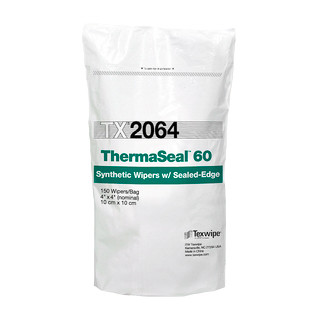
Texwipe TX2064 ThermaSeal 60 (4" × 4") is a dry, sealed-edge polyester cleanroom wiper engineered for cleaning tasks where the edges are the failure mechanism: tight clearances, repeated folding, corner work, and high-contact wiping around fittings, interfaces, and small hardware. In those situations, a standard cut edge can become the source of fibers and releasables precisely where you do not want them—at the boundary conditions of your process.
ThermaSeal 60’s role is straightforward: keep a small-format wipe mechanically stable and predictable at the edge, while maintaining low-linting performance and solvent compatibility for controlled-environment cleaning. For many programs, it is the “precision utility” wipe that lives on carts, in tool cribs, and at equipment wipe-down stations where larger wipes are inefficient and edge behavior matters.
What it’s for
TX2064 is commonly selected for critical cleaning of small areas: wipe-down of equipment touchpoints, fittings and interfaces, tooling surfaces, and tight-clearance locations where a 4" × 4" wipe can be controlled without overreach. Manufacturer positioning for the ThermaSeal 60 family includes cleaning and wiping down filling equipment, pressure chambers, cleanroom surfaces, and other critical parts where controlled handling and low releasables are required.
Decision drivers
TX2064 earns its place when the wiping step needs “mechanical discipline,” not just absorbency:
- Sealed-edge strategy: thermal bonding is used to seal and retain fibers at the edge—reducing edge-driven releasables during folding, corner work, and repeated strokes.
- Polyester construction for solvent workflows: designed for broad chemical compatibility and common cleanroom solvent cleaning.
- Small-format controllability: 4" × 4" supports precise wiping in tight spaces without dragging a larger wipe across adjacent surfaces.
- Published contamination context: typical values for particles/fibers, NVR, and ionic extractables help quality teams place the wipe appropriately and document rationale.
- Packaging discipline and traceability: double inner-bagging and lot coding support controlled introduction and faster investigations when a trend shifts.
- Made-in-USA program posture: relevant when country-of-origin is part of purchasing controls (confirm via incoming documentation tied to received lots, when required).
Practical selection cue: If you’re troubleshooting “mystery fibers” that correlate with folding, corner wiping, or aggressive edge contact, a sealed-edge wipe is usually the first technical step-up.
Materials and construction – explained like an engineer
“Polyester wiper” is not a sufficient specification. In practice, the edge and the converting method often determine whether the wipe behaves consistently under real wiping forces. TX2064 is built around a sealed-edge approach: thermal bonding is used at the perimeter so the edge is less likely to fray, feather, or shed when the wipe is folded and pushed into corners.
The 4" × 4" geometry is also part of the design intent. Small wipes allow operators to maintain a controlled contact patch, keep strokes directional, and avoid the “wipe tail” problem where excess material contacts surfaces unintentionally. That matters in tight-clearance cleaning, around ports and clamps, and on equipment exteriors where the wipe needs to be guided like a tool.
Terminology note: TX2064 is engineered for low-linting performance; no wiper is truly “lint-free” in every process condition.
Cleanliness and performance metrics
For most facilities, wipers introduce risk in three buckets: releasables (particles/fibers), residues (NVR), and ions (corrosion/ECM sensitivity). TX2064’s published typical values address those buckets and should be treated as a qualification starting point rather than a contractual per-lot specification unless explicitly stated otherwise.
- Releasables: typical particle and fiber results support placement decisions when edge contact and repeated folding are part of the task.
- NVR: low NVR is relevant when wipe-down occurs near residue-sensitive surfaces or where dry-down artifacts are investigated.
- Ions: low ionic extractables matter when cleaning is performed near corrosion-sensitive alloys, high-impedance electronics, or contact surfaces with ionic sensitivity.
- Sorption behavior: published sorptive capacity/rate supports small spill pickup and controlled wet cleaning (process-dependent).
Technique still dominates outcomes: Even low-releasable wipes can redeposit contamination if operators reuse a loaded face too long or wipe back-and-forth. Directional strokes and frequent face rotation are the controllable levers.
Specifications (what matters operationally)
- Size: 4" × 4" nominal
- Material: Polyester
- Edge: sealed / thermally bonded perimeter
- Packaging: 300 wipers per bag; double inner-bagged; 20 bags per case (packaging controls support staged introduction)
- Cleanroom placement: typically positioned for ISO Class 3–7 use (final suitability depends on your process and wiping method)
- Traceability: lot coded; shelf-life posture is commonly documented for controlled storage planning
Why 4" × 4" matters operationally
In real operations, the “best” wipe is often the one that lets technicians maintain control. A 4" × 4" format makes it easier to keep wiping directional, avoid overreach, and manage face rotation without creating a large contaminated contact patch. It also reduces the tendency to overuse a single wipe because it “still looks clean”—small wipes encourage a changeout cadence that better matches critical cleaning practice.
Best-practice use
TX2064 performs best when the wipe is treated as a controlled tool—especially in tight-clearance work.
- Fold for control: create a flat, stable contact face; avoid crumpling (crumpling concentrates pressure and increases redeposit risk).
- Directional strokes: wipe in controlled, overlapping, single-direction passes; avoid “scrub back and forth” unless the SOP explicitly calls for it.
- Face rotation discipline: treat each exposed face as single-pass for critical surfaces; rotate early and discard when loaded.
- Wetness control (if using solvents): damp is typically the control target—avoid flooding seams or interfaces where liquid can wick and carry soils under hardware.
- Staging: keep inner bags closed until use; return opened bags to controlled storage to minimize airborne exposure.
Common failure modes — and how TX2064 helps
A wiper becomes a contamination source in predictable ways: edge degradation in corner work, snagging and fraying, overusing a loaded face, and mobilizing residues with inconsistent solvent loading. TX2064’s sealed-edge approach is specifically aimed at reducing edge-driven releasables during folding and tight-clearance wiping. Cleanroom packaging and traceability help reduce incoming variability; technique controls the rest.
- Edge-driven fibers: mitigated by sealed-edge perimeter for folding/corner contact.
- Redeposit from loaded faces: prevented by aggressive face rotation and early discard rules.
- Residue artifacts after dry-down: minimized by controlling wetness and using consistent solvent/chemistry handling.
Closest comparators
The most defensible comparisons are to other sealed-edge polyester cleanroom wipes used for similar tight-clearance or edge-sensitive applications.
Berkshire MicroSeal® 1200 (sealed-edge polyester knit) is a common comparator when programs want a sealed-edge knit wipe for more defect-sensitive surfaces and edge-shedding control. Buyers typically compare edge technology, published cleanliness data, and packaging/traceability posture.
Contec Polynit® Heatseal (heatsealed polyester knit) is a close comparator when a heatsealed edge and polyester knit behavior are the decision drivers. Programs often evaluate “hand feel,” edge robustness in corner work, and documentation depth for qualification packages.
Valutek laser-sealed polyester knit wipes (laser-sealed edge) are a credible comparator class when laser sealing is preferred as the edge-control method. Compare construction, edge method, and the contamination-control documentation available through your procurement channel.
Rule of thumb: When edge control is the acceptance driver, sealed-edge/sealed-border is the technical step-up. When wetness repeatability is the constraint, consider a controlled pre-wetted system.
Where TX2064 fits in a cleanroom wiping program
TX2064 is a strong choice for edge-sensitive, tight-clearance cleaning in ISO Class 3–7 environments where the facility needs a small-format polyester wipe with a sealed perimeter to reduce edge-driven releasables. It complements larger-format daily-driver wipes by covering the “precision utility” layer: small wipe-downs, interfaces, ports, fixtures, and controlled cleaning tasks where geometry and edge behavior are the real constraints.
Program note: Use role clarity to keep investigations short: define which wipes are for precision interface cleaning (sealed-edge), which are for general wipe-down (daily-driver), and which are for validation-sensitive sampling (method-aligned sampling media).
Source basis
- SOSCleanroom product page: “Texwipe TX2064 ThermaSeal60 4" × 4" Polyester Cleanroom Wiper” (SKU positioning, size and packaging, sealed-edge posture). https://www.soscleanroom.com/product/wipers/texwipe-tx2064-thermaseal60-4-x-4-polyester-cleanroom-wiper/
- ITW Texwipe datasheet: “ThermaSeal® 60 Wipers” (construction/edge method, typical contamination metrics, sorption data, ISO Class positioning, packaging/traceability notes). https://www.soscleanroom.com/wp-content/uploads/2019/08/THERMASEAL60_Wipers.pdf
- Berkshire product literature: “MicroSeal® 1200” (sealed-edge polyester knit comparator class; positioning and technical framework). https://www.berkshire.com/products/cleanroom-wipers/microseal-1200/
- Contec product literature: “Polynit® Heatseal” (heatsealed polyester knit comparator class; sizing/packaging and positioning). https://www.contecinc.com/en-us/documents/1051/DS_PolynitHeatseal.pdf
- Valutek comparator class reference: laser-sealed polyester knit wipe description and packaging examples. https://shop.valutek.com/products/valutek-standard-weight-polyester-wiper-laser-seal?view=quick_view
Source: SOSCleanroom Technical Staff | Last reviewed: Jan. 1, 2026
© 2026 SOS Supply. All rights reserved.