The Technical Vault
By SOSCleanroom
High-Capacity Wiping Without the “Spill Rag” Penalty: How TX2409 AlphaSorb HC Delivers Large-Volume Pickup With Low Releasables
Last reviewed: Jan. 3, 2026 | Audience: contamination control, cleanroom operations, EHS, quality
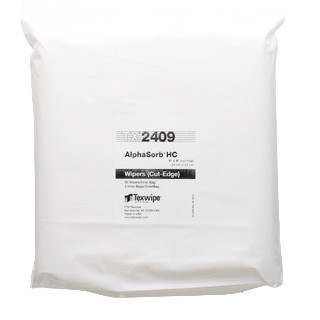
“High absorbency” is easy to claim and hard to control. In real clean operations, the high-capacity wipe often becomes the uncontrolled variable: fibers spike when technicians wipe fast, edges shed under pressure, and absorbency comes with extractables that show up after dry-down. Texwipe TX2409 AlphaSorb® HC (High Capacity) 9" × 9" is built to avoid that tradeoff by pairing two-ply, cleanroom-laundered 100% polyester knit with a high sorbency architecture designed for spill control and large-volume cleaning, sterilizing, and disinfecting.
In practice, TX2409 is a “capacity-first” control that still behaves like a cleanroom consumable: it is positioned for critical environments where pickup volume matters, but particles and extractables still belong in the qualification conversation.
What it’s for
TX2409 is best used for spill control, large-volume cleaning, and application and removal of cleaning/disinfecting solutions on production equipment and cleanroom surfaces—especially where operators need a wipe that can hold meaningful liquid volume without degrading into lint and particles. Manufacturer positioning places the AlphaSorb HC family in ISO Classes 1–4 and highlights compatibility with common disinfectant chemistries (bleaches, phenols, and quaternary ammonium compounds).
Decision drivers
TX2409 earns its place when the cleaning step needs capacity but the contamination model cannot be casual:
- Two-ply high-capacity architecture: a unique two-ply knit construction designed to hold higher liquid volume per wipe while maintaining structure during wiping.
- Polyester knit control: 100% polyester synthetic knit, cleanroom-laundered, double-knit, selected to resist snagging and reduce release under rigorous wiping.
- Low releasables posture: published typical data for particles/fibers, nonvolatile residue (NVR), and ionic extractables supports risk placement discussions.
- Chemistry exposure readiness: positioned to withstand common cleaning and disinfecting solutions used in routine cleanroom programs.
- Packaging discipline: solvent-safe cleanroom packaging with two inner bags of 50 (per 100-count bag) supports staged introduction and reduced handling exposure.
- Traceability and program stability: lot-to-lot traceability supports investigations and change control when “same wipe, same behavior” matters.
Materials and construction – explained like an engineer
High-capacity wiping fails when the fabric collapses under load. AlphaSorb HC addresses that by using a two-ply 100% polyester knit rather than a paper-like cellulose structure or a binder-dependent nonwoven. In day-to-day terms, that means the wipe can take up more solution, keep its shape when folded, and resist tearing when it is dragged across brushed stainless, equipment corners, or textured panels.
The practical outcome is not “more absorbent.” It is more absorbent without becoming a shedding event when technicians wipe fast, press harder, or chase a spill into seams and interfaces.
Specifications in context
TX2409 is a 9" × 9" (nominal 22 cm × 22 cm) two-ply polyester wiper supplied 100 wipers per bag with 2 inner bags of 50, and 10 bags per case. This is a consumption-friendly configuration: it supports staged issuance (open one inner bag, keep one protected) and reduces the time a bulk wipe population sits exposed on the bench.
If your cleaning SOP is capacity-driven (large wet surface area, high solution volume, or frequent re-wetting), this packaging style often reduces the “I’ll just keep using this one wipe” behavior that turns wiping into redeposition.
Cleanliness and performance metrics
For most facilities, the qualification discussion is three buckets: releasables (particles/fibers), residues (NVR), and ions. TX2409’s published values should be treated as typical capability data, then verified in your actual solvent set, surfaces, and technique window.
- Sorptive capacity: 680 mL/m² (high-capacity posture for large-volume pickup).
- Sorptive rate: < 1 second (fast uptake matters when spill spread is the failure mode).
- LPC (>0.5 µm): 8.2 × 10⁶ particles/m².
- Particles/fibers released: 0.5–5.0 µm: 2.5 × 10⁶ particles/m²; 5.0–100 µm: 95,000 particles/m²; fibers (>100 µm): 500 fibers/m².
- NVR: 0.02 g/m² (IPA extractant) and 0.01 g/m² (DI water extractant).
- Ions (typical): sodium 0.05 ppm, potassium 0.07 ppm, chloride 0.02 ppm.
Interpretation note: High capacity is an advantage only when technique stays controlled. If a wipe is allowed to reach full saturation and then dragged across interfaces, it becomes a redistribution device. Fold to manage wetness, rotate faces aggressively, and discard before “capacity” turns into pooling.
Why high-capacity wiping matters operationally
In cleaning and disinfection, a frequent failure mode is under-delivery of solution (not enough wetness to meet the intended dwell/contact logic) followed by overworking a wipe (reusing a loaded face until it smears). A high-capacity wipe helps because it can apply and remove solution with fewer “stop-and-rewet” interruptions. The control is to treat wetness as a process input: keep the wipe damp and controlled, avoid seam flooding, and define a discard trigger before the wipe becomes overloaded.
Best-practice use
TX2409 performs best when the technique matches the intent: controlled application/removal of larger solution volumes without spreading soils.
- Fold for control: quarter-fold and maintain a consistent “leading edge” to keep pickup directional.
- One-direction strokes: use overlapping passes; avoid back-and-forth scrubbing unless your SOP explicitly calls for it.
- Manage wetness: damp is the control target; avoid free liquid that can wick under hardware and labels.
- Face rotation discipline: treat each face as single-pass once it is visibly loaded or begins to smear.
- Disinfectant logic: apply enough solution to meet contact time, then remove with fresh faces to prevent redeposit.
Common failure modes — and how TX2409 helps
High-capacity wipes fail in predictable ways: over-saturation that drives pooling, overuse that turns pickup into smearing, and aggressive wiping that degrades fabric and elevates releasables. TX2409’s two-ply polyester knit is designed to maintain integrity under more rigorous wiping and to reduce snagging, which helps keep the wipe from becoming the contamination source during fast, real-world cleanup. The remaining controls are procedural: wetness control, directional strokes, and early discard rules.
Terminology note: TX2409 is engineered for low-linting performance; no wiper is truly “lint-free” in every process condition.
Closest comparators
The most defensible comparisons are to other high-absorption polyester cleanroom wipes intended for spill control and large-volume solution handling.
Texwipe TX49 Vertex (laser-sealed high-absorption polyester) is an appropriate comparator when edge control and absorption are both priorities; sealed edges are often selected when edge-driven releasables are the acceptance driver.
Berkshire high-absorption sealed-edge polyester families are appropriate category peers when you need capacity but want to reduce edge-related fiber contribution during folding and aggressive wiping.
Rule of thumb: When the constraint is volume, choose a high-capacity architecture. When the constraint is edge control, step to sealed-edge/sealed-border. When the constraint is wetness repeatability, consider a controlled pre-wetted system.
Where TX2409 fits in a cleanroom wiping program
TX2409 is a strong choice for the high-capacity cleaning tier in critical environments: spill response, large-area wipe-down, and cleaning/disinfection workflows where the wipe must apply and remove larger solution volumes without becoming a shedding or residue variable. Use it to stabilize real-world cleanup and disinfection steps, then keep the program mature by gating more defect-sensitive surfaces to sealed-edge knits and standardizing solvent/disinfectant handling so wetness and dwell are controlled inputs, not technician judgment calls.
Source basis
- SOSCleanroom product page: “Texwipe TX2409 AlphaSorb HC 9" × 9" Polyester Cleanroom Wiper” (SKU configuration, packaging, positioning).
- ITW Texwipe technical data sheet: “AlphaSorb® High Capacity Wipers” (TX2409/TX2412/TX2418) (two-ply construction, applications, packaging, typical performance/contamination characteristics, typical-value framing; effective January 2013).
- Method context referenced in the datasheet: IEST-RP-CC004.3 and ASTM E2090 (particle/fiber counting framework and methodology context).
Source: SOSCleanroom (SOS Supply) | Last reviewed: Jan. 3, 2026
© 2026 SOS Supply. All rights reserved.