The Technical Vault
By SOSCleanroom
High-Capacity Wiping Without the “Extractables Tax”: Where TX2412 AlphaSorb HC Earns Its Place in Large-Volume Cleanroom Cleaning
Last reviewed: Jan. 2, 2026 | Audience: contamination control, pharmaceutical manufacturing, cleanroom operations, EHS, quality
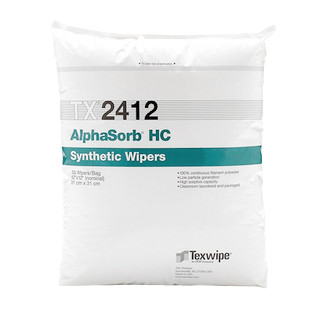
Texwipe TX2412 AlphaSorb® HC (12" × 12") is a two-ply, 100% polyester, cleanroom-laundered knit wiper built for one specific operational problem: large-volume wipe-downs where a standard “daily driver” wiper saturates too quickly and starts smearing, dripping, or pushing chemistry into seams and corners.
AlphaSorb HC is positioned for high-sorbency cleaning, sterilizing, and disinfecting workflows, including spill response and production-equipment wipe-downs. The value proposition is practical: hold more solution per wipe, keep strength under load, and reduce the number of change-outs required to complete a controlled wipe-down step.
What it’s for
TX2412 is best used where high sorbency and low releasables must coexist: large-area wipe-downs, application and removal of cleaning/disinfecting solutions, spill control, and routine cleaning of surfaces and production equipment in controlled environments. It is commonly evaluated for programs that run frequent wet cleaning cycles and want fewer “flood-and-chase” artifacts caused by a wipe reaching capacity too early.
Decision drivers
TX2412 is selected when the cleaning step is constrained by solution volume and wipe “face life,” not by a lack of wiping technique:
- Two-ply knit capacity: engineered to hold more solution per wipe, reducing change-outs during large-area wipe-downs.
- Strength under load: polyester knit construction supports rigorous wiping with minimal fiber/particle release (process-dependent).
- Low releasables posture: published typical values for particles/fibers, NVR, and ions help frame qualification discussions.
- Chemistry exposure readiness: positioned to withstand common cleaning/disinfecting chemistries (including bleaches, phenols, and quats).
- Packaging discipline: solvent-safe cleanroom packaging with staged inner-bag presentation supports controlled introduction.
- Program continuity: SOSCleanroom supports stable replenishment and consistent documentation handoff to reduce unqualified substitutions.
Materials and construction – explained like an engineer
“High capacity” in wipe-down work is not just absorbency; it is capacity plus mechanical stability. When a wipe is near saturation, weaker structures can distort, shed more, or release liquid unpredictably at the fold line. TX2412’s two-ply, cleanroom-laundered polyester knit is designed to maintain integrity while holding higher solution volumes, which matters when operators are applying and removing cleaning and disinfecting solutions across large surface areas.
Operationally, a higher-capacity wipe reduces the failure mode where technicians keep working a saturated face “to finish the section,” turning a removal step into a redistribution step. Capacity enables technique discipline: rotate faces sooner, keep strokes directional, and discard before the wipe becomes a smear tool.
Specifications in context
TX2412 is a 12" × 12" (31 cm × 31 cm) two-ply polyester wipe. It is packaged 100 wipers per bag with 2 inner bags of 50 and 6 bags per case. The larger format is not just convenience; it supports wide, overlapping, single-direction passes while still allowing consistent folding into stable faces.
Placement guidance should be tied to your process reality. Manufacturer literature positions AlphaSorb HC for ISO Classes 1–4. Your final suitability still depends on surface type, wiping force, solvent/disinfectant set, and acceptance criteria (visual, particle, residue, ionic, corrosion risk).
Cleanliness and performance metrics
For wet cleaning programs, the most useful framework is to evaluate three risk categories: releasables (particles/fibers), residues (NVR), and ions (corrosion/ECM sensitivity). TX2412’s published typical values provide a qualification starting point (typical analyses, not specifications).
- Absorbency: typical sorptive capacity 680 mL/m²; sorptive rate < 1 second.
- LPC (>0.5 µm): typical 8.2 × 10⁶ particles/m².
- Fibers (>100 µm): typical 500 fibers/m².
- NVR: typical 0.02 g/m² (IPA extractant); 0.01 g/m² (DI water extractant).
- Ions: typical sodium 0.05 ppm, potassium 0.07 ppm, chloride 0.02 ppm.
Why “high capacity” matters operationally
In real facilities, wet-cleaning variability is often driven by operator workarounds: stretching a wipe too long, re-wetting mid-pass, wiping back-and-forth to “pick up what’s left,” or flooding a surface because the wipe cannot hold enough to keep a controlled film. TX2412’s capacity reduces those behaviors by making it easier to keep the step procedural: apply solution, wipe directionally, rotate faces, discard before saturation, and complete the zone without turning seams and corners into solvent reservoirs.
Best-practice use
TX2412 performs best when capacity is used to improve control, not to justify longer reuse:
- Fold for control: create stable faces; treat each face as single-pass for critical wipe-downs.
- Directional strokes: use straight-line, overlapping passes; avoid circular scrubbing unless required by an SOP.
- Wetness discipline: apply enough solution to meet contact-time/dwell needs, then remove using fresh faces before dry-down artifacts set in.
- Face-life rules: rotate and discard early; do not “finish the section” with a saturated face.
- Zone separation: keep wipes dedicated by area/chemistry when cross-contamination risk is meaningful.
Common failure modes — and how TX2412 helps
Large-volume wiping fails in predictable ways: over-wetting that drives pooling and wicking, reuse of saturated faces that redeposit soils, and aggressive wiping that degrades marginal wipes. TX2412’s two-ply knit capacity and strength are designed to reduce those failure modes, but the decisive controls remain procedural: face rotation, directional strokes, and chemistry discipline (correct concentration, dwell, and removal logic).
Closest comparators
The most defensible comparisons are to other high-absorbency polyester cleanroom wipes intended for wet cleaning and disinfecting cycles.
Berkshire SuperSorb (sealed-edge, high-absorbency polyester knit) is an appropriate comparator when edge-driven releasables and aggressive wet wiping are primary concerns. Sealed-edge high-absorbency wipes are often selected where the wipe will be worked hard at folds, corners, and edges.
Contec polyester knit wipe formats are common comparators for general wet wipe-down programs. When evaluating, focus on capacity under load, published contamination context, packaging discipline, and whether the wipe stays intact and low-linting in your actual wipe pattern and chemistry set.
Rule of thumb: When the constraint is solution volume and wipe “face life,” step up to high-capacity constructions. When the constraint becomes edge-driven releasables, sealed-edge/sealed-border is often the next control step.
Where TX2412 fits in a cleanroom wiping program
TX2412 is a strong choice for large-volume wet cleaning, sterilizing, and disinfecting workflows where a standard wipe saturates too quickly and drives variability. It is particularly well-suited for equipment wipe-downs, production-area surface cleaning, and spill response where capacity and strength reduce the temptation to overwork a loaded wipe. When the process shifts to the most defect-sensitive surfaces or where edge control is the dominant risk, the technical step-up is typically a sealed-edge knit polyester family. When wetness repeatability is the constraint, the step sideways is a controlled pre-wetted system designed to standardize solvent loading.
Terminology note: TX2412 is engineered for low-linting performance; no wiper is truly “lint-free” in every process condition.
Source basis
-
SOSCleanroom product page: “Texwipe TX2412 AlphaSorb HC 12" × 12" Polyester Cleanroom Wiper”
(positioning, SKU details). https://www.soscleanroom.com/product/wipers/texwipe-tx2412-alphasorb-hc-12-x-12-polyester-cleanroom-wiper/
-
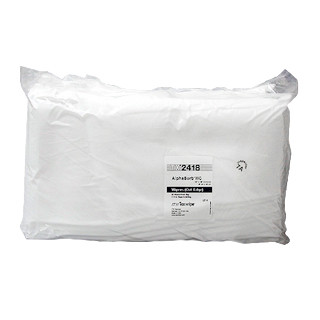
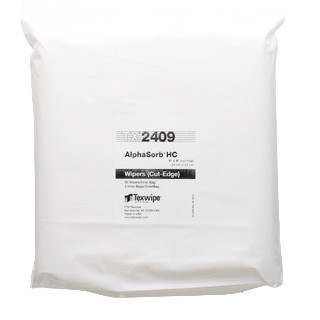
ITW Texwipe technical data sheet (Effective January 2013): “AlphaSorb® High Capacity Wipers (TX2409, TX2412, TX2418)”
(two-ply construction, packaging, ISO range positioning, sorbency, particles/fibers, NVR, ions; typical-value framing). https://www.soscleanroom.com/content/texwipe_pdf/2409%202412%202418.pdf
-
Comparator category context (high-absorbency polyester cleanroom wipes): Berkshire SuperSorb product information; Contec cleanroom wipe program information.
Source: SOSCleanroom Technical Vault | Last reviewed: Jan. 2, 2026
© 2026 SOS Supply. All rights reserved.