The Technical Vault
By SOSCleanroom
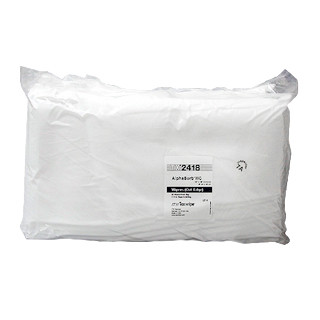
Texwipe TX2418 AlphaSorb® HC 18" x 18": high-capacity two-ply polyester knit for large-volume cleaning in ISO Class 4–8 environments
Last reviewed: Jan. 4, 2026 | Audience: contamination control, cleanroom operations, EHS, quality
TX2418 AlphaSorb® HC is a large-format, high-capacity 18" x 18" cleanroom-laundered polyester knit wiper designed for the moments when your process needs to move
more liquid per wipe—spill pickup, large surface wipe-downs, and the application/removal of cleaning and disinfecting solutions—without turning the wipe itself into a contamination source.
It is engineered for low-linting performance (no wiper is truly “lint-free” in every process condition) and is commonly specified when teams want a high-sorbency wipe that still
behaves predictably across shifts.
The “why this one” is the construction: a double-knit, two-ply, 100% polyester substrate paired with cleanroom laundering, solvent-safe packaging, and lot traceability. In practice, TX2418 is
chosen when operators are fighting rework from uneven wet steps (over-wetting/under-wetting), residues left behind after contact time, or inconsistent wipe mechanics on larger equipment and facility
surfaces. It is also cited as autoclave safe for dry-wipe workflows—validate the cycle, packaging integrity, and post-cycle dryness to your SOP.
What it’s for
Large-volume cleaning, sterilizing, and disinfecting steps (application and removal of solutions); spill control and high-sorbency pickup; cleaning environmental surfaces and production equipment;
and tray/parts lining for holding, protecting, drying, and staging items where approved by the site program. TX2418 is also used with common cleanroom solvents (e.g., IPA, ethanol, acetone, degreasers)
when validated for the surface and process endpoint.
Decision drivers
TX2418 is most valuable when your risk is “high-volume wet work creates variability” and you want a more forgiving, higher-capacity wipe without sacrificing contamination control discipline.
- High-capacity wipe mechanics: Two-ply knit construction is designed to carry and release larger volumes of cleaning/disinfecting solutions with fewer sheet changes on big surfaces.
- Cut-edge strategy (soft edge behavior): Cut edge can be preferred on cosmetic- and scratch-sensitive surfaces; qualification matters because edge control expectations differ versus sealed-edge formats.
- Cleanroom laundering posture: Laundered to reduce extractables and particulates; use published “typicals” as a qualification baseline, not incoming acceptance limits.
- Chemistry tolerance in real programs: Intended to withstand exposure to common cleaners/disinfectants (e.g., bleach, phenols, quats) when validated in your SOP and material compatibility matrix.
- Durability on abrasive surfaces: Designed to resist snagging/abrasion pathways that can release particles/fibers during aggressive wipe-downs.
- Program and audit fit: Lot coding and documentation availability help deviations/investigations when cleaning materials are part of the control strategy.
Materials and construction
TX2418 is a cleanroom-laundered, double-knit polyester substrate built as a two-ply construction from 100% polyester. Operationally, that “double layer” is the capacity feature:
it increases liquid hold-up so operators can maintain a controlled wet film across larger areas without repeatedly returning to a bottle or re-wetting mid-pass.
The edge is a cut edge. That typically yields a softer perimeter feel and can reduce cosmetic marking risk on certain surfaces, but it also means you qualify edge behavior in your
most aggressive wipe steps (fasteners, welds, brushed stainless, textured polymers). This wiper family is described as designed for abrasive surfaces and chemical resistance, and it is noted as
autoclave safe for dry wipe workflows—validate cycle parameters and post-cycle dryness to prevent residue and microbial risk from “wet storage.”
Specifications in context
SKU: TX2418
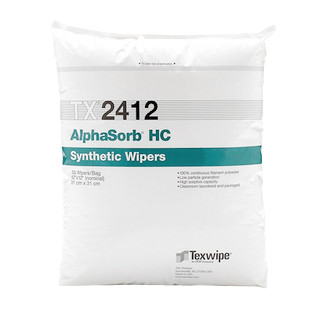
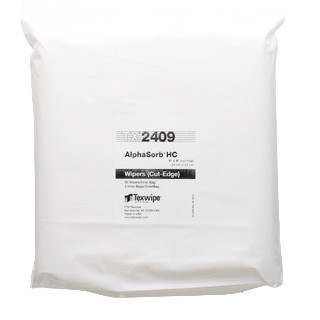
Wiper family: AlphaSorb® HC (high-capacity)
Size: 18" x 18" nominal (46 cm x 46 cm; manufacturer literature also lists 45 cm x 45 cm as a nominal metric equivalent)
Material/structure: 100% polyester, two-ply, double-knit cleanroom-laundered substrate
Edge strategy: cut edge
Packaging (case): 100 wipers/bag (2 inner bags of 50); 3 bags/case; 300 wipers total/case
ISO range (positioning): ISO Class 4–8 (Class 10–100,000; EU Grade A–D)
Autoclave posture: noted as autoclave safe for dry wipes only (validate to your SOP)
Shelf life: non-sterile (dry) listed as 5 years from date of manufacture
In context: the 18" x 18" format is specifically a productivity tool. If operators are over-folding, over-handling, or cutting wipes down, you may get better control (and less waste)
moving to a smaller format in the same family (e.g., 12" x 12")—but if your bottleneck is “surface area plus wet film control,” TX2418 is designed to solve that.
Cleanliness and performance metrics
Use cleanliness metrics as a process-control model: particles/fibers correlate to shedding potential, NVR correlates to residue film risk, and ions correlate to corrosion/ionic contamination risk.
Published values are typical analyses at time of publication and should be confirmed under your actual chemistry, contact time, surface roughness, and wipe method.
Typical physical performance (TX2418):
• Basis weight: 214 g/m2
• Sorptive capacity: 680 mL/m2
• Sorptive rate: <1 second
Typical contamination metrics (TX2418):
• LPC (≥0.5 µm): 8.2 x 10⁶ particles/m2
• Particles (0.5–5.0 µm): 2.5 x 10⁶ particles/m2
• Particles (5.0–100 µm): 95,000 particles/m2
• Fibers (>100 µm): 500 fibers/m2
Typical NVR:
• IPA extractant: 0.02 g/m2 • DIW extractant: 0.01 g/m2
Typical ionic extractables:
• Sodium: 0.05 ppm • Potassium: 0.07 ppm • Chloride: 0.02 ppm
Operational interpretation: On large surfaces, failures usually come from technique drift—overworking a drying film, reusing a loaded face, or changing zones without changing faces/gloves—rather than from the substrate itself. Treat face rotation and “wet-film discipline” as first-class controls.
High-volume wet-step control
High-capacity wipes can either stabilize a cleaning program (fewer interruptions, consistent wet film) or destabilize it (too much liquid carried too far, re-deposition, pooled chemistry, and uneven dry-down).
The control is not “use less wipe”—it is define the wet-film target, the zone boundary, and the face-change triggers. If your SOP requires dwell/contact time, separate the “apply” pass from the “remove/finish” pass to avoid polishing residues into a drying film.
Rule of thumb: For large surfaces, treat one folded face as a controlled “application pad” for a defined area, then switch to a fresh face for removal/finish. If you see pooling, streaks, or drag, you are past the face’s useful load—change faces early.
Best-practice use
The 18" x 18" format gives you capacity, but control still comes from how you fold, how you sequence strokes, and how you prevent re-deposition.
- Fold for control (do not “flag wipe”): Fold into manageable panels and rotate faces on a defined cadence; avoid carrying contamination across a wide surface with a single loaded face.
- Define zones and direction: Clean-to-less-clean with unidirectional, overlapping passes; reserve edge contacts (fasteners, seams) for a fresh face.
- Separate apply vs. remove: When using disinfectants/cleaners with dwell time, apply to achieve a controlled wet film, respect contact time, then remove residues with a fresh face.
- Spill logic: Contain first (perimeter), then recover inward; change wipes early to avoid spreading contamination through oversaturation.
- Change-out triggers: Replace the wipe when it begins to drag, leaves streaks/residue, becomes visibly soiled, or after crossing a zone boundary.
- Autoclave validation (if used): Validate packaging compatibility, cycle parameters, and post-cycle dryness to prevent residues and “wet storage” risk; document lot and cycle when tied to batch-quality outcomes.
Common failure modes
Over-wetting and pooling: High-capacity wipes can carry too much solution too far, creating uneven dry-down and residue transfer; fix with wet-film targets, defined area-per-face, and a separate finish pass.
Re-deposition from loaded faces: The wipe keeps “working” even when the face is saturated with soils; fix with early face rotation and zone-based discard triggers.
Technique drift on large surfaces: Wide strokes and back-and-forth wiping increase rework risk; fix with unidirectional, overlapping passes and a consistent stroke map.
Unexpected particle/fiber events on rough fixtures: Often surface-condition driven (burrs, damaged coatings) more than wipe-driven; fix by addressing surface defects and reserving a fresh face for edges/fasteners.
Autoclave variability: If autoclaving dry wipes, incomplete drying or packaging compromise can create downstream residue/microbial risk; fix with validated cycles and documented handling.
Closest competitors
Berkshire MicroSeal SuperSorb® (two-ply polyester, sealed edge): Similar high-sorbency “two-layer” intent, but with an edge-control step-up (sealed edge). Programs often compare these platforms when edge-shed sensitivity is driving qualification risk and when the wipe is used near critical product-contact boundaries.
Berkshire Super Polx® 1200 (100% polyester knit, knife cut): Similar polyester knit + cut-edge posture, typically lower capacity than a two-ply construction. Often evaluated when teams want a cleaner handling feel and are balancing absorbency needs against waste and face-management control.
Contec Polynit Heatseal Wipes (100% knit polyester, sealed edges): A mechanism-based alternative when edge sealing is prioritized for very low particles/fibers under aggressive wipe-downs. Often selected when the process is more sensitive to edge behavior than to maximum liquid capacity.
Where it fits in a cleanroom wiping program
TX2418 is a strong fit as the “high-volume workhorse” in an ISO Class 4–8 wiping program—large surface wipe-downs, spill events, and solution application/removal where absorbency and durability drive throughput.
Many programs pair it with a tighter edge-control option (sealed edge/laser edge) for the most critical surfaces or where edge-driven particle risk is the dominant constraint.
SOSCleanroom supports this kind of tiered approach with reliable availability, documentation help (lot traceability), and practical technique guidance so the selected wipe performs consistently across operators and shifts.
Terminology note: Engineered for low-linting performance; no wiper is truly “lint-free” in every process condition.
Source basis
- SOSCleanroom product page — Texwipe TX2418 AlphaSorb HC 18" x 18" Polyester Cleanroom Wiper: https://www.soscleanroom.com/product/wipers/texwipe-tx2418-alphasorb-hc-18-x-18-polyester-cleanroom-wiper/
- SOS-hosted PDF (stable reference) — AlphaSorb® High Capacity Wipers (TX2409/TX2412/TX2418), Effective: January 2013: https://www.soscleanroom.com/content/texwipe_pdf/2409%202412%202418.pdf
- Manufacturer TDS (current) — AlphaSorb® HC Technical Data Sheet, TEX-LIT-TDS-007 Rev.00-02/17 (PDF): https://www.texwipe.com/images/uploaded/documents/Wipers/Texwipe-AlphaSorbHC-TDS-ENG.pdf
- Manufacturer product page — AlphaSorb® HC TX2418 (dry, non-sterile): https://www.texwipe.com/alphasorb-hc-tx2418
- Test method basis referenced by manufacturer: IEST-RP-CC004.3 (wiping materials in controlled environments) and ASTM E2090 (particle/fiber release from wipers).
- Berkshire competitor context — MicroSeal SuperSorb® (two-ply polyester) overview listing: https://cleanroomworld.com/cleanroom-consumables/berkshire-cleanroom-wipes/
- Berkshire competitor reference — Super Polx® 1200 product page: https://berkshire.com/shop/cleanroom-wipes/knitted-wipes/super-polx-1200/s120009098p/
- Contec competitor reference (PDF) — Polynit Heatseal Wipes (sealed-edge knit polyester): https://www.contecinc.com>
Source: SOSCleanroom Technical Vault | Last reviewed: Jan. 4, 2026
© 2026 SOS Supply. All rights reserved.