The Technical Vault
By SOSCleanroom
Cotton Where Synthetics Struggle: Why TX304 Is Chosen for Heat-Tolerant, Solvent-Ready Wiping in Small Work Zones
Last reviewed: Jan. 2, 2026 | Audience: contamination control, cleanroom operations, EHS, quality
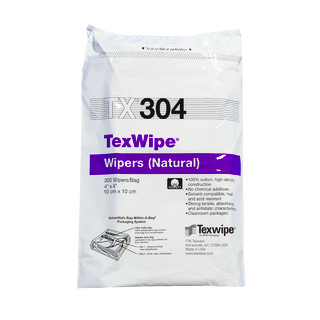
Texwipe TX304 TexWipe (4" × 4") is a 100% cotton, tight-weave, twill-pattern cleanroom wiper designed for situations where operators want the handling and absorbency of cotton, plus a contamination-control posture that is more defensible than improvised shop cloths.
It is most often selected for small-area wipe-downs, spill pickup (aqueous and many organic solvents), and equipment cleaning where elevated temperatures make many synthetic wipes less practical.
TX304 sits in a very specific niche: when the “right” technical answer is not always “polyester knit,” and the facility still needs a controlled consumable with documented performance context and cleanroom packaging discipline.
What it’s for
TX304 is commonly used for cleaning, polishing, and burnishing of metallic and nonmetallic surfaces; targeted cleaning of fixtures and tools; and removing aqueous and organic solvent spills.
It is also positioned for equipment cleaning in areas where high temperatures limit the use of synthetic wipers, making cotton’s heat tolerance a practical control in the workflow.
Decision drivers
TX304 typically earns selection when teams need cotton’s handling profile, but still want controlled-environment safeguards:
- Material and weave control: 100% cotton with a tight, twill-pattern weave and bias-cut strategy intended to improve performance in tight wipe zones.
- Fiber management posture: long-staple cotton yarn and edge treatment are positioned to reduce loose fibers in use (no wiper is truly “lint-free” in every process condition).
- Heat tolerance use-case: cotton is often chosen where hot equipment surfaces or process constraints make many synthetics less suitable.
- Static-conscious handling: positioned with dissipative performance in moderate humidity ranges as a guardrail against static discharge in real operations.
- Packaging discipline: solvent-safe cleanroom packaging (Bag-Within-A-Bag®) supports controlled staging and reduces handling-driven contamination.
- Documentation continuity through SOSCleanroom: consistent sourcing and stable documentation reduce last-minute substitutions that can alter wiping behavior and investigation timelines.
Materials and construction – explained like an engineer
“Cotton wipe” can mean anything from a loose shop rag to a controlled, woven textile. TX304 is positioned as a tight-weave, double-sided twill cotton wiper made with long-staple yarn.
Operationally, long-staple yarn is a fiber-control lever: fewer short ends on the surface generally means fewer “free” fibers available to shed when pressure increases.
The weave density and bias-cut strategy matter most at the edges and corners — the places operators actually press into fixtures, grooves, and interfaces.
If your process is sensitive to edge-driven releasables, cotton can still be a risk if it is overworked, used dry on abrasive textures, or reused past saturation.
Use terminology honestly: TX304 is engineered for low-linting performance relative to uncontrolled cotton cloth. No wiper is “zero-lint” across all pressures, surface textures, and wipe patterns.
Cleanliness and performance metrics
For most facilities, the “should we allow cotton here?” conversation comes down to three risk buckets: releasables (particles/fibers), residues (NVR), and ions.
TX304’s published values should be treated as a qualification starting point, not a contractual specification.
- Absorbency framework: typical sorptive capacity 250 mL/m²; typical sorptive rate 5 seconds.
- Releasables (typical): LPC >0.5 µm 38.3 × 10⁶ particles/m²; fibers (>100 µm) 46,000 fibers/m².
- Residues (typical NVR): 0.28 g/m² (IPA extractant); 0.16 g/m² (DI water extractant).
- Ions (typical): sodium 35 ppm; potassium 1.0 ppm; chloride 2.5 ppm.
Placement note: If ionic background or NVR is the dominant defect mechanism (corrosion, ECM, optical haze, adhesion loss), cotton may be the wrong architecture for the final touch. In those cases, a controlled polyester program is often the safer finishing step.
Packaging and handling controls that matter
TX304 is supplied in a high-count format that supports point-of-use kitting while keeping “open exposure time” controllable through inner-bag staging.
Packaging is part of the contamination control plan: open only what you need at the station, reseal or contain the remaining inner pack, and avoid moving open wipes between rooms or benches.
TX304 is described as autoclavable, but “autoclavable” is not a sterile claim by itself. If you sterilize in-house, you own the cycle qualification, post-cycle performance checks (strength, releasables, residues), and documentation controls.
Best-practice use
TX304 performs best when the technique is as controlled as the consumable:
- Stage by inner bag: only open the inner bag quantity you plan to consume at the station.
- Fold for clean faces: use consistent folding and rotate faces aggressively; discard once the face is loaded or the wipe approaches saturation.
- Directional strokes: use straight-line, overlapping passes; avoid “scrub back and forth” on residue-sensitive surfaces.
- Control wetness: damp is typically the control target; over-wetting increases redeposit, wicking into seams, and dry-down residue artifacts.
- Heat-zone discipline: when wiping hot hardware, keep EHS controls in scope (gloves, burn prevention, ventilation if solvents are present).
Common failure modes — and how to prevent them
Cotton wipes fail in predictable ways. The controls are mostly procedural:
- Dry wiping on abrasive textures: increases fiber release. Prevent by damp wiping where allowed, reducing pressure, or changing architecture for rough surfaces.
- Overworking one wipe: turns absorbency into redeposit. Prevent with face-rotation discipline and early discard triggers.
- Residue surprise after dry-down: often driven by chemistry concentration and wetness, not “lack of scrubbing.” Prevent by controlling solvent load and using a finishing wipe when required.
- Uncontrolled staging: open wipes left exposed become a handling contamination sink. Prevent with inner-bag staging and defined storage points.
Closest comparators
The most defensible comparisons are to other controlled-environment cotton wiping options intended for similar heat/handling scenarios, plus a “step-over” polyester option when residue/ions become the governing risk:
Hospeco NOVA-COT / cleanroom cotton wipe families are often evaluated when teams want cotton handling and absorbency but need a cleaner alternative to general-purpose cloth.
Valutek MacroTek Twill Cotton cleanroom wipes are a common comparator in the “twill cotton, cleanroom-packaged” category.
Polyester knit cleanroom wipes (as a category) are the appropriate comparator when the process is constrained by lower NVR/ions and lower shedding under wiping force, rather than heat tolerance and cotton handling.
Rule of thumb: Choose cotton when heat tolerance and cotton handling are the constraint. Choose polyester when residue/ions or particle control at the finishing step is the constraint.
Where TX304 fits in a controlled wiping program
TX304 fits best as a small-area, heat-tolerant cotton wiping tool for controlled environments that need cotton’s absorbency and handling, but still require cleanroom packaging, published performance context, and a defensible staging method.
Mature programs typically keep role clarity: cotton for the scenarios it solves, and a defined polyester finishing step when residue/ions or low shedding is the governing requirement.
Terminology note: TX304 is engineered for low-linting performance; no wiper is truly “lint-free” in every process condition.
Source basis
- SOSCleanroom product page: “Texwipe TX304 Texwipe 4" × 4" Cotton Cleanroom Wiper” (positioning, packaging presentation, controlled-environment framing). https://www.soscleanroom.com/product/wipers/texwipe-tx304-texwipe-4-x-4-cotton-cleanroom-wiper/
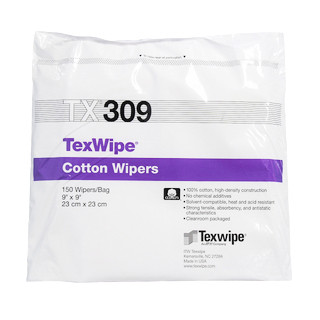
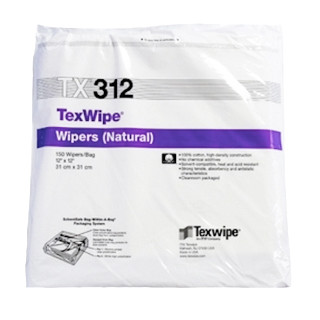
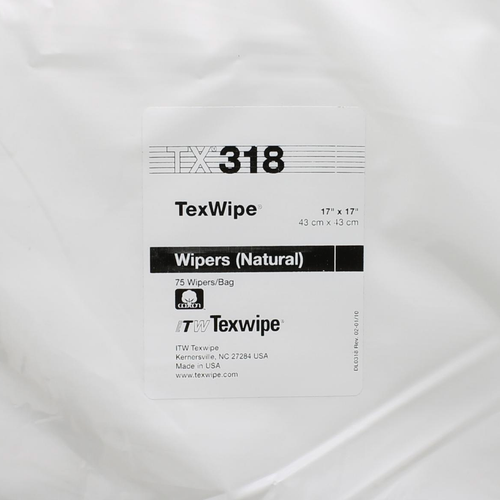
- ITW Texwipe datasheet: DS-309 “TexWipe® Wipers” (Effective December 2009) covering TX304/TX306/TX309/TX312/TX318 (construction, packaging, and typical performance/contamination characteristics; typical-value framing). https://www.soscleanroom.com/content/texwipe_pdf/304%20306%20309%20312%20318.pdf
- Method context referenced by the manufacturer: IEST-RP-CC004.3 (evaluation of wiping materials for cleanrooms/controlled environments) and ASTM E2090 (size-differentiated counting of particles and fibers released from cleanroom wipers).
Source: SOSCleanroom Technical Vault | Last reviewed: Jan. 2, 2026
© 2026 SOS Supply. All rights reserved.