The Technical Vault
By SOSCleanroom
TX3059 sterile microdenier sealed-edge wiper: scratch-safe particle capture for critical cleaning
Last reviewed: Jan. 4, 2026 | Audience: contamination control, cleanroom operations, EHS, quality
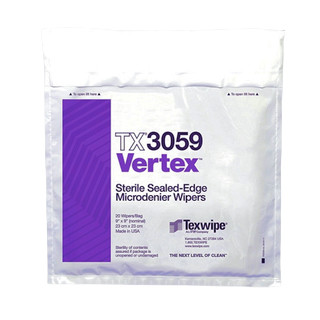
Texwipe TX3059 is a sterile, 9" x 9" microdenier polyester double-knit wiper built for environments where surface finish and contamination risk are both high. Microdenier yarn packs more filaments into the same footprint, increasing effective surface area and helping the fabric “hold onto” particulate rather than skating it across a surface—useful when wiping optics, polished metals, coated parts, and other scratch-sensitive substrates.
TX3059’s sealed-edge strategy and sterile packaging are the operational controls: the edge is engineered to reduce fray-driven shedding during high-contact wipes, while the sterile configuration supports validated workflows (USP-facing operations, aseptic support areas, and critical assemblies) where traceability and documentation matter as much as absorbency.
What it’s for
Final and intermediate cleaning where you need (1) low-linting wipe behavior, (2) high particle capture on smooth surfaces, and (3) sterile presentation for controlled introduction into the process. Typical uses include removing disinfectant residue, wiping product-contact or near-product surfaces, and precision cleaning of equipment faces, covers, tooling, and transport fixtures—especially on finishes prone to micro-scratching.
Decision drivers
Use these drivers to decide if TX3059 is the right “default” wiper for a step, or the escalation option when standard polyester knits are leaving haze, drag marks, or particle risk.
- Scratch sensitivity: Microdenier knit is selected when the surface finish is the constraint (optics, coated parts, polished stainless, sensitive plastics) and you want a soft hand with controlled wipe friction.
- Particle capture behavior: Microdenier’s higher filament count increases contact area, helping pull fine debris into the fiber bundle instead of pushing it.
- Edge control: Sealed edges are the mitigation for fray-driven particle generation at corners and during high-pressure wipes.
- Sterile workflow fit: Gamma-irradiated sterile presentation supports validated introduction into controlled spaces and helps standardize gowning-room and point-of-use handling.
- Residue control: When disinfectant residues are the problem (especially quats), pick a knit that can lift film and hold it without smearing.
- Documentation expectations: Choose when your process expects lot traceability and case-level documentation (CoC/processing/irradiation documentation availability).
Materials and construction
TX3059 is a 100% polyester double-knit microdenier fabric. “Microdenier” matters because it increases filament count (and therefore surface area) inside the yarn bundle. Practically, that means more contact points per wipe stroke and more “storage” volume inside the knit to retain captured particulate—helpful when you are chasing fine debris on smooth, hard finishes.
The sealed edge is a process control: it is designed to keep the knit stable at the perimeter so corners don’t unravel or shed during aggressive wiping, fold-and-wipe techniques, or when wiping around fasteners and tight radii.
Specifications in context
Size: 9" x 9" (23 cm x 23 cm) is the “control wipe” size for many SOPs because it folds cleanly into quarters, supports single-direction strokes, and stays manageable for glove dexterity.
Edge strategy: sealed edge to reduce perimeter shedding during pressure wipes and corner work.
Sterility: gamma irradiated; Sterility Assurance Level (SAL) 10−6 (typical sterile presentation expectation for critical consumables).
ISO environment fit: commonly qualified across ISO Class 3–8 programs; validate to your room classification, surface criticality, and residue/particle acceptance criteria.
Cleanliness and performance metrics
For cleanroom wiping, “good” is multi-axis: particles/fibers (what you shed), NVR (what you leave behind), and absorbency dynamics (how you move chemistry without flooding). Published values are typically typical analyses, not specifications—use them to set expectations and to choose validation tests.
Absorbency (typical): sorptive capacity ~350 mL/m²; sorptive rate ~0.3 seconds.
Particles/fibers (typical): LPC ≥0.5 µm ~15.0 x 10⁶ particles/m²; particles 0.5–5.0 µm ~4.8 x 10⁶ particles/m²; particles 5.0–100 µm ~130,000 particles/m²; fibers >100 µm ~520 fibers/m².
NVR (typical): IPA extractant ~0.07 g/m²; DI water extractant ~0.01 g/m².
Note on ions: ionic data is not published in the referenced TX3052/TX3059 microdenier table; if ions are critical, qualify with your method and request the applicable lot documentation/CoA.
Packaging, sterility, and traceability controls
TX3059 is configured to support controlled introduction: 100 wipers per bag (5 inner bags of 20), 5 bags per case (500 total). The microdenier sterile datasheet describes triple-bagging, and sterile processing is gamma irradiation aligned to ANSI/AAMI/ISO 11137 with case-level documentation availability (processing/compliance certificates are commonly referenced in Texwipe sterile programs).
Rule of thumb: Treat the outer bag as “warehouse clean,” the inner bag as your cleanroom transfer control, and only open the final inner pack at point-of-use inside the target area—then document the lot in your batch record or cleaning log.
Best-practice use
TX3059 performs best when your wiping method is as controlled as the consumable. If you want consistent residue removal and particle control, standardize stroke direction, fold logic, and wetness control.
- Fold discipline: Fold into quarters; use one face per defined area; refold to a clean face before you “run out” of capacity. This prevents re-depositing captured particulate.
- Single-direction strokes: Wipe in one direction with overlapping passes; avoid scrubbing circles unless the SOP explicitly calls for it (circles tend to rework debris across the same track).
- Residue removal sequencing: For disinfectant films (notably quats), use a controlled wet wipe (chemistry), then a follow-up wipe step appropriate to your SOP to remove residue before it dries into haze.
- Pressure control: Use enough pressure to maintain full-face contact, but do not “white-knuckle” tight radii—excess pressure increases edge loading and can raise shedding risk on any textile.
- Solvent compatibility check: If using IPA/EtOH/acetone or degreasers, confirm your surface compatibility and EHS ventilation requirements; keep wetness consistent to prevent streaking.
- Temperature awareness: Dry knit wipers are often used at elevated temperatures in industry; in sterile programs, keep within your site limits and avoid placing alcohol-wet wipes near ignition sources or hot surfaces.
Common failure modes
Streaking/haze: Usually a wetness and sequencing issue (too much chemistry, drying mid-stroke, or no residue-removal follow-up). Standardize wetness and define a second-pass residue step where needed.
Particle “chasing”: Often caused by reusing a loaded face or scrubbing in circles. Switch to one-direction strokes and refold to a clean face sooner.
Edge-driven shed in corners: Typically from over-pressure at edges and wiping around sharp hardware. Reduce edge loading, change wipe orientation, and use controlled corner techniques rather than “hooking” the wipe.
Sterile breach: Most common during transfer. Treat bag layers as controls, stage opening points, and document lot/expiry before entering the room.
Closest competitors
Contec Sterile Polynit Heatseal wipes (sealed-edge knit polyester): Mechanistically similar “sealed-edge knit” approach aimed at minimizing perimeter shed while maintaining solvent compatibility and low residue behavior; validate on scratch-sensitive surfaces if microdenier softness is your primary requirement.
Berkshire sealed-edge knit polyester wipes (category equivalents): Comparable knit-polyester sealed-edge families are commonly selected for critical wiping; if you are replacing microdenier, pay attention to surface scratch behavior and the residue-removal performance you need (microdenier can behave differently on films).
Where it fits in a cleanroom wiping program
TX3059 is a strong “precision step” wiper: use it where surface finish is at risk, where particle capture must be demonstrably consistent, or where sterile presentation is mandatory. Many programs position microdenier knits for final wipes on scratch-sensitive surfaces and for residue-sensitive steps after disinfectant application.
Supply planning note: The SOSCleanroom product page indicates “Discontinued by Texwipe,” while the Texwipe product page still lists TX3059. If you are qualification-bound, confirm current manufacturer status and consider a second-source or an approved alternate within your change-control process.
Terminology note: Engineered for low-linting performance; no wiper is truly “lint-free” in every process condition.
Source basis
- SOSCleanroom product page (TX3059): https://www.soscleanroom.com/product/wipers/texwipe-tx3059-sterile-vertex-9-x-9-microdenier-sealed-edge-cleanroom-wiper/
- SOS-hosted manufacturer datasheet (TX3052/TX3059 microdenier; Effective: May 2012): https://www.soscleanroom.com/content/texwipe_pdf/3052%203059.pdf
- Texwipe product page (TX3059): https://www.texwipe.com/vertex-microdenier-tx3059
- Texwipe Vertex Series Technical Data Sheet (US-TDS-022 REV. 03/23): https://www.texwipe.com/images/uploaded/documents/Wipers/Texwipe-VertexSeries-TDS.pdf
- Contec Sterile Polynit Heatseal Wipes PDS (competitor reference): https://www.contecinc.com
- Berkshire knitted wipes category overview (sealed-edge knit polyester families): https://berkshire.com/product-category/cleanroom-wipes/knitted-wipes/
- Test methods referenced in manufacturer documentation: IEST-RP-CC004; ASTM E2090 (see iest.org and astm.org for current editions)
Source: SOSCleanroom Technical Vault | Last reviewed: Jan. 4, 2026
© 2026 SOS Supply. All rights reserved.