The Technical Vault
By SOSCleanroom
Cotton With a Cleanroom Discipline: Why TX306 Is the Right Call When Heat, Solvents, and Edge Integrity Matter
Last reviewed: Jan. 2, 2026 | Audience: contamination control, cleanroom operations, EHS, quality
Texwipe TX306 TexWipe (6" × 6") is a dry, woven 100% cotton cleanroom wiper engineered for situations where cotton is not a “legacy material,” but a deliberate control—particularly when wiping intersects with high-temperature equipment, solvent exposure, and abrasive handling that can punish synthetic wipes or low-grade cotton shop wipes.
TX306 is built as a double-sided twill-pattern woven wiper (published as 118 × 60 threads per square inch) with long-staple cotton yarn and edge-integrity treatments intended to reduce loose ends and improve handling stability. It is commonly deployed in ISO 6–8 environments for maintenance and process-support wiping where the risk is less about “final optical pass” and more about preventing the wiper from becoming the contamination source when the work gets physical.
What it’s for
TX306 is positioned for cleaning diffusion furnace equipment, cleaning, polishing, and burnishing (including magnetic media disk surfaces), and removing aqueous and organic solvent spills. It is also used for general wiping tasks where cotton’s absorbency and wipe feel are advantageous, but the program still requires cleanroom packaging and a documented contamination-control posture.
Decision drivers
TX306 earns a place when the process needs cotton’s behavior, but with cleanroom controls:
- Substrate choice (cotton on purpose): 100% cotton with a twill weave can deliver strong absorbency and wipe feel for spill pickup and polishing-type tasks.
- Woven construction with published density: a tight weave (118 × 60 threads/in²) supports predictable handling and reduces the “fuzzy cloth” behavior seen with lower-control cotton.
- Edge integrity strategy: treatments applied to improve edge stability are specifically relevant for 6" × 6" wipes that get folded, pinched, and pushed into corners.
- High-temperature tolerance: a practical advantage for wiping around hot equipment zones where some synthetics can soften, smear, or leave a performance question mark.
- Solvent compatibility posture: designed to be used with organic solvents and aqueous cleaning solutions as a spill-response and wipe-down tool.
- Packaging discipline: solvent-safe Bag-Within-A-Bag configuration supports controlled introduction and reduces handling exposure.
Materials and construction – explained like an engineer
Cotton “cleanroom wiping” can fail for a simple reason: edges and surface fibers can become the product. TX306’s performance model is built around preventing that failure mode. A tight woven twill structure improves dimensional stability, while long-staple cotton yarn reduces the propensity for short fiber ends that can become loose during aggressive wiping. The 6" × 6" format further amplifies the importance of edge behavior because operators fold and pinch smaller wipes more often.
Practically, TX306 is not a universal finishing wipe. It is an engineered cotton wipe intended for process-support wiping where absorbency, solvent/spill handling, and stability under real wiping force are the controlling requirements.
Specifications in context
TX306 is a 6" × 6" dry cotton wiper with a cut edge, positioned for ISO 6–8 controlled environments. It is supplied as 600 wipers per bag (two inner bags of 300) and 6 bags per case, which supports kitting and staged introduction without turning the wipe station into an open-stack exposure point.
The small format is not just convenience—it supports control. A 6" × 6" wipe is easier to manage in tight work envelopes (fixtures, furnace zones, tool interfaces) and helps reduce accidental contact with adjacent surfaces when operators are working close to critical areas.
Cleanliness and performance metrics
In cotton wiping, the qualification discussion should focus on three practical risks: releasables (particles/fibers), residues (NVR), and ions. TX306 has published typical values that can be used as a starting point for process placement and method suitability.
- Absorbency (sorptive capacity / rate): typical sorptive capacity 270 mL/m²; typical sorptive rate < 0.3 seconds.
- Particles and fibers (what the wipe can add): typical particles (>0.5 µm) 67 × 106 particles/m²; typical fibers (>100 µm) 8,000 fibers/m².
- NVR (film risk after dry-down): typical NVR 0.02 g/m² (IPA) and 0.06 g/m² (DI water).
- Ions (corrosion/ECM sensitivity): typical ions include Na 2.5 ppm, K 0.5 ppm, and Cl 0.8 ppm.
- Electrical behavior: the family is described with a typical dissipative resistance value of 2.4 × 10¹⁰ ohms (40–60% RH context stated in documentation).
When cotton is the control—and when it is not
TX306 is a strong choice when the job is absorbency- and durability-driven: spill pickup, solvent wiping, and wiping around heat or process-support hardware. It is also often selected when operators need a wipe that “grips” films and soils in a way some knits do not, especially during polishing or burnishing-type motions.
When the program shifts to the most defect-sensitive surfaces (final-pass optics, ultra-trace residue control, or edge-driven fiber limits), cotton may not be the most defensible default. In those cases, the typical technical step-up is a polyester knit with tighter releasables control and, where needed, a sealed edge strategy.
Terminology note: TX306 is engineered for low-linting performance in its intended use conditions; no wiper is truly “lint-free” in every process condition.
Best-practice use
TX306 performs best when technique prevents the “loaded wipe” failure mode—especially in spill response and solvent wiping:
- Fold for faces: fold into quarters; treat each face as single-pass in critical wipe-downs.
- Wipe directionally: use straight-line, overlapping strokes; avoid “scrub back and forth” unless the SOP explicitly requires it.
- Control wetness: for solvent wiping, aim for damp-wet control (not dripping). Over-wetting increases pooling and residue migration.
- Spill logic: blot/pickup first, then finish with fresh faces to reduce redeposit.
- Change early: once near saturation or visibly loaded, the wipe becomes a redistribution tool.
Common failure modes — and how TX306 helps
Cotton wipe failures are typically procedural and edge-related: overworking a loaded face, aggressive scrubbing on sharp features, and wiping in ways that “fluff” the surface. TX306’s woven twill structure and edge-integrity posture are intended to reduce the likelihood of loose ends and wipe breakup during demanding tasks. The remaining control is technique: folding discipline, directional strokes, and defined discard triggers.
Closest comparators
The most defensible comparisons are to other cleanroom-positioned cotton twill or cotton wipe programs intended for ISO-class support cleaning and spill handling.
Buyers typically compare against cotton cleanroom wipe offerings from major contamination-control suppliers (including cotton wipe lines positioned for solvent wiping, polishing/burnishing, and equipment-support cleaning). The decision should be driven by edge strategy, packaging controls, and whether published releasables/residue/ion data aligns with your acceptance limits.
Rule of thumb: Choose cotton when absorbency + wipe feel + heat tolerance are the practical constraints. Choose polyester knit (and consider sealed-edge) when releasables, edge control, or residue budget becomes the dominant risk.
Where TX306 fits in a cleanroom wiping program
TX306 fits best as an ISO 6–8 process-support cotton wipe for spill pickup, solvent wiping, polishing/burnishing motions, and cleaning around high-temperature or maintenance-intensive equipment. It is most valuable when teams want cotton’s absorbency and handling characteristics without giving up cleanroom packaging discipline and a documented contamination-control framework. When the process shifts to higher defect sensitivity, the technical step-up is typically a polyester knit and—where needed—sealed-edge control.
Source basis
- SOSCleanroom product page: “Texwipe TX306 TexWipe 6" × 6" Cotton Cleanroom Wiper” (ISO class listing; packaging configuration; weave/thread count; features and positioning). https://www.soscleanroom.com/product/wipers/texwipe-tx306-texwipe-6-x-6-cotton-cleanroom-wiper/
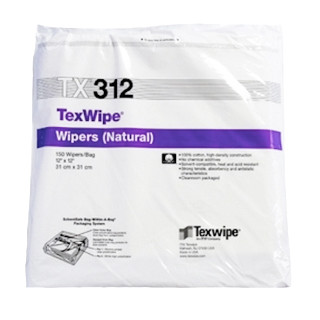
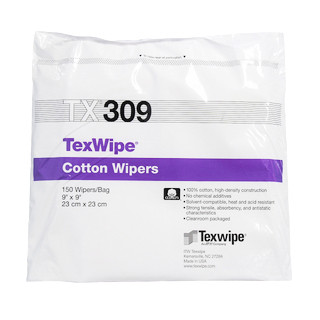
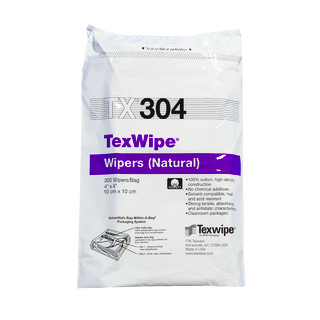
- ITW Texwipe documentation: “TexWipe Cotton Wipers — TX304, TX306, TX312” (construction and edge-integrity treatments; typical sorption, particles/fibers, NVR, ions; use-case positioning including furnace equipment and spill removal). (Accessed via the TX306 product page “Texwipe Technical Datasheet” link.)
Source: SOSCleanroom | Last reviewed: Jan. 2, 2026
© 2026 SOS Supply. All rights reserved.