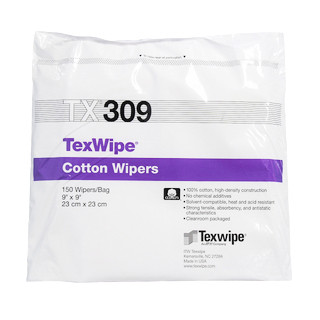
Texwipe TX309 TexWipe 9" x 9" Cotton Cleanroom Wiper

$121.13
(No reviews yet)
SKU:
TX309 BAG
Availability:
30-45 Days
Shipping:
Calculated at Checkout
Quantity Option (Bag):
300 Wipers Per Bag (2 Inner Bags of 150 wipers)
Quantity Option (Case):
6 Bags of 300 Wipers Per Case
Type:
Dry Wiper
Wiper Family:
TexWipe
Wiper Material:
Cotton
Wiper Size:
9" x 9"
Wiper Edge:
Cut Edge
ISO Class:
ISO 6 (Class 1,000)
ISO Class:
ISO 7 (Class 10,000)
ISO Class:
ISO 8 (Class 100,000)

TX309 TexWipe 9" x 9" Cotton Cleanroom Wiper

TX309 TexWipe is a low-linting (no wiper is truly ‘zero-lint’ in every process condition), high-absorbency cotton cleanroom wiper selected for wipe-downs where heat tolerance, durability, and controlled absorbency matter. It is a strong, double-sided twill-pattern cotton wiper with a tight-weave, bias-cut construction (118 x 60 threads per square inch) made with long-staple cotton yarn to help reduce free-floating fibers on the fabric surface.

Best-seller note: TX309 is commonly chosen for critical wipe-downs and spill control where teams want cotton’s absorbency and heat resistance—including high-temperature equipment cleaning steps where synthetic wipers may not be preferred.

Specifications:
  • Size: 9" x 9" (23 cm x 23 cm) nominal
  • Material: 100% cotton (long-staple cotton yarn)
  • Construction: Double-sided twill pattern; bias cut; tight weave (118 x 60 threads per square inch)
  • Edge: Cut edge (ULP-treated edges for contamination control)
  • Packaging: 300 wipers/bag (2 inner bags of 150); 6 bags/case
  • Use environments: ISO 6 (Class 1,000), ISO 7 (Class 10,000), ISO 8 (Class 100,000) controlled areas (final suitability depends on your process and cleaning method)
About the Manufacturer: 

Texwipe (an ITW company) differentiates itself in cleanroom wiping by treating the wiper as an engineered product, not a commodity consumable. In the TexWipe cotton line, performance comes from controlled fabric construction (tight weave and bias cut), ULP treatment at the edges to support contamination control, and cleanroom packaging designed to protect wipers through storage and staging before use.


Texwipe also supports program consistency through documentation discipline and repeatable packaging formats. SOSCleanroom (SOS) supports that manufacturing discipline with a close working relationship with Texwipe focused on continuity of supply, clean documentation handoff (certs, lot traceability), and practical application support—so customers can standardize wiping materials with predictable performance while maintaining procurement reliability and audit readiness.

TX309 Features:
  • 100% cotton
  • Bias cut and tight weave construction (118 x 60 threads per square inch)
  • Solvent-safe Bag-Within-A-Bag® cleanroom packaging
  • Autoclave safe
  • High temperature tolerance
TX309 Benefits:
  • Durability and absorbency: Provides durability, high absorbency, and heat resistance for demanding wipe-downs and spill pickup
  • Contamination control support: Minimizes cleanroom contamination with a low-lint surface and edges protected by ULP treatment (process-dependent)
  • Dissipative performance: Dissipation performance in 40–60% RH environments helps guard against static discharge
  • ESD buildup resistance: Excellent resistance to buildup of electrostatic discharge
Common Applications:
  • Cleaning, polishing, and burnishing of metallic and nonmetallic magnetic media disk surfaces
  • Cleaning diffusion furnace equipment in water fabrication and other equipment in areas where high temperatures prevent the use of synthetic wipers
  • Removing aqueous and organic solvent spills (verify compatibility to your chemistry and SOP)
Best-Practice Use:
  • Fold for control: Fold into quarters to create multiple clean faces; rotate faces instead of re-wiping with a loaded surface.
  • Wipe pattern: Use straight-line strokes (top-to-bottom or left-to-right) to reduce re-deposition of contamination.
  • Heat-related work: Allow hot surfaces to stabilize per your EHS/SOP before wiping; use cotton wipers where heat tolerance is a key requirement and synthetics are not preferred.
  • Wet vs. dry: For solvent wipe-downs, dampen—do not over-saturate—so you maintain control and reduce dripping.
  • Change-out triggers: Replace the wiper when the face becomes visibly soiled, tacky, or begins leaving streaks/residue.
  • Autoclave use: If autoclaving is part of your process, qualify the cycle and handling method to avoid recontamination during cooldown and staging.
Selection Notes (TX309 vs. Other Options)
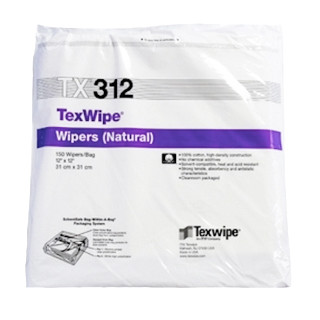
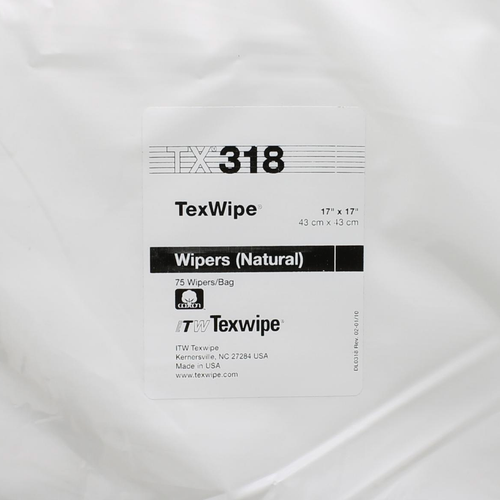
  • TX309 vs. smaller/larger TexWipe cotton sizes: Choose TX304 (4" x 4") and TX306 (6" x 6") for tight work areas; choose TX312 (12" x 12") or TX318 (17" x 17") when coverage per wipe matters.
  • TX309 vs. polyester knit wipes (e.g., AlphaWipe): Polyester knit wipes are commonly chosen for very low particle contribution and chemical compatibility; TX309 is often preferred when cotton’s absorbency and high-temperature tolerance are the driver.
  • ESD-sensitive workflows: If you are wiping near static-sensitive components, confirm your ESD control plan and grounding approach—and verify the wiper choice within your site’s ESD program requirements.

Link to Texwipe Technical Datasheet:
Click Here

Other Similar Products Available From SOSCleanroom.com

TexWipe Cotton Dry Wipers

  • TX304: 4" x 4" nominal (10 cm x 10 cm), 1200 wipers/bag
  • TX306: 6" x 6" nominal (15 cm x 15 cm), 600 wipers/bag
  • TX309: 9" x 9" nominal (23 cm x 23 cm), 300 wipers/bag
  • TX312: 12" x 12" nominal (31 cm x 31 cm), 150 wipers/bag
  • TX318: 17" x 17" nominal (43 cm x 43 cm), 75 wipers/bag

Notes: Looking for application guidance or qualification context for Texwipe TX309 TexWipe 9" x 9" cotton cleanroom wipers? Open the SOSCleanroom Technical Vault tab above for practical wipe execution tips, selection notes (TX309 vs. alternatives), and the documentation details teams typically review when standardizing cotton wiping materials across ISO-class controlled environments.

SOSCleanroom.com supports contamination-control programs with cleanroom consumables in stock, fair pricing, and responsive technical support—backed by same-day shipping options and customer service that understands real cleanroom workflows.

Product page updated: Jan. 1, 2026 (SOS Technical Staff)

© 2026 SOS Supply. All rights reserved.

The Technical Vault
By SOSCleanroom
Cotton as an Engineering Choice: Why TX309 Remains the “High-Temperature + ESD-Control” Wiper for Specific Cleanroom Work
Last reviewed: Jan. 1, 2026 |  Audience: contamination control, cleanroom operations, EHS, quality, wafer fab maintenance

Most cleanroom wiper decisions default to synthetics (polyester, polypropylene) for low-linting behavior and chemical compatibility. But there are “non-default” situations where cotton is selected on purpose: elevated temperature wipe points, diffusion furnace maintenance cleaning, magnetic media disk handling steps, and ESD-sensitive wipe-down tasks where static discharge control is part of the risk model. Texwipe TX309 is built for that niche: a 100% cotton twill wiper with a tight weave and a defined antistatic performance posture, packaged for controlled introduction.

Reliability is part of the control plan. SOSCleanroom supports program stability for Texwipe wipes through consistent sourcing, documentation continuity, and practical application support so teams avoid unqualified substitutions when schedules tighten and maintenance work accelerates.

What it’s for

TX309 is positioned for cleaning and polishing/burnishing magnetic media disks, cleaning diffusion furnace equipment in wafer fabrication and other elevated-temperature areas, and removing aqueous and organic solvent spills. It is also used as a utility wipe when teams want a cotton surface and a defined ESD-control posture rather than a generic shop rag or binder-heavy nonwoven.

Decision drivers

TX309 typically earns selection when the wiping risk is dominated by temperature exposure, static discharge control, and robust spill pickup rather than the absolute lowest synthetic wiper background.

  • Substrate: 100% cotton twill, bias cut, tight weave (listed as 118 × 60 threads/in²) designed to hold together under real wiping forces.
  • High-temperature posture: described as having strong heat tolerance; commonly used in diffusion furnace equipment cleaning contexts.
  • ESD-control posture: described as providing dissipative performance in 40–60% RH and resistance to ESD charge buildup, intended to help guard against static discharge during wiping.
  • Contamination control feature: a low-linting surface with edges protected by an ULP (Ultra Low Particulate) treatment, intended to reduce particle contribution from edges in use.
  • Packaging discipline: solvent-safe bag-within-bag presentation supports controlled introduction and staged use.
Materials and construction – explained like an engineer

Cotton behaves differently than synthetic continuous-filament knits. A tight twill weave can be mechanically stable, highly absorbent, and tolerant of higher temperature exposure, which is why cotton remains a deliberate choice for certain maintenance and equipment-cleaning steps. TX309 is described as bias cut—a practical construction choice that can help reduce fraying behavior compared with straight cuts under repeated folding and directional wipe force.

Keep terminology honest: no wiper is truly lint-free in every process condition. The control target is low-linting performance in your use condition—pressure, stroke direction, surface texture, and reusing a loaded face drive most fiber/particle events.

Specifications in context

TX309 is supplied as a 9" × 9" cotton twill wiper with cut edges. Packaging is listed as 300 wipers per bag with 2 inner bags of 150, and 10 bags per case. This configuration supports staged issuance (open one inner pack, keep the remainder protected), which is especially important for cotton wipes to reduce handling-driven contamination and uncontrolled exposure time.

Rule of thumb: Use cotton when temperature exposure, absorbency, and wipe robustness are the controlling constraints. Use polyester knit/other synthetics when the process is limited by releasables and residue budgets on defect-sensitive surfaces.

Cleanliness and performance metrics

For disciplined placement, TX309’s published typical values provide a starting point across releasables (particles/fibers), residues (NVR), and ionic extractables. Treat typical data as a qualification input—not a substitute for process-window confirmation when yield or audit defense depends on the wipe step.

  • Basis weight: 130 g/m² (typical).
  • Sorptive capacity: 800 mL/m² (typical) — aligns to “spill pickup” and liquid-hold requirements.
  • LPC (≥0.5 µm): 150 × 106 particles/m² (typical).
  • Fibers (≥100 µm): 150,000 fibers/m² (typical).
  • NVR: 0.04 g/m² (IPA) and 0.04 g/m² (DI water) (typical).
  • Ionic extractables (typical, ppm): Na 3, K 1, Cl 1.

Practical translation: TX309 is engineered as a robust cotton wipe with controlled packaging and defined ESD posture, but it will not behave like a sealed-edge polyester knit in edge-driven releasables risk. Technique (directional strokes, face rotation, early discard) is the decisive control lever.

ESD posture and EHS considerations

TX309 is positioned with a dissipative performance posture at 40–60% RH intended to reduce static discharge risk during wiping. In ESD-sensitive programs, treat humidity range, grounding strategy, and wipe technique as a system: a “dissipative wipe” is not a substitute for facility ESD controls.

For solvent spill pickup, confirm chemical compatibility against your solvent set and exposure time. For elevated-temperature use, keep handling discipline tight—avoid introducing cotton wipes into steps where loose fibers could be pulled into sensitive interfaces, airflow paths, or precision metrology surfaces.

Best-practice use
  • Stage the packaging: open only the inner bag needed for the task; reseal and store remaining wipes in controlled storage.
  • Fold for control: quarter-fold to create multiple clean faces; treat each face as single-pass for higher-sensitivity wipe-downs.
  • Directional strokes: wipe clean-to-dirty with overlapping, single-direction passes to avoid redeposition.
  • Swap early: once the wipe face is loaded or near saturation, it becomes a redistribution tool—take a fresh wipe instead of “working it harder.”
  • ESD discipline: keep humidity/grounding within your program window; do not treat wipe dissipativity as a standalone control.
Common failure modes — and how to prevent them
  • Using cotton as a default final-pass wipe: can elevate releasables risk on defect-sensitive surfaces. Prevent by defining wipe roles (maintenance/high-temp vs. finishing) in the SOP.
  • Overworking a saturated wipe: turns absorbency into redeposit. Prevent with face-rotation discipline and early discard triggers.
  • Dry wiping textured surfaces under high pressure: increases friction-driven fibers. Prevent by controlling pressure and wetness (when allowed) and using fresh faces.
  • Ignoring packaging discipline: open bags on benches invite handling-driven contamination and uncontrolled exposure. Prevent with staged inner-bag use.
Closest comparators

The most defensible comparisons are to other cleanroom-grade cotton twill wipes intended for similar “high-absorbency + robust handling” use cases, and to synthetic knit wipes when the constraint shifts to lower releasables on sensitive surfaces.

Valutek cotton twill-patterned cleanroom wipers (9" × 9" class) are a close category peer for cotton wipe programs. Compare packaging discipline, edge strategy, and published contamination context to match your process risk window.

Polyester knit cleanroom wipes (dry) are the typical step sideways when the program becomes limited by edge-driven releasables and residue budgets on highly defect-sensitive surfaces. Use cotton where temperature/absorbency/robustness dominate; use polyester knits where the “what the wipe can add” model is the limiting factor.

Where TX309 fits in a controlled wiping program

TX309 is a deliberate tool for high-temperature maintenance cleaning, robust spill pickup, and ESD-aware wiping where cotton twill behavior is an advantage and packaging discipline keeps handling risk in check. Mature programs treat it as a defined role wiper—not a universal default—paired with synthetic wipes for steps where releasables and residue budgets become the controlling acceptance driver.

Terminology note: TX309 is engineered for low-linting performance; no wiper is truly “lint-free” in every process condition.

Source basis
  • SOSCleanroom product page: “Texwipe TX309 TexWipe 9" × 9" Cotton Cleanroom Wiper” (positioning, feature/benefit statements, application framing). https://www.soscleanroom.com/product/wipers/texwipe-tx309-texwipe-9-x-9-cotton-cleanroom-wiper/
  • ITW Texwipe datasheet: “TexWipe® Wipers — TX309 / TX3099” (materials, weave/thread count, ULP treatment statement, ESD/dissipative posture framing, packaging configuration, typical performance metrics). https://www.soscleanroom.com/wp-content/uploads/2024/01/Texwipe_TexWipe_Wipers_TDS.pdf
  • Comparator context: Valutek cotton wiper collection/product listing (category peer reference for cotton cleanroom wipers). https://shop.valutek.com/collections/cotton-wiper
Source: SOSCleanroom |  Last reviewed: Jan. 1, 2026
© 2026 SOS Supply. All rights reserved.

Other Wipers We Recommend