The Technical Vault
By SOSCleanroom
Heat-Zone Wiping Without Synthetic Failure: Why TX312 Cotton TexWipe Still Earns a Place in Controlled Environments
Last reviewed: Jan. 2, 2026 | Audience: contamination control, cleanroom operations, EHS, quality
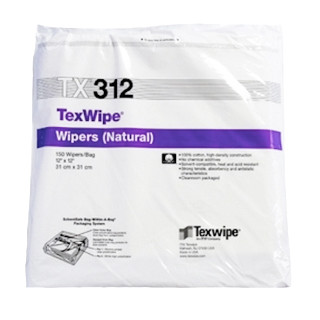
Texwipe TX312 TexWipe (12" × 12") is a dry, woven 100% cotton twill wiper built for the situations where many synthetics underperform: hot tooling, heat-zone fixtures, aggressive wipe-downs, and “get it clean now” maintenance events where you want absorbency, thermal stability, and a fabric that stays together instead of glazing, smearing, or snagging.
TX312 is not a default replacement for polyester knits. It is a deliberate control for specific mechanisms: high-temperature exposure, fast aqueous pickup, and rugged wipe-downs where a tight woven cotton behaves more predictably than a lightweight synthetic or a low-grade cloth. Texwipe positions TX312 for elevated-temperature use (listed up to 700°F / 371°C) and for environments where the wiper must remain durable under real operator force.
What it’s for
TX312 is best used for general wiping, spill control, and tool/fixture wipe-downs when absorbency and durability are the primary drivers, including high-temperature work zones and maintenance workflows that punish lighter wipes. Texwipe describes the construction as a tight woven twill with a bias-cut edge strategy intended to reduce unraveling, and it is positioned for use in controlled environments where a cotton wipe is appropriate to the contamination budget and the process step. :contentReference[oaicite:1]{index=1}
Decision drivers
TX312 earns its place based on a short list of engineering controls:
- Substrate and weave: 100% cotton, 2 × 1 twill construction for strength and high sorption in wipe-down work. :contentReference[oaicite:2]{index=2}
- Thread density: manufacturer data calls out a tight weave (listed as 118 × 60 threads/in²) to support durability and more controlled shedding versus looser cloths. :contentReference[oaicite:3]{index=3}
- Edge strategy: bias cut (and described ULP/bias-edge approach) intended to reduce unraveling risk in use. :contentReference[oaicite:4]{index=4}
- Thermal stability posture: positioned for high-temperature applications (TX312 listing includes up to 700°F / 371°C guidance).
- ESD/dissipative behavior note: supplier listing describes a dissipation pathway at 40–60% RH; treat this as a process note and validate to your site’s ESD control plan (garments, grounding, ionization, and verification method). :contentReference[oaicite:6]{index=6}
- Packaging discipline: solvent-safe, cleanroom packaging and double-bag presentation support controlled introduction and staging. :contentReference[oaicite:7]{index=7}
- Program stability: sourcing through SOSCleanroom supports repeat ordering, documentation continuity, and fewer last-minute substitutions when maintenance schedules compress. :contentReference[oaicite:8]{index=8}
Materials and construction – explained like an engineer
“Cotton wiper” can mean anything from loosely woven cloth (high lint risk) to a tight twill that behaves predictably under load. TX312 is a tight twill weave with a published thread count and a bias-cut edge strategy. That matters because most cotton failures in controlled work are mechanical: fraying at the edge, unraveling after repeated folding, and fiber release when a wipe is dragged across fasteners, burrs, or sharp geometry.
The practical takeaway is simple: TX312 is engineered to stay intact longer than commodity cloths during rough wipe-downs, while maintaining the absorbency that makes cotton useful for fast pickup. For facilities that fight “wipe shreds” during maintenance, the weave/edge design is the control lever, not the label. :contentReference[oaicite:9]{index=9}
Terminology note: TX312 is engineered for low-linting performance for its category; no wiper is truly “lint-free” in every process condition.
Cleanliness and performance metrics
Cotton is typically selected for absorbency and thermal behavior, then managed for contamination risk through technique and placement. Texwipe publishes typical values for TX312 across the categories that drive qualification discussions: releasables (particles/fibers), residues (NVR), and ions.
- Absorbency framework: typical sorptive capacity is listed at 250 mL/m² with a typical sorptive rate of 5 seconds (useful context for spill pickup and solution application/removal planning). :contentReference[oaicite:10]{index=10}
- Releasables: typical particle and fiber data is provided for the product family; treat these as qualification starting points rather than contractual limits, and validate in your wipe method window (dry vs. damp, pressure, surface texture). :contentReference[oaicite:11]{index=11}
- NVR: typical NVR is listed for IPA and DI water extractants (use this to align the wipe role with your residue budget; do not “wipe harder” to fix haze). :contentReference[oaicite:12]{index=12}
- Ions: typical extractable ion values are published (critical if the wipe touches corrosion-sensitive assemblies, plating, or high-impedance electronics). :contentReference[oaicite:13]{index=13}
Why cotton matters in high-temperature and maintenance workflows
In heat-adjacent work, the failure mode is often not “cleanliness” first—it is substrate behavior: softening, streaking, or loss of structural integrity that turns the wipe into residue or fragments. TX312 is positioned for high-temperature applications and rugged wipe-downs, so it is commonly chosen for hot tooling wipe-offs, fixture cleaning, and maintenance steps where cotton’s absorbency and thermal stability are the functional drivers. :contentReference[oaicite:14]{index=14}
Rule of thumb: When temperature and fast aqueous pickup are the constraints, tight woven cotton is often the right tool. When lowest background releasables are the acceptance driver, polyester knit (and, when needed, sealed-edge knits) is typically the safer control step.
Best-practice use
TX312 performs best when technique prevents the common cotton failure modes (edge stress, overuse of a loaded face, and aggressive dry wiping on abrasive textures).
- Fold for control: quarter-fold to create multiple clean faces; treat each face as single-pass in sensitive zones.
- Directional strokes: wipe in straight, overlapping passes; avoid back-and-forth scrubbing unless the SOP requires it.
- Wetness control: aim for damp (not flooding) when using solvents or aqueous solutions; over-wetting increases redeposit and dry-down residue risk.
- Heat-zone discipline: confirm surface temperature and EHS controls before wiping hot equipment; cotton can char/ignite under certain conditions, so follow site-specific hot-work and ignition-source controls.
- Discard early: once the wipe loads up, cotton’s absorbency can become a redistribution mechanism—swap to a fresh face or a fresh wipe.
Common failure modes — and how TX312 helps
Cotton wipes become a contamination source in predictable ways: edge fray under repeated folding, fiber release from aggressive dry wiping on rough surfaces, and redeposit after overuse. TX312’s tight twill and bias-edge strategy are intended to reduce unraveling risk and extend usable “face life” during rough wipe-downs. The remaining controls are procedural: face rotation, directional strokes, and disciplined discard rules. :contentReference[oaicite:15]{index=15}
Closest comparators
The most defensible comparisons are to other tight-woven cotton twill wipes intended for high-temperature or rugged wipe-down tasks:
Contec Twill Jean Wipe (TJ-1212) is positioned as a 100% cotton 2 × 1 twill wipe with bias-cut edges for high-temperature applications and tool/surface cleaning. It is a close functional peer when teams are selecting “cotton twill for heat-zone wiping.” :contentReference[oaicite:16]{index=16}
Berkshire TWILLX 1622 is commonly referenced as a cotton twill wipe option in similar maintenance and wipe-down workflows. When comparing, focus on weave/edge behavior in your use condition, packaging discipline, and the contamination documentation you can support in your quality system. :contentReference[oaicite:17]{index=17}
Where TX312 fits in a controlled wiping program
TX312 is best treated as a special-purpose control for high-absorbency, rugged wipe-downs and heat-zone workflows where cotton’s performance advantage is real. Use it where the mechanism demands it, then keep your program mature by separating roles: cotton twill for hot/rough maintenance wiping, polyester knit for daily low-linting routine cleaning, and sealed-edge knits (or validated pre-wetted systems) when edge control or wetness repeatability becomes the dominant constraint.
Packaging note: published case configuration can vary by listing/document revision. The TX312 product listing shows 150 wipes/bag and a case count used for SOSCleanroom fulfillment, while the Texwipe TX300-series data sheet lists TX312 as 150/bag with a different case quantity. For kitting and audit control, treat the label on the case you receive as governing. :contentReference[oaicite:18]{index=18}
Country-of-origin note: the SOSCleanroom listing states TX312 is made in the USA; if origin is a controlled attribute in your quality system, confirm it using documentation tied to the lots received. :contentReference[oaicite:19]{index=19}
Source basis
- SOSCleanroom product page: “Texwipe TX312 TexWipe 12" × 12" Cotton Cleanroom Wiper” (positioning, thread count statement, temperature note, packaging, country-of-origin statement). :contentReference[oaicite:20]{index=20}
- ITW Texwipe technical data sheet: “TexWipe™ Dry Wipers” (DS-309; covers TX300-series including TX312; construction and typical performance/contamination characteristics). :contentReference[oaicite:21]{index=21}
- Comparator context: Contec Twill Jean Wipe TJ-1212 listings describing 100% cotton 2 × 1 twill construction, bias-cut edges, and high-temperature positioning. :contentReference[oaicite:22]{index=22}
- Comparator context: Berkshire TWILLX 1622 product listing context for cotton twill wipe category. :contentReference[oaicite:23]{index=23}
Source: SOSCleanroom Technical Vault
Last reviewed: Jan. 2, 2026
© 2026 SOS Supply. All rights reserved.