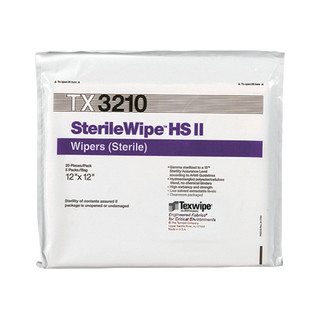
Texwipe TX3210 SterileWipe HSII 12" x 12" Cellulose and Polyester Cleanroom Wiper

$286.29
(No reviews yet)
SKU:
TX3210
Availability:
14-21 Business Days
Shipping:
Calculated at Checkout
International Shipping:
Available for this product
Quantity Option (Case Only):
5 Bags of 100 Wipers Per Case
Type:
Dry Wiper
Wiper Family:
TechniCloth SterileWipe HS II
Wiper Material:
Cellulose/Polyester
Wiper Size:
12" x 12"
Wiper Edge:
Cut Edge
Sterile:
Yes
ISO Class:
ISO 5 (Class 100) - ISO 8 (Class 100,000)
Country of Origin:
Made in the USA

TX3210 SterileWipe HS II 12" x 12" Cellulose and Polyester Cleanroom Wiper (Sterile)

TX3210 SterileWipe HS II is a low-linting (no wiper is truly ‘zero-lint’ in every process condition), sterile, highly absorbent nonwoven wiper made from a 55% cellulose / 45% polyester blend to balance absorbency with wet and dry strength. Each package is gamma irradiated to a 10-6 sterility assurance level (SAL) for use in sterile environments where economy and cleanliness are both critical.

Sterile program note: TX3210 is commonly selected when teams need sterile presentation plus strong spill-control performance, with packaging designed to support alcohol wipe-down of the outer bag prior to controlled transfer of the inner bag into the suite.

Specifications:
  • Size: 12" x 12" (31 cm x 31 cm) nominal
  • Material: Cellulose/Polyester (55% cellulose / 45% polyester)
  • Construction: Nonwoven, hydroentangled, binder-free
  • Edge: Cut edge
  • Sterility: Gamma irradiated to 10-6 SAL (sterility assurance level); expiration date marked on each package
  • Packaging: 5 bags/case; each bag contains 100 wipers (5 inner bags of 20)
  • Use environments: ISO 5 (Class 100) – ISO 8 (Class 100,000) controlled environments where sterile presentation is required (final suitability depends on your process and cleaning method)
About the Manufacturer: 

Texwipe (an ITW company) differentiates itself in sterile wiping by combining controlled materials (hydroentangled, binder-free substrates) with sterility assurance, lot-specific documentation, and packaging designed for controlled entry into aseptic areas. For TX3210, the goal is practical sterile cleaning: absorbent spill control and wipe-down strength, paired with predictable documentation and lot-to-lot traceability that aligns to sterile suite discipline.


SOSCleanroom (SOS) supports that manufacturing discipline with a close working relationship with Texwipe focused on continuity of supply, clean documentation handoff (certs, lot traceability), and practical application support—so customers can standardize sterile wiping materials with predictable performance while maintaining procurement reliability and audit readiness.

TX3210 Features:
  • Gamma irradiated to 10-6 sterility assurance level (SAL), according to AAMI guidelines
  • Lot-specific information on each shipment simplifies recordkeeping (Certificate of Processing, Certification of Compliance)
  • Expiration date marked on each package
  • Hydroentangled and binder-free wiper
  • High absorbency and strength
  • Low solvent extractable levels
  • Independent quality control audits for sterility assurance
TX3210 Benefits:
  • Endotoxin positioning: Meets FDA guideline for medical device bacterial endotoxin limit of not more than 20 EU/device (verify your facility acceptance criteria)
  • Chemical resistance: Designed to withstand exposure to common cleaning and disinfecting solutions (e.g., bleaches, phenols, quaternary ammonium compounds)
  • Microbiological control: Supports aseptic workflows where sterile presentation is required
  • Controlled entry packaging: Packaging permits alcohol wipe-down of exterior bag before introduction of the inner bag into sterile suites
  • Traceability: Assures quality of individual lots and lot-to-lot traceability
  • Economical sterile option: A general-purpose sterile wipe designed for high-absorbency tasks
Common Applications:
  • Superior for spill control in sterile environments
  • Cleaning and polishing equipment and environmental surfaces during and following production flow
  • Wipe-downs in sterile gowning rooms
  • General-purpose sterile wipe-downs where absorbency and cleanliness are both critical
Best-Practice Use:
  • Transfer discipline: Wipe down the exterior bag with sterile IPA per your SOP before bringing the inner bag into the sterile suite.
  • Fold for control: Fold into quarters to create multiple clean faces; rotate faces instead of re-wiping with a loaded surface.
  • Wipe pattern: Use straight-line strokes (top-to-bottom or left-to-right) to reduce re-deposition during sterile wipe-downs.
  • Spill response: Press and lift to load liquid; avoid aggressive scrubbing on first pass—then finish with a fresh face.
  • Change-out triggers: Replace the wiper when the face becomes visibly soiled, tacky, or begins to streak (especially under sterile lighting/inspection).
Selection Notes (TX3210 vs. Other Options)
  • TX3210 vs. sterile polyester options: Choose TX3210 when absorbency (cellulose blend) is the priority; choose sterile 100% polyester wipes when the lowest potential extractables profile and solvent robustness are primary drivers.
  • TX3210 vs. sterile pre-wetted: If consistent wetting and reduced solvent handling are priorities, consider sterile pre-wetted formats (70% IPA options are common) aligned to your disinfection program.
  • Size and coverage: 12" x 12" is often selected to reduce wipe count for larger surfaces; smaller wipes are preferred for tight work areas and localized cleaning.

Link to Texwipe Technical Datasheet:
Click Here

Other Similar Products Available From SOSCleanroom.com

Sterile Dry Wipers

  • TX3211: 9" x 9" sterile polyester wiper
  • TX3212: 12" x 12" sterile polyester wiper
  • TX3215: 12" x 12" sterile polyester wiper
  • TX3220: 12" x 12" sterile polyester wiper

Sterile Pre-Wetted Wipers

  • TX3213: 9" x 11" sterile pre-wetted 70% IPA (polypropylene)
  • TX3214: 9" x 11" sterile pre-wetted 70% IPA (polyester/cellulose)

Notes: Looking for application guidance or qualification context for Texwipe TX3210 SterileWipe HS II 12" x 12" sterile cellulose/polyester cleanroom wipers? Open the SOSCleanroom Technical Vault tab above for practical wiping technique, selection notes (TX3210 vs. alternatives), and the documentation details teams typically review when standardizing sterile wipes across ISO-class controlled environments.

SOSCleanroom.com supports contamination-control programs with cleanroom consumables in stock, fair pricing, and responsive technical support—backed by same-day shipping options and customer service that understands real cleanroom workflows.

Product page updated: Jan. 2, 2026 (SOS Technical Staff)

© 2026 SOS Supply. All rights reserved.

The Technical Vault
By SOSCleanroom
When Sterility Is the Constraint: Why TX3210 SterileWipe HS II Controls Entry, Wet Strength, and Documentation in ISO 5–8 Cleaning
Last reviewed: Jan. 2, 2026 |  Audience: aseptic processing, contamination control, cleanroom operations, quality, EHS

Texwipe TX3210 SterileWipe HS II (12" × 12") is a dry, sterile cellulose/polyester nonwoven engineered for the situation where the wiping task is inseparable from the sterility framework. Many facilities can clean effectively with a variety of non-sterile wipes; what breaks programs is controlled entry into the suite, repeatable documentation, and performance that stays intact once liquid hits the substrate.

TX3210 is positioned as an economical sterile “workhorse” for spill control and routine wipe-downs in ISO 5 (Class 100) through ISO 8 (Class 100,000) areas, including sterile gowning rooms and production-support cleaning where absorbency and speed matter—but the wipe still must behave like a controlled consumable with traceability.

What it’s for

TX3210 is best used for spill control, general-purpose sterile wipe-downs, and cleaning/polishing of equipment and environmental surfaces during and following production flow—especially when the wipe must be introduced into sterile areas using staged packaging and a documented sterility posture. It is also commonly selected for wipe-downs in sterile gowning rooms where wet strength and predictable behavior reduce rework and “wipe shredding” events.

Decision drivers

TX3210 typically earns its place based on controls that directly reduce aseptic and cleaning variability:

  • Validated sterility posture: gamma irradiated to 10−6 SAL (sterility assurance level) with sterility assurance supported by audits and lot-level documentation.
  • Documentation that accelerates investigations: lot-specific information, Certificate of Processing (radiation dosage), Certification of Compliance, and expiration dating on package.
  • Substrate architecture built for wet work: hydroentangled, binder-free 55% cellulose / 45% polyester blend designed to combine absorbency with wet strength.
  • Compatibility with common disinfectant workflows: positioned as chemically resistant for exposure to typical cleanroom cleaning/disinfecting solutions (e.g., bleach, phenols, quats).
  • Controlled entry by packaging design: packaging permits alcohol wipe-down of the exterior bag before introducing the inner bag into sterile suites.
  • Country-of-origin control: listed as Made in the USA for programs that manage origin as a purchasing/quality attribute (confirm via receiving documentation where required).
Materials and construction – explained like an engineer

“Sterile nonwoven wiper” is still too broad. What matters is how the fabric behaves when it is folded, wetted, and pushed into corners. TX3210 uses a hydroentangled (spunlace) blend rather than a binder-heavy construction. Hydroentanglement mechanically entangles fibers, which reduces one common source of variability—chemical binders—while improving integrity under wet wiping.

The blend ratio is intentional. Cellulose drives rapid wet-out and high sorption for aqueous spills and solution pickup. Polyester contributes tensile strength so the wipe remains intact when saturated and when operators increase wiping force during fast turn events.

Practical control note: no wiper is truly “lint-free” in every process condition. The control target is low-linting performance in your use window—pressure, texture, wetness, and face-rotation discipline are typically the dominant drivers.

Cleanliness and performance metrics

For validation-sensitive facilities, treat published values as a qualification starting point rather than a contractual guarantee. The decision logic is still useful: evaluate releasables (particles/fibers), residues (NVR), and ions against your surface sensitivity and acceptance criteria.

  • Sorptive capacity: typical 320 mL/m² with a typical <0.3 s sorptive rate (fast wet-out helps reduce “multiple-pass spread” during spill response).
  • Particles (LPC): typical 80 × 106 particles/m² (≥0.5 µm).
  • Fibers: typical 70,000 fibers/m² (≥100 µm).
  • NVR (nonvolatile residue): typical 0.01 g/m² (IPA) and 0.03 g/m² (DI water) extractants.

How to read the numbers: When residue after dry-down becomes the complaint, the first levers are wetness control, chemistry concentration control, and early face rotation—not “wiping harder.” When particles/fibers become the complaint, the levers are pressure control, avoiding textured/abrasive scrubbing, and tightening face-life rules.

Why sterile packaging and documentation matter operationally

In aseptic and near-aseptic workflows, wipes fail more often due to handling than substrate choice. TX3210’s packaging is designed to support controlled transfer: the exterior bag can be alcohol-wiped before the inner bag is introduced into the sterile suite. That reduces a common “quiet failure mode”—introducing touch contamination on packaging that becomes part of the suite environment.

Documentation is not an administrative extra; it is a change-control tool. Lot-specific labeling, a Certificate of Processing (radiation dose), Certification of Compliance, and an expiration date reduce ambiguity during investigations and keep sterile consumables aligned with quality expectations.

Typical case configuration is 5 bags of 100 wipes per case; in practice this supports kitting and controlled issue without forcing bulk exposure at the wipe station.

Best-practice use

TX3210 performs best when technique treats the wipe as a controlled tool rather than a disposable rag. Use folding discipline to keep clean faces available and to prevent redeposition.

  • Quarter-fold for face control: build multiple clean faces and treat each face as single-pass for critical wipe-downs.
  • Directional wiping: use straight, overlapping, single-direction strokes; avoid back-and-forth scrubbing unless an SOP explicitly requires it.
  • Wetness discipline: aim for damp wiping (or controlled dwell for disinfectants) and change faces before the wipe becomes saturated.
  • Aseptic entry workflow: wipe the exterior bag per site practice, stage the inner bag appropriately, and avoid “open bench storage” that collapses packaging intent.
  • Discard early: once a face is loaded, it becomes a redistribution tool—especially on stainless and polymer surfaces where films smear.
Common failure modes — and how TX3210 helps

Sterile wipes become contamination sources in predictable ways: overworking one face, reintroducing packaging contamination into the suite, inconsistent disinfectant dwell, and “wipe shredding” when a substrate loses integrity under wet wiping. TX3210’s hydroentangled blend is designed to balance absorbency with wet strength, while the sterile packaging and documentation posture reduce handling-driven variability.

  • Overworking a saturated face: tighten face-life rules and stage more wipes instead of increasing pressure.
  • Dragging dissolved soils: avoid re-wetting mid-pass; complete a pass, rotate, then re-wet if the SOP requires.
  • Packaging-driven contamination: keep staged introduction disciplined; do not bypass outer-bag wipe-down logic.
  • Disinfectant inconsistency: standardize mixing/labeling and contact time; then wipe with fresh faces to remove residues after dwell.
Closest comparators

The most defensible comparisons are to other sterile, gamma-irradiated cleanroom nonwoven wipe programs intended for ISO 5–8 cleaning and spill control.

Contec SterileSorb (sterile nonwoven wipe program) is a close comparator when facilities want a sterile, absorbent nonwoven with controlled packaging and documentation intended for aseptic environments.

Berkshire Gamma Wipe 67 (sterile cleanroom wiper family) is an appropriate comparator when programs emphasize gamma-irradiated sterility posture and want a sterile nonwoven positioned for controlled areas.

Rule of thumb: If sterility posture and entry workflow are the constraint, evaluate packaging discipline and documentation first. If residue background is the constraint after disinfectant dwell, tighten chemistry control and define a finishing step rather than escalating wiping force.

Where TX3210 fits in a cleanroom wiping program

TX3210 is a strong choice as the sterile, absorbent, general-purpose wipe for ISO 5–8 operations where the facility needs a balance of spill response, wet strength, and documented sterility controls. Use it for sterile gowning-room wipe-downs, production-support cleaning, and routine sterile housekeeping—then keep role clarity in the program: define when TX3210 is the workhorse wipe, when a sealed-edge polyester knit is the finishing control, and when sampling requires method-aligned consumables rather than general-purpose wipes.

Terminology note: TX3210 is engineered for low-linting performance; no wiper is truly “lint-free” in every process condition.

Source basis
  • SOSCleanroom product page: “Texwipe TX3210 SterileWipe HSII 12" × 12" Cellulose and Polyester Cleanroom Wiper” (packaging, ISO class listing, features/benefits, applications, country of origin). https://www.soscleanroom.com/product/wipers/texwipe-tx3210-sterilewipe-hsii-12-x-12-cellulose-and-polyester-cleanroom-wiper/
  • ITW Texwipe technical datasheet: “SterileWipe HS II TX3210” (substrate composition and construction; sterility posture; typical performance metrics including sorption, LPC/fibers, NVR; documentation and packaging framework). https://www.soscleanroom.com/content/texwipe_pdf/3210.pdf
  • Comparator reference: Contec “SterileSorb” sterile wipe program (category positioning and sterile wipe framework). https://contecinc.com/products/sterilesorb/
  • Comparator reference: Berkshire “Gamma Wipe 67” sterile cleanroom wiper family (category positioning and gamma-irradiated sterile wipe framework). https://berkshire.com/products/gamma-wipe-67/
Source: SOSCleanroom Technical Vault |  Last reviewed: Jan. 2, 2026
© 2026 SOS Supply. All rights reserved.