The Technical Vault
By SOSCleanroom
Sterile by design, not by assumption: why TX3212 SterileWipe LP10 is a controlled “low-background” polyester wipe for aseptic and ISO Class 4–8 workflows
Last reviewed: Jan. 3, 2026 | Audience: sterile manufacturing, contamination control, cleanroom operations, EHS, quality
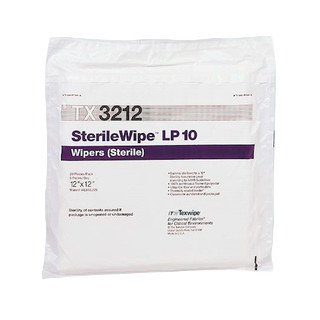
Sterile wiping steps fail in predictable ways: edge-driven fibers during folding, “clean” wipes that carry too much background residue, packaging that is hard to stage without re-contaminating, and sterile introduction that becomes inconsistent across shifts. Texwipe TX3212 SterileWipe LP10 (12" × 12") is built as a controlled input for those realities: a sterile, thermally sealed-border polyester wipe intended for critical cleaning where releasables (particles/fibers), residues (NVR), and packaging discipline all matter.
Reliability is part of the control plan. Sourcing through SOSCleanroom supports continuity of supply, documentation handoff, and lot-level traceability so teams avoid last-minute substitutions that change wipe behavior, background contamination, and audit posture.
Program note: Treat sterile wipes like any other process input: define the role (cleaning vs. sampling), confirm sterile barrier handling, and qualify performance in your actual solvent set, surfaces, and acceptance window.
What it’s for
TX3212 is intended for critical sterile wiping and cleaning in controlled environments where a sterile presentation, low background, and edge control are required. It is commonly placed for aseptic areas, sterile compounding/manufacturing support steps, and other workflows where the wipe is introduced under defined sterile transfer controls and used with approved cleaning chemistries.
Decision drivers
TX3212 typically earns approval when the program’s risks are dominated by sterile handling discipline and background control:
- Sterile assurance: gamma irradiated to a stated sterility assurance level (SAL) of 10−6, supporting sterile introduction when handled per SOP.
- Edge control: thermally sealed borders reduce edge-driven fiber release during folding, corner work, and higher-pressure wipe patterns.
- Low-background posture: published typical values for particles/fibers, NVR, and ionic extractables support qualification and change-control discussions.
- Packaging discipline: cleanroom packaging supports staged transfer; the sterile barrier design is intended to align with controlled introduction practices.
- Operational strength: polyester knit construction supports durability and solvent compatibility for many routine cleanroom chemistries (confirm your solvent/contact time).
- Traceability: lot coding and documentation posture reduce investigation time when a trend shifts.
Materials and construction – explained like an engineer
“Sterile polyester wipe” is not a complete specification. What matters in use is how the wipe behaves under folding, pressure, and solvent exposure. TX3212 is described as a 100% polyester knit wipe with thermally sealed borders. In practical terms, the sealed edge reduces loose edge filaments and helps keep the wipe stable when operators quarter-fold, work corners, or wipe along gasket lines and fasteners.
For many facilities, this is the key difference between “it looked clean” and “it stays clean after dry-down” on residue- and particle-sensitive surfaces. The remaining variable is technique: directional strokes, face rotation, and early discard.
Specifications in context
TX3212 is a 12" × 12" sterile wipe format designed for full-hand control and stable folding geometry. Larger wipes reduce “overhandling” (touching multiple surfaces to finish a pass) and make it easier to keep one-direction, overlapping strokes with disciplined face rotation.
Packaging configuration should be treated as a control attribute for kitting and staging. Use the case and inner-bag labeling tied to your received lots as the governing reference for SOPs, incoming inspection, and sterile transfer work instructions.
Cleanliness and performance metrics
A wipe’s published values are best treated as a qualification starting point, not a contractual per-lot specification unless explicitly stated. For placement decisions, focus on three risk categories: releasables (particles/fibers), residues (NVR), and ions (corrosion/ECM sensitivity).
- Releasables (particles/fibers): sealed-edge construction is specifically intended to reduce edge-driven releasables during folding and corner work.
- Residues (NVR): if haze or streaking occurs, first control levers are wetness, solvent purity, and early face change-out, not higher wiping force.
- Ions: for corrosion-sensitive assemblies, ionic background is a defect mechanism, not a paperwork metric; validate the wipe-down step in your real solvent and surface condition.
Packaging, sterility decisions, and traceability
Sterility is a separate control gate from cleanliness. TX3212 is positioned as a sterile wipe (gamma irradiated) intended to support aseptic workflows when introduced and staged per SOP. In practice, the sterile barrier and staging behavior often determine outcomes more than the substrate.
Traceability matters most when there is an investigation: a particle excursion, a residue complaint after dry-down, or a process change that shifts cleaning outcomes. Lot coding and consistent sourcing through SOSCleanroom reduce untracked substitutions and shorten the time to isolate variables.
Control reminder: Do not blur roles. Cleaning wipes stabilize cleaning. If you are performing residue recovery (TOC/HPLC/defined sampling), treat sampling as a measurement system with method-aligned consumables and chain-of-custody controls.
Best-practice use
TX3212 performs best when technique is treated as part of the control plan:
- Quarter-fold consistently: create multiple clean faces and rotate faces aggressively.
- One-direction strokes: use parallel, overlapping passes; avoid back-and-forth scrubbing unless an SOP requires it.
- Wetness control: aim for damp, not wet; over-wetting drives pooling, wicking, and residue artifacts after dry-down.
- Edge management: use the sealed edge strategically in corners and around fasteners to reduce snagging and edge degradation.
- Early discard: once a face is loaded or near saturation, it becomes a redistribution tool.
Common failure modes — and how TX3212 helps
Sterile wipe failures are usually procedural: leaving a wipe face in use too long, re-contacting cleaned areas, inconsistent solvent loading, or compromising the sterile barrier during staging. TX3212’s sealed-edge construction helps reduce edge-driven releasables when folding and working corners, and its sterile presentation supports disciplined introduction. The remaining controls are technique and SOP clarity: face rotation, directional strokes, wetness discipline, and clear separation of cleaning versus sampling.
Closest comparators
The most defensible comparisons are to other sterile, sealed-edge polyester wipe programs intended for similar ISO ranges and aseptic handling needs.
Contec sterile sealed-edge polyester wipe programs are commonly evaluated when facilities want strong sterile packaging options and a broad portfolio across wiping and disinfecting workflows.
Berkshire sealed-edge polyester cleanroom wipes are appropriate comparators when edge-driven releasables are the dominant risk and the program is stepping up from cut-edge knits.
Valutek sealed-edge polyester cleanroom wipers are often considered in the same “edge-controlled” category; qualification usually hinges on documentation depth, consistency over time, and how the wipe behaves with the site’s solvent/disinfectant set.
Rule of thumb: When edge control is the acceptance driver, sealed-edge/sealed-border is typically the next control step. When wetness repeatability is the constraint, step sideways to a controlled pre-wetted system.
Where TX3212 fits in a cleanroom wiping program
TX3212 fits best where sterile introduction and low-background wiping are non-negotiable: aseptic workflows, sterile manufacturing support steps, and critical cleaning where edge control and procedural discipline determine outcomes. It is often selected as the sterile “default” wipe when teams want a sealed-edge polyester option that supports consistent technique, qualification, and documentation.
Terminology note: TX3212 is engineered for low-linting performance; no wiper is truly “lint-free” in every process condition.
Source basis
- SOSCleanroom product page: “Texwipe TX3212 SterileWipe LP10 12" × 12" Polyester Cleanroom Wiper” (positioning, SKU context, purchasing configuration).
- ITW Texwipe technical data sheet: “SterileWipe® Wipers” covering TX3212 (sterility posture/SAL statement, sterile program framing, construction/edge strategy, and published typical contamination characteristics).
- Comparator category references: Contec sterile sealed-edge polyester wipe programs; Berkshire sealed-edge polyester cleanroom wipe programs; Valutek sealed-edge polyester cleanroom wipers (positioning and category framework for edge-controlled options).
Source: SOSCleanroom Technical Vault | Last reviewed: Jan. 3, 2026
© 2026 SOS Supply. All rights reserved.