The Technical Vault
By SOSCleanroom
Sterile, Presaturated, Repeatable: Why TX3214 Stabilizes the 70% IPA Wipe-Down Step in Controlled Environments
Last reviewed: Jan. 2, 2026 | Audience: contamination control, cleanroom operations, EHS, quality
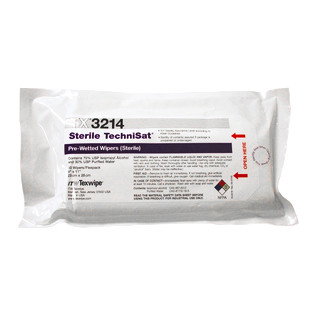
Many “inconsistent cleaning” issues trace back to the solvent workflow—not the surface. Open beakers concentrate as they evaporate, shared bottles get back-contaminated, and operator-controlled wetness swings from “too dry to clean” to “too wet and streaky.” Texwipe TX3214 Sterile TechniSat (9" × 11") is built to reduce that variability by delivering a sealed, point-of-use 70% IPA / 30% DI water wipe condition in a sterile presentation. :contentReference[oaicite:0]{index=0}
Program note: TX3214 is typically specified when teams want the cleaning step to behave like a controlled process input—standardized solvent loading, controlled packaging, and lot-level traceability—so investigations do not stall on “what wipe and what bottle did we use?”
Reliability is part of the control plan. Sourcing through SOSCleanroom supports continuity of supply and disciplined documentation handoff so programs are less exposed to unqualified substitutions when schedules tighten. :contentReference[oaicite:1]{index=1}
What it’s for
TX3214 is intended for routine wipe-downs where you want a repeatable 70% IPA wetting condition delivered in a sterile format: benches, carts, equipment exteriors, pass-through touchpoints, and pre-clean steps where open-solvent handling is a contamination risk. It is also a practical fit for kitting and point-of-use stations because the wipe is already conditioned—no on-the-fly mixing or re-wetting at the bench. :contentReference[oaicite:2]{index=2}
Decision drivers
TX3214 earns its place when your dominant risks are wetness variability, open-container handling, and sterile presentation requirements:
- Standardized solvent loading: factory presaturation reduces “damp vs. wet” operator variability and stabilizes dry-down behavior. :contentReference[oaicite:3]{index=3}
- Controlled wetting solution: manufacturer literature positions the IPA/DI water blend as filtered (commonly cited at 0.2 µm), tightening the contamination model versus ad hoc bottle handling. :contentReference[oaicite:4]{index=4}
- Sterile presentation: a sterile pre-wet format supports aseptic and sterile-transfer workflows when the wipe must enter controlled spaces under defined controls. :contentReference[oaicite:5]{index=5}
- Material balance for real soils: the TechniSat family is positioned around a cellulose/polyester nonwoven architecture designed for practical pickup plus handling strength. :contentReference[oaicite:6]{index=6}
- Packaging discipline: sealed, staged dispensing reduces evaporation drift and discourages re-dipping behaviors that collapse traceability. :contentReference[oaicite:7]{index=7}
- Traceability posture: lot identification and consistent sourcing support change control and faster investigations when trends shift. :contentReference[oaicite:8]{index=8}
Materials and construction – explained like an engineer
“Presaturated wipe” is a system label. The performance you see is the combined behavior of (1) the nonwoven structure, (2) solvent loading, and (3) how that solvent releases under pressure at seams, edges, and textured surfaces. TX3214’s cellulose/polyester architecture is selected to wet quickly and pick up aqueous/solvent-borne films while maintaining wet strength so the wipe does not degrade when operators speed up or increase pressure. :contentReference[oaicite:9]{index=9}
The practical control advantage is behavioral: a sealed, presaturated wipe reduces mid-pass re-wetting (one of the fastest ways to dissolve soil and then drag it across the next feature). It also reduces the probability of over-application that drives pooling and streaking in corners, fastener heads, seams, and interface lines.
Cleanliness and performance metrics
With sterile presaturated wipes, the most meaningful “performance” outcomes are repeatability and risk reduction:
repeatable wetness at point of use, reduced opportunities for back-contamination, and a packaging/traceability posture that supports qualification.
Manufacturer documentation should be treated as the qualification starting point; validation- or audit-sensitive programs should confirm performance in their real soils, surfaces, and acceptance windows. :contentReference[oaicite:10]{index=10}
Operational translation: when wipe-down results change across shifts, the usual levers are (a) face-rotation discipline, (b) over-wetting and pooling, (c) dwell-time and chemistry discipline for disinfectants, and (d) reuse of a loaded wipe face—not “wiping harder.”
Why sealed, staged packaging matters operationally
In daily clean operations, the wipe often becomes the “uncontrolled variable” through handling: packs left open, wipes moved between stations, and technicians stretching one wipe too far. A sealed presaturated format helps by controlling exposure time and helping preserve saturation across the pack life, reducing evaporation-driven drift and discouraging “top-off” behaviors that change the process input. :contentReference[oaicite:11]{index=11}
Rule of thumb: When wetness repeatability is the constraint, move to a controlled presaturated system. When edge-driven releasables are the constraint, move to an edge-controlled polyester knit (sealed-edge/sealed-border).
Best-practice use
TX3214 performs best when technique is standardized. Use quarter-folding to create multiple clean faces, wipe in controlled, overlapping single-direction strokes, and rotate to a fresh face frequently. Treat each face as single-pass in residue-sensitive steps.
- Stage and reseal: open only when ready, dispense what you need, and reseal immediately to preserve saturation and reduce incidental exposure. :contentReference[oaicite:12]{index=12}
- Control wetness at the surface: presaturated does not mean “free solvent.” Avoid pushing liquid into seams, edges, and interface lines.
- Do not top off: adding solvent changes saturation level and undermines repeatability and traceability.
- EHS posture: IPA is flammable—follow facility requirements for ventilation, ignition-source control, storage, and waste handling. :contentReference[oaicite:13]{index=13}
Common failure modes — and how TX3214 helps
A presaturated wipe program fails in predictable ways: leaving packs open (dry-down and concentration drift), overworking a loaded face (redeposit and streaking), and flooding seams (pooling and hidden residues). TX3214 helps by standardizing the wetness input and reducing the need for open-solvent handling; the remaining controls are procedural—face rotation, directional strokes, and disciplined pack management. :contentReference[oaicite:14]{index=14}
Closest comparators
The most defensible comparisons are to other sterile presaturated IPA wipe programs where packaging discipline, substrate behavior, and documentation depth drive the decision.
Berkshire Sterile SatPax® (sterile presaturated IPA systems) is a close comparator class when teams want sterile presaturation and staged dispensing with published quality posture.
Contec sterile presaturated wipe programs are commonly evaluated in similar workflows; selection should be driven by substrate architecture, packaging configuration, and how stable saturation remains across pack life in your real wipe cadence.
Where TX3214 fits in a controlled cleaning program
TX3214 fits the “standardized solvent wipe-down” tier for programs that need sterile presentation plus repeatable 70% IPA wetness at point of use. Use it to stabilize day-to-day cleaning and reduce open-solvent failure modes, then maintain role clarity across the program: presaturated wipes for controlled wipe-down, edge-controlled polyester knits for defect-sensitive finishing, and method-aligned sampling consumables when the wipe becomes part of a measurement system.
Terminology note: TX3214 is engineered for low-linting performance; no wiper is truly “lint-free” in every process condition.
Source basis
- SOSCleanroom product page: “Texwipe TX3214 Sterile TechniSat 9" × 11" Polyester and Cellulose Wiper Pre-Wetted 70% IPA.” https://www.soscleanroom.com/product/wipers/texwipe-tx3214-sterile-technisat-9-x-11-polyester-and-cellulose-wiper-pre-wetted-70-ipa/ :contentReference[oaicite:15]{index=15}
- ITW Texwipe technical literature (TechniSat sterile presaturated wipe documentation covering TX3214): solvent system (70% IPA/DI water) and filtration posture; sterile presentation and packaging/handling guidance. :contentReference[oaicite:16]{index=16}
- General controlled-environment practice basis applied: staged dispensing/resealing, single-direction strokes, aggressive fold/rotate/discard discipline, wetness control to prevent pooling, and separation of cleaning tools vs. validation sampling tools.
Source: SOSCleanroom Technical Vault | Last reviewed: Jan. 2, 2026
© 2026 SOS Supply. All rights reserved.