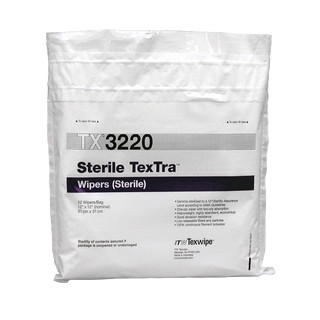
Texwipe TX3220 Sterile TexTra 12" x 12" Polyester Cleanroom Wiper

$554.24
(No reviews yet)
SKU:
TX3220
Availability:
Stock Item
Shipping:
Calculated at Checkout
Quantity Option (Case):
5 Bags of 100 Wipers Per Case
Type:
Dry Wiper
Wiper Family:
TexTra
Wiper Material:
Polyester
Wiper Size:
12" x 12"
Wiper Edge:
Cut Edge
Sterile:
Yes
ISO Class:
ISO 3 (Class 1)
ISO Class:
ISO 4 (Class 10)
ISO Class:
ISO 5 (Class 100)
ISO Class:
ISO 6 (Class 1,000)
ISO Class:
ISO 7 (Class 10,000)
ISO Class:
ISO 8 (Class 100,000)

TX3220 Sterile TexTra 12" x 12" Polyester Cleanroom Wiper

TX3220 Sterile TexTra is a low-linting (no wiper is truly ‘zero-lint’ in every process condition), sterile, single-ply, double-knit, 100% continuous-filament polyester cleanroom wiper engineered for high-capacity sorption in a heavyweight, large-surface-area format. It is positioned as an alternative to two-ply polyester wipers and is commonly used for spill control and large-volume solution handling in ISO Class 5-6 environments such as pharmaceutical aseptic fill areas, biotechnology manufacturing facilities, and microbiological laboratories.

Sterility note: Each case is gamma irradiated to a Sterility Assurance Level (SAL) of 10-6 in accordance with ANSI/AAMI/ISO 11137.

Specifications:
  • Size: 12" x 12" nominal (31 cm x 31 cm)
  • Material: 100% continuous-filament polyester
  • Construction: Single-ply, double-knit polyester wiper
  • Edge/Border: Thermally sealed borders
  • Sterile: Yes (gamma irradiated; SAL 10-6)
  • Packaging: 100 wipers/bag (5 inner bags of 20 wipers); 5 bags/case (500 wipers total/case)
  • Type: Dry Wiper
  • Wiper family: TexTra
  • Use environments: Commonly used in ISO Class 3 through ISO Class 8 controlled environments (final suitability depends on your process and cleaning method)
  • Typical performance/cleanliness metrics (datasheet; not specifications): Basis weight 233 g/m2; sorptive capacity 600 mL/m2; sorptive rate 0.3 seconds; particles 0.5–5.0 µm 10 x 106 particles/m2; particles 5.0–100 µm 460,000 particles/m2; fibers (> 100 µm) 500 fibers/m2; NVR (IPA) 0.07 g/m2; NVR (DIW) 0.04 g/m2
About the Manufacturer: 

Texwipe (an ITW company) differentiates itself in cleanroom wiping by treating the wiper as an engineered product, not a commodity consumable. For sterile programs, the focus is on controlled laundering/processing, solvent-safe packaging, lot-specific documentation, and sterility assurance practices that support repeatable, audit-ready adoption in aseptic and sterile environments.


TX3220 Sterile TexTra combines a heavyweight, high-sorbency polyester knit with gamma irradiation and packaging controls intended to simplify sterile wipe-down workflows while reducing the burden of in-house autoclave prep, documentation, and validation. SOSCleanroom (SOS) supports that manufacturing discipline with a close working relationship with Texwipe focused on continuity of supply, clean documentation handoff (certs, lot traceability), and practical application support—so customers can standardize sterile wiping materials with predictable performance while maintaining procurement reliability and audit readiness.

TX3220 Features:
  • Cleanroom-laundered 100% polyester knit with thermally sealed borders
  • Absorbency of a two-ply wiper (high-capacity sorption in a single-ply platform)
  • Good abrasion resistance
  • Gamma irradiated to a Sterility Assurance Level (SAL) of 10-6
  • Double-bagged in solvent-safe bags
  • Header strip protects wipers that remain in bag after opening
  • Lot-specific information attached to each case
  • Certificate of Processing confirms radiation dosage
  • Certificate of Compliance
  • Expiration date marked on each package
  • Independent quality control audits for sterility assurance
TX3220 Benefits:
  • Pre-sterilized for aseptic and sterile environments: Supports sterile introduction and use without on-site sterilization steps.
  • Eliminates autoclave prep burden: Reduces preparation, documentation, and validation requirements associated with autoclaving wipers.
  • High liquid capacity in a large format: Large wiper size and liquid capacity simplify the application and removal of large volumes of cleaning and disinfecting solutions.
  • Strength under rigorous wiping: Designed for robust wipe-downs with minimal release of particles and fibers (process-dependent).
  • Low visible fiber release: Extremely low levels of releasable visible fibers consistent with requirements for sterile ISO Class 5-6 environments.
  • Broad chemistry tolerance posture: Positioned to withstand exposure to common cleaning and disinfecting solutions including bleaches, phenols, and quats (verify compatibility to your chemistry and SOP).
  • Controlled introduction packaging: Packaging permits alcohol wipedown of exterior bag before introduction of inner bag to sterile environments.
  • Audit-friendly traceability: Lot-specific documentation supports lot-to-lot traceability and individual-lot quality review.
Common Applications:
  • Engineered for high-sorption use in ISO Class 5-6 environments
  • Sterile wiping of environmental surfaces and production equipment in aseptic fill areas
  • Applying and removing large volumes of cleaning and disinfecting solutions
  • Spill control
  • Sorptive work surface and staging support
Best-Practice Use:
  • Wipe down before entry: In a material airlock, alcohol-wipe the exterior bag before introducing the inner bag into higher-grade areas.
  • Open with sterile discipline: Use controlled opening technique to avoid pulling the outer bag over the inner bag; keep the inner bag protected until point-of-use.
  • Use the header strip correctly: Treat the header strip as the “guard” that helps protect remaining wipers after opening; do not remove it unless your SOP requires it.
  • Fold for control: Fold into consistent pads and rotate to clean faces early; avoid re-wiping with a loaded face.
  • Wipe pattern: Use straight-line, overlapping strokes (top-to-bottom or left-to-right) to reduce redeposition during wet wipe-downs.
  • Change-out triggers: Replace the wiper when the face becomes visibly loaded, begins smearing, or when liquid hold-up starts dropping during solution removal.
Selection Notes (TX3220 vs. Other Options)
  • TX3220 vs. non-sterile TexTra (TX2424): Choose TX3220 when sterile presentation and SAL documentation are required; choose TX2424 when sterility is not required and you want the same TexTra performance concept in a non-sterile workflow.
  • TX3220 vs. sterile blended nonwoven wipes: If your SOP favors a blended cellulose/polyester sterile wipe for disinfectant spread and first-pass lift, compare to sterile nonwoven options; choose TX3220 when high sorption capacity and polyester knit strength are the dominant drivers.
  • Single-ply high-capacity vs. two-ply platforms: TX3220 is positioned as an alternative to two-ply polyester wipers; if your process is limited by capacity per wipe, size-up/format choices and wipe-change frequency typically matter more than ply count.

Link to Texwipe Technical Datasheet:
Click Here

Other Similar Products Available From SOSCleanroom.com

TexTra / High-Capacity Polyester Wipers

  • TX2424: 12" x 12" TexTra (non-sterile)
  • TX2412: 12" x 12" AlphaSorb HC (high capacity, non-sterile)

Related Sterile Wipers

  • TX3210: sterile 12" x 12" cellulose/polyester wipe
  • TX3042: sterile 12" x 12" sealed-edge polyester wipe (high absorption)

Notes: Validating a sterile high-capacity wipe for disinfectant application/removal, spill response, or aseptic equipment wipe-downs? Open the SOSCleanroom Technical Vault tab above for operator-level technique (bag wipe-down, opening discipline, fold/face rotation, discard triggers), selection notes (TX3220 vs. non-sterile TexTra and other sterile formats), and the documentation details teams typically review when standardizing sterile wipers in ISO Class 3-6 controlled environments.

SOSCleanroom.com supports contamination-control programs with cleanroom consumables in stock, fair pricing, and responsive technical support—backed by same-day shipping options and customer service that understands real cleanroom workflows.

Product page updated: Jan. 3, 2026 (SOS Technical Staff)

© 2026 SOS Supply. All rights reserved.

The Technical Vault
By SOSCleanroom
Sterile Wiping Without the Autoclave Burden: Why TX3220 Sterile TexTra Helps Stabilize ISO 5–6 Cleaning Outcomes
Last reviewed: Jan. 3, 2026 |  Audience: contamination control, cleanroom operations, EHS, quality

In aseptic and sterile operations, the wipe is not just a consumable—it is part of the sterility and contamination-control system. The common failure mode is not “the surface was dirty,” it is that the cleaning step introduced a new variable: unvalidated in-house autoclaving, inconsistent packaging presentation, or a wipe that cannot hold enough chemistry to maintain contact time without shedding or tearing.

Texwipe TX3220 Sterile TexTra (12" × 12") is built to remove those variables with a pre-sterilized, gamma-irradiated polyester knit wiper designed for high-sorption sterile wiping in ISO Class 5–6 environments, including application and removal of larger volumes of cleaning and disinfecting solutions. It is specified as gamma irradiated to a SAL of 10−6 in accordance with ANSI/AAMI/ISO 11137, with lot-specific documentation and expiration dating tied to each case.

What it’s for

TX3220 is intended for sterile wiping of environmental surfaces and production equipment, spill control, and applying/removing larger volumes of cleaning and disinfecting solutions where the wipe must stay intact, keep releasables controlled, and support sterile-area handling discipline. It is specifically positioned for high-sorption use in ISO Class 5–6 environments.

Decision drivers

TX3220 earns its place when the cleaning step must be both technically effective and audit-defensible:

  • Sterility posture: gamma irradiated to SAL 10−6 per ANSI/AAMI/ISO 11137; positioned to eliminate the preparation, documentation, and validation burden of in-house autoclaving for wipes.
  • Substrate and strength: cleanroom-laundered 100% polyester knit with good abrasion resistance for rigorous wiping with minimal release of particles and fibers.
  • High-sorption behavior: absorbency is framed as “two-ply” performance; typical sorptive capacity is 600 mL/m² with a typical sorptive rate of 0.3 seconds.
  • Sterile introduction controls: double-bagged, solvent-safe packaging intended to support exterior bag alcohol wipe-down before sterile-area introduction; header strip helps protect remaining wipes after opening.
  • Quality and traceability: lot-specific information attached to each case, including a Certificate of Processing confirming radiation dosage, Certificate of Compliance, and expiration dating.
Materials and construction – explained like an engineer

“Sterile polyester wipe” is still a category, not a specification. For sterile cleaning, the design target is stable mechanical behavior under wet chemistry: the wipe must hold enough liquid to support contact time, release it predictably during wiping, and avoid rapid mechanical breakdown that turns wiping into particle generation.

TX3220 is a 100% polyester knit wiper that is positioned to provide absorbency of a two-ply wiper while retaining abrasion resistance and strength for rigorous wiping. The result is a wipe that can move meaningful volumes of disinfectant or cleaning solution without “going soft,” tearing, or leaving visible fibers that are incompatible with sterile ISO Class 5–6 expectations.

Practical note: no wiper is truly lint-free in every process condition. The control target is low-linting behavior in your actual use window—pressure, surface texture, edge contact, and chemistry loading determine what the wipe contributes.

Specifications in context

TX3220 is a 12" × 12" nominal (31 cm × 31 cm) sterile polyester wiper format designed for broad coverage and high liquid capacity. In practice, 12" × 12" helps operators maintain one-direction strokes and controlled overlaps while still allowing frequent folding to present fresh faces.

Packaging note (important for kitting): the TX3220 data sheet lists 100 wipers/bag (as 5 inner bags of 20), 5 bags/case (500 total/case). The SOSCleanroom product page lists a different case configuration (100 per bag, 8 bags/case) and emphasizes double vacuum sealed presentation. Treat the exact SKU labeling and case pack you receive as the governing control for inventory planning, sterile transfer SOPs, and incoming inspection—pack configurations can vary by sell-pack and documentation vintage.

Country-of-origin can be a controlled attribute in regulated programs. SOSCleanroom lists TX3220 as made in the USA; when COO must be verified, confirm through documentation tied to the lots received.

Cleanliness and performance metrics

For sterile wiping, the wipe must control three practical risk categories: releasables (particles/fibers), residues (NVR), and chemistry handling behavior (wet-out, hold, and release). TX3220’s published typical values provide a qualification starting point—typical analyses, not contractual specifications.

  • Absorbency: typical sorptive capacity 600 mL/m²; typical sorptive rate 0.3 seconds.
  • Particles and fibers: typical particles (0.5–5.0 μm) 10 × 106 particles/m²; (5.0–100 μm) 460,000 particles/m²; fibers (>100 μm) 500 fibers/m².
  • NVR: typical IPA extractant 0.07 g/m²; DI water extractant 0.04 g/m².

Operator reality: Most streaking and “mystery film” events trace back to over-wetting, reusing a loaded face too long, or dragging dissolved soils across new features. High-sorption wipes reduce re-wet behavior—but only if face rotation and directional strokes are disciplined.

Best-practice use

TX3220 performs best when technique matches the contamination model:

  • Sterile transfer discipline: wipe down the exterior bag with approved alcohol before introducing the inner bag to the sterile area; stage the opening to minimize exposure time.
  • Fold and rotate aggressively: quarter-fold to create multiple clean faces; treat each face as single-pass where residue control matters.
  • Directional strokes: use straight, overlapping, one-direction passes; avoid “scrub back-and-forth” on residue-sensitive surfaces.
  • Contact-time logic for disinfectants: apply enough chemistry to maintain required dwell, then remove with fresh faces to prevent redeposit.
  • Change-out triggers: discard early when the wipe is near saturation or visibly loaded; a saturated wipe becomes a redistribution tool.
Common failure modes — and how TX3220 helps

Sterile wiping failures are predictable: in-house sterilization drift (cycle, load, packaging), inadequate sorption that forces re-wetting mid-step, tearing during rigorous wiping, and reusing a contaminated face too long. TX3220 addresses the sterility and handling side by providing a gamma-irradiated SAL 10−6 product with lot documentation and packaging intended for sterile introduction, while the high-sorption polyester knit construction supports effective chemistry application/removal without rapid mechanical breakdown. The remaining controls are procedural: face rotation, directional strokes, and chemistry discipline.

Closest comparators

The most defensible comparisons are to other sterile polyester knit wipe programs designed for ISO 5–6 use, with documented sterility assurance, double-bag sterile introduction controls, and published typical releasables/NVR data. When evaluation is close, the differentiators tend to be (1) packaging configuration and ease of sterile transfer, (2) sorption and “face life” under real chemistry volumes, and (3) lot documentation completeness and traceability posture.

Terminology note: TX3220 is engineered for low-linting performance; no wiper is truly “lint-free” in every process condition.

Where TX3220 fits in a cleanroom wiping program

TX3220 is the right control when you need a sterile, high-sorption wipe for ISO Class 5–6 cleaning and disinfection—especially when eliminating the validation and documentation overhead of in-house autoclaving is a meaningful risk reduction. It is most at home in sterile-area environmental surface wiping, production equipment wipe-down, spill response, and any step where larger chemistry volumes must be applied and removed with controlled releasables behavior. When residue sensitivity becomes the primary constraint, define a finishing step and validate it to your acceptance criteria rather than “wiping harder” with the same consumable.

Source basis
  • SOSCleanroom product page: “Texwipe TX3220 Sterile TexTra 12" × 12" Polyester Cleanroom Wiper” (positioning; key specs; packaging presentation; COO marketing statement where applicable).
  • ITW Texwipe datasheet: “Sterile TexTra™ TX3220” (SAL 10−6 per ANSI/AAMI/ISO 11137; packaging framework; QA/lot documentation; typical absorbency and contamination characteristics; typical-value framing and referenced methods).
Source: SOSCleanroom Technical Vault |  Last reviewed: Jan. 3, 2026
© 2026 SOS Supply. All rights reserved.